

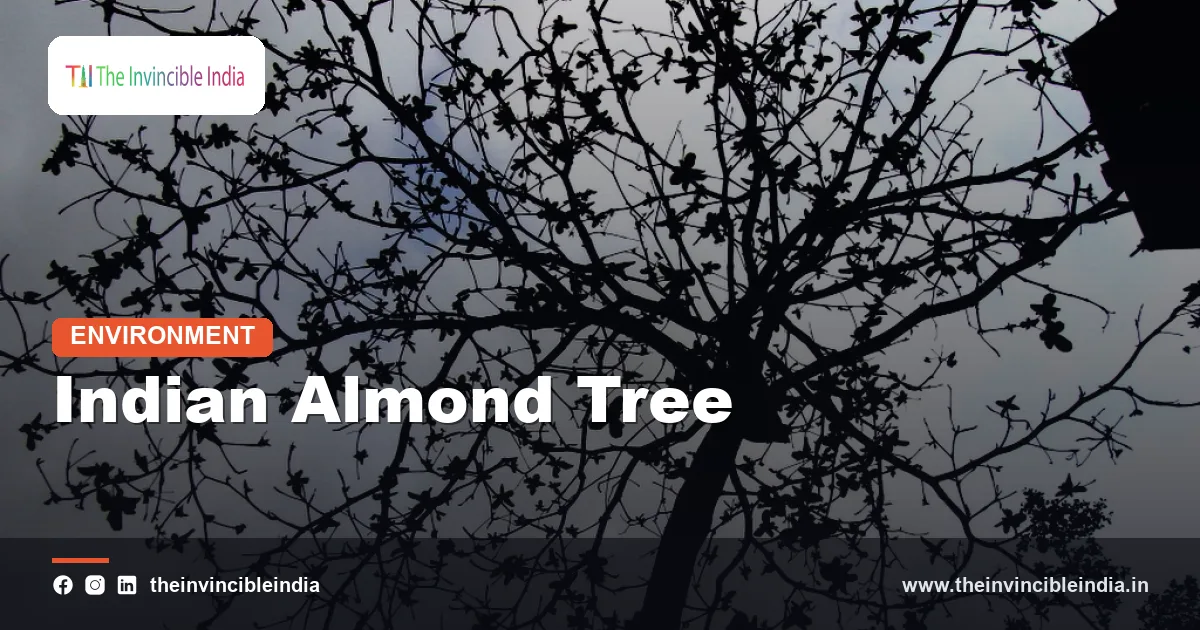
The Indian almond tree (Terminalia catappa) is a large, spreading tropical tree of the Combretaceae family, known for its tiered horizontal branches, big glossy leaves that turn red before they fall, and edible almond-flavoured kernels inside a fibrous, floating fruit. Across coastal India it is a familiar shade tree on beaches, roadsides, school campuses and temple grounds, and it is often called the sea almond, tropical almond, country almond or, in Hindi, jangli badam and desi badam.
The Indian almond tree is not related to the true almond (Prunus dulcis) sold as dried nuts, even though the names overlap. This article explains where the tree comes from, how to recognise it, what its fruit, leaves and bark are used for, and how it fits into India’s coastal and urban landscapes.
| Quick Facts | Details |
|---|---|
| Scientific name | Terminalia catappa |
| Family | Combretaceae (the same family as arjun, baheda and harad) |
| Origin | Tropical coasts of the Indian Ocean and western Pacific, including South and Southeast Asia; now grown across the tropics |
| Where grown in India | Coastal belts of Kerala, Tamil Nadu, Karnataka, Goa, Maharashtra, Odisha, West Bengal and the Andaman and Nicobar Islands, plus many towns as an avenue and shade tree |
| Parts used | Kernel (edible seed), leaves, bark, fruit pulp and wood |
| Season and cycle | Deciduous or semi-deciduous; sheds leaves once or twice a year and flowers in small spikes, with fruit following later |
| Main uses | Shade, coastal planting, edible kernels, tannin from bark and leaves, traditional medicine, timber and aquarium leaf litter |
| Notable facts | Fruit is buoyant and spreads along sea currents; leaves turn red, orange or yellow before falling; tree grows in a layered, pagoda-like form |
Key Takeaways
- The Indian almond tree is the species Terminalia catappa, a member of the Combretaceae family, and it is unrelated to the true almond of the rose family.
- Indian almond trees grow in distinct horizontal tiers of branches, which gives mature trees a layered, pagoda-like crown.
- The fruit of the Indian almond tree has a fibrous, air-filled husk that floats, allowing seeds to travel along ocean currents and settle on distant beaches.
- The kernel inside the hard stone of an Indian almond fruit is edible and tastes mildly like almond, but it is small and takes effort to extract.
- Leaves of the Indian almond tree turn bright red, orange or yellow before they drop, making the tree a seasonal colour spot in coastal Indian towns.
- Indian almond trees tolerate salt spray, sandy soil and strong wind, which is why coastal planting schemes in India use them widely.
What Is the Indian Almond Tree?
The Indian almond tree is a fast-growing tropical tree, Terminalia catappa, that usually reaches 15 to 25 metres in height and spreads wide, with a symmetrical crown built from horizontal tiers of branches. It belongs to the genus Terminalia, a large group of tropical trees that also includes the medicinal arjun, baheda and harad found across India.
The name “Indian almond” refers to the almond-like taste of the seed, not to any botanical kinship with the almond tree of Persia and the Mediterranean. People along the Indian coast also call it the sea almond because it thrives near beaches, and the tree is known by many local names in different Indian languages, though the Hindi names jangli badam (wild almond) and desi badam (country almond) are the ones most often heard in northern and central India.
Botanically, the tree is andromonoecious: the same tree carries both male flowers and bisexual flowers on its spikes. This arrangement, along with insect pollination, produces a steady crop of fruit on healthy trees.
Where Does the Indian Almond Tree Come From?
The Indian almond tree is generally considered native to the tropical coastlines of the Indian Ocean and the western Pacific, a range that includes parts of South Asia and Southeast Asia. Its exact original home is hard to pin down because ocean currents carried its floating fruit across long distances long before people began planting it.
Over time, humans spread the tree much further, planting it as shade along roads and in harbour towns across Africa, the Caribbean and the Americas. Today the species is found throughout the tropics, and in some regions it grows so freely along shorelines that it is treated as naturalised.
In India the tree is long established along both the Arabian Sea and Bay of Bengal coasts, and on the Andaman and Nicobar Islands, where it grows naturally near beaches. Inland towns also plant it, since it adapts well to warm, humid and even moderately dry conditions as long as there is enough water in the early years.
How Do You Identify an Indian Almond Tree?
You can identify an Indian almond tree by its tiered horizontal branches, its very large leaves bunched at the branch tips, and its flattened, almond-shaped fruit. These three features together make it one of the easier large trees to recognise in an Indian coastal town.
Branches and crown
New branches radiate outward in flat whorls, and each whorl sits above the previous one with a clear gap. Over the years this builds a layered crown, often compared to a pagoda. Botanists describe this growth habit as Aubreville’s model of tree architecture, and Terminalia trees are a classic example of it.
Leaves
The leaves are large, leathery and broad near the tip, tapering toward the stalk, and typically 10 to 25 centimetres long. They are glossy dark green when mature and crowd together at the ends of the twigs. Before falling, they change colour to red, orange, yellow or even purplish brown, and a tree can show several shades at once.
Flowers
The flowers are small, greenish-white and borne on slender spikes in the leaf axils. They are not showy, and many people never notice them, but they have a faint, slightly sweet scent and attract small insects.
Fruit
The fruit is a flattened drupe, roughly the size of a large plum or small mango stone, with a slightly ridged edge. It ripens from green to yellow, red or dark purplish brown, depending on the individual tree. Inside the fibrous husk lies a hard woody stone, and inside the stone is the edible kernel.
What Does the Indian Almond Tree Look Like Through the Year?
The Indian almond tree changes its appearance noticeably across the seasons because it loses its leaves once or twice a year, usually in the drier months, and then regrows a fresh canopy. During leaf fall, the crown turns from green to a patchwork of red and gold, and the ground beneath becomes covered with large dried leaves.
New leaf flushes appear soon after, and the tree then carries tender pale green foliage that darkens over a few weeks. Flower spikes follow and fruit develops over the next several months. The timing varies with the local climate: trees in humid coastal regions of Kerala may shed leaves in a slightly different pattern from those in drier parts of Tamil Nadu or Maharashtra.
Because the leaves are so large and drop in bulk, municipal workers and homeowners often need to sweep them regularly. Many gardeners, however, use the fallen leaves as mulch or compost, since they break down gradually and add organic matter to the soil.
Is the Indian Almond Kernel Edible?
Yes, the kernel of the Indian almond fruit is edible, and people eat it raw or roasted, usually after cracking the hard stone with a stone or a hammer. The kernel has a soft, oily texture and a flavour close to that of true almond, though it is smaller and less rich.
The challenge is extraction. The stone is tough and the kernel is thin, so collectors need patience and a steady hand to get it out whole. For this reason the kernel is mostly a seasonal snack in coastal villages and a children’s treat in some places, rather than a commercial nut.
Oil can be pressed from the kernel, and in some tropical countries this oil has been used in cooking and as a cosmetic base. It is not a major commercial product in India. As with any wild-collected food, people should avoid eating kernels from fruit that has been lying in polluted or chemically sprayed areas.
The soft husk beneath the fruit skin is fibrous and mostly not eaten, though in some places the ripe outer layer is chewed or sucked for its mild sweetness.
What Are the Other Uses of the Indian Almond Tree?
Beyond its kernel, the Indian almond tree is used for shade, tannin, traditional remedies, timber and even aquarium keeping. These uses have developed over centuries wherever the tree grows, and they differ from one coastal community to another.
- Shade and landscaping: The wide crown gives dense shade, so planners use the tree along beachfront roads, in school grounds, in parks and around bus stands.
- Tannin and dye: Bark and leaves contain tannins, which have been used for tanning leather and producing dark dyes and inks in traditional crafts.
- Traditional medicine: Folk practice in several tropical countries has used decoctions of the leaves and bark for common ailments such as skin problems and digestive complaints. These uses are traditional rather than clinically proven, and they should not replace medical treatment.
- Timber: The wood is moderately hard and reddish, and people use it for furniture, boxes, boat parts and general carpentry, usually from felled or fallen trees rather than from dedicated plantations.
- Aquarium use: Dried leaves are sold for freshwater aquariums, where hobbyists place them to soften the water and create a blackwater-like environment. The leaves release tannins and other organic compounds into the water.
- Fodder and green manure: In some places, young leaves are fed to livestock in small amounts, and fallen leaves go to the compost heap.
Why Is the Indian Almond Tree Planted Along Coasts?
The Indian almond tree is planted along coasts because it tolerates salt spray, sandy soil, wind and heat better than many other shade trees. These traits make it a practical choice for shoreline roads, resorts and beach parks where other species struggle.
The tree’s broad crown provides welcome shade for people on hot beaches, and its deep roots help hold sandy soil in place against moderate erosion. It is not a replacement for mangroves or dune vegetation, which protect coasts in different ways, but it serves as a useful companion species in landscaped coastal belts.
Planners should note that the tree grows large and its roots spread widely, so it needs room. Planting too close to buildings, walls or underground pipes can cause problems in later years. The brittle limbs may also break in strong cyclones, which matters along the cyclone-prone eastern coast of India.
How Does the Indian Almond Tree Spread Its Seeds?
The Indian almond tree spreads its seeds mainly through floating fruit that drifts on ocean currents, along with help from bats, birds and other animals. This sea dispersal explains why the species occurs on shorelines separated by thousands of kilometres of water.
The husk of the fruit contains a spongy, air-filled layer that makes it buoyant, and the thick outer skin resists seawater. After floating for weeks or months, a fruit may wash up on a beach, where its stone cracks open over time and the seed germinates in sandy soil with enough rain.
Fruit bats are known to carry ripe fruit to roosts and drop the stones nearby after eating the pulp. Some birds also feed on the outer layer. In India, rats and squirrels often gnaw through the stone to reach the kernel, which can reduce the number of seedlings near a mother tree.
How Do You Grow and Care for an Indian Almond Tree?
An Indian almond tree grows best in warm, frost-free climates with full sun and well-drained soil, and it establishes easily from fresh seed or from nursery saplings. Young plants need regular watering for the first two or three years, after which the tree becomes quite drought tolerant.
Planting basics
- Climate: Warm tropical or subtropical conditions are ideal, and frost damages young plants.
- Soil: Sandy, loamy and even slightly saline soils are suitable, provided water does not stand around the roots.
- Spacing: A wide spacing of eight to ten metres or more suits avenue planting, since the crown spreads considerably.
- Propagation: Fresh seeds, extracted from the stone or sown with the stone intact, germinate in several weeks. Cuttings are less common.
Common care points
Pruning of lower branches helps keep paths and roads clear, and light shaping in the early years keeps the tiered form attractive. Caterpillars may nibble the leaves, and fungal spots can appear in very humid weather, but serious pest problems are uncommon in healthy trees.
What Is the Ecological Role of the Indian Almond Tree?
The Indian almond tree supports coastal wildlife by providing shade, perches, nesting sites and food, and its role is most visible in towns where native forest has been cleared. Birds, bats, squirrels and insects all use it.
The flowers feed small insects, which in turn attract insect-eating birds. The fruit feeds fruit bats and some birds. The dense foliage gives roosting and nesting cover to crows, mynas, kites and other urban birds, and some butterflies and moths lay eggs on its leaves.
In some tropical islands outside India, the tree has spread aggressively into native coastal habitats, so ecologists treat it with caution there. In India, it is mostly regarded as a useful and long-naturalised coastal tree, but planners still prefer to mix it with native coastal species and not rely on it alone.
| Feature | Indian almond tree | True almond tree |
|---|---|---|
| Scientific name | Terminalia catappa | Prunus dulcis |
| Family | Combretaceae | Rosaceae |
| Climate | Tropical, coastal and warm lowlands | Mediterranean and cool-winter regions |
| Edible part | Small kernel inside a hard stone | Large seed inside a hard shell |
| Main use | Shade, coastal planting, timber, tannin | Commercial nut crop |
| Leaf behaviour | Large leaves that turn red before falling | Narrow leaves that turn yellow in autumn |
Bottom Line
The Indian almond tree, Terminalia catappa, is a salt-tolerant, shade-giving tropical tree whose tiered branches, reddening leaves and floating fruit make it a distinctive part of India’s coastal scenery. Its small edible kernel, tannin-rich leaves and bark, and adaptability to sandy shorelines explain why it has been planted for generations, even though it is not a true almond.
Frequently Asked Questions
Is the Indian almond tree the same as the almond tree?
No, the Indian almond tree (Terminalia catappa) is a different species from the true almond (Prunus dulcis). It belongs to the Combretaceae family, whereas the true almond belongs to the rose family. The name comes from the almond-like taste of its small kernel.
Can you eat the fruit of the Indian almond tree?
Yes, the kernel inside the hard stone of the fruit is edible and can be eaten raw or roasted. It tastes mildly like almond but is small and difficult to extract. The fibrous husk is generally not eaten, and fruit should be collected only from clean, unpolluted areas.
Why do Indian almond tree leaves turn red?
The leaves turn red because the tree is preparing to shed them, and pigments such as anthocyanins become visible as green chlorophyll breaks down. Indian almond trees lose their leaves once or twice a year, usually in the drier months. Leaves may show red, orange, yellow or purplish-brown shades before they fall.
Where does the Indian almond tree grow in India?
The Indian almond tree grows mainly along India’s coasts, including Kerala, Tamil Nadu, Karnataka, Goa, Maharashtra, Odisha, West Bengal and the Andaman and Nicobar Islands. It is also planted as a shade and avenue tree in many inland towns. It tolerates salt spray and sandy soil, which makes it well suited to coastal belts.
What is the Indian almond tree used for?
The Indian almond tree is used for shade, coastal landscaping, edible kernels, tannin from its bark and leaves, timber and traditional folk remedies. Its dried leaves are also sold for aquariums, where they release tannins into the water. Traditional medicinal uses are not clinically proven and should not replace medical advice.
How tall does an Indian almond tree grow?
An Indian almond tree typically grows 15 to 25 metres tall, with a crown that spreads widely in layered horizontal tiers. It grows quickly in warm, humid climates when young. Because of its size, it needs generous space away from buildings and underground pipes.
{“@context”:”https://schema.org”,”@graph”:[{“@type”:”FAQPage”,”mainEntity”:[{“@type”:”Question”,”name”:”Is the Indian almond tree the same as the almond tree?”,”acceptedAnswer”:{“@type”:”Answer”,”text”:”No, the Indian almond tree (Terminalia catappa) is a different species from the true almond (Prunus dulcis). It belongs to the Combretaceae family, whereas the true almond belongs to the rose family. The name comes from the almond-like taste of its small kernel.”}},{“@type”:”Question”,”name”:”Can you eat the fruit of the Indian almond tree?”,”acceptedAnswer”:{“@type”:”Answer”,”text”:”Yes, the kernel inside the hard stone of the fruit is edible and can be eaten raw or roasted. It tastes mildly like almond but is small and difficult to extract. The fibrous husk is generally not eaten, and fruit should be collected only from clean, unpolluted areas.”}},{“@type”:”Question”,”name”:”Why do Indian almond tree leaves turn red?”,”acceptedAnswer”:{“@type”:”Answer”,”text”:”The leaves turn red because the tree is preparing to shed them, and pigments such as anthocyanins become visible as green chlorophyll breaks down. Indian almond trees lose their leaves once or twice a year, usually in the drier months. Leaves may show red, orange, yellow or purplish-brown shades before they fall.”}},{“@type”:”Question”,”name”:”Where does the Indian almond tree grow in India?”,”acceptedAnswer”:{“@type”:”Answer”,”text”:”The Indian almond tree grows mainly along India’s coasts, including Kerala, Tamil Nadu, Karnataka, Goa, Maharashtra, Odisha, West Bengal and the Andaman and Nicobar Islands. It is also planted as a shade and avenue tree in many inland towns. It tolerates salt spray and sandy soil, which makes it well suited to coastal belts.”}},{“@type”:”Question”,”name”:”What is the Indian almond tree used for?”,”acceptedAnswer”:{“@type”:”Answer”,”text”:”The Indian almond tree is used for shade, coastal landscaping, edible kernels, tannin from its bark and leaves, timber and traditional folk remedies. Its dried leaves are also sold for aquariums, where they release tannins into the water. Traditional medicinal uses are not clinically proven and should not replace medical advice.”}},{“@type”:”Question”,”name”:”How tall does an Indian almond tree grow?”,”acceptedAnswer”:{“@type”:”Answer”,”text”:”An Indian almond tree typically grows 15 to 25 metres tall, with a crown that spreads widely in layered horizontal tiers. It grows quickly in warm, humid climates when young. Because of its size, it needs generous space away from buildings and underground pipes.”}}]}]}


