

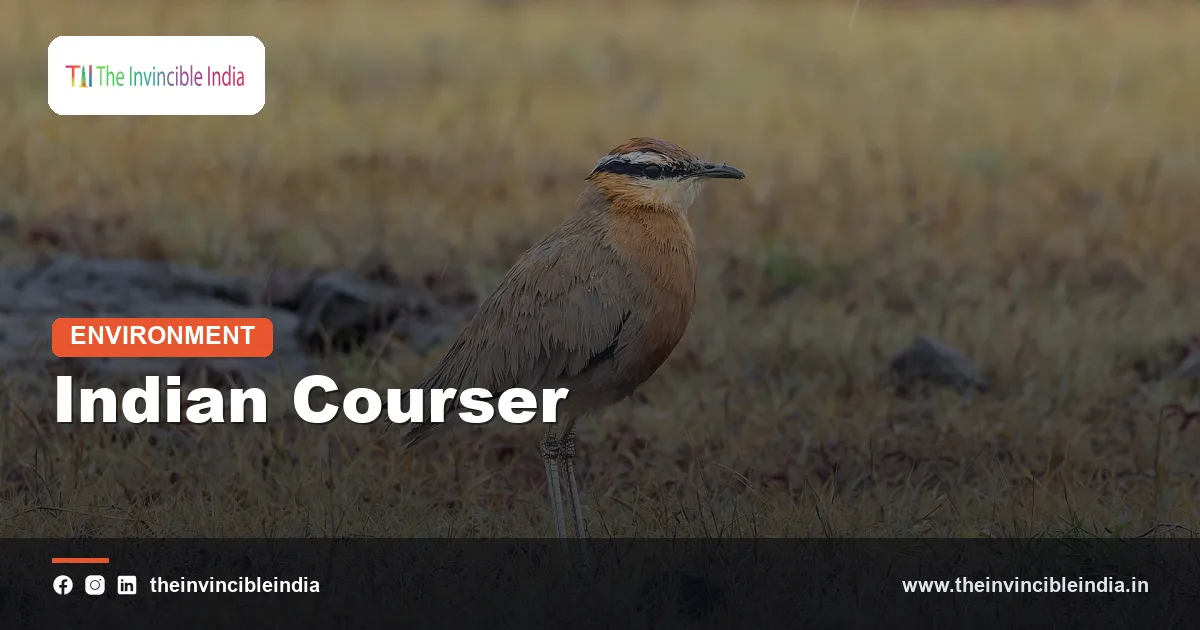
The Indian courser (Cursorius coromandelicus) is a long-legged, plover-like bird of dry Indian open country that runs fast over bare ground after insects, recognised by its rufous crown, bold black-and-white head stripes and chestnut underparts. It belongs to the same family as the pratincoles, but unlike them it lives far from water and relies on its legs rather than its wings.
The Indian courser is a bird of fallow fields, short grassland, stony wasteland and sparse scrub across most of peninsular India and the drier northern plains. This article explains how to identify the bird, where it lives, what it eats, how it nests on open ground and why its future depends on the survival of dry, open habitats that are often wrongly dismissed as wasteland.
| Quick Facts | Indian Courser |
|---|---|
| Common name | Indian courser |
| Scientific name | Cursorius coromandelicus |
| Family | Glareolidae (pratincoles and coursers), order Charadriiformes |
| Size | About 26 cm long, with long legs and a slim, upright build |
| Range and habitat in India | Dry, open country of peninsular and western India and the northern plains: fallow land, short grassland, stony scrub and ploughed fields |
| Diet | Insects, especially ants, termites, beetles and grasshoppers, caught on the ground |
| Breeding | Ground nester; lays two eggs in a bare scrape, mostly in the hot, dry season |
| Migration | Mainly resident, with local movements linked to rain and food |
| Conservation status | Least Concern on the IUCN Red List |
Key Takeaways
- The Indian courser is a fast-running, long-legged bird of the family Glareolidae whose scientific name is Cursorius coromandelicus.
- The Indian courser has a rufous crown, a white stripe above the eye, a black stripe through the eye and chestnut underparts with a dark patch on the belly.
- Indian coursers live on dry, open ground such as fallow fields, short grassland and stony scrub, and they avoid forest and wet habitats.
- Indian coursers feed mainly on ground insects, including ants, termites and beetles, which they catch in short, fast dashes.
- The Indian courser lays two well-camouflaged eggs directly on bare ground without building a nest.
- The IUCN Red List treats the Indian courser as a species of Least Concern, though the loss of open dry land to cultivation, plantations and development threatens local populations.
What is the Indian courser?
The Indian courser is a ground-dwelling bird in the family Glareolidae, the same family that holds the pratincoles, and it is native to the Indian subcontinent. Its scientific name is Cursorius coromandelicus, and the species is classed in the order Charadriiformes along with plovers, sandpipers, gulls and terns.
Coursers are adapted to dry land. Their legs are long, which lets them run quickly, and their wings are well developed but used mostly when a bird must escape or travel. Pratincoles, the closest relatives, have short legs and spend their time in the air, so the two groups represent different ways of living within one family.
The genus name Cursorius comes from the Latin word for a runner, and the name suits the bird well. The species name coromandelicus refers to the Coromandel coast of south-eastern India, from where the bird was first described for science. The name does not mean that the species is restricted to that coast, as it ranges widely over the interior of the country.
Although Indian coursers share the shape of plovers, they are not true plovers. They differ in bill form, wing structure and some details of behaviour, and modern classification puts them with the pratincoles.
How do you identify an Indian courser?
An Indian courser is identified by its upright stance, long pale legs, rufous crown, white eyebrow stripe, black eye stripe and chestnut underparts. The head pattern is the clearest feature, and it gives the bird a neat, striking face even at a distance.
Plumage
The upperparts are a uniform pale sandy-brown, which merges with dry soil and stubble. The crown is a rich rufous or chestnut colour. A white stripe passes above the eye, and a black stripe runs through the eye, and both extend toward the back of the head, where they meet in a V shape on the nape. The throat is pale. The breast and belly are warm chestnut-buff, and the lower belly carries a dark blackish patch. The legs are long and pale, and the bill is short, dark and slightly downcurved.
In flight
The wings look sandy above with black flight feathers, creating a clear contrast. The underwing is dark. The tail is short, with a white tip. Flight is fairly strong and direct, though the bird flies only when pressed. In flight the black flight feathers and pale body make an easy identification.
Behaviour
The bird runs in quick bursts, stops suddenly, stands upright with the head raised, and then dashes forward again. This run-and-stop pattern is a hallmark of coursers and is quite similar to the feeding pattern of many plovers. Birds often live in pairs or small groups, and they sometimes call with a short, sharp, repeated note, usually in flight or when alarmed.
Key field marks are listed below.
- Upright, long-legged build, about the size of a small partridge.
- Rufous crown with a white stripe above and a black stripe through the eye.
- Chestnut underparts with a dark belly patch.
- Black flight feathers visible in flight.
- Run-and-stop feeding style on open ground.
Where is the Indian courser found in India?
The Indian courser is found across much of peninsular India and the drier plains of the north and west, as well as in neighbouring Pakistan and Sri Lanka. It is widespread in suitable dry open country and absent from dense forest, high mountains and very wet regions.
Within India the bird is recorded in states such as Rajasthan, Gujarat, Madhya Pradesh, Maharashtra, Karnataka, Andhra Pradesh, Telangana and Tamil Nadu, wherever extensive dry grassland and fallow land remain. It is typically thin on the ground. A birdwatcher may walk through dry country for hours and see a single pair, which can make the species feel rarer than the broad range suggests.
Protected areas that retain open dry habitat, including grassland sanctuaries and scrub reserves, often have good numbers. Fields kept fallow in the dry season and village grazing lands can also hold coursers, provided they are not heavily disturbed. The species is often found in the same habitats as the blackbuck, the Indian bustard and larks, which also depend on open dry land.
Because it does not migrate over long distances, the same pair of Indian coursers may be found in the same area through the year. Local shifts happen after rain or when fields are ploughed or sown, which change the food supply and the cover.
What habitat does the Indian courser prefer?
The Indian courser prefers dry, flat, open habitat with bare or short vegetation, such as fallow fields, short grassland, stony plains and thin scrub. Open ground is essential because the bird needs a clear view to spot predators and room to run.
Typical places include the following.
- Fallow agricultural land and ploughed fields before sowing.
- Short, overgrazed or dry grassland.
- Stony or gravelly plains with sparse thorn scrub.
- Dry river and lake margins away from the water itself.
- Airfields, roadsides and wasteland on the edge of villages.
The courser avoids tall grass, thick bushes and tree cover. In places where grassland is converted into closely planted trees or irrigated crops, the bird disappears. The sandy-brown plumage and rufous cap fit the colours of dry earth and withered grass, giving the bird camouflage whenever it freezes.
These habitats are often classed as wasteland or unproductive land in official records, though they support a distinctive community of birds, reptiles, small mammals and insects. The Indian courser belongs to this community, together with larks, pipits, sandgrouse, lapwings, stone-curlews and other species.
What does the Indian courser eat?
The Indian courser eats insects, mostly caught on the ground. Ants, termites, beetles, grasshoppers, crickets and other small invertebrates make up its diet.
Feeding is based on sight. The bird stands upright and scans the ground, then runs several steps to seize prey, stops, and scans again. It may pick insects from the soil surface, from the base of grass tufts or from freshly ploughed earth. Ploughing exposes insects and attracts coursers, which follow tractors and ploughs at a distance in some regions.
Termite swarms and the insect flush that follows early rains are especially important. At such times coursers feed intensively. In dry weather the bird relies on whatever ground insects are available, and it can live without drinking much, though it will visit water when available.
By eating large numbers of ground insects, including crop pests such as grasshoppers and beetles, the Indian courser provides useful natural pest control for farmland edges.
How does the Indian courser breed?
The Indian courser breeds by laying two eggs in a simple scrape on bare ground, usually without any lining beyond a few pebbles or bits of dry matter. The breeding season is mostly during the hot, dry months, although timing varies across the country.
The eggs are buff or stone-coloured with dark brown spots and speckles, and they blend so well with pebbles and dry soil that they are almost impossible to see. Both parents are involved in incubation. The chicks hatch with a covering of down, are able to move soon after hatching and leave the nest scrape within hours. They are patterned to match the ground and crouch motionless when a parent signals danger.
Parents defend their eggs by distraction displays and by flying or running at intruders. Open-ground nesting leaves clutches vulnerable to dogs, mongooses, snakes, crows, tractors, grazing cattle and human foot traffic. Because the clutch is small, loss of a nest can reduce local breeding success considerably.
Few nests of the species are found because the nests are so well hidden. Much of what is known comes from careful field observation by ornithologists and amateur naturalists who watch the behaviour of adults.
Is the Indian courser a migratory bird?
No, the Indian courser is not a true migratory bird. It is mainly resident across its range, although individuals move locally in response to rain, ploughing, food supply and disturbance.
Movement is not seasonal in the sense of a long journey. A pair may leave a field when it is planted with a tall crop and return after harvest, when the ground is bare again. Some birds wander after breeding. This ability to relocate within the landscape is useful for a species that depends on a changing patchwork of open ground.
The table below shows how the courser’s activities usually follow the agricultural and weather year.
| Period | Typical conditions | Courser activity |
|---|---|---|
| Hot, dry months | Fallow and stubble land, bare soil, short grass | Pairs nest on open ground and raise chicks |
| Early monsoon | Rain, ploughing and termite emergence | Birds feed heavily and may shift to newly ploughed fields |
| Monsoon and growing season | Tall crops and green vegetation | Birds move to remaining open patches, grazing land or stony areas |
| Post-harvest and cool months | Open stubble and fallow land return | Birds spread out again and forage in pairs or small groups |
How is the Indian courser different from similar birds?
The Indian courser differs from other open-country birds by its rufous crown, bold black and white head stripes, chestnut underparts and fast running style. A few other birds are sometimes mistaken for it, and comparison helps.
- Cream-coloured courser (Cursorius cursor): a paler, sandier relative that occurs only rarely in north-western India; it lacks the Indian courser’s strong chestnut underparts and dark belly patch.
- Jerdon’s courser (Rhinoptilus bitorquatus): a rare nocturnal courser of scrub forest in Andhra Pradesh, historically thought lost and rediscovered in 1986; it has a very different pattern and habitat.
- Plovers and lapwings: share the run-and-stop habit but differ in plumage and usually live near water.
- Stone-curlews: larger-eyed, streaked, mainly crepuscular and with a different head pattern.
Because the Indian courser is the common courser of the Indian subcontinent, a courser seen on dry land in the peninsula with a rufous crown and chestnut underparts is almost certainly this species. Photographing the head pattern removes doubt.
Is the Indian courser threatened?
No, the Indian courser is not considered globally threatened, and the IUCN Red List classifies it as Least Concern because of its wide range. Its numbers in particular places depend on how much open dry land remains.
Threats to the species and its habitat include the following.
- Conversion of grassland and fallow land to irrigated agriculture or tree plantations.
- Afforestation of natural open habitats, which are mistakenly treated as degraded land.
- Urban expansion, industrial development and infrastructure projects on open land.
- Stray dogs, which disturb and kill ground-nesting birds.
- Pesticide use, which reduces insect food.
- Disturbance from vehicles and, in some places, hunting or egg collection.
Conserving grassland, scrub and fallow land helps not only the Indian courser but also birds such as the Indian bustard, floricans, larks and the grassland mammals that share the habitat. Recognising these ecosystems as valuable rather than wasteland is the central conservation message.
Why does the Indian courser matter?
The Indian courser matters because it is an indicator of healthy dry, open ecosystems and because it plays a part in controlling insects. A pair of coursers on a field is a sign that bare, undisturbed ground and a supply of insects remain.
The species also adds interest to the dry landscapes of India, which are often neglected by tourists and planners in favour of forests and wetlands. Birdwatchers who visit dry grassland sanctuaries often find the courser one of the most memorable birds, with its elegant stance and sudden dashes across the ground.
Tips for finding Indian coursers
- Search fallow fields, short grassland and stony plains in the early morning or late afternoon.
- Scan the ground slowly with binoculars, since the bird freezes and blends with the soil.
- Stay in a vehicle or on a track where possible, because walking toward the bird makes it run or fly.
- Avoid approaching nests or chicks; keep to a distance and move away if adults display alarm.
- Record the place and habitat in a checklist to help monitor the species.
Bottom Line
The Indian courser is a graceful, fast-running bird of dry open ground that eats insects and nests directly on the soil. It is widespread and rated Least Concern, but it depends on bare, grassy and fallow land that is steadily being converted to other uses.
Frequently Asked Questions
What is an Indian courser?
An Indian courser is a long-legged, ground-living bird of the family Glareolidae, with the scientific name Cursorius coromandelicus. It lives in dry open country of the Indian subcontinent and runs fast after insects. It has a rufous crown, white and black head stripes and chestnut underparts.
Where does the Indian courser live?
The Indian courser lives in dry, open habitats such as fallow fields, short grassland and stony scrub. It is found across peninsular India and the drier northern and western plains, and also in Pakistan and Sri Lanka. It avoids forests, wetlands and mountains.
What does the Indian courser eat?
The Indian courser eats insects, mainly ants, termites, beetles and grasshoppers. It catches them on the ground with quick dashes and sudden stops. It also takes other small invertebrates when they are available.
Does the Indian courser fly or run?
The Indian courser mainly runs, using its long legs to chase prey and escape danger. It can fly well, with strong wings showing black flight feathers, but it takes to the air only when pressed. Running and freezing are its usual responses to threats.
How does the Indian courser breed?
The Indian courser breeds by laying two eggs in a shallow scrape on bare ground. The eggs are camouflaged, and both parents take part in incubation. The downy chicks leave the scrape soon after hatching and hide on the ground.
Is the Indian courser endangered?
No, the Indian courser is not endangered. The IUCN Red List classifies it as Least Concern because it has a wide range. Local populations can fall when open dry habitats are converted to farms, plantations or development.
{“@context”:”https://schema.org”,”@graph”:[{“@type”:”FAQPage”,”mainEntity”:[{“@type”:”Question”,”name”:”What is an Indian courser?”,”acceptedAnswer”:{“@type”:”Answer”,”text”:”An Indian courser is a long-legged, ground-living bird of the family Glareolidae, with the scientific name Cursorius coromandelicus. It lives in dry open country of the Indian subcontinent and runs fast after insects. It has a rufous crown, white and black head stripes and chestnut underparts.”}},{“@type”:”Question”,”name”:”Where does the Indian courser live?”,”acceptedAnswer”:{“@type”:”Answer”,”text”:”The Indian courser lives in dry, open habitats such as fallow fields, short grassland and stony scrub. It is found across peninsular India and the drier northern and western plains, and also in Pakistan and Sri Lanka. It avoids forests, wetlands and mountains.”}},{“@type”:”Question”,”name”:”What does the Indian courser eat?”,”acceptedAnswer”:{“@type”:”Answer”,”text”:”The Indian courser eats insects, mainly ants, termites, beetles and grasshoppers. It catches them on the ground with quick dashes and sudden stops. It also takes other small invertebrates when they are available.”}},{“@type”:”Question”,”name”:”Does the Indian courser fly or run?”,”acceptedAnswer”:{“@type”:”Answer”,”text”:”The Indian courser mainly runs, using its long legs to chase prey and escape danger. It can fly well, with strong wings showing black flight feathers, but it takes to the air only when pressed. Running and freezing are its usual responses to threats.”}},{“@type”:”Question”,”name”:”How does the Indian courser breed?”,”acceptedAnswer”:{“@type”:”Answer”,”text”:”The Indian courser breeds by laying two eggs in a shallow scrape on bare ground. The eggs are camouflaged, and both parents take part in incubation. The downy chicks leave the scrape soon after hatching and hide on the ground.”}},{“@type”:”Question”,”name”:”Is the Indian courser endangered?”,”acceptedAnswer”:{“@type”:”Answer”,”text”:”No, the Indian courser is not endangered. The IUCN Red List classifies it as Least Concern because it has a wide range. Local populations can fall when open dry habitats are converted to farms, plantations or development.”}}]}]}


