

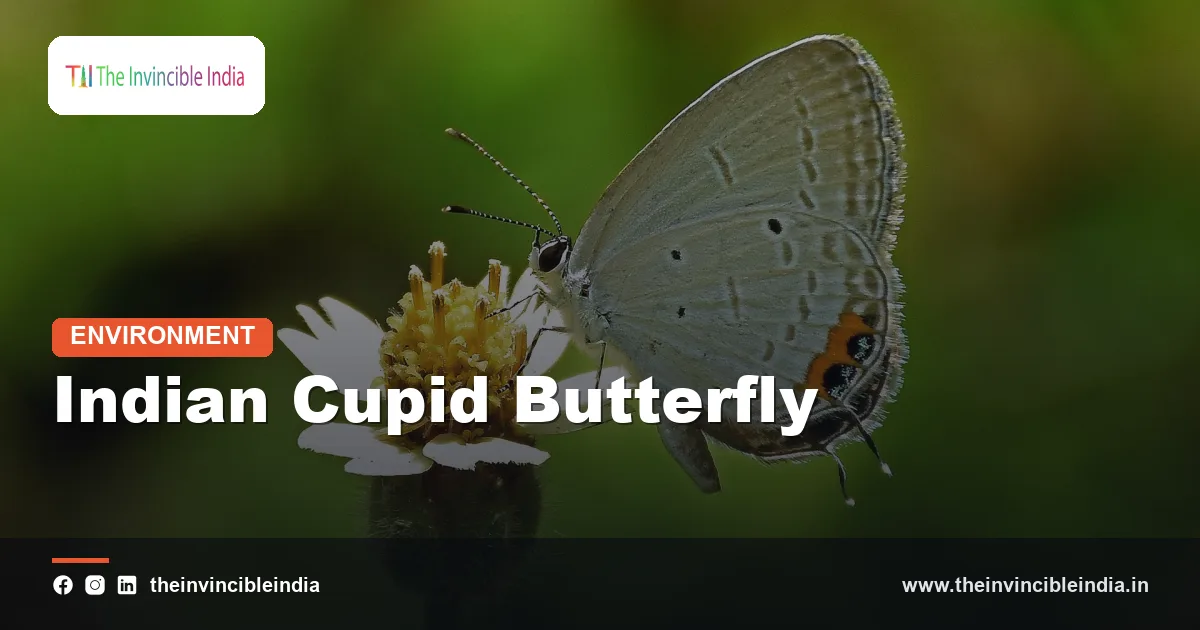
The Indian cupid is a tiny tailed blue butterfly, Everes lacturnus, of scrub, grassland edges, hill slopes and gardens in India, recognised by its pale underside with fine dark dashes, a single slender tail on each hindwing and a low, quick flight. It belongs to the family Lycaenidae, whose caterpillars often feed on legumes and are protected by ants, and it is one of the smaller butterflies a visitor is likely to meet on a country walk.
Because it is small and often rests with its wings closed, the Indian cupid is easy to miss. This article explains what the Indian cupid is, how to identify it, where it lives in India, what its caterpillars feed on, how it breeds and how gardeners can help it.
Quick Facts
| Common name | Indian cupid (also called orange-tipped pea-blue in some regions) |
|---|---|
| Scientific name | Everes lacturnus |
| Family | Lycaenidae (blues, coppers and hairstreaks), subfamily Polyommatinae |
| Wingspan | Roughly 2 to 3 cm |
| Host plants | Small plants of the pea family (Fabaceae), such as Crotalaria species, and other leguminous herbs and shrubs |
| Range | Across much of India including hills and the peninsula, Sri Lanka, and eastward through Southeast Asia to the Australian region |
| Habitat | Scrub, grassy slopes, forest clearings, hill roads and gardens |
| Broods | Several generations a year, with activity at almost any season where conditions are mild |
Key Takeaways
- The Indian cupid (Everes lacturnus) is a small tailed blue butterfly of the family Lycaenidae that is widespread in India.
- The Indian cupid has one fine tail on each hindwing and a pale grey-white underside marked with small dark spots and short dashes.
- The upper side of a male Indian cupid is violet-blue with a narrow dark border, while the female is mainly brown with a blue dusting at the base.
- Indian cupid caterpillars feed on small leguminous plants, and like many lycaenid larvae they may be tended by ants.
- The Indian cupid breeds in several generations through the year and is often found in open, sunny places near low flowering plants.
- The butterfly is considered common, and it benefits from unsprayed weedy patches, pea-family plants and a variety of small flowers.
What is the Indian cupid butterfly?
The Indian cupid is a small species of lycaenid butterfly with the scientific name Everes lacturnus, belonging to the group known as blues. It is part of the subfamily Polyommatinae, which includes many of the small blue butterflies found in grasslands, gardens and hillsides around the world.
The genus Everes contains a handful of small tailed blues, mostly found in Asia, Europe and North America. The Indian cupid is the species most often noticed in India and southern Asia. Its common name echoes the “cupids” of other regions, a loose term applied to some tiny, delicate blues, though butterflies in the genus Everes are not all closely alike.
Like other lycaenids, the Indian cupid is quick and light-bodied, with short legs and large eyes edged with a pale ring. The tail on the hindwing is thin and short, and it is easily mistaken for a bristle of the wing edge unless you look carefully.
How can you identify the Indian cupid?
You can identify the Indian cupid by its very small size, a single hair-like tail on each hindwing, a pale grey-white underside with fine dark spots and an orange mark near the tail. At rest, the butterfly holds its wings upright and closed, so the underside is what a watcher usually sees.
- Male upper side: a soft violet-blue sheen with a thin dark margin, visible when the wings are briefly opened in sunlight.
- Female upper side: mostly brown or dark grey, with blue scaling near the body.
- Underside: pale, with small black spots and short dark bars, and a bright orange or yellowish spot near the base of the tail.
- Tail: one slender black-and-white tail on each hindwing, often with a tiny black spot beside it.
Other small blues in India have similar colouring, and some lack tails altogether. The presence of the tail and the orange tornal marking are quick clues. For firm identification, photographs of both the upper and lower surfaces help.
Where is the Indian cupid found?
The Indian cupid is found across much of India, from the peninsula and Western Ghats to the Himalayan foothills and northeast, and the species extends to Sri Lanka and eastwards through Southeast Asia to the Australian region. It is not confined to the deep forest and is more common in open, bushy country than in dense woodland.
Typical places to find it include:
- Scrub jungle and rocky hill slopes with low flowering herbs.
- Edges of forests, tracks and road verges.
- Grassy patches in farmland, fallow land and field bunds.
- Gardens, parks and campuses with a mix of weeds and flowering plants.
In hill areas it can be seen at moderate altitudes, flying low over grass and flowers. Local populations rise and fall with rain and the growth of host plants, so numbers in any one place can vary from month to month.
What does the Indian cupid feed on?
Adult Indian cupids feed on nectar from small flowers, while the caterpillars eat leaves, buds and flowers of leguminous plants. The adult sips from low-growing herbs and weeds such as tiny daisy-family flowers, and it often settles on bare ground or damp soil to take up minerals.
The family Fabaceae, which includes peas, beans, gram and many wild herbs, supplies the typical larval food of the genus Everes. Records from India and neighbouring areas mention small leguminous plants such as Crotalaria, commonly called rattlepods, and other related plants. Wild legumes in waste ground and roadsides are therefore valuable, and they are often removed by tidy gardening or herbicides.
Because the butterfly uses ordinary roadside and field-edge plants, its presence is not a sign of pristine habitat. It is, however, a sign that some uncut, unsprayed vegetation remains in the area.
How does the Indian cupid breed and grow?
The Indian cupid breeds by laying single eggs on tender buds, flowers or young leaves of host plants, and each egg develops through caterpillar and pupal stages before the adult emerges. Like all butterflies it shows complete metamorphosis, with four stages that look entirely different.
| Stage | What happens |
|---|---|
| Egg | Tiny, pale, usually laid singly on buds or young shoots |
| Caterpillar | Short, flattened, slug-like larva that feeds on flowers, buds and soft leaves; may be green, pinkish or yellowish to match the plant |
| Pupa | Small, compact chrysalis attached to the plant or nearby debris |
| Adult | Emerges after a few days to weeks, feeds on nectar, mates and lays eggs |
In warm regions the cycle can be completed in about a month or less, which allows several generations in a year. In cooler hill areas, development slows and the butterflies may be seen mainly in the warmer months. The caterpillars blend with flower buds and are rarely noticed unless one looks closely at host plants.
Do ants protect Indian cupid caterpillars?
Ants often protect the caterpillars of lycaenid butterflies, and the Indian cupid belongs to a family in which this partnership is widespread. The larvae of many lycaenids have special glands that produce sugary droplets, and ants feed on these droplets while driving away small predators and parasites.
This association is called myrmecophily, meaning love of ants. It is a good example of mutual benefit in nature: the caterpillar receives protection, and the ants receive a food source. Not every lycaenid species is tended in every locality, and scientists record details by watching caterpillars and ants together on host plants.
Gardeners and field naturalists can contribute by noting whether ants are present with caterpillars, and by avoiding broad-spectrum pesticides that may harm both the ants and the larvae.
How does the Indian cupid behave through the day and the year?
The Indian cupid is a sun-loving butterfly that is most active in the warm, bright hours of the morning and early afternoon, flying low over grass, herbs and bare ground. It rarely rises above shrub height and usually settles after a short flight, often returning to the same flower head or twig.
Males commonly perch on a low leaf or grass blade and dart out to investigate passing insects, a behaviour used to find mates. Females spend more time among the host plants, moving from bud to bud to lay eggs. Both sexes visit tiny flowers, and groups of males may gather at damp soil on a warm day.
Through the year, adults are seen in most months in the warmer parts of India, with peaks that follow the rains when legumes and other herbs put out fresh growth. In the Himalayan foothills and higher hills the butterfly is more seasonal, appearing mainly from spring to autumn. At night and in poor weather it rests in grass or low bushes with wings closed.
Why is the Indian cupid called a “tailed blue”?
The Indian cupid is called a tailed blue because it belongs to the blues of the subfamily Polyommatinae and carries a small tail on each hindwing. The tail and the nearby coloured spot form a false-head pattern, which is a defensive trick common in lycaenids.
A bird or a lizard looking for a quick meal may strike at the tail end rather than at the real head. The butterfly may escape with a small tear in the wing. Butterflies with symmetrical bite marks on the hindwings often show that such an attack has failed.
The tail is not used for flight or balance. It is thin, easily broken and has no major function other than creating the false head. For naturalists, it is a handy field mark that separates this butterfly from many other tiny blues, which have a rounded hindwing without a tail.
How does the Indian cupid differ from other small blues?
The Indian cupid differs from other small Indian blues mainly by having a tail, a pale underside with sparse markings and a small orange spot near the tail. Several tiny blues share similar size and habitat, so comparison is useful.
| Feature | Indian cupid | Many other small blues |
|---|---|---|
| Hindwing tail | One thin tail present | Often absent or very short |
| Underside | Pale grey-white, fine dark dashes and spots | Varies; often more heavily spotted or banded |
| Orange spot near tail | Present, small | Sometimes larger or absent |
| Typical habitat | Scrub, grass, roadsides, gardens | Varies widely with species |
Close photographs are the best method of identification. A hand lens or a camera with a macro mode helps in distinguishing the tail, the spot and the pattern.
How can you attract the Indian cupid to a garden?
You can attract the Indian cupid to a garden by leaving a sunny patch with small flowering herbs, planting leguminous species for caterpillars and avoiding pesticides. The butterfly is not demanding and often colonises places where weeds are allowed to flower.
- Allow wild legumes such as rattlepods and other small pea-family plants to grow in a corner.
- Provide low-growing nectar plants in sun, for example small daisy-family flowers, native wildflowers and herbs.
- Leave bare patches of soil that are slightly moist, so butterflies can sip minerals.
- Avoid insecticide sprays and weedkillers on borders and field edges.
- Keep some long grass, since many blues use grass tufts to rest at night.
Planting native flowers instead of invasive ornamentals gives local insects a more reliable food supply. A small patch of untidy, flowering ground can support more butterflies than a neatly clipped lawn.
Why do tiny butterflies like the Indian cupid matter?
Tiny butterflies like the Indian cupid matter because they pollinate small flowers, feed birds, lizards and spiders, and act as indicators of the health of open habitats. Their short life cycles respond quickly to changes in rainfall, vegetation and pesticide use, so counting them gives early evidence of environmental change.
The Indian cupid also shows how a plain weedy patch can be ecologically productive. A strip of wild legumes and flowering herbs supports caterpillars, adult butterflies, ants and the predators that feed on them, all within a few square metres. Citizen-science platforms such as India Biodiversity Portal and eButterfly gather photographs of such small species, and each record adds to knowledge of range and flight season.
Bottom Line
The Indian cupid is a tiny, tailed blue that thrives in open scrub and gardens where wild legumes grow. Its single tail, false head and ant-tended caterpillars make it a neat example of the small tricks of lycaenid butterflies.
Frequently Asked Questions
What is the Indian cupid butterfly?
The Indian cupid is a small tailed blue butterfly, Everes lacturnus, in the family Lycaenidae. It is found in India, Sri Lanka and Southeast Asia in scrub, grassland edges and gardens, and has a pale underside with a thin tail on each hindwing.
How big is the Indian cupid?
The Indian cupid is a very small butterfly with a wingspan of roughly 2 to 3 centimetres. Its small size, closed-wing resting posture and low flight make it easy to overlook in grass and low vegetation.
What do Indian cupid caterpillars eat?
Indian cupid caterpillars eat the buds, flowers and soft leaves of small leguminous plants of the pea family. Rattlepods (Crotalaria) and similar wild legumes are among the plants used, which is why uncut roadside and field-edge vegetation helps the species.
How can I tell an Indian cupid from other blue butterflies?
You can tell the Indian cupid by the single thin tail on each hindwing, the pale underside with fine dark marks and the small orange spot near the tail. Many other small blues lack the tail, so a close look at the hindwing is the quickest check.
Where does the Indian cupid live in India?
The Indian cupid lives in many parts of India, including the peninsula, the Western Ghats, the Himalayan foothills and the northeast. It prefers open and bushy places such as scrub, hill slopes, forest clearings, road edges and gardens.
Why does the Indian cupid have a tail?
The Indian cupid has a tail because the tail and nearby spot create a false head that draws predators away from the real head. A bird or lizard may strike the tail end, allowing the butterfly to escape with a small tear in the wing.
{“@context”:”https://schema.org”,”@graph”:[{“@type”:”FAQPage”,”mainEntity”:[{“@type”:”Question”,”name”:”What is the Indian cupid butterfly?”,”acceptedAnswer”:{“@type”:”Answer”,”text”:”The Indian cupid is a small tailed blue butterfly, Everes lacturnus, in the family Lycaenidae. It is found in India, Sri Lanka and Southeast Asia in scrub, grassland edges and gardens, and has a pale underside with a thin tail on each hindwing.”}},{“@type”:”Question”,”name”:”How big is the Indian cupid?”,”acceptedAnswer”:{“@type”:”Answer”,”text”:”The Indian cupid is a very small butterfly with a wingspan of roughly 2 to 3 centimetres. Its small size, closed-wing resting posture and low flight make it easy to overlook in grass and low vegetation.”}},{“@type”:”Question”,”name”:”What do Indian cupid caterpillars eat?”,”acceptedAnswer”:{“@type”:”Answer”,”text”:”Indian cupid caterpillars eat the buds, flowers and soft leaves of small leguminous plants of the pea family. Rattlepods (Crotalaria) and similar wild legumes are among the plants used, which is why uncut roadside and field-edge vegetation helps the species.”}},{“@type”:”Question”,”name”:”How can I tell an Indian cupid from other blue butterflies?”,”acceptedAnswer”:{“@type”:”Answer”,”text”:”You can tell the Indian cupid by the single thin tail on each hindwing, the pale underside with fine dark marks and the small orange spot near the tail. Many other small blues lack the tail, so a close look at the hindwing is the quickest check.”}},{“@type”:”Question”,”name”:”Where does the Indian cupid live in India?”,”acceptedAnswer”:{“@type”:”Answer”,”text”:”The Indian cupid lives in many parts of India, including the peninsula, the Western Ghats, the Himalayan foothills and the northeast. It prefers open and bushy places such as scrub, hill slopes, forest clearings, road edges and gardens.”}},{“@type”:”Question”,”name”:”Why does the Indian cupid have a tail?”,”acceptedAnswer”:{“@type”:”Answer”,”text”:”The Indian cupid has a tail because the tail and nearby spot create a false head that draws predators away from the real head. A bird or lizard may strike the tail end, allowing the butterfly to escape with a small tear in the wing.”}}]}]}


