

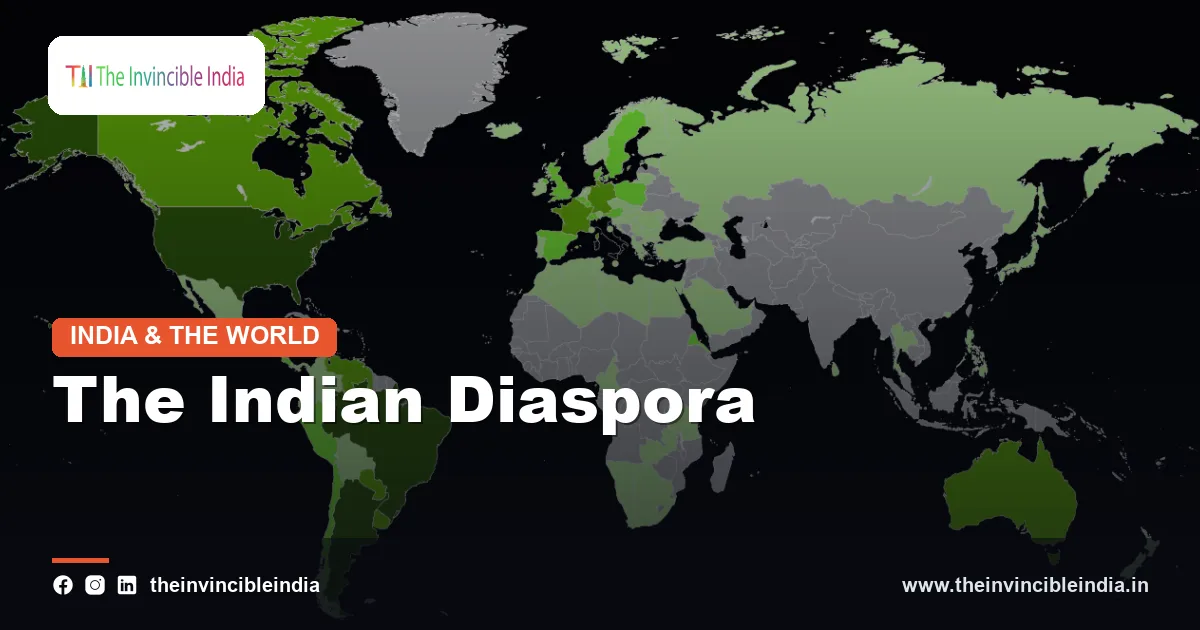
The Indian diaspora is the largest overseas community in the world, made up of people who were born in India or whose ancestors came from the subcontinent and who now live in nearly every part of the globe. From the sugar plantations of Mauritius and the Caribbean to the oil-rich Gulf and the technology hubs of North America, people of Indian origin have shaped economies, cultures and politics far beyond India’s borders.
For India, the Indian diaspora is both a human story and a strategic asset. It sends home remittances that support millions of households, brings back investment and ideas, and acts as an informal bridge between India and its host countries. This explainer covers who counts as an NRI, a PIO or an OCI, how successive waves of migration built the community, why remittances matter, how soft power works, and how the Indian government engages with its overseas citizens.
Quick Facts
| Item | Details |
|---|---|
| Term | Indian diaspora (overseas Indians) |
| Main categories | Non-Resident Indians (NRIs), Persons of Indian Origin (PIOs) and Overseas Citizens of India (OCIs) |
| Scale | The largest diaspora in the world, with tens of millions of people |
| Early migration | Indentured labour from the 1830s, after the abolition of slavery in the British Empire |
| Gulf migration | Large-scale labour flows from the 1970s oil boom onwards |
| Report that shaped policy | High Level Committee on the Indian Diaspora (chaired by L. M. Singhvi), report submitted in 2001 |
| Annual observance | Pravasi Bharatiya Divas, 9 January, first held in 2003 |
| OCI scheme | Introduced in 2005; the PIO card was merged into it in 2015 |
Who Is Part of the Indian Diaspora?
The term “Indian diaspora” covers a very wide range of people. It includes a software engineer in California who left India five years ago, a family in Trinidad whose ancestors arrived as indentured labourers in the nineteenth century, a nurse working in the Gulf on a short-term contract and a British-born professional whose grandparents emigrated from Gujarat. Their legal status, their ties to India and their cultural identity can be very different.
For administrative purposes, the Government of India uses three main categories. These are defined by citizenship and ancestry, not by culture or language.
Non-Resident Indians (NRIs)
An NRI is an Indian citizen who lives outside India. NRIs hold Indian passports and keep their Indian citizenship. They can vote in Indian elections if registered, though they must generally be present in their constituency to cast a ballot. For tax and foreign-exchange purposes, residency status is determined by the number of days spent in India in a financial year under the Income Tax Act and the Foreign Exchange Management Act.
Persons of Indian Origin (PIOs)
A PIO was traditionally a foreign national who, or whose ancestors, had been an Indian citizen or who belonged to territory that was once part of India. The PIO Card Scheme began in 2002, following the recommendations of the Singhvi Committee, and offered visa-free travel and certain economic privileges. In January 2015, the PIO card scheme was merged with the OCI scheme, and existing PIO cards were treated as OCI cards.
Overseas Citizens of India (OCIs)
The OCI scheme came into being through an amendment to the Citizenship Act in 2003 and became operational in 2005. An OCI cardholder is a foreign citizen of Indian origin, or the spouse of one, who is registered with the Indian government. OCI is not dual citizenship. It is a lifelong visa-like status that allows multiple-entry travel and the right to live and work in India, along with some other benefits.
NRI, PIO and OCI Compared
The table below summarises the main differences. Rules are revised from time to time, so readers should always check the latest notifications of the Ministry of External Affairs and the Ministry of Home Affairs.
| Feature | NRI | PIO (now merged) | OCI |
|---|---|---|---|
| Citizenship | Indian | Foreign | Foreign |
| Holds Indian passport | Yes | No | No |
| Right to vote in India | Yes, if registered | No | No |
| Can contest elections or hold constitutional office | Yes, for eligible offices | No | No |
| Lifelong multiple-entry travel | Not applicable | Valid for a fixed period under the old scheme | Yes |
| Purchase of agricultural land | Generally restricted | Restricted | Restricted |
Why India does not allow dual citizenship
A common question is why people of Indian origin cannot hold both an Indian and a foreign passport. The answer lies in the Constitution and the Citizenship Act, 1955. Article 9 of the Constitution says that a person who voluntarily acquires the citizenship of a foreign state is no longer a citizen of India. Section 9 of the Citizenship Act of 1955 provides for the termination of Indian citizenship in such cases.
The Singhvi Committee looked at this issue and recommended a compromise, a special status that would give emotional and practical benefits to the diaspora without conferring full citizenship. That compromise eventually took the shape of the PIO and OCI schemes. In practice, OCI gives many of the travel and economic conveniences of citizenship without voting rights or eligibility for government jobs of a constitutional nature.
The Great Waves of Migration
People have moved out of the Indian subcontinent for centuries as traders, scholars, monks and sailors. Hindu and Buddhist traders helped spread cultural influence across Southeast Asia, and merchant communities from Gujarat and Sindh settled along Indian Ocean trade routes. The modern diaspora, however, was formed in four broad waves.
Wave one: indentured and colonial labour
After slavery was abolished across the British Empire in the 1830s, plantation owners in colonies such as Mauritius, British Guiana, Trinidad, Natal, Fiji and Suriname sought cheap labour. Millions of Indians, mainly from the Gangetic plains, Bihar, eastern Uttar Pradesh, and from the south, were recruited under a system of indenture, which bound them to a contract of a fixed number of years. The system was widely criticised for harsh working conditions and was eventually abolished in 1917, with the last contracts ending in the early 1920s. Many labourers chose to stay after their contracts ended, and their descendants today form large and influential communities.
Wave two: kangani, maistry and merchant migration
Alongside indenture, other labour systems such as the kangani and maistry arrangements moved workers, especially Tamils, to Ceylon, Burma and Malaya. Merchants and clerks also moved to East and South Africa.
Wave three: post-war migration to the West
After the Second World War, people from Punjab, Gujarat and other regions migrated to Britain to fill labour shortages. In the United States, the Immigration and Nationality Act of 1965 removed national-origin quotas and opened the door to highly educated Indian doctors, scientists and engineers. Canada followed with its own point-based system. In 1972, the expulsion of Asians from Uganda sent many Indian-origin families to Britain, Canada and elsewhere.
Wave four: the Gulf and the knowledge economy
The oil boom of the early 1970s triggered a huge demand for workers in the Gulf countries. Millions of Indians from Kerala, Tamil Nadu, Andhra Pradesh, Telangana, Punjab and Uttar Pradesh took up construction, healthcare, trade and service jobs, usually on temporary contracts. From the 1990s, the growth of information technology led to a new flow of software professionals to the United States, the United Kingdom, Canada, Australia, Singapore and Germany.
Where the Diaspora Lives
The distribution of the Indian diaspora is uneven, and the communities differ sharply in their history and profile.
- Gulf region: Large expatriate workforces in the United Arab Emirates, Saudi Arabia, Kuwait, Qatar, Oman and Bahrain, who are mostly temporary migrants and not citizens.
- North America: A prosperous and highly educated community in the United States and Canada, with strong presence in medicine, technology, academia and business.
- United Kingdom: One of the oldest and best-established South Asian communities in Europe, with deep roots in business, public life and the health service.
- Indentured-descent countries: Mauritius, Guyana, Trinidad and Tobago, Suriname and Fiji, where people of Indian origin are a very large share of the population, sometimes the largest.
- Southeast Asia and Africa: Established communities in Malaysia, Singapore, South Africa, Kenya and other countries.
- Australia and New Zealand: A fast-growing community, with significant student and skilled-worker migration.
Remittances: The Economic Lifeline
Money sent home by overseas Indians, known as remittances, is one of the most significant links between the diaspora and India. According to World Bank estimates over many years, India has been among the largest recipients of remittances in the world, and in recent years the annual inflow has crossed the 100 billion US dollar mark. For several decades it has helped balance the country’s current account, which would otherwise show a larger deficit because India imports more goods than it exports.
How remittances help households and the economy
- They raise household incomes, particularly in states like Kerala, Punjab, Goa, Tamil Nadu and Telangana, where emigration is common.
- They are spent on housing, children’s education, healthcare and small business capital.
- They add to the foreign exchange available to the country and are generally more stable than portfolio flows.
- They support local economies, from real estate to retail and services.
Remittance patterns have shifted over time. Earlier, a larger share came from the Gulf. In recent years, remittances from advanced economies such as the United States, the United Kingdom and Singapore have grown in importance, reflecting the rise of high-skilled migration. The rise of digital payment platforms and lower transfer costs has also changed how money moves.
Soft Power, Culture and Influence
The diaspora is a major part of India’s soft power, the ability to attract and persuade through culture and example rather than coercion. Festivals such as Diwali and Holi are celebrated in public spaces around the world, and some host countries have given them official recognition. Indian cuisine, yoga, Bollywood films, classical music and dance, and cricket are carried abroad by the diaspora and have become part of the global cultural landscape.
Political and professional presence
People of Indian origin have held senior positions in government, business and science in many countries. In several nations, persons of Indian descent have served as heads of state or government, ministers and legislators. In the corporate world, Indian-origin executives lead major global companies. This visibility generates goodwill for India, though the relationship between a diaspora community and the land of its ancestors remains complex and each community maintains its own identity.
Diaspora as a bridge
Overseas Indians serve as informal ambassadors. They connect Indian firms with foreign partners, lobby for favourable policies in their host countries, invest in start-ups and contribute to philanthropy in India. Organisations such as the Global Organisation of People of Indian Origin, founded in 1989, show how the community builds networks across countries.
Pravasi Bharatiya Divas and Diaspora Recognition
The Government of India celebrates Pravasi Bharatiya Divas (Overseas Indian Day) on 9 January. The date marks the day in 1915 when Mahatma Gandhi returned to India from South Africa, an event often seen as a turning point in India’s freedom movement. The first such event was held in New Delhi in 2003, and the convention became a major annual gathering. Since 2015, it has been held once every two years.
Pravasi Bharatiya Samman
The Pravasi Bharatiya Samman is the highest honour conferred on overseas Indians. It is presented at the convention to recognise outstanding achievements in fields such as public service, science, business, arts and philanthropy. The event gives overseas Indians a platform to meet policymakers, state governments and business leaders.
Diaspora Engagement Policy and Institutions
India’s approach to its overseas citizens has changed considerably. In the first decades after independence, the government kept a measured distance from the older diaspora, in line with the principle that Indians who had chosen to settle in other countries should be loyal to those countries. From the late 1990s, as the economic and political value of the diaspora became clearer, policy became more active.
Key institutions and schemes
- Ministry of Overseas Indian Affairs: Created in 2004 and merged into the Ministry of External Affairs in 2016, which now handles diaspora matters through its Overseas Indian Affairs division.
- Indian Community Welfare Fund: Provides emergency assistance to Indians in distress abroad, such as help with repatriation and legal aid.
- Emigration Act, 1983 and the e-Migrate system: Regulate recruitment and protect low-skilled workers who migrate for employment, particularly to certain Gulf and other countries.
- Know India Programme and scholarship schemes: Introduce young people of Indian origin to the country and support their education in India.
- Indian Council for Cultural Relations: Promotes cultural exchange, including Indian cultural centres and chairs of Indian studies abroad.
- Insurance and skilling schemes for emigrant workers: Offer protection and training for those heading overseas.
Challenges Facing the Diaspora and the Government
The experience of overseas Indians is not uniformly easy. Many low-skilled workers in the Gulf face problems such as unpaid wages, poor living conditions, contract substitution and exploitation by unscrupulous recruitment agents. The government has responded with regulations, bilateral labour agreements and welfare funds, though implementation remains a continuing challenge.
Emergencies and evacuations
The government has repeatedly stepped in to bring citizens home during crises. The airlift of Indians from Kuwait in 1990, following the Iraqi invasion, is regarded as one of the largest civilian evacuations in history. Later operations followed conflicts and natural disasters in West Asia, Africa, Ukraine and elsewhere, and the repatriation effort during the COVID-19 pandemic, called the Vande Bharat Mission, was among the largest ever organised by India.
Other issues
- Rules for visas and work permits in host countries can change quickly and affect families.
- Anxiety about discrimination and hate crimes in some countries has prompted diplomatic engagement.
- “Brain drain” debates continue, though many now speak of “brain circulation” as returnees and investors bring back skills and capital.
Conclusion
The Indian diaspora is not a single community but a mosaic of histories, from indentured labourers who built new societies in the nineteenth century to professionals who drive the digital economy today. It matters to India through remittances, investment, cultural reach and diplomatic goodwill, and India in turn has built a growing set of institutions to engage with it. Understanding the legal categories of NRI, PIO and OCI, as well as the long history of migration, helps explain why the diaspora has become such an important pillar of India’s global presence.
Frequently Asked Questions
What is the difference between an NRI and an OCI?
An NRI is an Indian citizen living abroad and holds an Indian passport. An OCI is a foreign citizen of Indian origin, or a spouse of one, who is registered with the Indian government and receives a lifelong, multiple-entry visa-like status. OCI is not dual citizenship and does not carry voting rights.
What happened to the PIO card?
The Person of Indian Origin card scheme, introduced in 2002, was merged into the Overseas Citizen of India scheme in January 2015. Existing PIO cardholders were treated as OCI cardholders, and the OCI card is now the single document for this category.
Why does India not allow dual citizenship?
Article 9 of the Constitution and the Citizenship Act of 1955 provide that an Indian citizen who voluntarily acquires another country’s citizenship ceases to be an Indian citizen. The OCI scheme was created as an alternative that offers many practical benefits without granting full citizenship.
When is Pravasi Bharatiya Divas celebrated and why?
Pravasi Bharatiya Divas is observed on 9 January because Mahatma Gandhi returned to India from South Africa on that date in 1915. The first convention was held in 2003, and since 2015 it has been organised every two years.
How important are remittances to India?
India is one of the largest recipients of remittances in the world, and in recent years inflows have exceeded 100 billion US dollars annually according to World Bank estimates. These funds support household incomes, education and healthcare, and help India manage its current account.
How did the Indian diaspora begin?
While traders and travellers have left the subcontinent for centuries, the modern diaspora began in the 1830s with indentured labour sent to plantation colonies. Later waves included migration to Britain after the Second World War, professionals moving to North America after 1965, Gulf workers from the 1970s and software specialists from the 1990s.


