

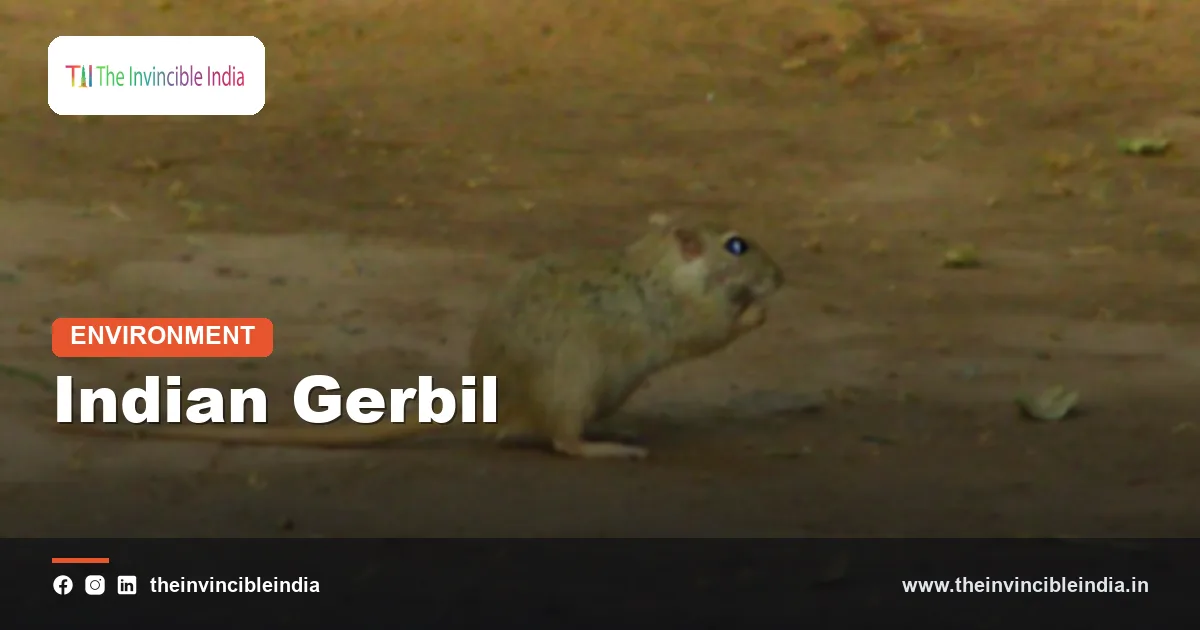
The Indian gerbil (Tatera indica) is a large-eyed, long-tailed burrowing rodent of the gerbil subfamily that lives in open fields, scrub and semi-arid land across the Indian subcontinent. It is a nocturnal, ground-dwelling animal that digs elaborate tunnel systems, eats seeds, roots and crops, and is an important prey species for owls, snakes and other predators.
The Indian gerbil is often mistaken for a rat, yet it is a distinct rodent with a sandy coat, pale underside and a tail longer than its body. This explainer covers what the Indian gerbil is, how it looks and lives, where it is found, what it eats, its burrows, its relationship with farmers and public health and why it matters in the food web. It was last reviewed on 23 October 2026.
| Quick Fact | Detail |
|---|---|
| Scientific name | Tatera indica (also called Hardwicke’s gerbil or the Indian antelope rat in older literature) |
| Classification | Order Rodentia, family Muridae, subfamily Gerbillinae |
| Range | India, Pakistan, Nepal, Sri Lanka and parts of Afghanistan, Iran and Iraq |
| Typical habitat | Open fields, scrub, dry grassland, farmland edges and sandy or loamy soils |
| Body size | Head and body roughly 12 to 20 centimetres, with a tail that is longer than the body |
| Activity pattern | Mostly nocturnal and ground-living |
| Diet | Seeds, grain, roots, tubers, shoots and some insects |
| Shelter | Branching burrow systems with several entrances and chambers |
| Conservation status | Generally regarded as widespread; assessed as Least Concern by the IUCN |
Key Takeaways
- The Indian gerbil, scientifically Tatera indica, is a burrowing rodent of the subfamily Gerbillinae found widely across the Indian subcontinent.
- The Indian gerbil has big dark eyes, sandy-brown upper fur, a white belly and a tail that is longer than its head and body.
- The Indian gerbil lives in branching burrows and is mostly active at night, when it forages for seeds, grain and roots.
- The Indian gerbil is a common prey animal for owls, snakes, foxes, jackals and birds of prey, so it supports many predators in farmland.
- The Indian gerbil can damage standing and stored crops, and it has historically been linked with plague in parts of India.
- The Indian gerbil is not the same animal as the pet gerbil sold in shops, and wild gerbils should not be kept or trapped without legal clearance.
What is the Indian gerbil?
The Indian gerbil is a medium-sized rodent, scientifically named Tatera indica, belonging to the gerbil subfamily Gerbillinae within the mouse family Muridae. Gerbils are adapted to dry, open habitats, and the Indian gerbil is among the most widespread wild gerbils of South Asia.
It is sometimes called Hardwicke’s gerbil, after the British naturalist Thomas Hardwicke, who collected specimens in India in the early nineteenth century. Older Indian zoological texts also use the name Indian antelope rat, because the animal can bound away in long leaps when alarmed.
Several subspecies have been described in the literature across its range, with colour and size varying from region to region. Taxonomists continue to study whether some of these forms deserve separate status, so exact subspecies lists differ between sources.
What does the Indian gerbil look like?
The Indian gerbil looks like a slim, long-legged rat with a sandy or light brown back, a clean white underside, large dark eyes and a long tail. The coat is soft and short, and the fur on the back is often slightly speckled.
The key identifying features are as follows.
- Eyes: large and dark, an adaptation for night vision.
- Tail: longer than the head and body together, lightly haired and often darker toward the tip.
- Hind legs: long and strong, which allows rapid running and leaping.
- Ears: fairly large, thin and rounded.
- Colour: pale sand, brown or reddish-brown above and white below, which helps it blend into dry soil.
Adults usually weigh in the range of roughly 100 to 200 grams, although size varies with age, food supply and region. Compared with a house rat, a gerbil looks cleaner and more graceful, and has a more upright posture when it sits.
Where does the Indian gerbil live?
The Indian gerbil lives mainly in dry, open and semi-arid habitats across the Indian subcontinent, and it also occurs in parts of Iran, Iraq and Afghanistan. Within India it is found in a large share of the country, from the plains of the north and the Deccan to the drier regions of the west and south.
Typical habitats include:
- cultivated fields and field margins,
- dry scrub and thorn forest,
- grassland and fallow land,
- sandy or loamy soils where tunnelling is easy,
- embankments, canal banks and roadside verges.
It prefers soil that is soft enough to dig but dry enough not to flood. Very dense forest and waterlogged ground are generally unsuitable. The species is able to live close to human settlements, which brings it into regular contact with agriculture.
How does the Indian gerbil dig and use burrows?
The Indian gerbil digs branching underground burrow systems that serve as shelter, nursery and food store. A burrow commonly has several entrances, connecting tunnels and chambers at different depths, and entrances are often partly hidden by loose soil or plants.
The burrow provides several benefits.
- Temperature control: the soil stays cooler by day and warmer on cold nights than the air above, which matters in dry regions.
- Predator escape: multiple openings give the gerbil several ways to bolt when a predator appears.
- Storage: chambers are used to hoard grain and seeds for lean seasons.
- Breeding: females give birth in nesting chambers lined with plant material.
Gerbils usually plug their entrances during the day, which helps them avoid detection. Burrows can occur in loose clusters, so a field with many gerbils shows scattered holes surrounded by small mounds of fresh soil. The tunnelling also loosens and aerates the soil and can mix organic matter into it.
What does the Indian gerbil eat?
The Indian gerbil eats mainly seeds, grain, roots, tubers and shoots, and it adds insects when available. It is therefore a granivore and herbivore with occasional animal food.
In farmland, its diet may include wheat, millet, sorghum, groundnut, maize, pulses and vegetable seedlings. In natural habitats, it feeds on wild grass seeds, pods and roots. Because water is scarce in dry areas, gerbils get much of their moisture from their food and have kidneys that conserve water efficiently.
The gerbil forages at night and collects food in its cheeks and teeth to carry to the burrow. Hoarded stores can be significant, and farmers sometimes dig out burrows after harvest and find considerable amounts of grain.
Its feeding habits make it both a seed disperser, since forgotten seeds can sprout, and a seed predator, since many seeds are eaten.
How does the Indian gerbil breed?
The Indian gerbil breeds mainly when food is plentiful, with females producing several litters a year in favourable conditions. Litter size is typically a few young, and the pups are born blind and hairless in the nesting chamber.
The young grow quickly, open their eyes after a couple of weeks and begin to eat solid food soon after. They become independent in a matter of weeks and can start breeding at a young age.
Breeding peaks often follow the monsoon or the harvest, when seeds and crops are plentiful, so populations can rise sharply in good seasons. They fall again when food is short or predators and weather take their toll. Exact breeding patterns vary with region and climate, and scientists use local field studies to describe them.
In the wild, many individuals live for a year or less because of predation, so high reproduction balances high mortality.
Is the Indian gerbil a pest or a health risk?
The Indian gerbil is a recognised agricultural pest in many regions, and it has also been associated with plague transmission in India’s history. Both points need balanced treatment, since the animal is also a normal part of the ecosystem.
Crop damage
Gerbils feed on sown seeds, seedlings, standing grain and stored produce. They also dig burrows in fields and along bunds, which can damage irrigation channels and field edges. The extent of damage varies a great deal by crop, season and population density.
Disease
The Indian gerbil has been identified in plague research as a wild rodent reservoir for the bacterium Yersinia pestis in parts of peninsular India, where fleas moving between wild rodents and house rats allowed spillover to humans. Plague is rare today in India and is monitored by public health authorities, but historical surveys give the gerbil an important place in the story.
Basic precautions include not handling wild rodents, storing grain in sealed containers and informing local health officials if unusual rodent die-offs occur.
How does the Indian gerbil compare with other Indian gerbils and rats?
The Indian gerbil is the largest and most widespread of India’s wild gerbil-type rodents, and it differs from rats and from desert-living relatives in several ways. The comparison below highlights the main points.
| Feature | Indian gerbil | Indian desert jird | Indian hairy-footed gerbil | Brown or black rat |
|---|---|---|---|---|
| Scientific name | Tatera indica | Meriones hurrianae | Gerbillus gleadowi | Rattus norvegicus or Rattus rattus |
| Typical region | Plains, scrub, farmland | Thar desert and arid north-west | Dry north-western India | Towns, houses, farms |
| Size | Medium to large | Medium | Small | Medium to large |
| Tail | Longer than body | Roughly body length, tufted tip | Longer than body | Varies by species |
| Habit | Burrowing, nocturnal | Burrowing, mostly active by day or dusk | Burrowing, nocturnal | Burrowing or climbing, nocturnal |
| Pest status | Field and store pest | Local crop pest | Minor | Major household and store pest |
Another distinction is that Indian gerbils are wild animals, whereas the common pet gerbil, the Mongolian gerbil, comes from a different genus and region.
Which animals prey on the Indian gerbil?
Owls, snakes, small carnivores and birds of prey are the main predators of the Indian gerbil, which makes the rodent an important link between plants and top predators. Barn owls, spotted owlets, rat snakes, cobras, monitor lizards, jackals, foxes, jungle cats and raptors such as kestrels and harriers all take gerbils where they are available.
This predator-prey relationship has practical uses. Farmers and agricultural scientists in some parts of India encourage barn owls by installing nest boxes and leaving perches in fields. The owls eat large numbers of rodents and can reduce the need for poison baits, which can also harm non-target wildlife.
Preserving hedgerows, trees and uncultivated patches helps maintain predator populations. Using rodenticides carelessly can poison owls and snakes through secondary exposure, so integrated pest management, which combines habitat measures, proper grain storage and natural predators, is generally favoured.
Can the Indian gerbil be kept as a pet?
The Indian gerbil is a wild animal that is not suitable as a pet, and capturing or keeping wildlife may be restricted under Indian wildlife law. Pet gerbils sold in shops are usually Mongolian gerbils, bred in captivity for generations, and they are a different species.
Wild rodents can carry parasites and diseases, are stressed by captivity and cannot easily be tamed. Anyone who finds an injured gerbil should contact a local wildlife rescue organisation or forest department instead of keeping it.
The best way to appreciate the Indian gerbil is to watch it where it lives. With a torch at dusk near a quiet field, you may see its large eyes shine and its long tail trailing as it bounds from burrow to burrow.
How can farmers manage gerbil populations without harming wildlife?
Farmers can manage Indian gerbil numbers best through integrated rodent management, which combines clean fields, protected grain stores and encouragement of natural predators. This approach reduces losses while avoiding the unintended poisoning of owls, snakes and other wildlife.
- Keep field bunds and borders clear of dense weeds that offer cover.
- Store harvested grain in sealed metal or concrete bins that gerbils cannot gnaw through.
- Level and fill burrows after harvest to disrupt the tunnel network.
- Install barn owl nest boxes and perches to draw in natural predators.
- Coordinate control efforts across neighbouring fields, since gerbils move between plots.
Local agricultural universities and krishi vigyan kendras provide region-specific advice, and following their guidance is wiser than improvising with strong poisons.
Bottom Line
The Indian gerbil is an adaptable, burrowing rodent that thrives in India’s open fields and dry scrub. It can cost farmers grain and has a historic link to plague, yet it also feeds owls, snakes and many other predators. Understanding it as one part of a working food web supports pest management that protects both crops and wildlife.
Frequently Asked Questions
What is the Indian gerbil?
The Indian gerbil is a burrowing rodent, scientifically named Tatera indica, found across the Indian subcontinent. It has large eyes, a sandy coat, a white belly and a tail longer than its body. It is mostly nocturnal and lives in open fields and scrub.
Is the Indian gerbil a rat?
No, the Indian gerbil is not a true rat, although it belongs to the same broad rodent family, Muridae. It is a member of the gerbil subfamily, Gerbillinae. Compared with rats, it has a longer tail, larger eyes and a cleaner, sandy look.
Where does the Indian gerbil live?
The Indian gerbil lives in dry, open habitats such as fields, scrub, grassland and farmland edges across India and neighbouring countries. It digs burrows in soft, well-drained soil. It is absent from dense forest and waterlogged ground.
What does the Indian gerbil eat?
The Indian gerbil eats seeds, grain, roots, tubers and shoots, along with some insects. In farmland it feeds on crops such as wheat, millet, groundnut and pulses. It forages mainly at night and stores food in its burrow.
Is the Indian gerbil dangerous to humans?
The Indian gerbil is not aggressive, but it can carry fleas and parasites and has historically been linked with plague in parts of India. Plague is rare today and is monitored by health authorities. Avoid handling wild rodents and store grain in sealed containers.
Can I keep an Indian gerbil as a pet?
No, the Indian gerbil is a wild animal and is not suitable as a pet. Capturing wildlife may be restricted by law, and wild rodents can carry diseases. Pet gerbils sold in shops are a different species, the Mongolian gerbil.
{“@context”:”https://schema.org”,”@graph”:[{“@type”:”FAQPage”,”mainEntity”:[{“@type”:”Question”,”name”:”What is the Indian gerbil?”,”acceptedAnswer”:{“@type”:”Answer”,”text”:”The Indian gerbil is a burrowing rodent, scientifically named Tatera indica, found across the Indian subcontinent. It has large eyes, a sandy coat, a white belly and a tail longer than its body. It is mostly nocturnal and lives in open fields and scrub.”}},{“@type”:”Question”,”name”:”Is the Indian gerbil a rat?”,”acceptedAnswer”:{“@type”:”Answer”,”text”:”No, the Indian gerbil is not a true rat, although it belongs to the same broad rodent family, Muridae. It is a member of the gerbil subfamily, Gerbillinae. Compared with rats, it has a longer tail, larger eyes and a cleaner, sandy look.”}},{“@type”:”Question”,”name”:”Where does the Indian gerbil live?”,”acceptedAnswer”:{“@type”:”Answer”,”text”:”The Indian gerbil lives in dry, open habitats such as fields, scrub, grassland and farmland edges across India and neighbouring countries. It digs burrows in soft, well-drained soil. It is absent from dense forest and waterlogged ground.”}},{“@type”:”Question”,”name”:”What does the Indian gerbil eat?”,”acceptedAnswer”:{“@type”:”Answer”,”text”:”The Indian gerbil eats seeds, grain, roots, tubers and shoots, along with some insects. In farmland it feeds on crops such as wheat, millet, groundnut and pulses. It forages mainly at night and stores food in its burrow.”}},{“@type”:”Question”,”name”:”Is the Indian gerbil dangerous to humans?”,”acceptedAnswer”:{“@type”:”Answer”,”text”:”The Indian gerbil is not aggressive, but it can carry fleas and parasites and has historically been linked with plague in parts of India. Plague is rare today and is monitored by health authorities. Avoid handling wild rodents and store grain in sealed containers.”}},{“@type”:”Question”,”name”:”Can I keep an Indian gerbil as a pet?”,”acceptedAnswer”:{“@type”:”Answer”,”text”:”No, the Indian gerbil is a wild animal and is not suitable as a pet. Capturing wildlife may be restricted by law, and wild rodents can carry diseases. Pet gerbils sold in shops are a different species, the Mongolian gerbil.”}}]}]}


