

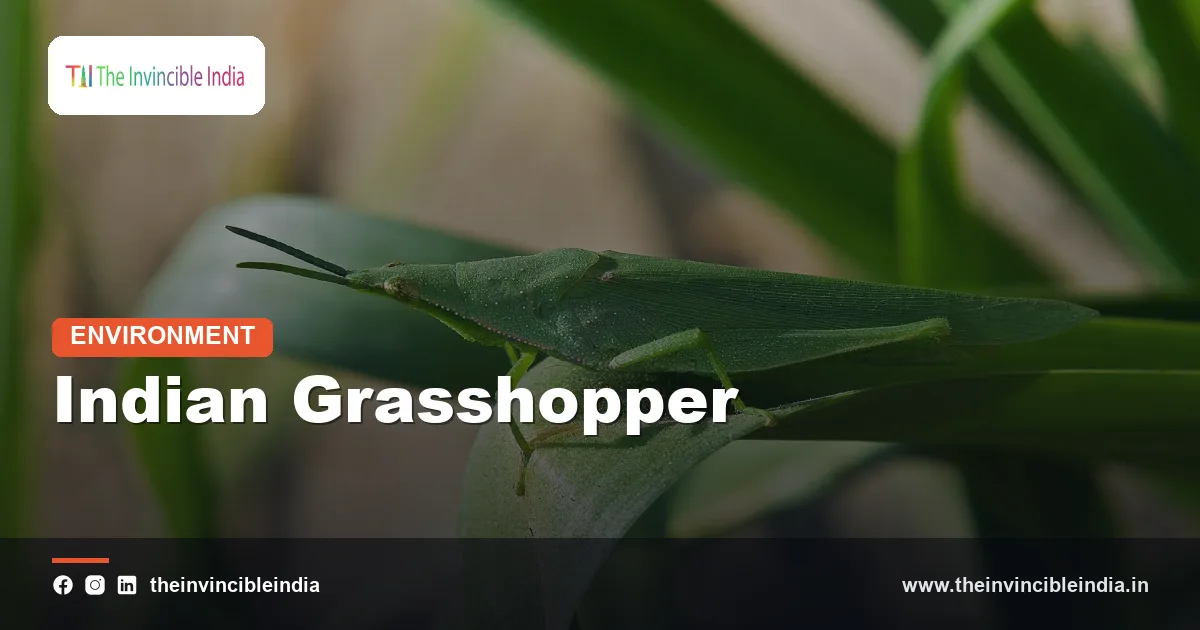
A grasshopper is a plant-eating insect of the order Orthoptera, suborder Caelifera, recognised by its powerful hind legs built for jumping, its short antennae and its habit of making chirping sounds by rubbing body parts together. Grasshoppers are among the most familiar insects of Indian fields, grasslands, roadsides and gardens, where they leap away from walkers’ feet in the monsoon and post-monsoon months.
India is home to many species of grasshopper, ranging from small, green paddy-field insects to the large, brightly coloured milkweed grasshopper of dry scrub. Most are harmless and are an important food for birds, lizards and spiders, while a few species occasionally cause serious crop damage, and the desert locust, a swarming grasshopper, has historically been one of India’s most feared agricultural pests.
| Quick Facts | Grasshopper |
|---|---|
| Order and suborder | Orthoptera, suborder Caelifera (short-horned grasshoppers), mostly family Acrididae |
| Size | Adults typically 1 to 8 cm long depending on the species |
| Habitat in India | Grasslands, crop fields, scrub, forest clearings, roadsides and gardens |
| Diet | Mostly grasses and leaves; a few species feed on specific plants |
| Life cycle | Incomplete metamorphosis: egg pod, nymph (hopper), adult |
| Ecological role | Herbivore and a major prey animal for birds, reptiles, mantises and spiders |
| Notable features | Large jumping hind legs, ears on the abdomen, sound production, locust swarm phase in some species |
| Relatives | Locusts, crickets, katydids and bush crickets |
Key Takeaways
- A grasshopper belongs to the suborder Caelifera of the insect order Orthoptera, and it is characterised by short antennae and enlarged hind legs for jumping.
- A grasshopper has its hearing organs, called tympana, on the sides of the first abdominal segment rather than on its head or legs.
- Grasshoppers develop through incomplete metamorphosis, so the nymphs that hatch from underground egg pods resemble small, wingless adults.
- Locusts are a group of grasshopper species in the family Acrididae that can change behaviour and form and gather in huge migrating swarms.
- Most grasshoppers in India are harmless herbivores, and only a few species are significant crop pests.
- Grasshoppers are an essential part of food webs, feeding birds, lizards, frogs, spiders and other predators.
What Is a Grasshopper?
A grasshopper is a herbivorous insect that moves mainly by jumping and walking, with a body divided into head, thorax and abdomen and a pair of large hind legs with thick, muscular thighs. It belongs to the order Orthoptera, a name meaning “straight wings”, and to the suborder Caelifera, the short-horned Orthoptera.
The great majority of Indian grasshoppers belong to the family Acrididae, though other families occur as well. Grasshoppers have two pairs of wings in most species: narrow, leathery forewings that protect the body, and broad, folded hindwings used for flight. Some species are flightless or have short wings, and these are generally those that live in dense grass or on the ground.
How is a grasshopper different from a cricket or katydid?
A grasshopper differs from a cricket or katydid chiefly in its antennae, which are short and thick, while those of crickets and katydids are long and thread-like. Grasshoppers are mostly active by day and feed on grasses, whereas crickets and katydids are often active at night and may eat a wider range of foods. The two groups are close relatives within the Orthoptera but belong to different suborders.
| Feature | Grasshopper | Cricket or katydid |
|---|---|---|
| Suborder | Caelifera | Ensifera |
| Antennae | Short and stout | Long and thread-like, often longer than the body |
| Activity | Mostly by day | Mostly at night |
| Hearing organ | On the abdomen | On the front legs |
| Sound made by | Rubbing hind legs on wings, or flying noise | Rubbing the wings together |
| Egg-laying | Egg pods in soil | Single eggs in soil, stems or leaves |
Where Are Grasshoppers Found in India?
Grasshoppers are found in almost every land habitat in India, with the highest numbers in grasslands, crop fields, scrub and open woodland, and they are rare only in dense, shaded, wet forest floors and at the highest altitudes. They are most conspicuous from the monsoon through to the post-monsoon season, when fresh grass and crops provide abundant food.
The kinds of grasshopper vary by region. Dry western and central India supports species that feed on desert and scrub vegetation, the paddy-growing plains of the east and south support species that feed on rice and grasses, and the Himalayan meadows have their own cold-tolerant forms. Gardens and road verges throughout the country shelter common, adaptable species that jump out of the long grass.
Which grasshoppers are commonly seen in India?
Several grasshoppers are well known in India, each with its own habitat and habits. The following examples are widely recorded.
- Milkweed or ak grasshopper (Poekilocerus pictus): a large, brightly marked grasshopper found on the akda or calotropis plant, which it eats and whose toxins it uses for defence
- Rice grasshopper (Hieroglyphus banian): a large green grasshopper that can damage paddy, sugarcane and other crops
- Small rice grasshopper (Oxya species): a small green species that is common in paddy fields and wet grassland
- Giant green slant-faced grasshopper (Acrida exaltata): a long, narrow, pointed-headed grasshopper that blends in with grass stems
- Surface grasshopper (Chrotogonus species): a small, ground-hugging species that is a minor pest of many crops
- Desert locust (Schistocerca gregaria): a swarming species that breeds in arid regions, including western India
How Does a Grasshopper Jump?
A grasshopper jumps by contracting the large muscles in its hind legs to store energy and then releasing it suddenly in a rapid extension that launches the whole body into the air. The hind femur, or thigh, is greatly enlarged and holds the muscle, and the tibia, or shin, acts like a lever to push against the ground.
The jump is extremely fast and covers a distance many times the insect’s body length, which is why grasshoppers escape so effectively from predators. Part of the power comes from a spring-like elastic structure in the leg that is loaded slowly and released quickly, a mechanism that allows muscle to deliver more energy than it could directly. Adults with wings often follow the jump with a short flight, which opens the wings and carries the insect further away.
How Do Grasshoppers Make Sound and Hear?
Grasshoppers make sound mostly by stridulation, in which the insect rubs a row of small pegs on the inner surface of the hind leg against a hard vein on the forewing, producing a chirping or rasping call. Many species also make a clattering sound in flight, produced by the hindwings, and this is known as crepitation.
The sounds serve to attract mates and to establish territory, and each species has its own pattern, so females recognise males of the right kind. Grasshoppers hear using a pair of membranes called tympana, which sit on the sides of the first abdominal segment and are covered in many species by the wing bases. The fact that hearing organs sit on the abdomen rather than on a leg or the head is one of the key points of difference between grasshoppers and crickets or katydids.
What Does a Grasshopper Eat?
A grasshopper eats mostly grasses and the leaves of herbs, shrubs and crops, chewing them with strong, toothed jaws called mandibles that move sideways. Most species are fairly generalist feeders, though some specialise on a particular plant or group of plants, and a few feed on flowers, seeds or fallen leaves.
Because grasshoppers feed in large numbers in the right conditions, their impact on vegetation can be considerable. In natural grassland, however, this grazing is part of normal nutrient cycling. The insects convert plant material into body tissue that is eaten by birds, lizards and other animals, and their droppings return nutrients to the soil.
What Is the Life Cycle of a Grasshopper?
The life cycle of a grasshopper has three stages: egg, nymph and adult, and it follows incomplete metamorphosis, with no pupal stage. The female lays a pod of eggs in the soil, from which tiny wingless nymphs, called hoppers, emerge, and these grow by moulting several times until the final moult reveals the winged adult.
| Stage | Description |
|---|---|
| Egg pod | The female pushes the tip of her abdomen into the soil and lays a cluster of eggs, sealed in a frothy material that hardens into a pod |
| Nymph (hopper) | The hatchling resembles a small adult without wings and moults several times, developing wing pads as it grows |
| Adult | After the last moult the grasshopper has fully formed wings, matures and mates |
In much of India, grasshopper eggs lie in the soil through the dry season and hatch with the first monsoon rains, which is why nymphs appear in large numbers as grass flushes. Many species have one generation a year, while some in warmer regions may produce more. The nymph stage takes several weeks, and the adults then live for a few months before dying at the end of the breeding season.
What Is the Difference Between a Grasshopper and a Locust?
A locust is a type of grasshopper that can switch from a solitary, shy form into a gregarious, swarming form when crowded, whereas ordinary grasshoppers remain solitary in behaviour. All locusts are grasshoppers in the family Acrididae, but only a small number of grasshopper species have this swarming ability.
When food becomes abundant after rain and the population rises, the physical contact between crowded individuals triggers changes in hormone levels and behaviour. The insects become more active and attracted to one another, change colour, and develop longer wings and different body proportions. They then form huge bands of hoppers and later airborne swarms that may travel long distances and consume crops. The desert locust is the species best known to India and has caused major outbreaks in Rajasthan and Gujarat, with a significant upsurge in 2019 and 2020.
Who monitors locusts in India?
Locust surveillance in India is carried out by the Locust Warning Organisation (LWO), a body under the Union Ministry of Agriculture and Farmers Welfare with its headquarters at Faridabad in Haryana. It monitors desert areas in Rajasthan and Gujarat, and coordinates control operations with state governments and with international agencies when an outbreak threatens.
Are Grasshoppers Harmful or Beneficial?
Grasshoppers are mostly neither harmful nor especially helpful to people, because the great majority of species live in grasslands and wild vegetation without affecting crops. A few species, however, can damage rice, sugarcane, millets, vegetables and pasture when their numbers rise, and in those cases they are treated as agricultural pests.
On the beneficial side, grasshoppers are a key part of the food web and a source of protein for many animals, including birds such as drongos, rollers, bee-eaters and egrets, as well as lizards, frogs, snakes and spiders. In some communities in India and elsewhere, grasshoppers and locusts are also collected and eaten as food, a practice that has a long history in many parts of the world.
- Pest species: a few kinds feed heavily on rice, sugarcane and other crops
- Prey: food for birds, lizards, frogs, spiders, mantises and small mammals
- Nutrient cycling: turn plant material into manure and animal protein
- Indicators: grassland grasshoppers often reflect the condition of the habitat
How Do Farmers Manage Grasshoppers?
Farmers manage grasshoppers mainly by monitoring their numbers, disturbing egg-laying sites and protecting the natural enemies that keep populations in check, resorting to insecticides only when an outbreak is serious. Integrated pest management (IPM) is the standard approach, using a combination of methods rather than relying on spraying alone.
- Ploughing or turning the soil to expose egg pods to birds and the sun
- Keeping bunds and field margins weeded, so nymphs have fewer places to gather
- Protecting birds, lizards and other natural enemies
- Using biological or botanical options, such as neem-based products, where suitable
- Reporting large aggregations early to the agriculture department
Early detection is vital, because young hoppers are easier to control than winged adults. Hopper bands, which form on the ground, can be dealt with before the insects mature and spread to new areas.
Bottom Line
The grasshopper is a common, powerful jumper and an essential link in Indian food webs, turning grass into food for countless predators. Understanding the difference between a harmless field grasshopper and a swarming locust helps put this familiar insect in proper perspective.
Frequently Asked Questions
What is a grasshopper?
A grasshopper is a plant-eating insect of the order Orthoptera and suborder Caelifera, with short antennae and strong hind legs for jumping. It develops through egg, nymph and adult stages. Many species are found in Indian grasslands, fields and gardens.
What is the difference between a grasshopper and a locust?
A locust is a grasshopper species that can change into a swarming form when crowded, while ordinary grasshoppers stay solitary. All locusts are grasshoppers in the family Acrididae, but not all grasshoppers are locusts. The desert locust is the most important swarming species affecting India.
How does a grasshopper make its chirping sound?
A grasshopper makes its chirping sound by rubbing a row of small pegs on its hind leg against a hard vein on its forewing. This process is called stridulation. Some species also make a clicking or clattering sound with their hindwings in flight.
What do grasshoppers eat?
Grasshoppers eat mainly grasses and the leaves of herbs, shrubs and crops, which they chew with strong sideways-moving jaws. Some species specialise on particular plants, and a few also eat flowers or seeds. Rice, sugarcane and millets can be damaged when pest species are abundant.
Are grasshoppers harmful to humans?
No, grasshoppers are not harmful to humans, as they do not sting and rarely bite. A few species release a bitter fluid or foam when handled, particularly the milkweed grasshopper. Their main impact is on crops when pest species increase in number.
How long does a grasshopper live?
A grasshopper usually lives for a few months as an active nymph and adult, after spending the dry season as an egg in the soil. In much of India, eggs hatch with the monsoon rains and adults die at the end of the breeding season. Lifespans vary with species and climate.
{“@context”:”https://schema.org”,”@graph”:[{“@type”:”FAQPage”,”mainEntity”:[{“@type”:”Question”,”name”:”What is a grasshopper?”,”acceptedAnswer”:{“@type”:”Answer”,”text”:”A grasshopper is a plant-eating insect of the order Orthoptera and suborder Caelifera, with short antennae and strong hind legs for jumping. It develops through egg, nymph and adult stages. Many species are found in Indian grasslands, fields and gardens.”}},{“@type”:”Question”,”name”:”What is the difference between a grasshopper and a locust?”,”acceptedAnswer”:{“@type”:”Answer”,”text”:”A locust is a grasshopper species that can change into a swarming form when crowded, while ordinary grasshoppers stay solitary. All locusts are grasshoppers in the family Acrididae, but not all grasshoppers are locusts. The desert locust is the most important swarming species affecting India.”}},{“@type”:”Question”,”name”:”How does a grasshopper make its chirping sound?”,”acceptedAnswer”:{“@type”:”Answer”,”text”:”A grasshopper makes its chirping sound by rubbing a row of small pegs on its hind leg against a hard vein on its forewing. This process is called stridulation. Some species also make a clicking or clattering sound with their hindwings in flight.”}},{“@type”:”Question”,”name”:”What do grasshoppers eat?”,”acceptedAnswer”:{“@type”:”Answer”,”text”:”Grasshoppers eat mainly grasses and the leaves of herbs, shrubs and crops, which they chew with strong sideways-moving jaws. Some species specialise on particular plants, and a few also eat flowers or seeds. Rice, sugarcane and millets can be damaged when pest species are abundant.”}},{“@type”:”Question”,”name”:”Are grasshoppers harmful to humans?”,”acceptedAnswer”:{“@type”:”Answer”,”text”:”No, grasshoppers are not harmful to humans, as they do not sting and rarely bite. A few species release a bitter fluid or foam when handled, particularly the milkweed grasshopper. Their main impact is on crops when pest species increase in number.”}},{“@type”:”Question”,”name”:”How long does a grasshopper live?”,”acceptedAnswer”:{“@type”:”Answer”,”text”:”A grasshopper usually lives for a few months as an active nymph and adult, after spending the dry season as an egg in the soil. In much of India, eggs hatch with the monsoon rains and adults die at the end of the breeding season. Lifespans vary with species and climate.”}}]}]}


