


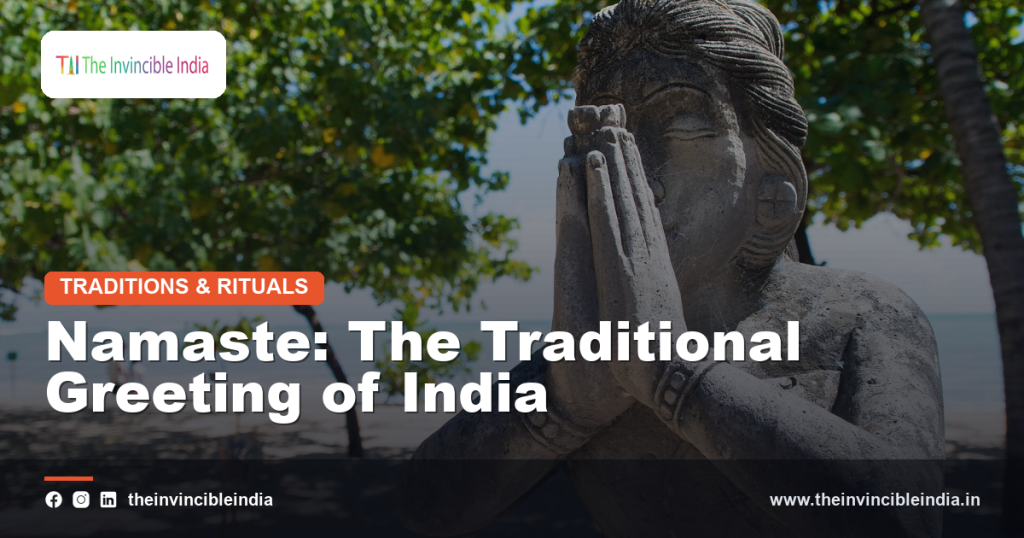
Namaste is the traditional Indian greeting in which the palms are joined together in front of the chest, accompanied by a slight bow of the head, and is among the most widely recognised gestures associated with Indian culture. Far more than a simple hello, the greeting is understood to carry a sense of respect, humility and acknowledgement of the person being greeted. It appears alongside other markers of Indian etiquette, including the customs of welcome observed at gatherings such as an Indian wedding, where greeting rituals play a prominent role. This guide explores the meaning, history and continuing everyday use of Namaste.
Quick Facts
| Detail | Information |
|---|---|
| Also Known As | Namaskar, Namaskaram (regional variants) |
| Gesture | Joined palms (Anjali Mudra) with a slight bow |
| Literal Meaning | “I bow to you” (from Sanskrit namah and te) |
| Used For | Greeting, farewell, respect and gratitude |
| Regional Variants | Namaskar, Namaskaram, and other regional greetings |
| Recognition | Widely recognised as a symbol of Indian culture internationally |
Meaning and Origins of Namaste
Namaste is one of the most familiar and enduring greetings associated with Indian culture, performed by bringing the palms together in front of the chest and offering a slight bow of the head. The gesture is understood to convey respect toward the person being greeted, along with a sense of humility and goodwill, rather than serving merely as a functional exchange of hellos.
Its long history in Indian social and religious life has made it a gesture recognised well beyond its place of origin, though its everyday use across India remains rooted in simple, routine interactions between family, friends, strangers and guests alike.
The Sanskrit Roots of the Word
The word namaste derives from Sanskrit, combining namah, meaning bow or salutation, with te, meaning to you, giving the greeting a literal sense of I bow to you or greetings to you. This etymology reflects the gesture’s underlying spirit of respectful acknowledgement rather than a casual or purely social exchange.
Because Sanskrit forms the root of many Indian languages, similar greeting words, such as namaskar, are found in various regional tongues, each carrying the same essential meaning while reflecting local linguistic variation across the country.
The Anjali Mudra: Gesture and Posture
The physical gesture accompanying Namaste, joined palms held before the chest, is known in yogic and spiritual contexts as Anjali Mudra, a hand position also used in meditation and prayer beyond its role as a greeting. The gesture is typically performed with the palms flat together and fingers pointing upward, accompanied by a gentle inclination of the head.
This posture is often interpreted as symbolically bringing the two hands, sometimes described as representing the individual and the universal or divine, into a single point of unity, adding a layer of symbolic meaning to what might otherwise appear to be a simple physical gesture.
Namaste in Hindu Philosophy and Spirituality
Within Hindu thought, Namaste is often associated with the idea of recognising the divine present within another person, an interpretation sometimes summarised as the divine in one person bowing to the divine in another. While not every use of the greeting carries this explicit philosophical weight in daily life, the association reflects a broader spiritual outlook that values humility and mutual respect.
This philosophical dimension helps explain why Namaste is used not only as a greeting between people but also as a gesture of reverence before deities, elders and teachers, extending its use well beyond ordinary social interaction.
Namaste as Everyday Greeting
In daily life across much of India, Namaste functions as a versatile greeting, used both to say hello and goodbye, and appropriate across a wide range of social situations, from meeting a stranger to greeting an elder relative. Its simplicity, requiring no physical contact, has long made it a practical and universally understood gesture.
Because it can be performed at a respectful distance, Namaste is also commonly used in situations where a handshake might be considered less appropriate, such as greeting someone significantly older or of a different social standing, reflecting its flexible role in Indian social etiquette.
Regional Variants Across India
While Namaste is widely recognised across the country, regional languages have their own related or parallel greeting terms, such as namaskar in Hindi and Marathi-speaking areas, and namaskaram in parts of South India. Other regions have entirely distinct traditional greetings rooted in their own languages, sometimes accompanied by a similar joined-palm gesture and sometimes not.
This coexistence of a broadly shared gesture with locally specific greeting words illustrates the layered linguistic and cultural diversity of India, in which a widely recognised national custom sits alongside numerous regional expressions of the same underlying idea of respectful welcome.
Namaste in Yoga Practice
Namaste has become closely associated with yoga practice, both in India and internationally, typically used by instructors and practitioners at the close of a session as a gesture of gratitude and mutual respect. This usage draws directly on the gesture’s traditional spiritual associations, particularly the Anjali Mudra posture from which it takes its physical form.
The widespread adoption of Namaste within global yoga culture has played a significant role in familiarising audiences outside India with the gesture, even where its broader everyday use as a general greeting is less well understood.
Namaste Compared to Other Forms of Greeting
Unlike a handshake or embrace, Namaste involves no physical contact between the two people greeting one another, a feature that has long been noted as practical in terms of hygiene and social comfort across different relationships and contexts. This contactless quality has also contributed to renewed international attention to the gesture during periods when physical greetings were discouraged for health reasons.
At the same time, Namaste conveys a level of warmth and respect comparable to more physically expressive greetings, achieved instead through posture, eye contact and the accompanying bow, illustrating that respectful greeting need not depend on physical touch.
Namaste in Formal and Religious Contexts
Beyond casual daily use, Namaste is commonly performed in more formal and religious settings, including as a gesture of respect before entering a temple, greeting a religious teacher, or opening public ceremonies and gatherings. In such contexts, the gesture often carries additional weight, reflecting deference toward the occasion or the person being addressed.
Public figures, including political and cultural leaders, frequently use Namaste in formal settings both within India and internationally, reinforcing its status as a recognisable and dignified gesture appropriate to a wide range of formal occasions.
Gender, Age and Social Context in Greeting Customs
The manner in which Namaste is offered can vary subtly depending on the relationship between those greeting one another, with younger people often bowing slightly deeper when greeting elders as a mark of additional respect. Conventions around physical greetings between men and women have also historically shaped when Namaste is preferred over a handshake in more traditional or formal settings.
These nuances reflect the broader role of etiquette in Indian social life, where small variations in gesture and posture can communicate differences in relationship, respect and context without requiring any change in the words spoken.
Namaste in Indian Hospitality
Namaste is frequently the first gesture offered to a guest arriving at an Indian home, hotel or event, often paired with other welcoming customs such as a garland or a tilak mark. This pairing of gesture and ritual reflects the broader Indian emphasis on hospitality as an occasion for warmth expressed through both word and action.
In hospitality and service settings, from airports to hotels, Namaste has also become a recognisable branding element, used to signal a welcoming, culturally rooted approach to greeting visitors, both domestic and international.
Namaste in Indian Cinema and Popular Culture
Namaste has long featured in Indian cinema and popular media as a visual shorthand for politeness, tradition and cultural identity, often used in scenes depicting family gatherings, formal introductions or respectful greetings between characters. Its recognisable gesture makes it an effective and immediately understood piece of visual storytelling.
Beyond film, the gesture appears widely in advertising, tourism promotion and public messaging as a symbol of Indian identity, reflecting its status as one of the most immediately recognisable cultural markers associated with the country.
International Recognition of Namaste
Namaste has achieved considerable recognition outside India, partly through the global spread of yoga and meditation practices, and partly through its adoption in general conversation as a friendly, culturally aware way of acknowledging Indian custom. International visitors are often introduced to the gesture as an accessible way to greet people respectfully while travelling in India.
This international familiarity has, over time, made Namaste one of the most widely recognised single words and gestures associated with Indian culture globally, alongside other iconic cultural symbols such as classical dance forms and traditional attire.
Common Variations: Namaskar and Namaskaram
Namaskar and namaskaram are closely related terms used in various Indian languages, generally understood as more elaborate or slightly more formal versions of the greeting, though usage often overlaps with Namaste in everyday conversation. The exact preference for one term over another largely follows regional linguistic custom rather than any fundamental difference in meaning or gesture.
In each case, the accompanying physical gesture, palms joined and a slight bow, remains largely consistent, underscoring that variation across India tends to occur primarily at the level of language rather than in the underlying form of the greeting itself.
Etiquette Surrounding the Greeting
While Namaste is a simple gesture, certain conventions guide its respectful use, such as maintaining eye contact, offering a genuine rather than perfunctory bow, and using it consistently when greeting elders or guests regardless of familiarity. Overly casual or rushed execution of the gesture is sometimes viewed as diminishing its intended respectfulness.
These etiquette considerations, while informal and rarely explicitly taught, are generally absorbed through observation and practice within family and social life, reflecting how many aspects of Indian greeting customs are transmitted culturally rather than through formal instruction.
Namaste as a Non-Verbal Form of Communication
Because Namaste can be performed silently, it functions as an effective form of non-verbal communication, allowing greeting and acknowledgement to take place even across language barriers or from a distance where speech may not carry easily. This quality has made it a practical gesture in a country with many spoken languages, where a shared physical greeting can bridge linguistic difference.
The gesture is also commonly used silently in crowded or noisy settings, such as large gatherings or religious processions, where a spoken greeting might go unheard. This adaptability, working equally well in quiet reflection or a bustling crowd, is part of what has helped Namaste remain a consistently practical greeting across a wide range of everyday situations.
Namaste Today
In contemporary India, Namaste remains a widely used and readily understood greeting, comfortably coexisting with handshakes and other more globally common gestures depending on context and setting. Its continued relevance owes much to its simplicity, adaptability and the layered cultural and spiritual meaning it carries.
As India’s cultural presence continues to grow internationally, Namaste has increasingly come to serve as a recognisable ambassador gesture, representing respect and warmth in a form that requires no shared spoken language, a quality that has helped sustain its relevance across both traditional and modern contexts.
Sources & Further Reading
- Ministry of Culture, Government of India (indiaculture.gov.in).
- Sahitya Akademi.
Frequently Asked Questions
What does Namaste mean?
Namaste is a traditional Indian greeting formed by joining the palms with a slight bow, derived from Sanskrit words meaning roughly “I bow to you”.
What is the correct way to perform Namaste?
The greeting involves bringing the palms together in front of the chest, known as Anjali Mudra, accompanied by a gentle bow of the head.
Is Namaste used only as a greeting?
While commonly used to say hello or goodbye, Namaste is also used as a gesture of respect before deities, elders and teachers, and at the close of yoga sessions.
Why is Namaste associated with yoga?
The gesture’s Anjali Mudra hand position is used in yogic and meditative practice, and instructors commonly use Namaste to close sessions as a mark of respect and gratitude.
Are there regional variations of Namaste?
Yes, related terms such as namaskar and namaskaram are used in different Indian languages, generally paired with the same joined-palm gesture.