

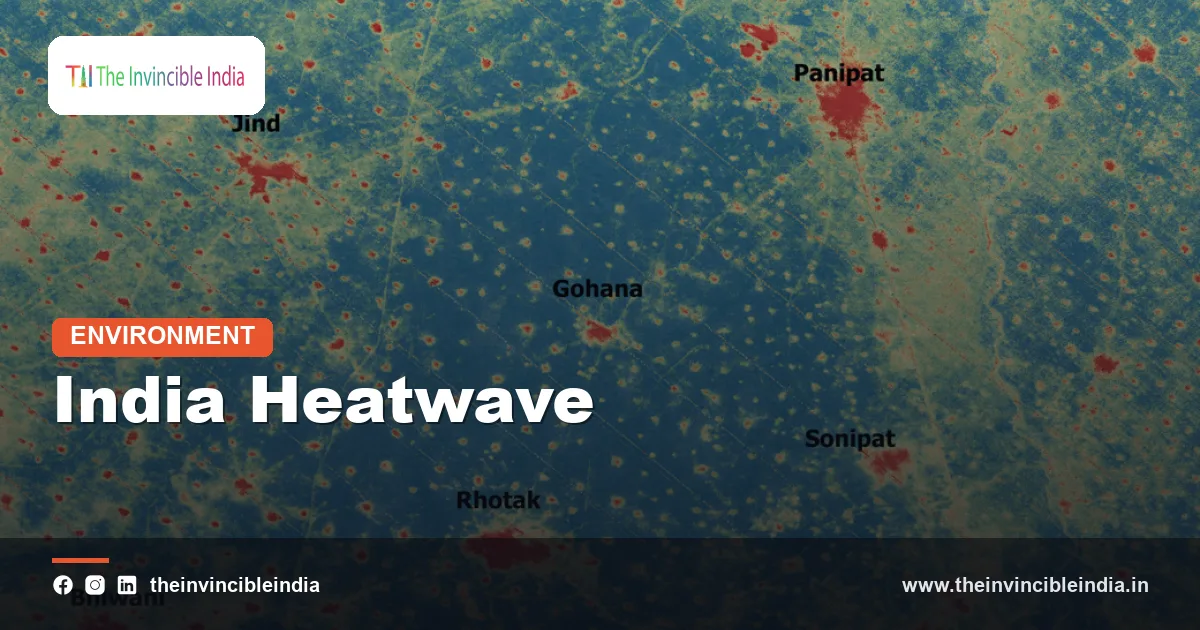
An Indian heatwave is a spell of abnormally high temperatures, formally declared by the India Meteorological Department (IMD) when the maximum temperature in the plains reaches at least 40 degrees Celsius and runs well above normal for two or more days. Heatwaves in India typically occur between March and June, and they are growing longer, more frequent and more intense as the climate warms.
The consequences reach well beyond discomfort. Extreme heat causes heatstroke deaths, damages crops such as wheat, strains the power grid, cuts the productivity of outdoor workers and widens the gap between rich and poor households. This explainer sets out how the IMD defines a heatwave, what causes one, how climate change and urban growth are changing the pattern, what the impacts are, and how heat action plans and individuals can respond.
| Indian Heatwaves: Quick Facts | |
|---|---|
| Definition | A spell of abnormally high temperature, declared on the basis of IMD temperature and departure thresholds |
| Plains threshold | Maximum of at least 40 degrees Celsius and 4.5 degrees or more above normal, or an actual maximum of 45 degrees or above |
| Severe heatwave (plains) | Departure above 6.4 degrees, or an actual maximum of 47 degrees or above |
| Usual season | March to June, occasionally extending into July in the north |
| Most affected regions | North-west, central and east India, plus parts of the east coast and the Deccan |
| Official monitoring | India Meteorological Department (IMD), Ministry of Earth Sciences |
| Response framework | National Disaster Management Authority (NDMA) guidelines and state heat action plans |
| Highest recorded temperature | 51.0 degrees Celsius at Phalodi, Rajasthan, on 19 May 2016 |
| First city heat action plan | Ahmedabad, 2013 |
Key Takeaways
- The India Meteorological Department declares a heatwave in the plains when the maximum temperature reaches at least 40 degrees Celsius and is 4.5 degrees or more above normal, or when it reaches 45 degrees outright.
- An Indian heatwave must persist for at least two consecutive days in a meteorological sub-division before it is formally declared.
- Climate change is making heatwaves in India hotter, longer and more frequent, and some attribution studies estimate that recent record events were many times more likely because of human-driven warming.
- Heatwaves affect India’s health, agriculture, electricity demand and labour productivity at once, which makes them a multi-sector emergency rather than only a weather event.
- The Ahmedabad heat action plan of 2013 was the first of its kind in South Asia, and the National Disaster Management Authority has since issued national guidelines to help states prepare their own plans.
- The simplest protective steps are to avoid outdoor exertion at midday, drink fluids regularly, wear light cotton clothes and know how to recognise heatstroke.
What Is a Heatwave According to the IMD?
A heatwave, according to the IMD, is a condition of air temperature that becomes fatal to the human body when exposed, and it is declared using region-specific temperature thresholds. The IMD does not apply a single number to the whole country, because the normal temperature differs sharply between the hills, the plains and the coast.
| Region type | Heatwave criterion | Severe heatwave criterion |
|---|---|---|
| Plains | Maximum of at least 40 degrees Celsius with a departure from normal of 4.5 to 6.4 degrees | Departure of more than 6.4 degrees from normal |
| Hilly regions | Maximum of at least 30 degrees Celsius with a departure of 4.5 to 6.4 degrees | Departure of more than 6.4 degrees from normal |
| Coastal regions | Maximum of at least 37 degrees Celsius with a departure of 4.5 degrees or more | Departure of more than 6.4 degrees from normal |
| Absolute threshold (plains) | Actual maximum of 45 degrees Celsius or above, irrespective of normal | Actual maximum of 47 degrees Celsius or above |
The IMD generally declares a heatwave only when the criterion is met in at least two stations in a meteorological sub-division for at least two consecutive days, and the heatwave is declared on the second day. The department also issues “warm night” and “hot day” alerts, since heat that persists after dark prevents the body from recovering.
What Causes an Indian Heatwave?
An Indian heatwave is caused by a combination of clear skies, dry air, a persistent high-pressure system aloft and hot winds from the arid north-west. When a large area of high pressure settles over central or north India, air sinks, warms by compression and suppresses cloud, so the surface heats day after day.
- Anticyclonic circulation: A stable ridge of high pressure in the upper air traps heat near the surface.
- Dry north-westerly winds: Winds blowing from the desert regions of Pakistan and Rajasthan carry very hot, dry air into the plains, which is the setting for the Loo.
- Absence of western disturbances and thunderstorms: The weather systems that normally bring rain and cooling are weak or absent, so the heat builds without relief.
- Delayed or weak pre-monsoon showers: A dry spring leaves soils parched, and dry soil heats the air faster than damp soil.
- Large-scale climate patterns: The El Nino phase of the Pacific is often linked to hotter and drier Indian summers, though not every El Nino year brings an extreme heatwave.
Is Climate Change Making Indian Heatwaves Worse?
Yes, climate change is making Indian heatwaves hotter, more frequent and longer-lasting, according to observations by the IMD and a large body of climate research. India has warmed by roughly one degree Celsius since the early twentieth century, and the number of hot days and heatwave days in much of the country has been rising.
Extreme events show the shift. The heatwave that struck India and Pakistan in March and April 2022 was the hottest March on record for India since national records began in 1901, and a rapid attribution study by the World Weather Attribution group estimated that human-driven climate change made such an event about thirty times more likely. India’s early heat in 2022 was followed by long and severe heat spells in 2023 and 2024 across the north and east.
Humid heat is a growing concern
Heat in India is not only about temperature, because humidity changes how dangerous it is. In coastal and eastern states such as Odisha, West Bengal and Andhra Pradesh, high humidity stops sweat from evaporating, so even moderate temperatures can cause heat stress. A measure called wet-bulb temperature combines heat and humidity, and rising wet-bulb values are a concern for the future in the Indo-Gangetic plain and along the coast.
Why Are Cities Hotter Than the Countryside?
Cities are hotter than the surrounding countryside because concrete, asphalt and dense buildings absorb and re-emit heat, and because few trees, ponds or open soil are left to cool the air. This is called the urban heat island effect, and it can raise city temperatures by several degrees, particularly at night.
Several features of Indian cities worsen the problem. Tin and concrete roofs in low-income settlements trap heat. Air conditioners push hot air into the street. Narrow lanes and tall buildings block the breeze, and the loss of lakes and green cover removes natural cooling. Residents without fans, cooling or reliable power face the greatest danger. Measures such as cool roofs, reflective paint, tree planting and shaded public spaces can lower local temperatures.
What Are the Health Impacts of Heatwaves in India?
The main health impacts of Indian heatwaves are heatstroke, heat exhaustion, dehydration and the worsening of existing heart, lung and kidney conditions, and they can be fatal. Official heatstroke death counts are widely thought to understate the real toll, because many heat-related deaths are recorded as cardiac or other causes.
The deadliest events are well known. The 2010 Ahmedabad heatwave caused many excess deaths, which prompted the city’s heat action plan. A severe heatwave in 2015, mainly in Andhra Pradesh and Telangana, was reported to have killed over two thousand people. Those most at risk include outdoor workers, older adults, infants, pregnant women, people with chronic illness and those without access to shade, water or cooling.
Warning signs
- Heat exhaustion: heavy sweating, weakness, headache, nausea, dizziness and cool, clammy skin.
- Heatstroke: body temperature above about 40 degrees Celsius, hot skin, confusion, fits or loss of consciousness, which is a medical emergency.
How Do Heatwaves Affect Crops, Power and Work?
Heatwaves hit agriculture, electricity and labour at the same time, so their cost to the economy is large. Each channel reinforces the others during a long hot spell.
- Agriculture: Heat during the grain-filling stage shrinks wheat grains and cuts yield. The early heat in March 2022 reduced wheat output in several northern states, and India restricted wheat exports soon afterwards. Heat also stresses livestock, lowering milk yields, and damages fruit and vegetable crops.
- Electricity: Cooling demand drives record peak loads. India’s peak power demand has crossed about 250 gigawatts in recent summers, and shortfalls, outages or sharp price spikes can follow if supply is strained.
- Water: Higher evaporation and consumption stress reservoirs and drinking water supplies, and some cities see shortages.
- Labour: Workers in construction, farming, brick kilns, delivery and street trades lose working hours or face health risks, which cuts earnings for those who can least afford it.
- Infrastructure and transport: Rail tracks can buckle, roads soften, transformers overheat and forest fires become more likely.
What Is a Heat Action Plan?
A heat action plan is a written set of steps that a city, district or state follows before, during and after a heatwave to prevent deaths and reduce harm. The model began in Ahmedabad in 2013, after the 2010 heatwave, and has since spread to many Indian states and cities under guidance from the National Disaster Management Authority (NDMA).
The NDMA issued national guidelines on heatwave preparedness in 2016 and has updated its advisories since. A typical heat action plan includes the following.
- Early warning and alerts: IMD forecasts are converted into colour-coded alerts (yellow, orange, red) that trigger specific actions by local authorities.
- Public awareness: Messages by SMS, radio, television, posters and schools on how to stay safe, and what to do in an emergency.
- Health system readiness: Training of doctors and nurses, stocks of ORS and ice, and dedicated heatstroke beds in hospitals.
- Adjusted work hours: Shifting outdoor work away from the hottest part of the day, and ensuring shade and water at work sites.
- Cooling infrastructure: Drinking water points, cool shelters in public buildings, and longer-term measures such as cool roofs and tree cover.
- Review after the season: Counting heat-related illness and deaths, and learning from each season.
Evaluations of the Ahmedabad plan suggest it helped reduce heat-related deaths, though quantifying the effect is difficult. The main challenges across India are funding, enforcement at the local level and reaching the most vulnerable groups. Heatwave has not historically featured on the central list of notified disasters, so state governments have used their own provisions to treat it as a state-specific disaster and fund relief.
How Can You Stay Safe in an Indian Heatwave?
The safest approach in a heatwave is to limit time outdoors in the hottest hours, drink fluids often and keep the body and home as cool as possible. These steps follow advisories from the IMD, the Ministry of Health and Family Welfare, and the NDMA.
- Avoid going out between about noon and 4 pm, and do heavy work in the early morning or evening.
- Drink water, ORS, buttermilk, lemon water or coconut water regularly, even if you do not feel thirsty, and limit alcohol, tea and coffee.
- Wear loose, light-coloured cotton clothes and cover your head with a hat, scarf or umbrella.
- Keep rooms cool using curtains, fans, wet cloths and good ventilation, and take cool baths.
- Never leave children, older people or pets in parked vehicles.
- Check regularly on neighbours who live alone, and watch for confusion or collapse.
- If heatstroke is suspected, call 108 or 112, move the person to shade and cool them with wet cloths and a fan until help arrives.
What Has India Done and What Still Needs to Be Done?
India has improved forecasting, expanded heat action plans and begun to build cooling into housing and city design, but the gap between the plans and protection at the street level remains wide. Better forecasts alone do not help a labourer who cannot afford to stop working at midday.
Experts point to several priorities. These include more reliable counting of heat deaths, funds for cool roofs and urban trees, protection for outdoor workers through rest and water breaks, and stronger early warning that reaches rural areas in local languages. Long-term cuts in greenhouse gas emissions are needed to stop the underlying trend. Designing energy-efficient cooling, so that air conditioning does not itself add to the heat and strain the grid, is another challenge.
Bottom Line
An Indian heatwave is a formally defined, increasingly common and dangerous hazard that touches health, food, power and work. Climate change and urban growth are raising the risk, and heat action plans and simple personal precautions are the main tools that reduce harm today.
Frequently Asked Questions
How does the IMD define a heatwave?
The IMD defines a heatwave in the plains as a maximum temperature of at least 40 degrees Celsius that is 4.5 degrees or more above normal, or an actual maximum of 45 degrees or above. A severe heatwave means a departure above 6.4 degrees or an actual maximum of 47 degrees or above. The condition must persist for at least two consecutive days.
Which months have heatwaves in India?
Heatwaves in India occur mainly from March to June, with the peak in May and early June. In some years they begin in March and extend into July in the north. They end when the south-west monsoon or pre-monsoon thunderstorms bring cooler, humid air.
Are Indian heatwaves getting worse because of climate change?
Yes, Indian heatwaves are becoming hotter, longer and more frequent because of climate change. India has warmed by about one degree Celsius since the early twentieth century, and the number of hot days has risen. Attribution studies suggest recent record events were many times more likely because of human-driven warming.
What is a heat action plan?
A heat action plan is a written set of steps that a city or state follows to prevent heat deaths. It covers early warning, public awareness, hospital preparedness, adjusted work hours and cooling measures. Ahmedabad launched India’s first such plan in 2013, and the NDMA has since issued national guidelines.
Who is most at risk during a heatwave?
Outdoor workers, older adults, young children, pregnant women and people with chronic illness are most at risk during a heatwave. Residents of poorly ventilated housing without cooling are also vulnerable. Many of the deaths occur among people who cannot avoid exposure because of their jobs or homes.
What should I do to stay safe in a heatwave?
To stay safe in a heatwave, avoid the sun between noon and 4 pm, drink fluids regularly and wear light cotton clothes with your head covered. Keep your home cool and check on neighbours. If someone shows confusion, hot skin or collapses, call 108 or 112 and cool them immediately.
{“@context”:”https://schema.org”,”@graph”:[{“@type”:”FAQPage”,”mainEntity”:[{“@type”:”Question”,”name”:”How does the IMD define a heatwave?”,”acceptedAnswer”:{“@type”:”Answer”,”text”:”The IMD defines a heatwave in the plains as a maximum temperature of at least 40 degrees Celsius that is 4.5 degrees or more above normal, or an actual maximum of 45 degrees or above. A severe heatwave means a departure above 6.4 degrees or an actual maximum of 47 degrees or above. The condition must persist for at least two consecutive days.”}},{“@type”:”Question”,”name”:”Which months have heatwaves in India?”,”acceptedAnswer”:{“@type”:”Answer”,”text”:”Heatwaves in India occur mainly from March to June, with the peak in May and early June. In some years they begin in March and extend into July in the north. They end when the south-west monsoon or pre-monsoon thunderstorms bring cooler, humid air.”}},{“@type”:”Question”,”name”:”Are Indian heatwaves getting worse because of climate change?”,”acceptedAnswer”:{“@type”:”Answer”,”text”:”Yes, Indian heatwaves are becoming hotter, longer and more frequent because of climate change. India has warmed by about one degree Celsius since the early twentieth century, and the number of hot days has risen. Attribution studies suggest recent record events were many times more likely because of human-driven warming.”}},{“@type”:”Question”,”name”:”What is a heat action plan?”,”acceptedAnswer”:{“@type”:”Answer”,”text”:”A heat action plan is a written set of steps that a city or state follows to prevent heat deaths. It covers early warning, public awareness, hospital preparedness, adjusted work hours and cooling measures. Ahmedabad launched India’s first such plan in 2013, and the NDMA has since issued national guidelines.”}},{“@type”:”Question”,”name”:”Who is most at risk during a heatwave?”,”acceptedAnswer”:{“@type”:”Answer”,”text”:”Outdoor workers, older adults, young children, pregnant women and people with chronic illness are most at risk during a heatwave. Residents of poorly ventilated housing without cooling are also vulnerable. Many of the deaths occur among people who cannot avoid exposure because of their jobs or homes.”}},{“@type”:”Question”,”name”:”What should I do to stay safe in a heatwave?”,”acceptedAnswer”:{“@type”:”Answer”,”text”:”To stay safe in a heatwave, avoid the sun between noon and 4 pm, drink fluids regularly and wear light cotton clothes with your head covered. Keep your home cool and check on neighbours. If someone shows confusion, hot skin or collapses, call 108 or 112 and cool them immediately.”}}]}]}


