

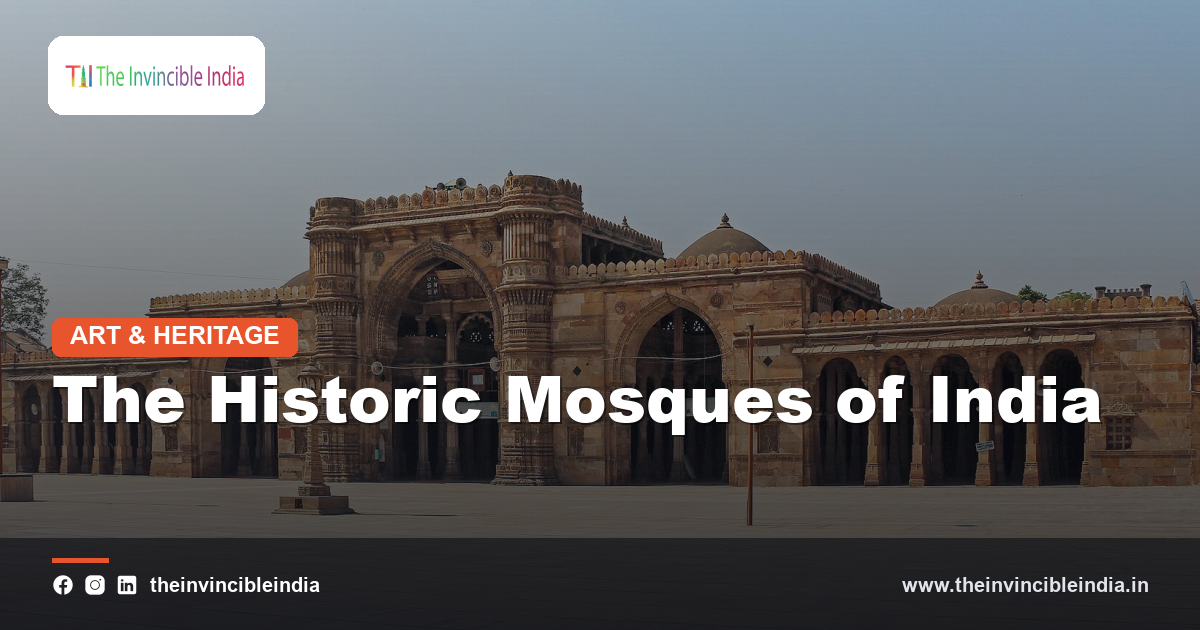
The historic mosques of India are among the great achievements of Indo-Islamic architecture, monumental places of worship that combine soaring domes, tall minarets and spacious courtyards with the decorative traditions of the regions in which they were built. From the vast Jama Masjid of Delhi to Mecca Masjid in Hyderabad, these mosques were raised over many centuries by sultans, emperors and regional rulers, each bringing its own architectural language while sharing the essential elements of mosque design, much as the same era gave rise to India’s Mughal architecture. This guide explores the origins, architecture, famous examples and heritage of India’s historic mosques.
Quick Facts
| Detail | Information |
|---|---|
| Type | The historic congregational mosques of India |
| Function | Places of Islamic worship and community gathering |
| Famous examples | Jama Masjid, Delhi, and Mecca Masjid, Hyderabad |
| Features | Domes, minarets, courtyards and prayer halls |
| Styles | Sultanate, Mughal and regional Indo-Islamic styles |
| Heritage | Monuments of Indo-Islamic architecture and craftsmanship |
The Historic Mosques of India
The historic mosques of India stand among the most impressive achievements of Indo-Islamic architecture, grand places of worship built over many centuries by sultans, emperors and regional rulers across the subcontinent. Combining domes, minarets, arched prayer halls and spacious courtyards with decorative traditions drawn from local craft, these mosques served as centres of worship, learning and community life for the Muslim populations of the cities and regions where they were built. Their scale and beauty attest to the importance rulers placed on religious architecture. As grand monuments uniting worship, learning and architectural ambition, the historic mosques of India occupy an important place among the country’s architectural heritage.
What Is a Mosque
A mosque is a place of Islamic worship, its essential features shaped by the requirements of communal prayer, including a large hall or courtyard oriented toward Mecca, a mihrab or prayer niche marking that direction, and a minbar or pulpit from which sermons are delivered. Many mosques also include one or more minarets, traditionally used to call the faithful to prayer, and a courtyard for ablutions and overflow congregation during major gatherings. This functional core underlies mosques of every scale and style. This basic form of the mosque, shaped by the practical and spiritual needs of congregational prayer, provides the foundation upon which India’s many regional mosque styles were built.
The Arrival of Islamic Architecture in India
Islamic architecture arrived in India with the establishment of Muslim rule in different parts of the subcontinent, bringing with it the architectural forms and religious requirements of the mosque alongside the tomb and the fort. Early mosques in India often combined imported architectural ideas with materials, craftsmen and decorative techniques drawn from existing Indian building traditions, producing a distinctive Indo-Islamic style rather than a simple transplant of foreign forms. This blending began almost immediately. This early fusion of Islamic architectural requirements with Indian craftsmanship and material set the pattern for the development of mosque architecture across the subcontinent in the centuries that followed.
Mosques of the Sultanate Period
The mosques built during the Delhi Sultanate period display an evolving Indo-Islamic style, often incorporating pillars, brackets and decorative motifs adapted from earlier Indian temple architecture alongside arches and domes introduced from the wider Islamic world. These early mosques, built in growing cities under new Muslim dynasties, established many of the architectural conventions that later mosque builders in India would refine and expand. Their construction often reused materials from earlier structures. This Sultanate period mosque architecture, blending indigenous craftsmanship with imported forms, represents a formative stage in the development of India’s rich Indo-Islamic architectural tradition.
The Courtyard Plan
Most historic Indian mosques are organised around a large open courtyard, providing space for the congregation to gather during major prayers and festivals when the covered prayer hall alone cannot accommodate the full number of worshippers. The courtyard is typically enclosed by arcades or walls and often features a tank or fountain for ritual ablution before prayer, integrating practical necessity with architectural order. This spacious plan reflects the communal scale of Friday prayer. This courtyard plan, central to the design of India’s great congregational mosques, reflects the communal character of Islamic worship and the need to accommodate large gatherings of the faithful.
Domes and Minarets
Domes and minarets are among the most visually striking features of historic Indian mosques, the dome crowning the prayer hall as a symbol of the heavens and the minaret rising above the complex both to call the faithful to prayer and to announce the mosque’s presence within the city skyline. Indian mosque builders developed distinctive regional variations in the proportion, material and decoration of domes and minarets, giving each city’s mosques a recognisable silhouette. These vertical elements often became local landmarks. This tradition of domes and minarets, varying in style from region to region, gives the historic mosques of India much of their striking and memorable visual character.
The Prayer Hall and Mihrab
The covered prayer hall of an Indian mosque typically consists of a series of bays defined by arches or pillars, oriented so that worshippers face toward Mecca during prayer, with the mihrab set into the wall to mark this sacred direction with particular architectural emphasis. The mihrab is often the most richly decorated element of the mosque’s interior, framed with fine carving, calligraphy or tilework that draws the eye and dignifies its function. This focal point anchors the entire prayer hall. This careful design of the prayer hall and mihrab, orienting worship and marking sacred direction with architectural distinction, lies at the heart of every historic Indian mosque.
Jama Masjid of Delhi
Among the grandest of India’s historic mosques is the Jama Masjid of Delhi, built in red sandstone and white marble with vast courtyards, soaring gateways and twin minarets that dominate the old city skyline. Commissioned by a Mughal emperor as the principal congregational mosque of the imperial capital, it remains one of the largest mosques in the country and a significant centre of worship and community life to this day. Its scale reflects the ambitions of the empire that built it. This Jama Masjid of Delhi, majestic in scale and setting, stands among the most celebrated and important historic mosques of India.
Mecca Masjid of Hyderabad
Mecca Masjid in Hyderabad is one of the largest and most historic mosques of southern India, built by the rulers of the Qutb Shahi dynasty and later completed under Mughal patronage, its vast prayer hall supported by tall arched colonnades of finely worked stone. According to local tradition the mosque incorporates soil brought from the holy city of Mecca in its construction, lending it particular sanctity among worshippers in the region. Its scale and history make it a landmark of the city. This Mecca Masjid of Hyderabad, monumental in scale and steeped in regional history, ranks among the most important historic mosques of the Deccan.
Regional Styles of Mosque Architecture
Across India, mosque architecture developed distinctive regional styles shaped by local materials, craftsmanship and earlier architectural traditions, from the stone-pillared mosques of Gujarat to the brick and terracotta mosques of Bengal and the domed stone mosques of the Deccan sultanates. Each region adapted the essential requirements of mosque design to its own building traditions, producing a rich variety of forms across the subcontinent. This regional diversity is one of the great strengths of Indian mosque architecture. This wide range of regional mosque styles across India reflects the successful adaptation of Islamic architectural requirements to the diverse building traditions of each area.
Mughal Mosque Architecture
The Mughal era produced some of the grandest and most refined mosques in India, built in red sandstone and white marble with a harmonious sense of proportion, symmetry and decoration that reflected the empire’s broader architectural achievements. Mughal mosques typically combine a monumental gateway, a spacious courtyard and a prayer hall crowned with domes, decorated with fine calligraphy, inlay and carved ornament befitting an imperial capital. Their design set a standard admired across the subcontinent. This Mughal tradition of mosque architecture, marked by grandeur, symmetry and refined decoration, represents one of the high points of Indo-Islamic religious architecture in India.
Mosque Architecture of the Deccan
The sultanates of the Deccan developed their own distinguished tradition of mosque architecture, often featuring bulbous domes, tall arched facades and richly decorated stonework that reflected both Persian influence and local building practices. These mosques, built in cities across the Deccan plateau, display a scale and grandeur that rivalled the mosque architecture of northern India, contributing significantly to the overall richness of the Indo-Islamic tradition. Their distinctive silhouette sets them apart from northern mosques. This Deccan tradition of mosque architecture, shaped by regional sultanates and Persian influence, adds an important and distinctive chapter to the story of India’s historic mosques.
Calligraphy and Decorative Ornament
Decoration in Indian mosque architecture relies heavily on calligraphy, geometric pattern and stylised floral motifs, since figural representation is generally avoided within the sacred space of the mosque in keeping with Islamic tradition. Inscriptions from religious texts are often carved or painted around gateways, mihrabs and domes, combining spiritual meaning with considerable artistic skill in the discipline of calligraphic design. This ornament transforms surfaces into vehicles of devotion. This rich tradition of calligraphy and decorative ornament within India’s historic mosques reflects the deep integration of artistic and religious expression in Islamic architecture.
Mosques as Centres of Community Life
Beyond their role as places of worship, historic mosques in India often functioned as centres of community life, housing religious schools, providing space for public gatherings and serving as landmarks around which neighbourhoods and markets developed. Some of the greatest mosques were closely associated with the political and administrative life of the cities in which they stood, reflecting the close relationship between religious and civic institutions. This social role extended well beyond formal prayer times. This role of mosques as centres of community life, education and civic identity underscores their broader significance within the historic Indian city beyond their primary religious function.
Conservation of Historic Mosques
Many of India’s historic mosques remain active places of worship even as they are also recognised and protected as important architectural monuments, requiring careful conservation that balances ongoing religious use with the preservation of historic fabric and decoration. Government heritage bodies, religious trusts and local communities often work together to maintain these buildings, addressing the challenges of weathering, urban growth and the wear of continuous use. This dual role as living shrine and heritage monument shapes conservation efforts. This ongoing work of conservation is essential to ensuring that India’s historic mosques continue to serve their communities while surviving as monuments for future generations.
The Historic Mosques of India Today
Today the historic mosques of India stand as some of the country’s most significant religious and architectural monuments, admired by worshippers, historians and visitors alike for their scale, craftsmanship and enduring beauty. From the Jama Masjid of Delhi to Mecca Masjid in Hyderabad and the many regional mosques across the subcontinent, these buildings continue to serve their communities while bearing witness to centuries of Indo-Islamic architectural achievement. Their domes and minarets remain defining features of many Indian city skylines. As enduring monuments of faith and architecture, the historic mosques of India remain among the most significant treasures of the country’s architectural heritage.
Sources & Further Reading
- Archaeological Survey of India, on historic mosques and Indo-Islamic monuments (asi.nic.in).
- Ministry of Culture, Government of India, on the architectural heritage of India (indiaculture.gov.in).
Frequently Asked Questions
What are the key architectural features of an Indian mosque?
Key features of an Indian mosque typically include a large courtyard, a covered prayer hall oriented toward Mecca, a mihrab marking that direction, a minbar for sermons, and often one or more domes and minarets that define the building’s silhouette.
Why is the Jama Masjid of Delhi significant?
The Jama Masjid of Delhi is significant as one of the largest and grandest mosques in India, built in red sandstone and marble under Mughal patronage as the principal congregational mosque of the imperial capital, and it remains an active centre of worship today.
What makes Mecca Masjid in Hyderabad notable?
Mecca Masjid is notable for its vast scale, its tall arched colonnades and its historical association with the Qutb Shahi and Mughal periods, and it is traditionally said to include soil brought from Mecca in its construction.
How does regional style influence Indian mosque architecture?
Regional style strongly influences Indian mosque architecture, with materials, decoration and proportion varying from the stone-pillared mosques of Gujarat to the brick mosques of Bengal and the domed mosques of the Deccan sultanates, each reflecting local building traditions.
Why is figural imagery generally absent from mosque decoration?
Figural imagery is generally avoided in mosque decoration in keeping with Islamic tradition, so Indian mosques instead rely on calligraphy, geometric patterns and stylised floral motifs to create rich and spiritually meaningful ornamentation.


