

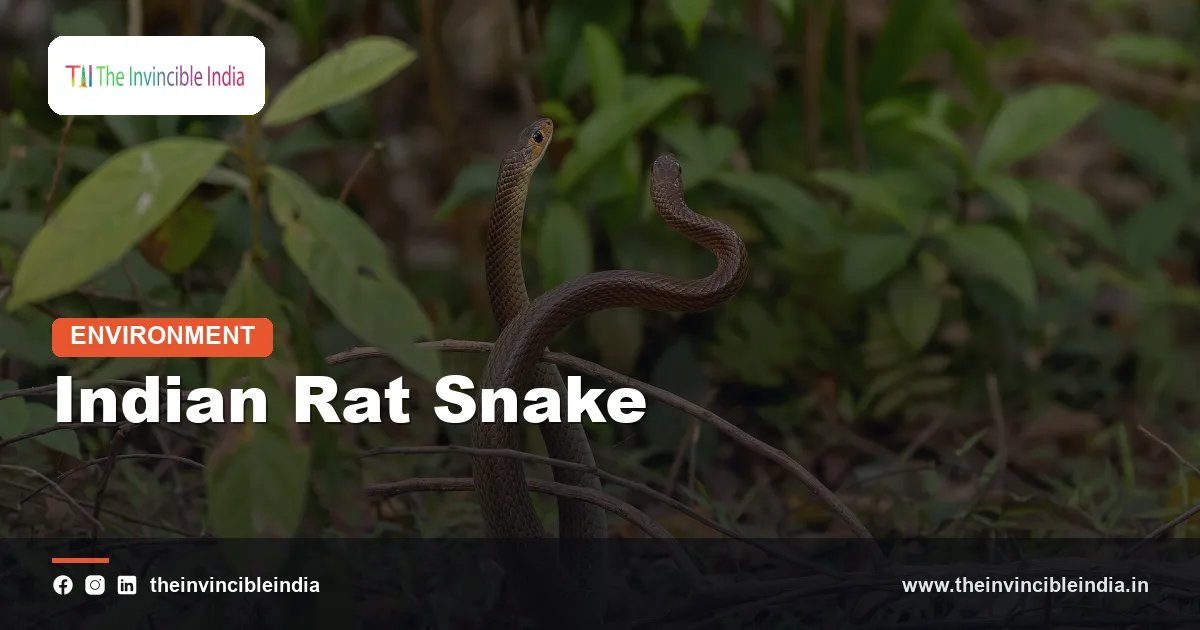
The Indian rat snake, known in Hindi and Marathi as the dhaman (Ptyas mucosa), is a large, fast-moving, non-venomous snake found across most of India and much of South and Southeast Asia, and it is one of the most useful natural rodent controllers in Indian farms, villages and towns. Despite being completely harmless in terms of venom, the Indian rat snake is regularly killed by people who mistake it for a cobra, which makes it one of the most persecuted snakes in the country.
This evergreen explainer covers what the Indian rat snake looks like, where it lives, what it eats, how it breeds, how to tell it apart from a cobra, and why it is protected under Indian law. Last updated: 22 October 2026.
| Quick Facts | Details |
|---|---|
| Common name | Indian rat snake (also oriental rat snake); dhaman in Hindi and Marathi |
| Scientific name | Ptyas mucosa (described by Linnaeus in 1758) |
| Family | Colubridae, the largest family of snakes |
| Venom status | Non-venomous; kills or subdues prey by biting and swallowing, not by venom |
| Typical adult length | About 1.5 to 2.5 metres; exceptional individuals can exceed 3 metres |
| Activity | Diurnal (active by day) and a very fast mover on the ground |
| Reproduction | Oviparous (egg-laying); roughly 6 to 20 eggs per clutch |
| Main diet | Rats, mice and other rodents, plus frogs, lizards, birds and sometimes other snakes |
| Legal status | Protected under the Wildlife (Protection) Act, 1972; listed in CITES Appendix II; IUCN status Least Concern |
Key Takeaways
- The Indian rat snake (dhaman, Ptyas mucosa) is a non-venomous colubrid snake that poses no venom danger to humans.
- An adult Indian rat snake commonly reaches 1.5 to 2.5 metres in length, making it one of the longest and fastest snakes seen around Indian homes and farms.
- The Indian rat snake feeds mainly on rats and mice, so a single healthy dhaman can remove many rodents from a field or granary over a season.
- The dhaman is frequently killed in India because people confuse it with the spectacled cobra, even though the Indian rat snake has no hood and round-pupilled, large eyes.
- Indian rat snakes lay eggs, usually in burrows, hollow trees or rubbish heaps, and females do not look after the hatchlings.
- Killing, capturing or trading the Indian rat snake is illegal in India, and anyone who finds one indoors should call a trained snake rescuer or the forest department.
What is the Indian rat snake?
The Indian rat snake is a long, slender, non-venomous snake of the family Colubridae, scientifically named Ptyas mucosa, and in much of north and central India it is called the dhaman. The species is also commonly called the oriental rat snake or, in older books, the common rat snake. The name “rat snake” simply reflects its habit of hunting rodents.
The Indian rat snake is one of the commonest large snakes in the country. It is found in forests, scrub, grasslands, farmland, village outskirts, and increasingly in towns and the edges of cities. Because it is diurnal and moves fast, people see it more often than most other snakes, and a sighting of a large snake streaking across a road or lawn in daylight is very often a dhaman.
The dhaman should not be confused with other animals that share the “rat snake” label. In India, several other colubrids, such as the trinket snake and the banded racer, are sometimes called rat snakes in everyday speech, but Ptyas mucosa is the species most people mean when they say “Indian rat snake”.
What does an Indian rat snake look like?
The Indian rat snake looks like a long, slim, muscular snake with a small, elongated head, large eyes with round pupils and a very long tapering tail that makes up roughly a quarter of the body length. Its colour varies from light yellowish-brown to olive, grey, dark brown or almost black, depending on region, habitat and age.
Several features help in recognising the dhaman:
- Body pattern: The front half of the body is usually plain and lighter, while the rear half and the tail often show dark-edged scales that create a faint net-like or crosshatched look.
- Lips and throat: Many individuals have a pale yellowish or cream throat and upper lip, sometimes with dark bars on the lip scales.
- Eyes: The eyes are noticeably large relative to the head, with a round pupil and a golden-brown iris, which gives the snake an alert expression.
- Build: The body is long and tube-like, laterally compressed only slightly, with smooth scales that glide quickly over the ground.
Young Indian rat snakes are often more olive or greyish with faint cross bands, and they gradually take on the plainer adult colour as they grow. A newly hatched dhaman is roughly 30 to 40 centimetres long, which is why a small, quick, brownish snake in a courtyard may also be a juvenile rat snake and not something dangerous.
How big does an Indian rat snake grow?
An adult Indian rat snake usually grows to between about 1.5 and 2.5 metres, and the largest recorded individuals have crossed 3 metres, which makes the dhaman one of the biggest non-venomous snakes in the Indian subcontinent after the pythons. Males are generally a little larger and more heavily built than females.
The snake is long but light, with a slim body. A 2-metre dhaman may weigh only a kilogram or two. Its size and speed are the very reasons people panic when they see one, since a long snake moving fast and lifting its head high can look threatening even though it is harmless in terms of venom.
Size also helps in identification. A snake that is more than two metres long, slim, brown and plain on the front half is far more likely to be a dhaman than a cobra, because common cobras of the Indian subcontinent are usually shorter, thicker-bodied and move more slowly.
Where does the Indian rat snake live in India?
The Indian rat snake lives across almost the whole of India, from the plains and hills of the north to the peninsula, and it is absent only from the driest hot deserts and the highest mountain altitudes. Its wider range extends from parts of Pakistan and Nepal through Bangladesh and Sri Lanka into Southeast Asia and southern China.
The dhaman is highly adaptable. It occupies several types of habitat:
- Farmland and paddy fields: Fields offer abundant rodents, frogs and cover along bunds and irrigation channels.
- Villages and outskirts of towns: Grain stores, cattle sheds, stone walls, thatched roofs and rubbish heaps attract rats, and the dhaman follows its prey.
- Scrub, grassland and open forest: Dry deciduous forest, hedgerows and rocky outcrops provide hiding places and basking spots.
- Gardens, farmhouses and campuses: Large green campuses and farm houses in and around cities regularly host a resident dhaman.
It shelters in rodent burrows, termite mounds, tree hollows, wood piles, wall cavities and roof spaces. It is also a good climber and swimmer, and it will enter water to cross a stream or pond.
What does the Indian rat snake eat?
The Indian rat snake eats mainly rats and mice, but it also takes frogs, toads, lizards, small birds, bird eggs and occasionally other snakes, including small venomous ones. It is an active hunter that uses speed and sharp eyesight to chase down prey during the day.
The dhaman has no venom to subdue what it catches. It grabs the prey in its jaws and either swallows small animals alive or pins larger ones against the ground or inside a burrow with the weight of its body before swallowing them. The snake can swallow prey much wider than its head because of its flexible jaws.
A well-fed adult may take a rat every few days. In grain-growing areas, this makes the dhaman a free pest-control service, and farmers who tolerate or relocate the snake carefully often see fewer rat losses in standing crops and stored grain.
How does the Indian rat snake behave when threatened?
When threatened, the Indian rat snake first tries to flee at high speed, but a cornered dhaman will rear up, flatten and puff out its neck, hiss loudly and even strike at the intruder. This display can look dramatic, and it is the main reason the snake gets mistaken for a cobra.
The dhaman also has a habit of vibrating its tail rapidly against dry leaves, which makes a rustling sound. In an extreme situation it may release a foul-smelling fluid from its glands. These are bluffing and defensive behaviours and not signs of aggression toward humans.
Bites do happen when a snake is handled or trapped. A dhaman bite is not venomous, but its many small, backward-curving teeth can leave scratches or lacerations. Any bite should be washed with clean water and soap and examined by a doctor, mainly to prevent infection and to check tetanus protection. Because bites from different snakes can look alike, a person should not assume the snake was harmless and should go to a hospital if the species is unknown.
In older folklore it was said that the dhaman chases people along a path. In reality, the snake is racing towards its burrow or escape route, and a person who happens to stand in the way is not its target.
How is the Indian rat snake different from a cobra?
The Indian rat snake differs from a cobra mainly in having no hood, a long slim body, a very long tail and large round-pupilled eyes, while the cobra spreads a broad hood, has a heavier body and moves more slowly. Telling the two apart correctly is the most useful lesson in this article, because it can save the life of a harmless snake.
| Feature | Indian rat snake (dhaman) | Spectacled cobra (Naja naja) |
|---|---|---|
| Venom | None; non-venomous | Highly venomous (neurotoxic) |
| Hood | No true hood; may only flatten the neck slightly | Broad hood, often with a spectacle-like mark on the back |
| Body build | Long, slim, whip-like | Thicker, heavier, shorter relative to girth |
| Tail | Very long, thin and tapering | Shorter and thicker |
| Eyes | Large, round pupils, alert look | Small, rounded, calmer look |
| Speed | Very fast, moves smoothly across ground | Fast when needed, but slower generally |
| Scale pattern | Dark-edged scales on the rear body and tail | Smooth, uniform scales without a net-like rear pattern |
| Active time | Day | Mostly evening, night and early morning |
A simple rule is that a very long, thin brown snake moving fast in daylight with no hood is far more likely to be a dhaman than a cobra. However, the correct approach to any unknown snake is distance and calm, because positive identification is not always possible from a few seconds of sighting. Anyone who is unsure should keep at least a few metres away and call a trained rescuer.
Does the Indian rat snake mate with cobras?
No, the Indian rat snake does not mate with cobras, because the two belong to different families and cannot interbreed. The widespread belief that a dhaman and a cobra produce hybrid offspring, or that the dhaman is a cobra “relative” that carries venom in some seasons, is a myth.
The confusion has a simple origin. Male dhamans take part in a ritual combat in the breeding season, in which two males rear up, twist around each other and push for dominance. Observers who see this “dance” often assume it is a snake mating pair, and because the dhaman is mistaken for a cobra, the idea of cobra-and-rat-snake mating spread. Other common myths include the idea that the dhaman sucks milk from cows or chases people. None of these have any scientific basis.
How does the Indian rat snake breed?
The Indian rat snake breeds by laying eggs: females lay a clutch of roughly 6 to 20 eggs, often before or at the start of the monsoon, in a hidden spot such as a burrow, tree hollow, crevice or heap of decaying vegetation. Mating usually follows the male-to-male combat described above, and the winners get access to females.
The eggs are left unattended and hatch after about two to three months, depending on temperature. The young snakes emerge fully independent, about 30 to 40 centimetres long, and begin feeding on small lizards, frogs and insects before moving on to rodents as they grow. Many hatchlings are eaten by birds of prey, mongooses, monitor lizards and other snakes, so only a fraction survive to adulthood.
In the wild, a healthy dhaman may live for well over a decade. Captive snakes may live longer, but removing a dhaman from the wild to keep as a pet is illegal in India.
Why is the Indian rat snake important and beneficial?
The Indian rat snake is important because it is a top predator of rodents, so it reduces crop damage, grain loss and the spread of rodent-borne diseases, which gives farmers and households a direct economic benefit. In a country where rats consume a large share of stored food grain, a resident dhaman is far more helpful than harmful.
Its ecological value is broader than rat control:
- It keeps frog, lizard and rodent populations in balance in agricultural landscapes.
- It provides food for raptors such as eagles, harriers and kites, as well as for mongooses and monitor lizards.
- It reduces the need for chemical rodenticides, which can poison owls, snakes and pets that eat poisoned rats.
- Its presence indicates a reasonably healthy food web in the surrounding fields.
Rodenticide use is one of the quieter threats to rat snakes, since a snake that eats a poisoned rat can itself be affected. Using traps and proper grain storage, and letting the snake do its work, is better for everyone.
Is the Indian rat snake protected by law in India?
Yes, the Indian rat snake is protected in India under the Wildlife (Protection) Act, 1972, which bars hunting, killing, capturing and trading in listed species, and the species is also listed in Appendix II of CITES, which regulates international trade. In India’s wildlife schedules the dhaman is generally cited as a Schedule II species.
The dhaman has historically been hunted for its skin, which is used to make leather goods, and for meat in some countries. Killing it out of fear still happens daily. The IUCN assesses the species as Least Concern because it is widespread and common, but local declines occur where road traffic, habitat loss, rodenticides and persecution are heavy.
The practical advice for anyone who finds a dhaman at home or in a farm shed is straightforward:
- Keep calm, keep children and pets away, and give the snake room to leave on its own.
- Do not try to catch it with bare hands, sticks or nets, because a frightened snake is more likely to bite or injure itself.
- Call a trained snake rescuer, an NGO helpline or the local forest department, who can relocate it safely.
- Seal gaps and holes, store grain in rat-proof containers and clear rubbish heaps to make homes less inviting.
It is also important to remember that India has several truly dangerous snakes, led by the “Big Four”: the spectacled cobra, common krait, Russell’s viper and saw-scaled viper. Snakebite remains a serious public-health problem in India. Anyone bitten by an unidentified snake should stay calm, keep the bitten limb still, and reach a hospital with antivenom facilities at once, without relying on home or traditional remedies, which waste vital time and can cause harm.
Bottom Line
The Indian rat snake (dhaman) is a harmless, fast, rodent-eating snake that works in favour of farmers and householders. The best response to a sighting is to stay calm, give the snake space and call a trained rescuer, never to kill it because it resembles a cobra.
Frequently Asked Questions
Is the Indian rat snake poisonous or venomous?
No, the Indian rat snake is not venomous and has no venom glands that are dangerous to humans. Its bite can leave scratches or small cuts from its teeth, so the wound should be washed and checked by a doctor. A person should still treat any unidentified snakebite as an emergency until a medical professional confirms it.
How can I tell a dhaman from a cobra?
A dhaman has no hood, a long slim body, a very long tapering tail and large round-pupilled eyes, whereas a cobra spreads a broad hood and has a thicker body. The dhaman is also active mainly during the day and moves very fast, while cobras are mostly crepuscular and nocturnal. If you cannot be sure, stay at a safe distance and call a trained rescuer.
How long does the Indian rat snake grow?
Adult Indian rat snakes usually grow to about 1.5 to 2.5 metres, and exceptional individuals exceed 3 metres. The tail makes up a large share of that length. Hatchlings are only about 30 to 40 centimetres long.
What does the Indian rat snake eat?
The Indian rat snake eats mainly rats and mice, along with frogs, lizards, small birds, eggs and sometimes other snakes. It hunts actively by day and swallows its prey whole. This diet makes it an effective natural controller of rodents in farms and villages.
Is it legal to kill or keep an Indian rat snake?
No, it is illegal to kill, capture, keep or trade the Indian rat snake in India, because it is protected under the Wildlife (Protection) Act, 1972. The species is also listed in CITES Appendix II, which regulates international trade. Offenders can face imprisonment and fines, so the right step is to call the forest department or a trained rescuer.
What should I do if an Indian rat snake enters my house?
Stay calm, keep people and pets away, and let the snake leave on its own through an open door if possible. Do not try to grab, hit or trap it, and call a snake rescuer or the forest department for safe relocation. Afterwards, seal gaps, clear clutter and secure grain stores so rodents, and the snakes that follow them, are less likely to return.
{“@context”:”https://schema.org”,”@graph”:[{“@type”:”FAQPage”,”mainEntity”:[{“@type”:”Question”,”name”:”Is the Indian rat snake poisonous or venomous?”,”acceptedAnswer”:{“@type”:”Answer”,”text”:”No, the Indian rat snake is not venomous and has no venom glands that are dangerous to humans. Its bite can leave scratches or small cuts from its teeth, so the wound should be washed and checked by a doctor. A person should still treat any unidentified snakebite as an emergency until a medical professional confirms it.”}},{“@type”:”Question”,”name”:”How can I tell a dhaman from a cobra?”,”acceptedAnswer”:{“@type”:”Answer”,”text”:”A dhaman has no hood, a long slim body, a very long tapering tail and large round-pupilled eyes, whereas a cobra spreads a broad hood and has a thicker body. The dhaman is also active mainly during the day and moves very fast, while cobras are mostly crepuscular and nocturnal. If you cannot be sure, stay at a safe distance and call a trained rescuer.”}},{“@type”:”Question”,”name”:”How long does the Indian rat snake grow?”,”acceptedAnswer”:{“@type”:”Answer”,”text”:”Adult Indian rat snakes usually grow to about 1.5 to 2.5 metres, and exceptional individuals exceed 3 metres. The tail makes up a large share of that length. Hatchlings are only about 30 to 40 centimetres long.”}},{“@type”:”Question”,”name”:”What does the Indian rat snake eat?”,”acceptedAnswer”:{“@type”:”Answer”,”text”:”The Indian rat snake eats mainly rats and mice, along with frogs, lizards, small birds, eggs and sometimes other snakes. It hunts actively by day and swallows its prey whole. This diet makes it an effective natural controller of rodents in farms and villages.”}},{“@type”:”Question”,”name”:”Is it legal to kill or keep an Indian rat snake?”,”acceptedAnswer”:{“@type”:”Answer”,”text”:”No, it is illegal to kill, capture, keep or trade the Indian rat snake in India, because it is protected under the Wildlife (Protection) Act, 1972. The species is also listed in CITES Appendix II, which regulates international trade. Offenders can face imprisonment and fines, so the right step is to call the forest department or a trained rescuer.”}},{“@type”:”Question”,”name”:”What should I do if an Indian rat snake enters my house?”,”acceptedAnswer”:{“@type”:”Answer”,”text”:”Stay calm, keep people and pets away, and let the snake leave on its own through an open door if possible. Do not try to grab, hit or trap it, and call a snake rescuer or the forest department for safe relocation. Afterwards, seal gaps, clear clutter and secure grain stores so rodents, and the snakes that follow them, are less likely to return.”}}]}]}


