

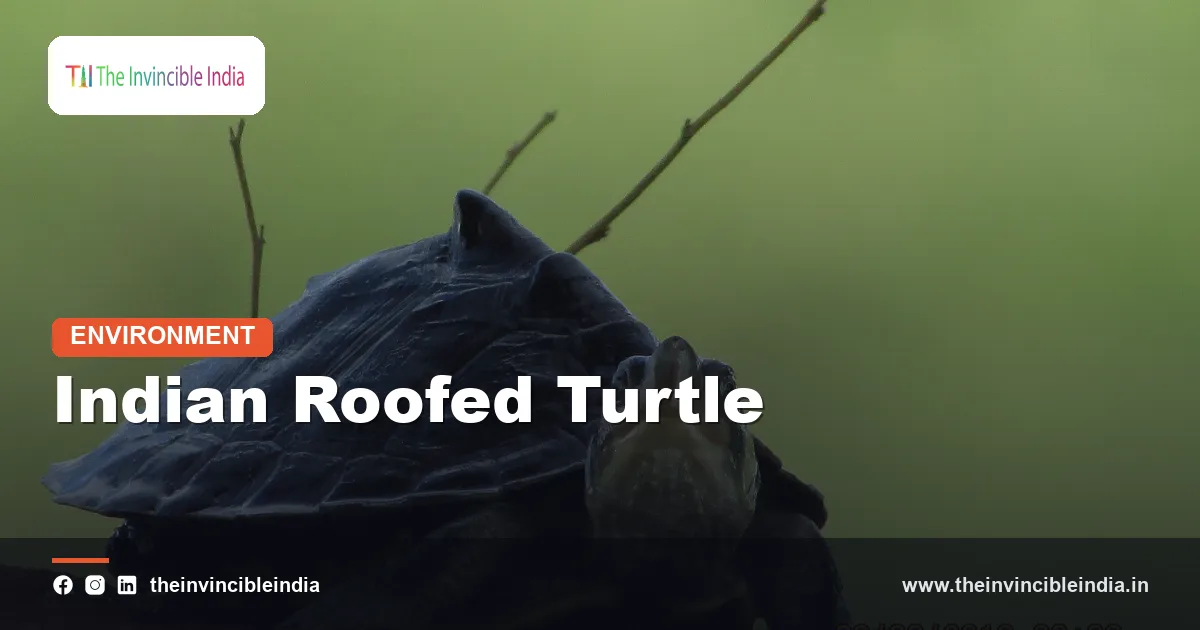
The Indian roofed turtle (Pangshura tecta) is a small freshwater turtle with a distinctive ridged, roof-like shell that lives in the slow rivers, ponds and wetlands of the Ganga, Brahmaputra and Indus basins of South Asia. Named for the pronounced keel along the middle of its upper shell, the Indian roofed turtle is a basking, mostly plant-eating reptile that is protected by Indian law and by international trade rules because of illegal collection for the pet trade.
The Indian roofed turtle is one of the better-known freshwater turtles of the Indian subcontinent and is frequently featured in wildlife seizure reports. This explainer sets out what the Indian roofed turtle is, how to recognise it, where it lives, what it eats, how it breeds, what threatens it and how it is protected, using stable and well-documented facts.
| Attribute | Detail |
|---|---|
| Common names | Indian roofed turtle, roofed turtle |
| Scientific name | Pangshura tecta (formerly Kachuga tecta) |
| Family | Geoemydidae (Asian river turtles and allies), order Testudines |
| Shell | Domed upper shell with a prominent central keel; adult shell length commonly 15 to about 23 centimetres, females larger |
| Habitat | Slow rivers, oxbow lakes, ponds, canals and floodplain wetlands |
| Diet | Mainly aquatic plants and algae, with some insects, snails and other small animals |
| Range | Ganga, Brahmaputra and Indus river systems in India, Pakistan, Bangladesh and Nepal |
| Trade rules | Listed on CITES Appendix I; protected in India under the Wildlife (Protection) Act, 1972 |
| Main threats | Illegal pet trade, hunting, habitat loss, pollution and sand mining |
Key Takeaways
- The Indian roofed turtle (Pangshura tecta) is a small freshwater turtle named for the strong ridge, or keel, that runs along the centre of its shell.
- The Indian roofed turtle lives in the river systems of the Ganga, Brahmaputra and Indus, and it prefers slow-moving or still water with basking sites.
- The Indian roofed turtle is largely herbivorous, feeding on aquatic plants and algae, with occasional insects and snails.
- The Indian roofed turtle spends long periods basking on banks and logs, which helps it regulate body temperature and keep its shell free of parasites.
- The Indian roofed turtle is listed on Appendix I of CITES, which prohibits international commercial trade, and it is protected under Indian wildlife law.
- The Indian roofed turtle is mainly threatened by illegal collection for the pet trade, along with loss and degradation of river habitats.
What is the Indian roofed turtle?
The Indian roofed turtle is a small freshwater turtle of the family Geoemydidae, scientifically named Pangshura tecta, native to the plains and foothills of northern India and neighbouring countries. It is a member of the genus Pangshura, a group of South Asian river turtles often called “roofed” or “tent” turtles because of their ridged shells.
Older books place the species in the genus Kachuga, and the Indian roofed turtle appears under the name Kachuga tecta in many earlier references. The species name tecta is Latin for “roofed”, describing the shell’s shape.
The Indian roofed turtle belongs to the order Testudines, which includes turtles, terrapins and tortoises. In common Indian usage, “turtle” covers freshwater and marine species that swim, while “tortoise” is used for land-dwelling species with domed shells and stumpy legs. The Indian roofed turtle is a freshwater swimmer that also spends time on land when basking and nesting.
How can you recognise the Indian roofed turtle?
The Indian roofed turtle can be recognised by its high, domed olive to brown upper shell with a clear raised keel along the middle, a smooth, flat-looking lower shell and a head marked with a pinkish, reddish or orange streak behind the eye. These shell and head features set it apart from many other freshwater turtles.
The keel gives the shell a gable-like, roofed appearance when seen from the side or back, and the rear margin of the shell is usually flared and slightly serrated. Hatchlings and young turtles have a sharper keel and a more vivid pattern, which fades with age. The skin is dark, the limbs are webbed and the toes carry claws. Females grow larger than males, which is common among turtles.
Features that help identification include:
- A pronounced central keel on the carapace, giving a roof-like profile
- A markedly domed, olive to brown shell with dark and light markings
- A reddish or pinkish head streak behind the eye, visible in many individuals
- Small adult size compared with large river turtles
- Strong preference for still or slow water
Where does the Indian roofed turtle live?
The Indian roofed turtle lives in the Ganga, Brahmaputra and Indus basins, in the rivers, oxbow lakes, ponds, canals and floodplain wetlands of northern and eastern India, Bangladesh, Nepal and Pakistan. It prefers slow water with soft bottoms, aquatic vegetation and sandy or muddy banks.
In India, the species is reported from the Gangetic plains and the Brahmaputra valley, including states such as Uttar Pradesh, Bihar, West Bengal and Assam, and from the wider network of rivers, tanks and canals in those regions. It is typically found in smaller, slower waterbodies than the large river turtles, which prefer main channels with deep water.
Because turtles are secretive and surveys are patchy, local numbers are uncertain and exact population estimates should not be assumed. The species is believed to have declined in many areas due to collection and habitat loss, but it can still be found in suitable waterbodies.
What does the Indian roofed turtle eat?
The Indian roofed turtle is mostly herbivorous and eats aquatic plants such as water weeds and algae, supplementing its diet with insects, snails and other small invertebrates, especially when young. Hatchlings and juveniles tend to eat more animal food than adults.
Feeding takes place in shallow water, where the turtle crops vegetation with its sharp-edged jaws. By eating aquatic plants, the Indian roofed turtle can help keep waterways open and recycle nutrients, and its droppings contribute to the food web of ponds and slow rivers. Turtles in general also scavenge dead fish and other organic matter, helping to clean water bodies.
Captive turtles are often fed unsuitable diets, which contributes to illness and early death among animals taken from the wild for the pet trade.
Why does the Indian roofed turtle bask?
The Indian roofed turtle basks on logs, rocks and sandy banks because, like all reptiles, it is cold-blooded and uses the sun to warm its body, aid digestion and dry its shell, which discourages algae and parasites. Basking is one of the easiest behaviours to observe and is how most people first see the species.
Groups of turtles often stack up on a favourite log or bank in the morning, slipping into the water at the slightest disturbance. Basking sites are therefore a crucial habitat resource: removing fallen logs, sand mining of banks or constant human disturbance can make a waterbody unsuitable even if the water itself seems healthy.
Basking also exposes the turtles to hunters and collectors, since they are easy to spot and catch from the bank or from boats. Quiet, protected stretches of bank are important for the species’ survival.
How does the Indian roofed turtle breed?
The Indian roofed turtle breeds seasonally, with females leaving the water to dig nests in sandy or soft soil on banks and laying a small clutch of hard-shelled eggs, after which the eggs incubate for roughly two to three months before the young hatch. Nesting generally takes place in the drier months before the monsoon floods raise water levels.
Clutch sizes are small compared with large river turtles, and exact numbers and timing vary between regions and years. The sex of turtle hatchlings is commonly influenced by the temperature of the nest, a pattern known as temperature-dependent sex determination, which means that changes in climate and shading of nest sites can alter the sex ratio of hatchlings.
Nests are vulnerable to flooding, trampling, digging by animals, sand extraction and collection by people. Conservation programmes for freshwater turtles often protect nesting banks or collect eggs for hatching in safe enclosures and release the young into suitable water.
| Stage | Key points |
|---|---|
| Courtship and mating | Occurs in water in the cooler season or before nesting |
| Nesting | Females dig nests in sandy or soft soil above the waterline |
| Eggs | Small clutch of hard-shelled eggs; numbers vary |
| Incubation | Roughly two to three months; temperature affects hatchling sex |
| Hatchlings | Emerge near the start of the rains and head for the water |
How does the Indian roofed turtle differ from other Indian freshwater turtles?
The Indian roofed turtle differs from other Indian freshwater turtles chiefly in its small size, strong shell keel and preference for slow water, while related species such as the Indian tent turtle and the brown roofed turtle have different shell shapes, patterns and ranges. Identification by non-specialists can be difficult, so distinguishing features are best confirmed by experts.
| Species | Scientific name | Distinguishing notes |
|---|---|---|
| Indian roofed turtle | Pangshura tecta | Domed shell with strong central keel; head streak behind the eye |
| Indian tent turtle | Pangshura tentoria | Tent-shaped shell with a keel; wider geographic spread in peninsular rivers |
| Brown roofed turtle | Pangshura smithii | Brown shell and a smoother, less pronounced keel |
| Indian flapshell turtle | Lissemys punctata | Softer, flatter shell with flaps over the hind limbs |
| Indian softshell turtle | Nilssonia gangetica | Large, leathery shell without hard plates |
Why is the Indian roofed turtle threatened?
The Indian roofed turtle is threatened mainly by illegal collection for the international and domestic pet trade, hunting for meat, loss and degradation of river and wetland habitat and pollution of the water bodies it lives in. Its small size and attractive shell make it a target for traffickers, and seizures of hundreds or thousands of freshwater turtles have been reported in India over the years.
Other pressures include sand mining that destroys nesting and basking banks, fishing nets that drown turtles, dams and canals that alter flows, agricultural runoff and the drying up of seasonal wetlands. The Ganga and its tributaries face widespread pollution and extraction of water, which affect aquatic wildlife of all kinds.
Wild-caught turtles often die during transport and in captivity, making the trade both illegal and cruel. Even where the species is still found in numbers, ongoing collection can cause local populations to fall quickly because turtles breed slowly and take years to mature.
How is the Indian roofed turtle protected?
The Indian roofed turtle is protected in India under the Wildlife (Protection) Act, 1972, which prohibits hunting, capture and trade in the species, and internationally under Appendix I of CITES, which bans commercial international trade. Anyone keeping, selling or transporting these turtles without lawful authority can face prosecution.
The exact schedule placement under Indian law has been revised through amendments, and the current official text should be checked for the latest listing. The IUCN Red List assessment of the species has varied over time and local declines are reported, so the global category should also be verified from current sources rather than assumed.
Conservation measures that help freshwater turtles include:
- Enforcement against poaching, trafficking and the pet trade, including wildlife crime bureau action at ports and borders
- Protection of nesting banks and basking sites from sand mining and disturbance
- Community-based monitoring and awareness in river villages
- Captive breeding, head-starting and release programmes run by forest departments and conservation groups
- Reduction of pollution and maintenance of river flows
- Release of rescued turtles into suitable, uncontaminated water through proper procedures
What should you do if you find an Indian roofed turtle?
If you find an Indian roofed turtle, you should leave it where it is if it is safe, or move it only a short distance in the direction it is heading if it is crossing a road, and you should never keep it as a pet. Wild turtles must not be collected, because possession of protected species is an offence.
If a turtle appears injured or has been found in captivity or trade, contact the state forest department or a recognised wildlife rescue organisation. Do not release a captive turtle into a random pond, since it may carry disease or come from a distant region. Reporting wildlife trade, including online sales, to the authorities helps protect the species.
Bottom Line
The Indian roofed turtle is a small, keeled, basking freshwater turtle of the Ganga, Brahmaputra and Indus basins that eats mostly plants and nests on sandy banks. It is legally protected and listed in CITES Appendix I because collection for the pet trade and loss of river habitat threaten it, and the best help anyone can give is to leave wild turtles alone and report illegal trade.
Frequently Asked Questions
What is the Indian roofed turtle?
The Indian roofed turtle is a small freshwater turtle, Pangshura tecta, native to the Ganga, Brahmaputra and Indus basins. It is named for the strong ridge along the middle of its shell, which gives it a roofed look. It lives in slow rivers, ponds and wetlands and eats mostly aquatic plants.
Why is it called the roofed turtle?
It is called the roofed turtle because its domed shell has a pronounced central keel that resembles the ridge of a roof. The species name tecta is Latin for “roofed”. Related turtles in the same genus, such as the Indian tent turtle, have similar ridged shells.
What does the Indian roofed turtle eat?
The Indian roofed turtle eats mainly aquatic plants and algae, with some insects, snails and other small animals. Young turtles eat more animal food than adults. By grazing on water plants, the turtle plays a small role in keeping ponds and slow rivers balanced.
Is it legal to keep an Indian roofed turtle as a pet?
No, it is not legal to keep an Indian roofed turtle as a pet in India without lawful authority. The species is protected under the Wildlife (Protection) Act, 1972, and is listed on Appendix I of CITES, which prohibits international commercial trade. Capturing, selling or possessing wild turtles can lead to prosecution.
Where does the Indian roofed turtle live?
The Indian roofed turtle lives in the Ganga, Brahmaputra and Indus river systems of India, Pakistan, Bangladesh and Nepal. It prefers slow-moving or still water with aquatic plants and sandy banks for basking and nesting. It is found in rivers, oxbow lakes, ponds and canals.
How is the Indian roofed turtle different from a tortoise?
The Indian roofed turtle is a freshwater swimmer with webbed feet, while a tortoise is a land-dwelling reptile with a heavy dome and stumpy, elephant-like legs. Both belong to the order Testudines. The Indian roofed turtle spends most of its life in or near water, climbing out mainly to bask and to nest.
{“@context”:”https://schema.org”,”@graph”:[{“@type”:”FAQPage”,”mainEntity”:[{“@type”:”Question”,”name”:”What is the Indian roofed turtle?”,”acceptedAnswer”:{“@type”:”Answer”,”text”:”The Indian roofed turtle is a small freshwater turtle, Pangshura tecta, native to the Ganga, Brahmaputra and Indus basins. It is named for the strong ridge along the middle of its shell, which gives it a roofed look. It lives in slow rivers, ponds and wetlands and eats mostly aquatic plants.”}},{“@type”:”Question”,”name”:”Why is it called the roofed turtle?”,”acceptedAnswer”:{“@type”:”Answer”,”text”:”It is called the roofed turtle because its domed shell has a pronounced central keel that resembles the ridge of a roof. The species name tecta is Latin for “roofed”. Related turtles in the same genus, such as the Indian tent turtle, have similar ridged shells.”}},{“@type”:”Question”,”name”:”What does the Indian roofed turtle eat?”,”acceptedAnswer”:{“@type”:”Answer”,”text”:”The Indian roofed turtle eats mainly aquatic plants and algae, with some insects, snails and other small animals. Young turtles eat more animal food than adults. By grazing on water plants, the turtle plays a small role in keeping ponds and slow rivers balanced.”}},{“@type”:”Question”,”name”:”Is it legal to keep an Indian roofed turtle as a pet?”,”acceptedAnswer”:{“@type”:”Answer”,”text”:”No, it is not legal to keep an Indian roofed turtle as a pet in India without lawful authority. The species is protected under the Wildlife (Protection) Act, 1972, and is listed on Appendix I of CITES, which prohibits international commercial trade. Capturing, selling or possessing wild turtles can lead to prosecution.”}},{“@type”:”Question”,”name”:”Where does the Indian roofed turtle live?”,”acceptedAnswer”:{“@type”:”Answer”,”text”:”The Indian roofed turtle lives in the Ganga, Brahmaputra and Indus river systems of India, Pakistan, Bangladesh and Nepal. It prefers slow-moving or still water with aquatic plants and sandy banks for basking and nesting. It is found in rivers, oxbow lakes, ponds and canals.”}},{“@type”:”Question”,”name”:”How is the Indian roofed turtle different from a tortoise?”,”acceptedAnswer”:{“@type”:”Answer”,”text”:”The Indian roofed turtle is a freshwater swimmer with webbed feet, while a tortoise is a land-dwelling reptile with a heavy dome and stumpy, elephant-like legs. Both belong to the order Testudines. The Indian roofed turtle spends most of its life in or near water, climbing out mainly to bask and to nest.”}}]}]}


