

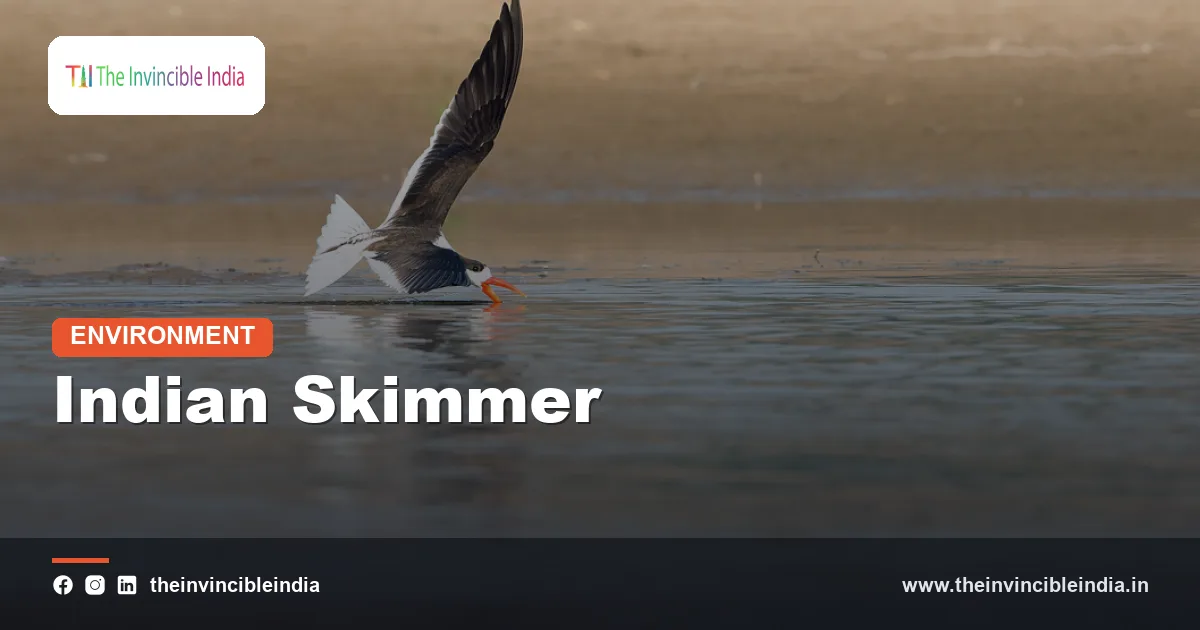
The Indian skimmer (Rynchops albicollis) is an Endangered, tern-like river bird with a bright orange bill whose lower half is longer than the upper, a feature that lets it feed by skimming the water surface with its bill open. It nests in colonies on bare river sandbars, and in India its most important strongholds are the National Chambal Sanctuary and stretches of the Mahanadi river.
Because the Indian skimmer depends on sandbars that appear in the dry season, it is highly sensitive to changes in river flow, sand mining and human disturbance. Its decline across South and Southeast Asia makes it a flagship species for the protection of healthy, free-flowing rivers.
| Attribute | Details |
|---|---|
| Scientific name | Rynchops albicollis |
| Family | Laridae (gulls, terns and skimmers), subfamily Rynchopinae |
| Distinctive feature | Longer lower mandible used for skim-feeding |
| Appearance | Dark upperparts, white underparts and collar, black cap, orange-red bill with a yellow tip |
| Habitat | Large rivers with sandbars, plus some lakes and estuaries |
| Key Indian strongholds | National Chambal Sanctuary and the Mahanadi river system |
| Breeding | Colonial nesting on exposed river sandbars, mainly in the dry season |
| IUCN status | Endangered |
| Legal protection in India | Highest level of protection under the Wildlife (Protection) Act, 1972 |
Key Takeaways
- The Indian skimmer (Rynchops albicollis) is a river bird whose lower mandible is longer than its upper mandible, which allows it to feed by skimming the water surface.
- The Indian skimmer nests in colonies on bare sandbars in large rivers, laying eggs in simple scrapes in the sand during the dry season.
- The National Chambal Sanctuary and the Mahanadi river are among the most important breeding areas for the Indian skimmer in India.
- The Indian skimmer is classified as Endangered by the IUCN, and its global population is small and declining.
- Dams, sand mining, river-bed cultivation, fishing activity and human disturbance are the main threats to the Indian skimmer.
- The Indian skimmer is legally protected in India, and conserving it requires maintaining natural river flows and undisturbed sandbars.
What is the Indian skimmer?
The Indian skimmer is a medium-sized water bird, about 40 centimetres long, that belongs to the same family as gulls and terns and is easily recognised by its orange-red bill. The bird has a black cap, dark brown-black back and wings, a white forehead, a white neck and white underparts. In flight, its long wings show a white trailing edge.
The species is also called the Indian scissors-bill, because its bill looks like a pair of blades. The bill is flattened from side to side, resembling a knife, and the lower half extends beyond the upper half. Skimmers are a small group, with only three species in the world, and the Indian skimmer is the species found across the Indian subcontinent and parts of mainland Southeast Asia.
Most people notice the Indian skimmer at dawn or dusk, when flocks glide low over the water in silence or give short, nasal calls.
Why does the Indian skimmer have a longer lower bill?
The Indian skimmer has a longer lower bill so that it can cut through the water surface while flying and snap shut on any fish it touches. This adaptation is unique among birds and is best understood as a way of fishing by touch.
When feeding, the skimmer flies low over calm water with its lower bill dipped just below the surface. When the bill makes contact with a small fish, a reflex action snaps the head down and the upper bill closes onto the prey. The method works well in shallow, slow-moving water at dawn, dusk and at night, when small fish rise to the surface and the water is calm.
Skimming at a glance
- Flight: low and steady, with deep, slow wingbeats.
- Target: small fish and sometimes crustaceans and insects.
- Time: mostly twilight and early morning, with some feeding after dark.
- Eyes: vertical pupils, which are thought to help in dim light.
The skimmer needs clear, undisturbed water with abundant small fish, so pollution and heavy boat traffic reduce its feeding success.
Where is the Indian skimmer found?
The Indian skimmer is found on large, slow-moving rivers of the Indian subcontinent and mainland Southeast Asia, including India, Pakistan, Nepal, Bangladesh and Myanmar, although many local populations have disappeared. Its range was once wider, and in several countries the species has become rare or has vanished.
In India, the bird occurs along the Chambal, the Ganga and its tributaries, the Mahanadi and a few other rivers and reservoirs. It prefers wide rivers with extensive sandbars, and it also uses lakes and coastal estuaries outside the breeding season. Some populations move short distances along rivers or to the coast in the non-breeding months.
The exact distribution changes year to year with river levels, so surveys are done every breeding season to find active colonies.
Why is the National Chambal Sanctuary important for the Indian skimmer?
The National Chambal Sanctuary is important for the Indian skimmer because its long, clean stretch of river holds some of the largest breeding colonies of the species in India. The sanctuary was set up as a tri-state protected area along the Chambal river, passing through Madhya Pradesh, Rajasthan and Uttar Pradesh, mainly to protect the gharial, but it supports a rich bird community.
The Chambal is relatively free of heavy industry and large towns along much of its protected stretch. It has many sandbars that appear as the water level falls after the monsoon, giving skimmers safe places to nest. Along with the gharial, Gangetic river dolphin, mugger crocodile and several turtle species, the skimmer is one of the sanctuary’s flagship animals.
Annual bird counts in the sanctuary record skimmers during the breeding season, and these surveys are important for tracking population trends.
Is the Mahanadi important for the Indian skimmer?
Yes, the Mahanadi river in Odisha is another key site for the Indian skimmer, where birds nest on sandbars in the river below dams and in protected stretches such as those near the Satkosia region. The Mahanadi basin supports a mix of resident and breeding birds, and surveys there have recorded nesting colonies.
The river is heavily regulated by dams, notably the Hirakud dam. Releases of water from reservoirs can flood sandbars during the breeding period, which makes nesting uncertain. The site shows how a species can survive in a modified river but remains at the mercy of water management decisions.
Odisha forest authorities and conservation groups monitor the Mahanadi colonies and try to coordinate protection of nesting sites during the dry season.
How does the Indian skimmer breed?
The Indian skimmer breeds in dense colonies on exposed river sandbars, usually between the end of the winter months and the start of the monsoon. Pairs lay their eggs directly on the sand in a shallow scrape, with no real nest, and both parents share incubation and chick care.
A clutch normally contains about three or four eggs, which are well camouflaged against the sand. Skimmers often nest alongside other river birds such as terns and lapwings, which helps the whole colony detect and mob predators. Chicks are fed on small fish and learn to skim as they mature.
| Stage | What happens |
|---|---|
| Site selection | Pairs select bare sandbars that appear as river levels drop |
| Egg laying | Eggs are laid in shallow scrapes, usually a few per clutch |
| Incubation | Both parents sit on the eggs and shade them during heat |
| Chick rearing | Parents bring small fish; chicks stay near the nest site |
| Fledging | Young birds learn to fly and skim before the monsoon floods return |
Because the whole breeding cycle must fit between the fall and rise of the river, even a small change in water flow can destroy a colony.
What are the main threats to the Indian skimmer?
The main threats to the Indian skimmer are changes to river flow from dams, sand mining, disturbance of nesting sandbars, river-bed cultivation, fishing pressure and pollution. Each of these either destroys the sandbars it needs or makes nesting unsafe.
- Dams and barrages: regulated flows can submerge nests during the breeding season or reduce the number of sandbars that appear.
- Sand mining: extraction removes the very banks and bars the birds use for nesting and brings noise and traffic.
- Disturbance: grazing animals, fishermen, boat traffic and tourists near colonies can cause birds to abandon eggs.
- River-bed farming: crops such as melons and vegetables are sometimes grown on exposed sandbars, replacing the bare surface the birds need.
- Fishing and pollution: depleted fish stocks and contaminated water reduce food supply.
- Egg collection and predation: eggs and chicks are lost to people, dogs and other predators in some places.
The IUCN classifies the species as Endangered, and its global population is thought to be a few thousand birds at most, with a declining trend in many regions.
How is the Indian skimmer protected in India?
The Indian skimmer is protected in India under the Wildlife (Protection) Act, 1972, which gives it the highest level of legal protection and prohibits hunting, capture, egg collection and trade. State forest departments and the Ministry of Environment, Forest and Climate Change (MoEFCC) are responsible for enforcement and policy.
Key habitats are covered by protected areas. The National Chambal Sanctuary prohibits activities such as sand mining and netting in the core stretches, although enforcement remains a challenge. Other river habitats, such as parts of the Mahanadi, receive some protection through state action and local conservation groups.
Internationally, the species is on lists of globally threatened birds and is a priority for bird-conservation organisations working in South Asia.
What can be done to save the Indian skimmer?
Saving the Indian skimmer requires protecting free-flowing river stretches, safeguarding nesting sandbars during the breeding season, and involving riverside communities in monitoring and management. The most useful step is to keep natural river processes working so that sandbars form each year.
- Protect breeding colonies by fencing or guarding sandbars and keeping people, dogs and livestock away.
- Regulate sand mining strictly in and near known breeding stretches.
- Coordinate dam and barrage releases so that nests are not flooded during the breeding season.
- Continue annual surveys in the Chambal, Mahanadi and other rivers to track numbers.
- Work with fishing and farming communities, offering alternatives to river-bed cultivation and encouraging local stewardship.
- Reduce pollution entering rivers and restore fish populations.
Because the skimmer shares its habitat with gharial, river dolphins and turtles, actions to help it also benefit other river wildlife. In this sense, the skimmer acts as an umbrella species for river conservation.
Why does the Indian skimmer matter?
The Indian skimmer matters because it is an indicator of river health, a threatened bird with a unique adaptation, and a symbol of the need to protect India’s free-flowing rivers. Where skimmers breed successfully, rivers usually still have natural sandbars, clean water and healthy fish populations.
Losing the species would remove one of the most distinctive birds of the subcontinent. It would also signal that river systems are being altered beyond the tolerance of the wildlife that depends on them. Protecting skimmer colonies supports not only the bird but the broader river ecosystem and the people who rely on it.
Bottom Line
The Indian skimmer is an Endangered river bird with a uniquely long lower bill, nesting on sandbars in the Chambal, the Mahanadi and a few other rivers. Its survival depends on natural river flows, undisturbed sandbars and effective control of sand mining and disturbance. Data reflects knowledge as of 17 October 2026.
Frequently Asked Questions
What is the scientific name of the Indian skimmer?
The scientific name of the Indian skimmer is Rynchops albicollis. It belongs to the skimmer group within the family Laridae and is recognised by its orange-red bill and longer lower mandible.
Why does the Indian skimmer have a longer lower beak?
The Indian skimmer has a longer lower beak so that it can skim the water surface while flying and catch fish by touch. When the lower bill touches a small fish, the head snaps down and the bill closes on the prey.
Where can the Indian skimmer be seen in India?
The Indian skimmer can be seen mainly on large rivers such as the Chambal, the Ganga and its tributaries and the Mahanadi. The National Chambal Sanctuary is one of the best-known sites, especially during the dry-season breeding period.
Is the Indian skimmer endangered?
Yes, the Indian skimmer is classified as Endangered by the IUCN. Its population is small and declining because of dams, sand mining, disturbance and pollution in the rivers where it lives.
How does the Indian skimmer nest?
The Indian skimmer nests in colonies on bare river sandbars, laying a few eggs in shallow scrapes in the sand. Nesting takes place in the dry season, so the colonies are highly vulnerable to flooding and disturbance.
What threatens the Indian skimmer the most?
The biggest threats to the Indian skimmer are changes to river flow caused by dams, sand mining and human disturbance of nesting sandbars. River-bed farming, fishing pressure and pollution add further risk.
{“@context”:”https://schema.org”,”@graph”:[{“@type”:”FAQPage”,”mainEntity”:[{“@type”:”Question”,”name”:”What is the scientific name of the Indian skimmer?”,”acceptedAnswer”:{“@type”:”Answer”,”text”:”The scientific name of the Indian skimmer is Rynchops albicollis. It belongs to the skimmer group within the family Laridae and is recognised by its orange-red bill and longer lower mandible.”}},{“@type”:”Question”,”name”:”Why does the Indian skimmer have a longer lower beak?”,”acceptedAnswer”:{“@type”:”Answer”,”text”:”The Indian skimmer has a longer lower beak so that it can skim the water surface while flying and catch fish by touch. When the lower bill touches a small fish, the head snaps down and the bill closes on the prey.”}},{“@type”:”Question”,”name”:”Where can the Indian skimmer be seen in India?”,”acceptedAnswer”:{“@type”:”Answer”,”text”:”The Indian skimmer can be seen mainly on large rivers such as the Chambal, the Ganga and its tributaries and the Mahanadi. The National Chambal Sanctuary is one of the best-known sites, especially during the dry-season breeding period.”}},{“@type”:”Question”,”name”:”Is the Indian skimmer endangered?”,”acceptedAnswer”:{“@type”:”Answer”,”text”:”Yes, the Indian skimmer is classified as Endangered by the IUCN. Its population is small and declining because of dams, sand mining, disturbance and pollution in the rivers where it lives.”}},{“@type”:”Question”,”name”:”How does the Indian skimmer nest?”,”acceptedAnswer”:{“@type”:”Answer”,”text”:”The Indian skimmer nests in colonies on bare river sandbars, laying a few eggs in shallow scrapes in the sand. Nesting takes place in the dry season, so the colonies are highly vulnerable to flooding and disturbance.”}},{“@type”:”Question”,”name”:”What threatens the Indian skimmer the most?”,”acceptedAnswer”:{“@type”:”Answer”,”text”:”The biggest threats to the Indian skimmer are changes to river flow caused by dams, sand mining and human disturbance of nesting sandbars. River-bed farming, fishing pressure and pollution add further risk.”}}]}]}


