

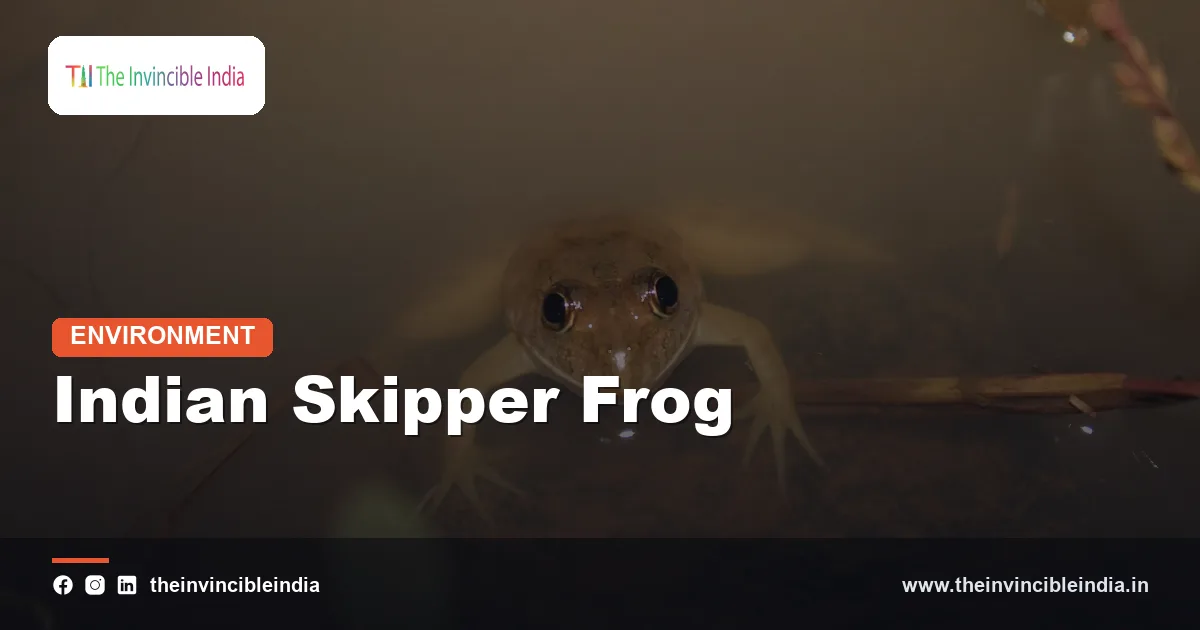
The Indian skipper frog (Euphlyctis cyanophlyctis) is a small, olive-brown pond frog of the family Dicroglossidae that floats at the water surface and skips across it when disturbed. Also called the skittering frog, it is one of the commonest amphibians of ponds, tanks, ditches and paddy fields across India and the rest of South Asia.
The Indian skipper frog spends nearly its whole life in or beside water, with only its eyes and nostrils showing above the surface. This explainer describes how to recognise the Indian skipper frog, why it skips, where it lives, what it eats, how it breeds and why this ordinary frog is a useful sign of a healthy wetland.
| Quick Fact | Detail |
|---|---|
| Scientific classification | Euphlyctis cyanophlyctis; class Amphibia, order Anura (frogs and toads), family Dicroglossidae |
| Size | Adults are small to medium, usually about 5 to 7 cm from snout to vent, with females somewhat larger than males |
| Habitat in India | Ponds, village tanks, lakes, ditches, slow streams, wells, paddy fields and garden pools, from the plains to moderate hill altitudes |
| Diet | Insects, spiders, small crustaceans, worms and other small animals; larger frogs sometimes eat tadpoles and tiny fish |
| Life cycle | Eggs laid in water, aquatic tadpoles, metamorphosis into froglets and then adult frogs; breeds mainly in the rainy season |
| Ecological role | Predator of insects, including mosquitoes and crop pests, and prey for snakes, birds and fish |
| Notable features | Eyes and nostrils on top of the head, fully webbed hind feet, habit of floating at the surface and skipping across it |
| Conservation status | Widespread and common, assessed by the IUCN as a species of Least Concern |
Key Takeaways
- The Indian skipper frog (Euphlyctis cyanophlyctis) is a small pond frog that floats at the surface and skips across the water when alarmed.
- The Indian skipper frog has eyes and nostrils on top of its head and fully webbed hind feet, adaptations for a life spent mostly in water.
- The Indian skipper frog is common throughout India and South Asia and is considered a species of Least Concern.
- The Indian skipper frog eats insects and other small animals, including mosquitoes, and is itself eaten by snakes, herons and fish.
- The Indian skipper frog breeds mainly during the monsoon, laying eggs in shallow water where the tadpoles grow.
- The Indian skipper frog is harmless to humans and is a useful indicator of clean, healthy ponds and wetlands.
What is the Indian skipper frog?
The Indian skipper frog is a small aquatic frog, Euphlyctis cyanophlyctis, that is found in standing and slow-moving waters across India and neighbouring countries. It belongs to the family Dicroglossidae, a large group of Asian and African frogs that also includes the Indian bullfrog and many field frogs.
The frog is also known as the skittering frog, and it is sometimes referred to by its older scientific genus name Rana. Its other common names in Indian languages vary by region, but the animal is widely recognised by villagers as the small frog that sits at the edge of a pond and plops into the water when approached.
Unlike many frogs that move far from water after the rains, the Indian skipper frog is tied closely to water. It sits in shallows and basks in the sun with its body half submerged. This lifestyle shapes its body, behaviour and diet.
Why is it called the skipper frog?
The Indian skipper frog is called the skipper frog because it skips or skitters across the surface of the water in a series of low hops when it is startled. This behaviour carries the frog quickly away from danger without it having to dive straight down.
The skipping works through the frog’s powerful hind legs and fully webbed feet. When the frog pushes off hard, it moves fast enough and with enough spread of its toes that its body skims over the surface for a short distance before it sinks. It then dives to the bottom and hides in mud or among water plants, or comes up again some distance away.
The same speed helps it to catch insects that land on the water. The ability to leave the water in a single leap also lets the frog escape from the water’s edge on to the bank when necessary.
What does the Indian skipper frog look like?
The Indian skipper frog looks like a compact, olive-green to brown frog with dark spots on its back, banded legs and a whitish belly. The body is slightly flattened, and the skin on the back is rough with small warts.
- Head: The eyes and nostrils are on top of the head, so the frog can see and breathe with most of its body hidden beneath the water.
- Back: The back is olive, grey-brown or greenish, with darker blotches that break up the outline.
- Limbs: The hind limbs are long and strong, with dark cross-bars, and the toes are webbed all the way to the tips.
- Underside: The belly is whitish or cream, sometimes with a bluish tinge on the chin and chest, particularly in breeding males.
- Size: Adults are about 5 to 7 cm in length from snout to vent, with females being larger.
The scientific species name cyanophlyctis is usually read as meaning blue blister, a reference to the faint bluish tinge seen on parts of the body in some individuals. The frog varies a good deal in colour, depending on the water and background.
Where does the Indian skipper frog live in India?
The Indian skipper frog lives in almost every part of India, in any permanent or semi-permanent water body, from village ponds and irrigation tanks to paddy fields and pools in gardens. It is found from the plains up into the lower hills.
The frog tolerates a range of conditions, including water that is muddy, weedy or somewhat polluted, and it can be found in ponds in the middle of towns. It prefers places with floating plants, open edges for basking and nearby cover. Beyond India, the species ranges through Pakistan, Nepal, Bangladesh and Sri Lanka and into some neighbouring countries to the west.
Because it stays near water in all seasons, the frog is often seen even when other frogs are only active in the monsoon. In the dry season it retreats to the last remaining water, or shelters in mud, under stones or in cracks and burrows near the water’s edge.
How does the Indian skipper frog survive the dry season?
The Indian skipper frog survives the dry season by staying in the last remaining water or by sheltering in damp mud, under stones or in cracks and burrows near the water’s edge. Because its skin is thin and loses moisture easily, the frog cannot stay long in dry, hot places.
In the cooler months the frog becomes less active but often remains visible in the sun at the edge of ponds. In summer, when small village ponds shrink, the frogs gather in the deeper pools. When the first heavy rains return, the ponds refill, and the frogs move out again, feed heavily and begin to breed.
This tolerance of changing water levels is one reason the species is so widespread. It can colonise new ponds, borrow pits and flooded fields quickly, often within a single rainy season, which explains why the frog turns up even in newly dug garden pools and temporary water bodies.
What does the Indian skipper frog eat?
The Indian skipper frog eats mostly insects and other small invertebrates that it catches at or near the water surface. It also takes spiders, small crustaceans and worms, and large individuals will eat tadpoles, small fish and even smaller frogs.
The frog is a sit-and-wait predator. It stays still at the edge of the water, watches for movement and then lunges, catching the prey with a quick flick of its sticky tongue. Flies, mosquitoes, beetles, moths and aquatic insects that fall on the water are the usual targets.
Tadpoles of the species feed differently, scraping algae and other plant material and soft organic matter from plants and the bottom. As the young frog develops, its diet changes from plant matter to animal prey, which is typical of frogs.
Does the Indian skipper frog help control pests?
The Indian skipper frog helps to control pests because it eats large numbers of insects, including mosquitoes and the insects that attack crops in and near paddy fields. Its effect is modest on its own but significant when many frogs live in a wetland.
How does the Indian skipper frog breed?
The Indian skipper frog breeds mainly during the monsoon, when males call from the water and females lay eggs in shallow, still pools. In some warm areas breeding may extend over a longer part of the year, depending on rainfall.
Males call to attract females, producing a low croaking sound, often while floating or partly submerged. Several males may call together in a pond, forming a chorus on rainy evenings. Mating takes place in the water in a clasp known as amplexus, in which the male holds the female from behind.
The eggs are laid in clusters, often attached to submerged plants or lying in shallow water. They hatch into tadpoles, which swim, feed and grow before they develop limbs, absorb their tails and emerge as small froglets. Eggs and tadpoles are heavily preyed upon by fish, insects and birds, and only a small share survive to adulthood.
- Egg stage: Clusters of eggs in shallow water.
- Tadpole stage: Aquatic, feeding on algae and plant matter.
- Metamorphosis: Hind limbs appear first, then the forelimbs, and the tail is gradually absorbed.
- Froglet and adult: A small version of the adult that feeds on insects and matures over a period of months.
How can you tell the Indian skipper frog from other Indian frogs and toads?
The Indian skipper frog can be told from other common Indian amphibians by its habit of floating with the eyes above water, its fully webbed feet and its small, olive-brown body. Several other frogs share ponds and fields, and the comparison below shows the main differences.
| Amphibian | Appearance | Habit |
|---|---|---|
| Indian skipper frog | Small, olive-brown, spotted back, fully webbed hind feet, bluish-white belly | Floats at the surface, skips on water, stays near water all year |
| Indian bullfrog (Hoplobatrachus tigerinus) | Much larger, yellowish-green with long ridges down the back | Found in ponds and fields; males turn bright yellow in the breeding season |
| Field or cricket frogs (Minervarya group) | Small, brown, rather slender, with a more pointed snout | Live on damp ground around water and hop away rapidly |
| Common Indian toad (Duttaphrynus melanostictus) | Warty, dry skin with bony ridges on the head and large glands behind the eyes | Walks or hops on land, near houses and gardens, and enters water mainly to breed |
The simplest field test is to approach a pond edge slowly. A small frog sitting in the water with only its head showing, which then skips over the surface and dives, is almost always an Indian skipper frog.
Why is the Indian skipper frog important to ecosystems?
The Indian skipper frog is important because it links aquatic and land food webs, eating large numbers of insects and serving as food for many larger animals. It also provides a simple indicator of wetland health.
Snakes such as water snakes and keelbacks, herons and egrets, kingfishers, fish and monitor lizards all eat skipper frogs and their tadpoles. In that sense the frog passes energy from insects up to bigger predators. The tadpoles also help to keep algae in check in small ponds.
Amphibians breathe in part through their thin, moist skin, which makes them sensitive to pollutants in the water. A pond where skipper frogs are numerous and breeding is generally in reasonably good condition. Their decline, on the other hand, may point to pollution, pesticide use or loss of wetlands.
Is the Indian skipper frog threatened or harmful?
The Indian skipper frog is not threatened globally and is harmless to people. The IUCN lists it as a species of Least Concern, because it is widespread and tolerant of a range of habitats, although local populations can still suffer from pollution and habitat loss.
The frog does not bite, sting or produce harmful venom. As with all amphibians, it is sensible to wash hands after touching it, because the skin can carry bacteria and may irritate eyes or cuts. Handling should be minimised in any case, since frogs absorb substances through their skin and can be harmed by lotions, soaps or salt on the hands.
- Pesticides and fertiliser run-off: Chemicals used on farms can poison tadpoles and adults in paddy fields and ponds.
- Wetland filling: Small ponds and tanks are lost to construction or drained for farmland.
- Pollution: Sewage, detergents and industrial waste degrade water quality.
- Introduced fish: Some non-native fish eat tadpoles and reduce breeding success.
Protecting village ponds, tanks and field margins is the most effective way to support skipper frogs and the many other species that depend on the same water.
Bottom Line
The Indian skipper frog is a common, harmless pond frog best known for skipping across the water surface. By eating insects and feeding larger predators, it plays a steady role in Indian wetlands, and its presence is a good sign of a living pond.
Frequently Asked Questions
What is the Indian skipper frog?
The Indian skipper frog is a small aquatic frog, Euphlyctis cyanophlyctis, found in ponds, tanks and paddy fields across India and South Asia. It is also called the skittering frog. It floats at the water surface and skips across it when frightened.
Why is it called a skipper frog?
It is called a skipper frog because it skips in a series of low hops across the water surface when disturbed. The strong hind legs and fully webbed feet let it skim over the water before it dives. The behaviour helps it escape predators quickly.
Is the Indian skipper frog poisonous?
No, the Indian skipper frog is not poisonous or dangerous to humans. It does not bite or sting. It is still wise to wash your hands after touching any frog, and to handle frogs as little as possible.
What does the Indian skipper frog eat?
The Indian skipper frog eats mainly insects such as flies, mosquitoes and beetles, together with spiders, worms and small crustaceans. Larger frogs may also take tadpoles and tiny fish. The tadpoles feed on algae and plant matter.
When does the Indian skipper frog breed?
The Indian skipper frog breeds mainly in the monsoon, when males call from the water and females lay eggs in shallow pools. In warm places the breeding season may last longer, depending on rainfall. The eggs hatch into tadpoles that later turn into froglets.
Is the Indian skipper frog endangered?
No, the Indian skipper frog is not endangered and is listed by the IUCN as a species of Least Concern. It is widespread, common and tolerant of many kinds of water body. Local numbers can still fall where ponds are polluted, drained or heavily treated with pesticides.
{“@context”:”https://schema.org”,”@graph”:[{“@type”:”FAQPage”,”mainEntity”:[{“@type”:”Question”,”name”:”What is the Indian skipper frog?”,”acceptedAnswer”:{“@type”:”Answer”,”text”:”The Indian skipper frog is a small aquatic frog, Euphlyctis cyanophlyctis, found in ponds, tanks and paddy fields across India and South Asia. It is also called the skittering frog. It floats at the water surface and skips across it when frightened.”}},{“@type”:”Question”,”name”:”Why is it called a skipper frog?”,”acceptedAnswer”:{“@type”:”Answer”,”text”:”It is called a skipper frog because it skips in a series of low hops across the water surface when disturbed. The strong hind legs and fully webbed feet let it skim over the water before it dives. The behaviour helps it escape predators quickly.”}},{“@type”:”Question”,”name”:”Is the Indian skipper frog poisonous?”,”acceptedAnswer”:{“@type”:”Answer”,”text”:”No, the Indian skipper frog is not poisonous or dangerous to humans. It does not bite or sting. It is still wise to wash your hands after touching any frog, and to handle frogs as little as possible.”}},{“@type”:”Question”,”name”:”What does the Indian skipper frog eat?”,”acceptedAnswer”:{“@type”:”Answer”,”text”:”The Indian skipper frog eats mainly insects such as flies, mosquitoes and beetles, together with spiders, worms and small crustaceans. Larger frogs may also take tadpoles and tiny fish. The tadpoles feed on algae and plant matter.”}},{“@type”:”Question”,”name”:”When does the Indian skipper frog breed?”,”acceptedAnswer”:{“@type”:”Answer”,”text”:”The Indian skipper frog breeds mainly in the monsoon, when males call from the water and females lay eggs in shallow pools. In warm places the breeding season may last longer, depending on rainfall. The eggs hatch into tadpoles that later turn into froglets.”}},{“@type”:”Question”,”name”:”Is the Indian skipper frog endangered?”,”acceptedAnswer”:{“@type”:”Answer”,”text”:”No, the Indian skipper frog is not endangered and is listed by the IUCN as a species of Least Concern. It is widespread, common and tolerant of many kinds of water body. Local numbers can still fall where ponds are polluted, drained or heavily treated with pesticides.”}}]}]}


