

The Indian sunbeam (Curetis thetis) is a small lycaenid butterfly of Indian forests and wooded hills, named for the flash of orange-copper on the upperside of its wings that shows when it basks in the sun, while its underside is silvery white and its caterpillars feed on legume trees such as Pongamia. It is the best-known member of the genus Curetis, the sunbeams, a small group of butterflies found across tropical Asia.
The Indian sunbeam is a butterfly of two looks. Seen from below, with its wings folded, it is a quiet silver-white shape that blends with sunlit foliage, but when it opens its wings in the sun, it shows a flash of colour that is easy to remember. Its fast flight, its basking habit and the ants that tend its caterpillars make it a rewarding species to watch.
| Quick Fact | Detail |
|---|---|
| Common name | Indian sunbeam |
| Scientific name | Curetis thetis |
| Family | Lycaenidae (gossamer-winged butterflies), subfamily Curetinae |
| Wingspan | Roughly 35 to 50 mm |
| Host plants | Legumes of the family Fabaceae, notably Pongamia (Millettia pinnata) and Derris species |
| Range and habitat in India | Western Ghats, peninsular hills, Himalayan foothills and the north-east; deciduous and evergreen forest, forest edges and wooded gardens |
| Flight season and broods | On the wing for much of the year, with several broods and peaks after the monsoon |
| Notable features | Orange-copper upperside in the male, silver-white underside, pointed forewings, ant-attended caterpillars |
Key Takeaways
- The Indian sunbeam is a small lycaenid butterfly, Curetis thetis, with a wingspan of roughly 35 to 50 mm.
- The Indian sunbeam has a silvery-white underside and, in the male, an orange-copper upperside that flashes when the butterfly basks.
- Caterpillars of the Indian sunbeam feed on the leaves of legume plants of the family Fabaceae, including Pongamia and Derris.
- Caterpillars of the Indian sunbeam are tended by ants, in a partnership typical of the family Lycaenidae.
- The Indian sunbeam lives in forests and wooded hills across India, including the Western Ghats, the Himalayan foothills and the north-east.
- The Indian sunbeam belongs to the genus Curetis, a small group of tropical Asian butterflies placed in their own subfamily, Curetinae.
What does the Indian sunbeam look like?
The Indian sunbeam is a medium-small butterfly with pointed forewings, a silvery-white underside and, on the upperside, an orange-copper flush in the male and a paler, whitish-blue tone in the female. Its shape is slightly angular, with a hooked forewing tip that distinguishes it from rounder lycaenids.
The underside is the side most often seen, because the sunbeam usually rests with its wings closed. It is silver-white or pale grey, marked with faint, fine dark lines and tiny spots. This pale underside reflects light and helps the butterfly to merge with sunlit leaves.
The upperside is revealed only when the butterfly opens its wings. In the male, the colour is a bright orange or copper tone, bordered with dark brown or black. The female is generally paler and more bluish-white, with a broader dark border. Because the butterfly opens its wings mainly in direct sun, the bright flash is brief and striking.
Why is it called a sunbeam?
The butterfly is called a sunbeam because its upperside seems to flash like a beam of light when it opens and closes its wings in the sun. The name is shared by the other members of the genus Curetis, which also show a gleaming upperside against a pale, silvery underside.
Where is the Indian sunbeam found in India?
The Indian sunbeam is found in forests and wooded country across India, with records from the Western Ghats, the peninsular hills, the Himalayan foothills and the north-east, and it also occurs in neighbouring regions of Asia. It favours areas with a good cover of trees, especially where its legume host plants grow.
Typical places to find the butterfly include:
- Moist and dry deciduous forest, particularly along tracks and clearings
- Evergreen and semi-evergreen forest edges in hill country
- Streamsides and damp patches where males gather
- Gardens and avenues with Pongamia or similar trees, close to forest
The butterfly is most often seen in sunny gaps where light falls through the canopy. In very dense, dark forest it is rare, and in the open plains with few trees it is also scarce, as it needs both shelter and suitable host plants.
What does the Indian sunbeam caterpillar eat?
The Indian sunbeam caterpillar eats the young leaves of legume trees and climbers in the family Fabaceae, with Pongamia (also called karanj or Millettia pinnata) and Derris among the best-known host plants. Pongamia is a common native tree that is planted along roads and in gardens in much of India, and it often supports sunbeam caterpillars.
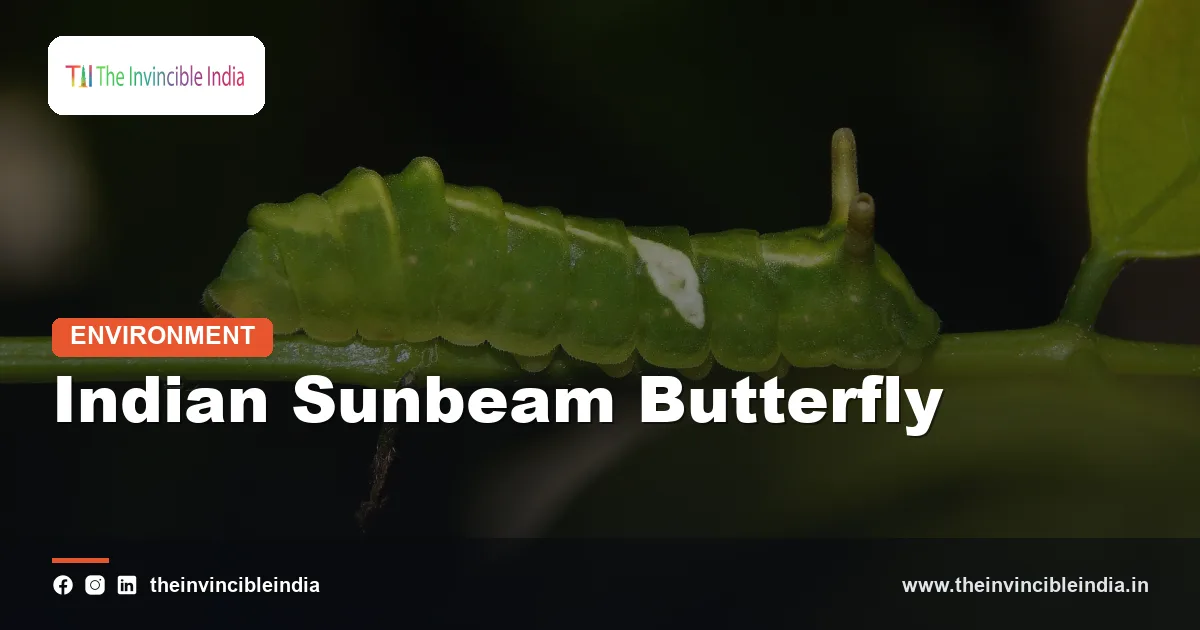
The larva is a short, stout, slug-like caterpillar, typically green and well matched to the colour of young leaves. It feeds on tender new growth rather than on old leaves. Females tend to lay their eggs singly on fresh shoots, where the young caterpillars will find soft food as soon as they hatch.
The pupa is formed on or near the host plant and is held in place by silk. Pupae are well camouflaged and rarely noticed unless an observer is searching carefully.
How do ants look after Indian sunbeam caterpillars?
Ants look after Indian sunbeam caterpillars by staying close to them and guarding them against predators and parasites, in return for sweet secretions that the caterpillars produce. This partnership, called myrmecophily, is a defining feature of the family Lycaenidae and is well documented in the sunbeam genus.
Caterpillars of the genus Curetis have glands that produce droplets of liquid rich in sugars and amino acids. Ants collect the droplets and stay near the caterpillar. A tended caterpillar therefore benefits from a small bodyguard, while the ants gain a reliable source of food.
How can you spot an ant-tended caterpillar?
You can spot an ant-tended caterpillar by looking for ants lingering on young shoots of host plants, such as Pongamia, with no obvious reason. A few ants walking up and down a new leaf, pausing to stroke or touch a small, flat, green larva with their antennae, indicate a tended lycaenid.
Because the caterpillars are small and well camouflaged, the ants are often easier to notice than the larva. Gentle observation, without disturbing the plant, is the best approach.
How does the Indian sunbeam life cycle work?
The Indian sunbeam passes through four stages, egg, caterpillar, pupa and adult, and the whole cycle takes about a month in warm weather. As in all butterflies, the change from one stage to the next is complete, so each form looks entirely different.
| Stage | What happens |
|---|---|
| Egg | The female lays tiny, rounded eggs singly on tender shoots of legume host plants |
| Caterpillar | The green, slug-like larva eats young leaves and is tended by ants |
| Pupa | The mature caterpillar pupates on or near the host plant, held by silk |
| Adult | The butterfly emerges, basks to warm its wings, feeds and mates |
Fresh growth on host trees triggers breeding, so broods tend to follow the rains. In regions with a clear dry season, adults become fewer in the hottest, driest months and increase again as leaves and flowers return after the monsoon.
Growth rates vary with the weather. In warm, humid conditions a caterpillar can complete its feeding in under two weeks, while in cooler hill regions the same stage may last noticeably longer. The pupal stage is short in warm weather, usually about a week or so, and the new adult is ready to fly within hours of emerging. Because several generations follow one another, a single Pongamia tree can support caterpillars at different stages throughout the favourable season.
Natural enemies include parasitic wasps, spiders, ambush bugs and insect-eating birds. Ant guards reduce the losses, but they cannot remove them entirely, which is why a female lays many eggs spread over several shoots and not in a single place.
How does the Indian sunbeam behave?
The Indian sunbeam is a fast, alert butterfly that basks in the sun with its wings spread, takes off with a rapid, darting flight and often returns to the same perch. It is easiest to watch on warm mornings, when it warms its wings in the first sunlight filtering through the trees.
Typical behaviours include:
- Basking with the wings spread flat to the sun, then snapping them shut.
- Resting on leaves with the wings closed, showing the silvery underside.
- Males gathering at damp ground, sand or mud to sip minerals.
- Males perching on a favoured leaf and darting out at passing butterflies.
The sunbeam is wary and is often disturbed by movement, but it commonly returns to the same spot after a minute or two. Visiting damp patches by streams and forest tracks is a reliable way to see males at close range.
What do adult Indian sunbeams feed on?
Adult Indian sunbeams feed mainly on moisture and minerals from damp ground, on the sap of wounded plants and on honeydew, with only occasional visits to flowers. This is typical of the genus Curetis, whose members are less dependent on nectar than many other butterflies.
Males in particular gather at wet sand or mud along streams and forest tracks. They stand with their wings closed, probing the damp surface with the proboscis, and sometimes several males sip together. This habit, called mud-puddling, supplies sodium and other minerals that the butterflies cannot get easily from nectar.
Some individuals also visit rotting fruit, fermenting sap and the sugary deposits left by sap-sucking insects on leaves. Such sources are especially useful in the drier months, when flowers are scarce.
Why does basking matter?
Basking matters because butterflies are cold-blooded and need to raise their body temperature before they can fly well. By opening its wings to the morning sun, the Indian sunbeam warms its flight muscles quickly and can then take off at speed. A basking butterfly is also easiest to see, which is why early mornings are the best time to look for the flash of copper.
How can you tell the Indian sunbeam from other sunbeams?
The Indian sunbeam is told apart from other sunbeams by the shape of its forewing tip, the colour of the upperside and its overall size, and a clear view of both sides of the wing is usually needed. Several species of Curetis occur in India, and they look alike at first glance.
- Indian sunbeam (Curetis thetis): the most widely recorded species, with an orange-copper male upperside and a silver-white underside.
- Angled sunbeam (Curetis acuta): a related species with a more sharply angled outline to the wings.
- Bulis sunbeam (Curetis bulis): a related species recorded mainly from the eastern parts of the Indian region.
- Siva sunbeam (Curetis siva): another related species with its own distinct pattern.
Observers should note whether the butterfly is male or female, since their upperside colours differ. Photographs of both the open and closed wings, taken in good light, are the most reliable aid for identification.
Why does the Indian sunbeam matter?
The Indian sunbeam matters because it is a visible link between butterflies, legume trees and ants, and because its presence suggests a reasonably wooded landscape. A butterfly that needs forest cover, host trees and an active ant community shows how many different species a single patch of woodland depends on.
The species is widespread and not generally considered threatened, so conservation concerns are mostly local. Heavy clearing of forest patches, removal of native trees along roads and indiscriminate spraying can all reduce local populations. Where Pongamia and similar native trees are protected and left to grow, the sunbeam often persists even in lightly settled areas.
For butterfly watchers, the sunbeam is a favourite because of its quick flashes of colour and because it is a species that rewards patience. Recording its sightings with date and place adds to the picture of how common butterflies are changing across India.
How can you attract and protect the Indian sunbeam?
You can attract the Indian sunbeam by planting native legume trees such as Pongamia, keeping patches of shaded ground and avoiding pesticides. The butterfly needs host plants for its caterpillars, sunlit perches for basking and damp spots for males to drink.
- Plant native legume trees and shrubs, and let them put out fresh shoots.
- Leave open, sunny gaps in tree cover where butterflies can bask.
- Provide a shallow, damp patch of sand or soil in the shade for males.
- Avoid broad-spectrum insecticides, which harm both caterpillars and their ant guards.
- Allow ants to live on the trees unless they cause real problems.
Protecting native trees along forest roads and at the edges of villages also helps, because these corridors connect forest patches and give the butterfly places to feed and breed.
Bottom Line
The Indian sunbeam is a quick, silver-and-copper butterfly of Indian woodland, with ant-tended caterpillars that feed on legume trees such as Pongamia. It thrives wherever native trees, sunny gaps and damp ground are available, and it offers a rewarding glimpse of the connections between butterflies, plants and ants.
Frequently Asked Questions
What is the Indian sunbeam butterfly?
The Indian sunbeam is a small lycaenid butterfly, scientifically named Curetis thetis, found in forests and wooded hills across India. It has a silvery-white underside and, in the male, an orange-copper upperside. Its caterpillars feed on legume trees such as Pongamia.
Why is it called a sunbeam?
It is called a sunbeam because the upperside of its wings seems to flash like a beam of light when the butterfly opens them in the sun. The effect is strongest in the male, whose upperside is orange-copper. The name is shared by other butterflies of the genus Curetis.
What does the Indian sunbeam caterpillar eat?
The caterpillar eats young leaves of legume plants in the family Fabaceae, notably Pongamia and Derris. It is a short, green, slug-like larva that feeds on tender shoots. Ants commonly tend the caterpillars and guard them from predators.
Where can I see the Indian sunbeam in India?
The Indian sunbeam can be seen in forest clearings, forest edges and wooded gardens in the Western Ghats, peninsular hills, Himalayan foothills and the north-east. Sunny mornings and damp patches by streams are good places to look. Pongamia trees near forest are also worth checking.
How can I tell male and female Indian sunbeams apart?
Male and female Indian sunbeams are told apart by the upperside colour. The male shows an orange-copper flush bordered with dark brown, while the female is paler and more whitish-blue with a broader dark border. The underside is silvery white in both sexes.
Is the Indian sunbeam endangered?
No, the Indian sunbeam is not generally considered endangered, and it is widely distributed in suitable habitat. Local populations can decline when forest cover, native host trees or ant communities are lost. Protecting native trees and avoiding pesticides helps the species persist.
{“@context”:”https://schema.org”,”@graph”:[{“@type”:”FAQPage”,”mainEntity”:[{“@type”:”Question”,”name”:”What is the Indian sunbeam butterfly?”,”acceptedAnswer”:{“@type”:”Answer”,”text”:”The Indian sunbeam is a small lycaenid butterfly, scientifically named Curetis thetis, found in forests and wooded hills across India. It has a silvery-white underside and, in the male, an orange-copper upperside. Its caterpillars feed on legume trees such as Pongamia.”}},{“@type”:”Question”,”name”:”Why is it called a sunbeam?”,”acceptedAnswer”:{“@type”:”Answer”,”text”:”It is called a sunbeam because the upperside of its wings seems to flash like a beam of light when the butterfly opens them in the sun. The effect is strongest in the male, whose upperside is orange-copper. The name is shared by other butterflies of the genus Curetis.”}},{“@type”:”Question”,”name”:”What does the Indian sunbeam caterpillar eat?”,”acceptedAnswer”:{“@type”:”Answer”,”text”:”The caterpillar eats young leaves of legume plants in the family Fabaceae, notably Pongamia and Derris. It is a short, green, slug-like larva that feeds on tender shoots. Ants commonly tend the caterpillars and guard them from predators.”}},{“@type”:”Question”,”name”:”Where can I see the Indian sunbeam in India?”,”acceptedAnswer”:{“@type”:”Answer”,”text”:”The Indian sunbeam can be seen in forest clearings, forest edges and wooded gardens in the Western Ghats, peninsular hills, Himalayan foothills and the north-east. Sunny mornings and damp patches by streams are good places to look. Pongamia trees near forest are also worth checking.”}},{“@type”:”Question”,”name”:”How can I tell male and female Indian sunbeams apart?”,”acceptedAnswer”:{“@type”:”Answer”,”text”:”Male and female Indian sunbeams are told apart by the upperside colour. The male shows an orange-copper flush bordered with dark brown, while the female is paler and more whitish-blue with a broader dark border. The underside is silvery white in both sexes.”}},{“@type”:”Question”,”name”:”Is the Indian sunbeam endangered?”,”acceptedAnswer”:{“@type”:”Answer”,”text”:”No, the Indian sunbeam is not generally considered endangered, and it is widely distributed in suitable habitat. Local populations can decline when forest cover, native host trees or ant communities are lost. Protecting native trees and avoiding pesticides helps the species persist.”}}]}]}


