


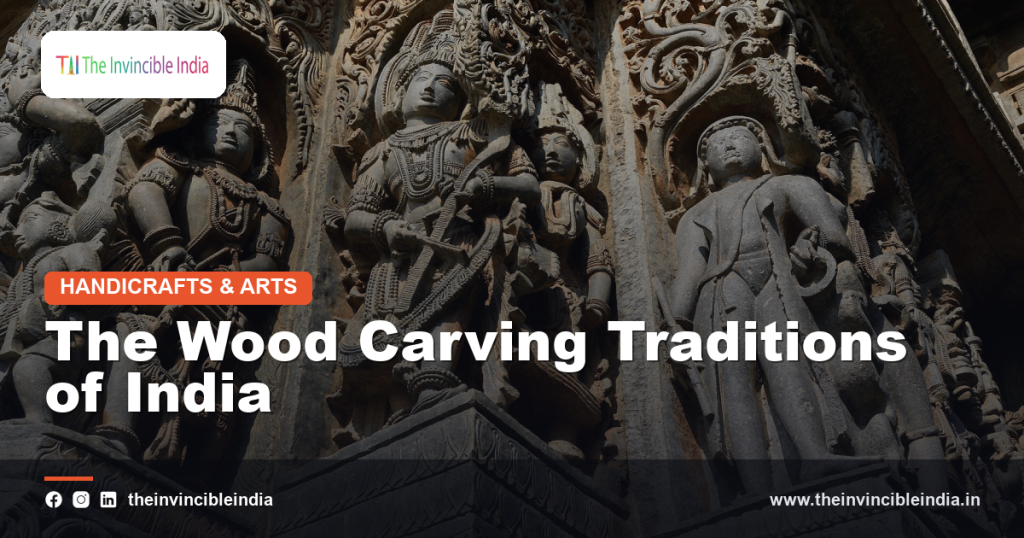
Wood carving is one of India’s oldest and most geographically diverse handicraft traditions, encompassing everything from temple architecture and carved doorways to furniture, panels, and devotional figures shaped entirely by hand using chisels and mallets. Distinct regional styles have developed across the country, from the carved havelis and furniture of Rajasthan and Gujarat, closely related to the broader family of traditional handicrafts of Rajasthan, to the sandalwood sculpture of Karnataka and the walnut wood carving of Kashmir. Despite considerable regional variation in style and subject matter, these traditions share a common reliance on skilled hand-tool carving passed down through generations of craftsmen.
Quick Facts
| Detail | Information |
|---|---|
| Also Known As | Woodcraft, carved woodwork |
| Key Regions | Rajasthan, Gujarat, Kashmir, Karnataka, Kerala, Saharanpur |
| Common Woods | Teak, sandalwood, walnut, sheesham, rosewood |
| Core Tools | Chisels, mallets, hand saws |
| Common Products | Doors, furniture, panels, figures, jaali screens |
| Notable Styles | Kashmiri walnut carving, Mysore sandalwood carving, Saharanpur woodwork |
A Widespread and Diverse Tradition
Wood carving in India is not a single unified craft but a broad family of related regional traditions, each shaped by locally available timber, architectural needs, and cultural or religious practice. Nearly every region of the country has developed some form of decorative or structural wood carving, ranging from the elaborately latticed screens of Rajasthan and Gujarat to the finely detailed walnut wood carving associated with Kashmir.
This diversity reflects wood’s long-standing practical importance in Indian architecture and daily life, used for doors, pillars, ceilings, furniture, and religious images. While techniques and preferred woods vary considerably between regions, the shared reliance on hand tools and inherited craftsmanship links these traditions together as part of a broader national heritage.
Tools and Basic Technique
Traditional Indian wood carving relies on a relatively simple set of hand tools, primarily chisels of varying widths and profiles, wooden or metal mallets, and hand saws used for initial shaping before detailed carving begins. Carvers typically work from a rough sketch or a more detailed design transferred onto the wood surface before carving starts.
The process generally moves from broad, rough shaping of the overall form to progressively finer detail work, with the most skilled carvers usually responsible for the delicate final passes. Sanding and finishing, sometimes followed by staining or lacquering, complete the piece after carving is finished.
Types of Wood Used
The choice of wood in Indian carving traditions is closely tied to regional availability, with teak favoured in many parts of western and southern India for its durability and resistance to decay. Sandalwood, prized for its fine grain, fragrance, and suitability for very detailed carving, is strongly associated with the sculpture tradition of Karnataka.
Walnut wood, valued for its rich colour and fine, even grain, is closely associated with the carving tradition of Kashmir, while sheesham and rosewood are widely used across northern India for furniture and decorative panels. Each wood type presents different working properties that experienced carvers must account for.
Jaali and Lattice Work
Jaali, an ornamental perforated screen carved from a single panel of wood or stone, represents one of the most technically demanding forms of Indian carving, requiring carvers to remove significant amounts of material while leaving a delicate, structurally sound lattice pattern intact. Traditionally used in windows and balconies, jaali allowed air and filtered light to pass through while providing privacy and shade.
Patterns range from simple geometric grids to elaborate floral and star-based designs, requiring careful planning to ensure the finished lattice remains strong. This combination of structural engineering and decorative artistry makes jaali one of the most admired achievements of the craft.
Carved Doors and Architectural Woodwork
Elaborately carved wooden doors and door frames are among the most recognisable products of Indian wood carving traditions, particularly associated with the havelis, or traditional mansions, of Rajasthan and Gujarat, where entire facades might feature extensive carved woodwork. These doors often combine floral, geometric, and figurative motifs.
Door carving required not only artistic skill but also an understanding of structural requirements. Similar traditions of architectural wood carving appear in temple structures and palaces across many regions, contributing significantly to the decorative character of traditional Indian architecture.
Temple Wood Carving
Wood carving has long played an important role in temple architecture across parts of India, particularly in regions such as Kerala where wooden temple structures and carved ceiling panels, pillars, and doorways are a distinctive feature. Carved wooden temple chariots, used during festival processions in some regions, represent another significant application of the craft.
Temple carving traditionally depicted deities, mythological scenes, and auspicious symbols, requiring carvers to have detailed knowledge of religious iconography alongside their technical skills, sustaining ongoing demand for skilled woodwork over long periods.
Kashmiri Walnut Wood Carving
Kashmir is particularly renowned for its walnut wood carving tradition, in which the region’s fine-grained walnut timber is carved into furniture, decorative panels, and small boxes featuring dense floral and foliage patterns similar in spirit to the region’s carpet and shawl designs. Carvers typically work in styles ranging from deep, high-relief carving to shallower, more delicate surface patterns.
Walnut wood’s rich natural colour, which can deepen further with age and polishing, is often left largely unstained to showcase the timber’s natural grain. This tradition developed alongside Kashmir’s other well-known textile crafts.
Mysore Sandalwood Carving
The Mysore region of Karnataka is closely associated with sandalwood carving, a tradition that takes advantage of the wood’s fine, even grain and natural fragrance to produce intricately detailed sculptures, decorative boxes, and religious figures. Sandalwood’s density and fine texture allow carvers to achieve extremely detailed work.
Historically supported by royal patronage, sandalwood carving became closely linked with Mysore’s identity as a centre of fine craftsmanship. Increasing scarcity of natural sandalwood in recent decades has led to regulation of harvesting and increased reliance on legally sourced or alternative timber.
Saharanpur Woodwork
Saharanpur, in Uttar Pradesh, has developed into one of India’s most significant centres for wood carving, particularly known for detailed relief carving on furniture and decorative items produced for both domestic and export markets. The city’s woodworking tradition combines carving with other decorative techniques, including inlay work.
Saharanpur’s workshops range from small family enterprises to larger operations capable of fulfilling substantial export orders. Government recognition and support for the Saharanpur woodcraft cluster has helped promote the region’s products in both domestic and international markets.
Gujarat and Rajasthan Styles
Wood carving traditions in Gujarat and Rajasthan are closely tied to the region’s architectural heritage, particularly the carved wooden facades, balconies, and interior elements found in historic havelis and public buildings. Carvers developed distinctive styles of relief carving featuring floral scrollwork, geometric patterns, and figurative panels.
Certain towns within Rajasthan became particularly associated with specific types of wood carving, produced for both local use and wider trade. This tradition exists alongside the region’s many other well-known handicrafts.
Kerala and South Indian Traditions
Kerala’s wood carving tradition is closely linked to the region’s distinctive temple and domestic architecture, which historically made extensive use of timber given the state’s tropical climate and abundant hardwood resources. Carved wooden pillars, ceiling panels, and decorative brackets are characteristic features of traditional Kerala architecture.
Rosewood and other locally available hardwoods are commonly used for both architectural elements and smaller carved objects. Other parts of South India have developed their own related wood carving traditions, often connected to temple architecture and religious sculpture.
Furniture and Domestic Woodwork
Beyond architectural and religious applications, wood carving has long been used to produce decorative furniture for domestic use, including carved beds, chests, chairs, and storage boxes found across many regions of India. This furniture often features relief carving on visible surfaces such as headboards, panels, and legs.
Carved furniture has historically served as an important marker of household status, with elaborately carved pieces sometimes commissioned specifically for weddings or as family heirlooms. Contemporary demand for handcrafted wooden furniture continues to support carving workshops today.
Figures and Devotional Carving
Carved wooden figures, particularly of deities and mythological subjects, form an important category within Indian wood carving, produced both for temple use and for private devotional purposes in homes. These figures require carvers to combine technical skill with knowledge of established iconographic conventions.
Regional styles of devotional wood carving vary in scale, level of detail, and finishing, with some traditions favouring painted or gilded figures. Beyond religious subjects, wood carvers have also produced figures depicting everyday life, animals, and folk characters.
The Artisan Workshop
Wood carving in India is typically organised around small workshops, often family-run, where skills are passed down through direct apprenticeship over a period of years before a young carver is entrusted with detailed independent work. Master carvers within these workshops are responsible for the most demanding and delicate carving.
Larger commercial workshops, particularly in centres such as Saharanpur, have developed more structured production processes while still relying fundamentally on skilled hand carving for detailed work. The continued viability of these workshops depends heavily on sustaining a pipeline of trained carvers.
Challenges Facing Woodcarvers
Indian wood carving traditions face a number of significant challenges, including restricted access to certain traditional timbers, such as sandalwood, due to environmental regulation and scarcity following decades of over-harvesting. Competition from machine-carved and moulded imitation products has put pressure on prices for genuine handwork.
The lengthy training required to become a skilled carver can also discourage younger generations from entering the craft. Sustainable sourcing of alternative woods and continued government support for artisan communities are among the approaches being used to address these pressures.
Export Markets and Recognition
Carved wooden products from India, including furniture, decorative panels, and figures, have long found markets beyond the country’s borders, with export demand playing an important role in sustaining commercial wood carving clusters such as those in Saharanpur. International buyers, interior designers, and retailers interested in traditional craftsmanship have provided a significant outlet for carved woodwork alongside domestic demand.
Government-supported craft fairs, trade promotion bodies, and geographical or craft recognition schemes have helped connect wood carving communities to wider markets, providing valuable exposure for regional styles that might otherwise remain known only locally. This export dimension has encouraged some workshops to adapt designs and finishes to suit international tastes, while others continue to produce pieces primarily in established traditional styles, together broadening the reach of India’s wood carving heritage.
Indian Wood Carving Today
Indian wood carving today remains a richly diverse craft tradition, encompassing everything from the walnut wood carving of Kashmir to the sandalwood sculpture of Karnataka and the commercial woodcraft clusters of Saharanpur. Despite considerable regional variation, these traditions share a reliance on skilled hand carving passed down through generations.
Sustained demand for authentic handcrafted furniture and decorative objects provides continued economic opportunity for skilled carvers. As long as India’s diverse wood carving communities continue to train new artisans, this ancient family of crafts is likely to remain a vital part of the country’s heritage.
Sources & Further Reading
- Ministry of Textiles, Government of India (texmin.nic.in).
- Ministry of Culture, Government of India (indiaculture.gov.in).
Frequently Asked Questions
What types of wood are commonly used in Indian wood carving?
Commonly used woods include teak, sandalwood, walnut, sheesham, and rosewood, with the choice depending heavily on regional availability and the intended use of the finished carved piece.
What is jaali in Indian wood carving?
Jaali refers to an ornamental perforated lattice screen carved from a single panel of wood or stone, traditionally used in windows and screens to allow air and filtered light through while providing privacy.
Which region is known for walnut wood carving?
Kashmir is particularly known for its walnut wood carving tradition, producing furniture, panels, and boxes featuring dense floral and foliage patterns carved into the region’s fine-grained walnut timber.
Why has sandalwood carving become more difficult to sustain?
Sandalwood carving, closely associated with the Mysore region, has faced supply challenges due to over-harvesting and environmental regulation, leading to restrictions on harvesting and greater reliance on alternative timber.
Is Indian wood carving used only for religious purposes?
No, while devotional figures and temple woodwork form an important category, Indian wood carving is also widely used for architectural elements such as doors and lattice screens, as well as furniture.