

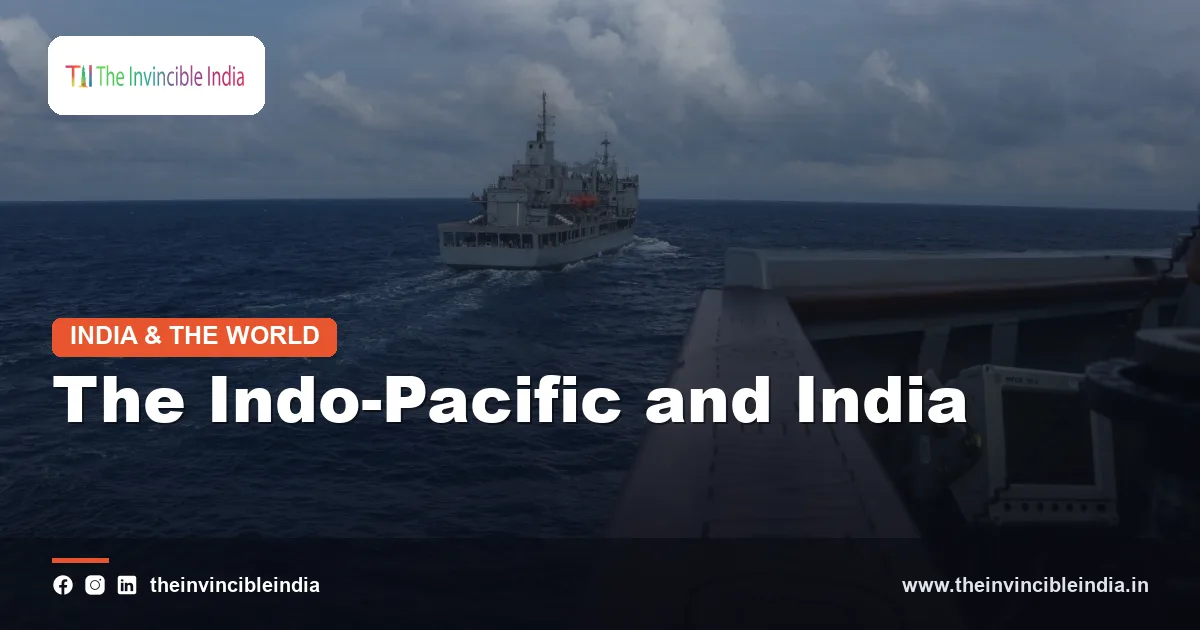
The Indo-Pacific is a strategic and geographical concept that links the Indian Ocean and the Pacific Ocean into one connected maritime region, stretching from the east coast of Africa to the western shores of the Americas. In the last two decades, the term has moved from academic writing into official policy documents across Asia, Europe and North America, and India has become one of its most active advocates.
For India, the Indo-Pacific is not an abstract idea. Most of India’s trade travels by sea, its energy imports cross the Indian Ocean, and its neighbourhood, its island territories and its economic partners all lie within this wider maritime space. This explainer covers the origin of the Indo-Pacific concept, India’s own maritime vision under SAGAR, the Indo-Pacific Oceans Initiative, the connection with the Quad and ASEAN, and the principles of freedom of navigation that underpin the debate.
Quick Facts
| Item | Details |
|---|---|
| Concept | A single strategic region linking the Indian and Pacific Oceans |
| India’s SAGAR vision | Security and Growth for All in the Region, articulated in Mauritius in March 2015 |
| Shangri-La Dialogue speech | Prime Minister Narendra Modi’s keynote on the Indo-Pacific, June 2018 |
| Indo-Pacific Oceans Initiative (IPOI) | Announced by India at the East Asia Summit, Bangkok, November 2019 |
| Indian Ocean grouping | Indian Ocean Rim Association (IORA), established in 1997 |
| Related groupings | Quadrilateral Security Dialogue (Quad), ASEAN, East Asia Summit |
| Legal basis for navigation | United Nations Convention on the Law of the Sea (UNCLOS), 1982 |
| India’s first tri-service command | Andaman and Nicobar Command, created in 2001 |
What Is the Indo-Pacific?
For much of the twentieth century, strategists and diplomats spoke of the “Asia-Pacific”, a term that centred on the Pacific rim and often left out South Asia and the Indian Ocean. As India’s economy grew and as maritime trade routes between the Gulf, Africa, South Asia and East Asia became more important, a broader term gained favour: the Indo-Pacific. It treats the two oceans as a single theatre because the economic and security links between them are so dense.
Geographic boundaries
There is no single agreed map of the Indo-Pacific. Different countries define its limits in different ways. India’s approach is wide, covering the area from the shores of Africa to the Pacific Islands, and it deliberately includes the Indian Ocean littoral states of Africa and West Asia. Some other countries start their definition further east. This flexibility is part of why the concept is described as a strategic framework rather than a formal region.
Why the term caught on
- The Indian and Pacific Oceans carry a very large share of global trade and a large share of the world’s energy shipments.
- Major economies, including India, Japan, China, South Korea, the United States and ASEAN members, are linked through these sea lanes.
- Key chokepoints such as the Strait of Malacca, the Strait of Hormuz and the Bab-el-Mandeb connect the two oceans.
- Rising naval capabilities and territorial disputes have sharpened attention on the maritime commons.
The Geography and Maritime Importance for India
India has a long coastline, a large exclusive economic zone and island territories, such as the Andaman and Nicobar Islands and Lakshadweep, which lie close to important shipping lanes. The Andaman and Nicobar archipelago sits at the western entrance to the Strait of Malacca, one of the busiest sea routes in the world. This geography gives India a natural position at the centre of the Indian Ocean.
Economic stakes
The sea is a vital economic space for India. Most of the country’s foreign trade by volume moves through ports, and a large part of its oil and gas imports arrive by tanker from the Gulf. Fisheries, offshore energy, seabed minerals and the growing blue economy all add to the importance of maritime stability. Any disruption in the Indian Ocean, such as piracy, conflict or blockage of a chokepoint, quickly affects Indian prices and supply chains.
Security stakes
India’s maritime security concerns include protecting its coastline after events such as the 2008 Mumbai attacks, safeguarding sea lanes, countering piracy and trafficking, responding to natural disasters and monitoring the growing presence of foreign navies in the region. These concerns shaped India’s naval modernisation and its cooperation with partner countries.
SAGAR: India’s Maritime Vision
India’s own articulation of a maritime strategy came in March 2015, when Prime Minister Narendra Modi unveiled SAGAR, which stands for Security and Growth for All in the Region, during a visit to Mauritius. The word “sagar” also means “ocean” in Hindi, which gave the policy a strong symbolic ring.
Elements of SAGAR
- Safeguarding India’s mainland and island territories and the safety of its maritime interests.
- Deepening economic and security cooperation with maritime neighbours and helping build their capacities.
- Promoting collective action to address common maritime challenges, including natural disasters and piracy.
- Pursuing sustainable regional development through the cooperative use of the oceans.
- Engaging with countries outside the region that have a stake in the Indian Ocean.
SAGAR marked a shift from a narrow, defence-focused view of the Indian Ocean towards a cooperative and development-oriented approach in which India acts as a net security provider. In 2025, India announced MAHASAGAR (Mutual and Holistic Advancement for Security and Growth Across Regions) as a wider successor idea, although SAGAR remains the best-known formulation of the earlier policy.
The Shangri-La Dialogue speech of 2018
India’s vision of the Indo-Pacific was spelt out in detail by Prime Minister Modi in his keynote address at the Shangri-La Dialogue in Singapore in June 2018. The speech described the Indo-Pacific as a “natural region” and set out the principles that India would follow.
Key messages
- The Indo-Pacific is free, open and inclusive, and is not a club of limited members.
- India does not view the concept as a strategy directed against any country or as a grouping seeking to dominate.
- ASEAN has a central role in the region’s institutions and architecture.
- Peaceful dispute resolution, respect for international law and a rules-based order are essential.
- Connectivity and trade should rest on transparency, sustainability and respect for sovereignty.
This speech is still widely cited as the clearest statement of India’s official position on the Indo-Pacific.
The Indo-Pacific Oceans Initiative (IPOI)
At the East Asia Summit in Bangkok in November 2019, Prime Minister Modi announced the Indo-Pacific Oceans Initiative, an open, non-treaty, global initiative aimed at creating cooperative maritime partnerships. It builds on existing regional structures and does not seek to replace them.
The seven pillars
| Pillar | Focus |
|---|---|
| Maritime security | Safe seas, information-sharing and counter-piracy cooperation |
| Maritime ecology | Marine environment, pollution control and protection of ocean habitats |
| Maritime resources | Sustainable fisheries and use of ocean resources |
| Capacity building and resource sharing | Training, technology and shared assets |
| Disaster risk reduction and management | Early warning and humanitarian response |
| Science, technology and academic cooperation | Ocean research and joint studies |
| Trade connectivity and maritime transport | Efficient ports, shipping and supply chains |
Under the initiative, individual countries take the lead on specific pillars, so that responsibility is shared and the programme does not appear to be run by one capital alone.
The Quad and the Indo-Pacific
The Quadrilateral Security Dialogue, or Quad, brings together India, Japan, the United States and Australia. Its roots go back to the joint relief work that the four navies undertook after the Indian Ocean tsunami of December 2004.
From early idea to revival
In August 2007, Japanese Prime Minister Shinzo Abe addressed the Indian Parliament and spoke of the “confluence of the two seas”, linking the Indian and Pacific Oceans. An informal Quad meeting followed in 2007, but the effort faded in 2008 amid hesitation among some members. The grouping was revived at the officials’ level in 2017, and its leaders met for the first time, virtually, in March 2021 and then in person in September 2021.
What the Quad does and does not do
The Quad’s agenda covers maritime security, supply chains, critical technologies, health cooperation, climate action and disaster relief. It is not a military alliance and has no mutual defence clause. India stresses that the Quad is one element of a wider and inclusive Indo-Pacific approach, not a replacement for broader regional institutions.
ASEAN Centrality and the Wider Architecture
India has repeatedly said that the Association of Southeast Asian Nations (ASEAN) should remain at the centre of the Indo-Pacific’s regional architecture. ASEAN-led forums such as the East Asia Summit, the ASEAN Regional Forum and the ASEAN Defence Ministers’ Meeting-Plus bring together large and small powers and provide a place for dialogue.
Look East to Act East
India’s engagement with Southeast Asia began with the Look East Policy in 1992 and was upgraded in 2014 to the Act East Policy, which puts more weight on action, connectivity and security cooperation. India became a full dialogue partner of ASEAN in 1996 and a member of the East Asia Summit at its start in 2005.
The ASEAN Outlook on the Indo-Pacific
In 2019, ASEAN adopted its own Outlook on the Indo-Pacific, which emphasises openness, inclusiveness, dialogue and respect for international law. India welcomed the document and found it broadly consistent with its own approach, in particular the emphasis on ASEAN centrality and the idea of cooperation rather than rivalry.
Freedom of Navigation and the Law of the Sea
A central theme of Indo-Pacific policy is the principle of freedom of navigation, meaning that ships and aircraft of all countries may use the seas and airspace in accordance with international law. The main legal basis is the United Nations Convention on the Law of the Sea (UNCLOS), signed in 1982 and in force since 1994, which sets out the rights of coastal states and others in territorial waters, exclusive economic zones and the high seas.
India’s position
India has ratified UNCLOS and supports the peaceful settlement of maritime disputes in line with international law. In its statements, it has called for respect for the freedom of navigation, overflight and unimpeded lawful commerce. India has also supported the idea of a code of conduct for the South China Sea that is consistent with UNCLOS, while saying that it does not take sides in the sovereignty disputes of other countries.
India’s Maritime Capabilities and Partnerships
To act as a credible partner in the region, India has invested in its naval power, its island infrastructure and its cooperation networks.
Military and institutional steps
- The Andaman and Nicobar Command, established in 2001, was India’s first integrated tri-service command.
- The Indian Navy has expanded its fleet with aircraft carriers, destroyers, frigates, submarines and long-range maritime patrol aircraft.
- The Information Fusion Centre for the Indian Ocean Region, set up near Gurugram in 2018, shares maritime security information with partner navies.
- The Indian Ocean Naval Symposium, launched in 2008 at India’s initiative, brings together navies of the region.
- The Malabar naval exercise, which began as a bilateral drill with the United States in 1992, now includes the other Quad members.
Logistics and facilities
India has signed logistics support agreements with several partners that allow navies to use each other’s ports and facilities for refuelling and supplies. It has also developed ports and infrastructure in neighbouring countries and in places such as Chabahar in Iran, and has built relations with island states in the Indian Ocean, including Mauritius, Seychelles, Maldives and Sri Lanka.
Regional cooperation: IORA, BIMSTEC and humanitarian missions
India also uses regional organisations in the Indian Ocean to pursue shared goals. The Indian Ocean Rim Association (IORA), formed in 1997 and including countries from Africa, West Asia, South Asia, Southeast Asia and Australia, is one such body. India has focused on maritime safety, the blue economy and disaster risk management within it. The Bay of Bengal Initiative for Multi-Sectoral Technical and Economic Cooperation (BIMSTEC) is another platform that links South Asia with Southeast Asia.
Humanitarian assistance and disaster relief
The Indian Navy has often been the first responder in the region after cyclones, earthquakes and tsunamis. It has delivered relief to neighbours, evacuated nationals during crises and joined anti-piracy patrols in the Gulf of Aden since 2008. This “first responder” role is a core part of India’s claim to be a net security provider and a trusted partner.
Debates, Challenges and Perspectives
The Indo-Pacific concept is not without debate. Different countries read the same words differently, and strategic competition, especially the growing naval and economic presence of China in the Indian Ocean, gives the region a charged atmosphere. Some observers see the Indo-Pacific framework as a balancing effort by several democracies, while others, including China, have criticised it as a bloc mentality. India’s stated position is that the Indo-Pacific is inclusive and that it works with many partners, including those who do not share all its views.
Key challenges for India
- Balancing close cooperation with Quad partners and the need to preserve strategic autonomy.
- Maintaining good relations with neighbours in South Asia at a time of growing external investment in the region.
- Expanding naval and surveillance capacities in line with ambitions.
- Combining security cooperation with development, climate and economic goals.
Conclusion
The Indo-Pacific has become one of the central ideas of contemporary international relations, and India has played a major role in shaping how it is understood. Through SAGAR, the Shangri-La address of 2018 and the Indo-Pacific Oceans Initiative, India has articulated a vision that is inclusive, rules-based and centred on cooperation, while also strengthening its own maritime power. As trade, technology and security increasingly meet at sea, India’s choices in the Indian Ocean and beyond will remain a vital part of the region’s story.
Frequently Asked Questions
What does Indo-Pacific mean?
The Indo-Pacific is a strategic concept that treats the Indian Ocean and the Pacific Ocean as a single, connected region because of their shared trade routes, energy flows and security concerns. Countries define its precise boundaries differently, and India uses a broad definition that stretches from the shores of Africa to the Pacific Islands.
What is SAGAR in Indian foreign policy?
SAGAR stands for Security and Growth for All in the Region. It was announced by Prime Minister Narendra Modi in Mauritius in March 2015 and sets out India’s cooperative approach to the Indian Ocean, including maritime security, capacity building for partners and sustainable development.
What is the Indo-Pacific Oceans Initiative?
The Indo-Pacific Oceans Initiative (IPOI) was announced by India at the East Asia Summit in Bangkok in November 2019. It is an open, non-treaty initiative built around seven pillars, including maritime security, maritime ecology, maritime resources, disaster risk reduction and trade connectivity.
How is the Quad connected to the Indo-Pacific?
The Quad brings together India, Japan, the United States and Australia to cooperate on maritime security, technology, supply chains and humanitarian assistance in the Indo-Pacific. It is not a military alliance, and India sees it as one element of a wider inclusive Indo-Pacific approach.
What does ASEAN centrality mean for India?
ASEAN centrality means that the Association of Southeast Asian Nations should remain at the heart of the region’s institutions, such as the East Asia Summit. India supports this principle and has aligned its Act East Policy and Indo-Pacific vision with it.
Why is freedom of navigation important to India?
Most of India’s trade and a large part of its energy imports travel by sea, so open and safe sea lanes are essential to its economy and security. India supports freedom of navigation under international law, especially the United Nations Convention on the Law of the Sea.


