

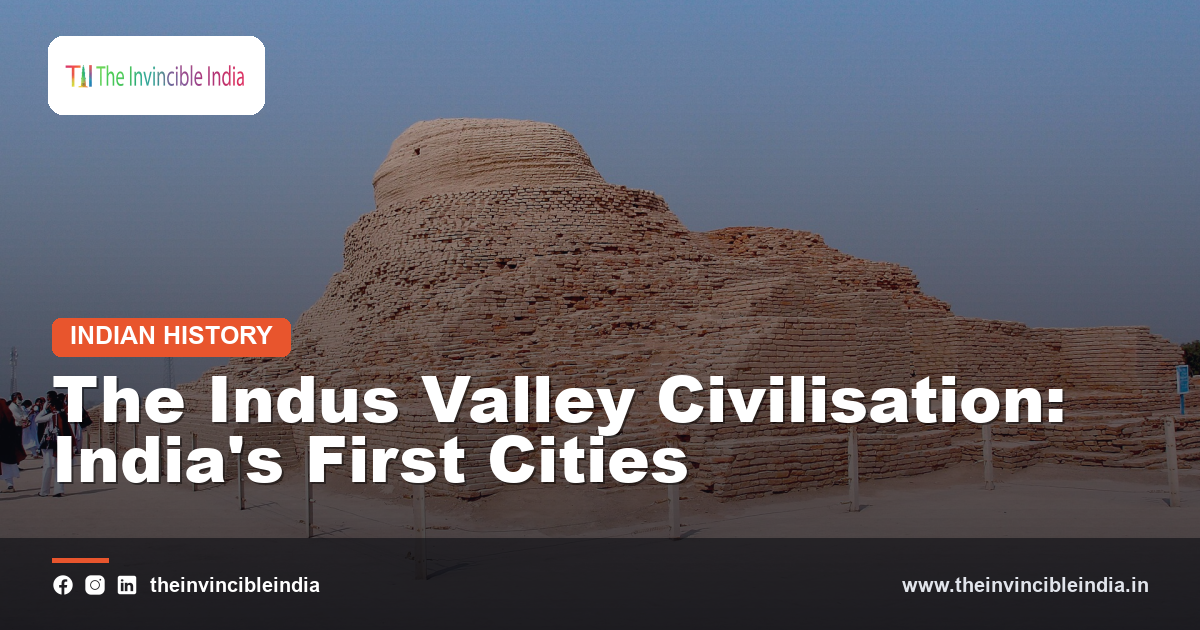
The Indus Valley Civilisation, also known as the Harappan Civilisation, was one of the earliest and greatest urban civilisations in the history of the world, flourishing thousands of years ago in the north-western regions of the Indian subcontinent. Contemporary with the ancient civilisations of Egypt and Mesopotamia, it was remarkable for its great, carefully planned cities, its advanced drainage and sanitation, its craftsmanship and trade, and its mysterious script that remains undeciphered to this day. Cities such as Harappa and Mohenjo-daro stand among the wonders of the ancient world, and the civilisation forms the very foundation of the long history of India. This guide explores the Indus Valley Civilisation, its cities, its achievements, its mystery and its legacy, the beginning of the great story of India’s history.
Quick Facts
| Detail | Information |
|---|---|
| Also known as | The Harappan Civilisation |
| Antiquity | One of the world’s earliest urban civilisations |
| Region | The north-western Indian subcontinent |
| Great cities | Harappa and Mohenjo-daro |
| Famed for | Planned cities, drainage and craftsmanship |
| Mystery | Its script remains undeciphered |
India's First Great Civilisation
The Indus Valley Civilisation was India’s first great civilisation and one of the earliest urban civilisations in the history of the world, flourishing thousands of years ago in the north-western regions of the Indian subcontinent. Contemporary with the ancient civilisations of Egypt and Mesopotamia, it was a remarkable civilisation of great planned cities, advanced organisation and fine craftsmanship, and it forms the very foundation of the long history of India. As one of the world’s earliest and greatest urban civilisations, remarkable for its cities and achievements and forming the foundation of Indian history, the Indus Valley Civilisation holds a place of profound importance and fascination in the story of India and of humanity.
The Discovery of a Lost World
For thousands of years the great cities of the Indus Valley lay buried and forgotten, and the civilisation was rediscovered only in modern times through archaeology, revealing a lost world of astonishing achievement. The excavation of the great mounds at Harappa and Mohenjo-daro in the early twentieth century revealed to an astonished world the existence of a vast and advanced ancient civilisation, previously unknown, and this discovery transformed the understanding of the ancient history of India. This rediscovery of a lost world is one of the great achievements of archaeology. This discovery of the lost world of the Indus Valley through the excavations of the twentieth century, revealing a vast and advanced ancient civilisation previously unknown, transformed the understanding of Indian history and is one of the great achievements of modern archaeology.
The Great Cities
The Indus Valley Civilisation is above all famed for its great cities, remarkable for their size, their careful planning and their advanced organisation, among the first true cities in the world. The cities were laid out on a planned grid of streets, with well-built houses of baked brick, granaries, public buildings, and remarkable systems of drainage and water supply, revealing a society of great organisation, prosperity and civic order. These great cities are the glory of the civilisation. These great cities of the Indus Valley, remarkable for their size, planning and organisation and among the first true cities in the world, are the glory of the civilisation, and the astonishing achievement of their builders in creating such advanced and well-ordered cities thousands of years ago is one of the wonders of the ancient world.
Harappa and Mohenjo-daro
The two greatest and most famous cities of the civilisation are Harappa and Mohenjo-daro, magnificent urban centres whose ruins reveal the greatness of the Indus Valley. These great cities, with their planned streets, their citadels and public buildings, their fine houses and their remarkable drainage, were major centres of the civilisation, home to large populations and to flourishing craft and trade, and their excavated ruins are among the most important archaeological sites in the world. Harappa and Mohenjo-daro are the crowning cities of the civilisation. These two great cities of Harappa and Mohenjo-daro, the most famous urban centres of the civilisation whose ruins reveal its greatness, are the crowning achievements of the Indus Valley, and their planned streets, public buildings and remarkable engineering make them among the most important and impressive sites of the ancient world.
Town Planning and Drainage
One of the most remarkable achievements of the Indus Valley Civilisation was its advanced town planning and its extraordinary systems of drainage and sanitation, unmatched in the ancient world. The cities were laid out on a planned grid, and they possessed remarkable covered drains along the streets, private wells and bathrooms in the houses, and great public baths, revealing a concern for cleanliness, water and civic order far ahead of their time. This town planning and drainage are among the wonders of the civilisation. This advanced town planning and the extraordinary systems of drainage and sanitation of the Indus Valley cities, revealing a concern for water, cleanliness and civic order far ahead of their time, are among the most remarkable achievements of the civilisation and one of the wonders of the ancient world.
Craft and Trade
The Indus Valley Civilisation was a prosperous society of skilled craftsmanship and flourishing trade, producing fine goods and trading them over great distances. The people were skilled in many crafts, making fine pottery, beads, ornaments, seals, tools and objects of metal, stone and other materials, and they carried on trade both within the civilisation and with distant lands, including the civilisations of Mesopotamia, revealing a prosperous and connected society. This craft and trade are important achievements of the civilisation. This prosperous life of skilled craftsmanship and flourishing trade, in which the people made fine goods and traded them over great distances, including with distant lands, is an important achievement of the Indus Valley Civilisation and reveals a wealthy, skilled and connected society.
The Famous Seals
Among the most famous and intriguing objects of the Indus Valley Civilisation are its seals, small carved objects bearing images and the mysterious script of the civilisation. These seals, usually of stone and beautifully carved with images of animals, figures and symbols, along with the characters of the Indus script, were probably used in trade and administration, and they are among the most important and evocative relics of the civilisation. The seals are a treasured and mysterious legacy. These famous seals of the Indus Valley, small carved objects bearing beautiful images of animals and figures along with the mysterious script, are among the most important and evocative relics of the civilisation, treasured both as works of craft and as clues to the life and mysteries of this ancient world.
The Undeciphered Script
One of the greatest mysteries of the Indus Valley Civilisation is its script, a system of writing found on the seals and other objects that has never been deciphered. The characters of the Indus script, though found in considerable numbers, remain unread, for the language they record is unknown and no key has been found to unlock them, so that the writing of the civilisation, and much of what it might tell us, remains a tantalising mystery. This undeciphered script is one of the great enigmas of the ancient world. This undeciphered script of the Indus Valley, a system of writing that has never been read and whose language remains unknown, is one of the greatest mysteries of the civilisation and one of the great enigmas of the ancient world, holding secrets that scholars still long to unlock.
Art and Culture
The Indus Valley Civilisation possessed a rich artistic and cultural life, revealed in its beautiful crafted objects, its figurines, and its evidence of belief and daily life. The people created fine figurines and sculptures, beautiful ornaments and pottery, and the famous seals with their images, revealing artistic skill and a rich culture, while other finds suggest their religious beliefs, their daily life and their social organisation. This art and culture reveal a sophisticated society. This rich artistic and cultural life of the Indus Valley, revealed in its beautiful figurines, ornaments, pottery and seals, and in the evidence of its beliefs and daily life, reveals a sophisticated and cultured society, and the artistic achievements of the civilisation are an important part of its greatness and its legacy.
A Peaceful and Ordered Society
The evidence of the Indus Valley suggests a remarkably peaceful, prosperous and well-ordered society, notable for its organisation, its uniformity and its apparent lack of great warfare. The careful planning and uniformity of the cities across a vast area, the evidence of prosperity and organised civic life, and the relative absence of the weapons and fortifications of a warlike society, suggest a civilisation of remarkable order, stability and peace. This peaceful and ordered character is a striking feature of the civilisation. This character of the Indus Valley as a remarkably peaceful, prosperous and well-ordered society, notable for its organisation and its apparent stability and peace, is a striking and admirable feature of the civilisation, and the order and prosperity it achieved are among the most impressive aspects of this ancient world.
The Decline of the Civilisation
After flourishing for many centuries, the Indus Valley Civilisation declined and its great cities were gradually abandoned, for reasons that remain debated among scholars. Over time the great cities fell into decline and were abandoned, and the urban civilisation came to an end, its causes uncertain but possibly including environmental and climatic changes, the shifting of rivers, and other factors, so that the decline of the civilisation, like its script, remains partly a mystery. This decline is a debated chapter in the story. This decline of the Indus Valley Civilisation, in which its great cities were gradually abandoned for reasons that remain debated, is a mysterious and much-discussed chapter in the story, and the causes of the end of this great urban civilisation are among the questions that scholars continue to explore.
The Legacy of the Indus Valley
The Indus Valley Civilisation left a profound legacy as the foundation of Indian civilisation, and elements of its culture may have contributed to the later traditions of India. Though the urban civilisation declined, it stands as the great beginning of the history of India, and scholars have suggested that aspects of its culture, crafts and perhaps beliefs may have contributed to the later civilisation of the subcontinent, so that its legacy endures. This legacy makes the civilisation deeply important. This profound legacy of the Indus Valley Civilisation as the foundation of Indian civilisation, and the possible contribution of its culture to the later traditions of India, make it deeply important, and it stands as the great and ancient beginning of the long and continuous story of Indian history and culture.
A Wonder of the Ancient World
The Indus Valley Civilisation stands today as one of the wonders of the ancient world, admired and studied for its achievements and treasured as a source of pride and fascination. Its great cities, its town planning and drainage, its craft and trade, its art and its mysteries continue to astonish and inspire, and it is recognised as one of the great civilisations of antiquity, studied by scholars from across the world and treasured by India as the beginning of its history. This standing as a wonder of the ancient world is the crown of its greatness. This standing of the Indus Valley Civilisation as one of the wonders of the ancient world, admired for its achievements and treasured as a source of pride and fascination, is the crown of its greatness, and the astonishing accomplishments of this ancient civilisation continue to inspire wonder across the world.
The Indus Valley in History
Today the Indus Valley Civilisation is celebrated as the great and ancient foundation of Indian history, one of the earliest and greatest urban civilisations in the world, endlessly studied and admired. Its great cities of Harappa and Mohenjo-daro, its remarkable town planning and drainage, its craft, trade and art, its famous seals and its undeciphered script continue to fascinate scholars and to fill India with pride in its ancient heritage. The wonder and mystery of the civilisation endure. As one of the world’s earliest and greatest urban civilisations, remarkable for its cities and achievements and forming the very foundation of Indian history, the Indus Valley Civilisation endures as one of the most important and fascinating chapters in the long story of India and of humanity.
Sources & Further Reading
- Archaeological Survey of India, on the Harappan sites of India (asi.nic.in).
- National Museum, New Delhi, on the Indus Valley Civilisation.
Frequently Asked Questions
What was the Indus Valley Civilisation?
The Indus Valley Civilisation, also called the Harappan Civilisation, was one of the world’s earliest and greatest urban civilisations, flourishing thousands of years ago in the north-western Indian subcontinent. It was famed for its great planned cities, advanced drainage and fine craftsmanship.
What were the great cities of the Indus Valley?
The two greatest and most famous cities of the Indus Valley Civilisation were Harappa and Mohenjo-daro, magnificent urban centres with planned streets, citadels, public buildings, fine houses and remarkable drainage, whose excavated ruins are among the most important archaeological sites in the world.
Why is the Indus script important?
The Indus script is the system of writing found on the seals and other objects of the civilisation. It is one of the great mysteries of the ancient world because it has never been deciphered, so the language and much of what it might tell us about the civilisation remain unknown.
What was special about Indus Valley town planning?
The Indus Valley cities were remarkable for their advanced town planning, laid out on a planned grid of streets, with well-built brick houses and extraordinary systems of covered drains, wells, bathrooms and public baths, revealing a concern for water and civic order far ahead of their time.
Why did the Indus Valley Civilisation decline?
After flourishing for many centuries, the Indus Valley Civilisation declined and its cities were gradually abandoned for reasons that remain debated, possibly including environmental and climatic changes and the shifting of rivers. The causes of its decline remain partly a mystery.


