

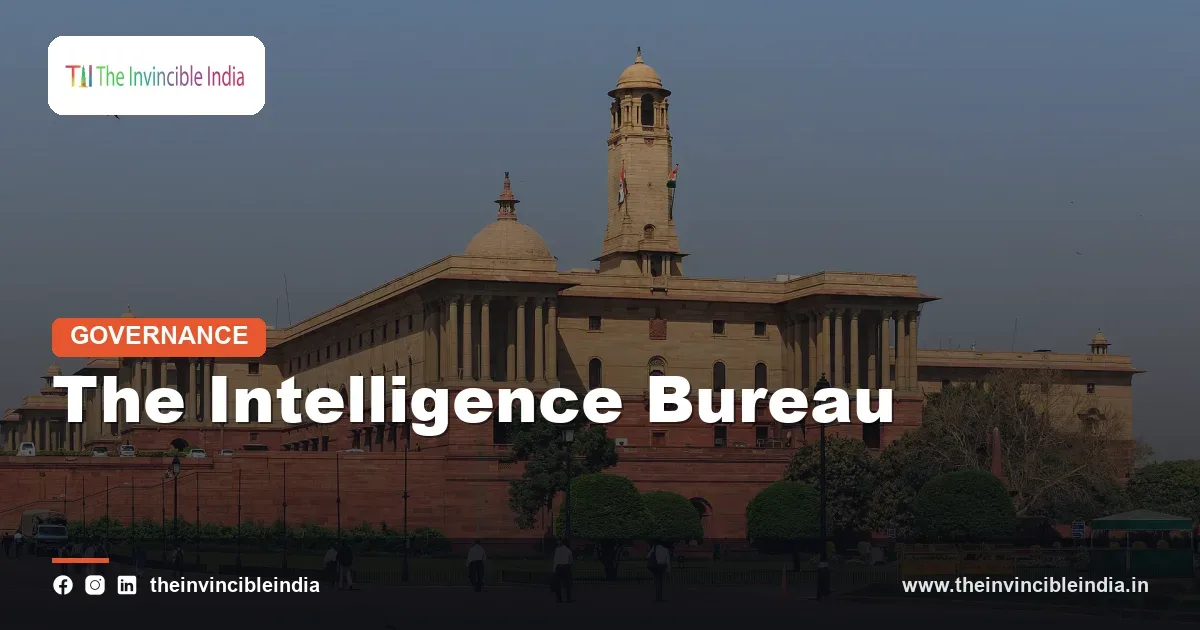
The Intelligence Bureau (IB) is India’s domestic intelligence agency, working under the Ministry of Home Affairs to collect and analyse intelligence on internal security threats and to carry out counter-intelligence within the country. Its institutional lineage is traced to 1887, which makes the Intelligence Bureau among the oldest intelligence organisations in the world, and it has served every government since Independence in 1947.
The Intelligence Bureau is headed by a Director, who is an Indian Police Service (IPS) officer, and it works alongside the Research and Analysis Wing (R&AW), which handles foreign intelligence. This explainer sets out, at a public and institutional level, how the Intelligence Bureau began, what it is mandated to do, how it is organised and how it is overseen. 9 October 2026
Intelligence Bureau at a Glance: Quick Facts
| Attribute | Details |
|---|---|
| Full name | Intelligence Bureau (IB), also called the Central Intelligence Bureau in older usage |
| Type | Domestic (internal) intelligence and counter-intelligence agency |
| Parent ministry | Ministry of Home Affairs, Government of India |
| Institutional lineage | Central Special Branch, 1887; reorganised as the Intelligence Bureau in 1920 |
| Head | Director, Intelligence Bureau, an IPS officer |
| Headquarters | New Delhi |
| Counterpart for foreign intelligence | Research and Analysis Wing (R&AW), formed in 1968 |
| Constitutional reference | Entry 8, Union List, Seventh Schedule (“Central Bureau of Intelligence and Investigation”) |
| Key legal provisions | Intelligence Organisations (Restriction of Rights) Act, 1985; Second Schedule of the Right to Information Act, 2005 |
Key Takeaways
- The Intelligence Bureau is India’s internal intelligence agency and functions under the Ministry of Home Affairs.
- The institutional roots of the Intelligence Bureau go back to the Central Special Branch of 1887, and the body was reorganised as the Intelligence Bureau in 1920.
- The Director of the Intelligence Bureau is traditionally an Indian Police Service officer appointed by the Government of India for a fixed term.
- Foreign intelligence has been the responsibility of the Research and Analysis Wing since 1968, while the Intelligence Bureau concentrates on threats inside India.
- The Intelligence Bureau is not created by a dedicated Act of Parliament, and it is listed in the Second Schedule of the Right to Information Act, 2005, which exempts it from most disclosure obligations.
- Employees of the Intelligence Bureau are subject to restrictions on certain rights under the Intelligence Organisations (Restriction of Rights) Act, 1985, made under Article 33 of the Constitution.
What Is the Intelligence Bureau of India?
The Intelligence Bureau of India is the country’s principal agency for internal security intelligence, set up to give the executive early and reliable assessments of threats that originate or develop inside the country. It is a civilian organisation, attached to the Ministry of Home Affairs, and it is separate from the armed forces’ own intelligence directorates and from the police forces of the states.
In everyday usage the Intelligence Bureau is simply called the IB. Its work is primarily advisory: it gathers information, assesses it and passes it to the Union Home Minister, the Prime Minister’s Office and other authorised users in government. It is not a law enforcement body in the way the Central Bureau of Investigation or the National Investigation Agency is, and the investigation and prosecution of crimes remain with the police and those agencies.
The organisation is widely understood to function through a headquarters in New Delhi and a network of regional and state-level units, known as Subsidiary Intelligence Bureaus, which work in coordination with state police intelligence branches. This structure reflects India’s federal setting, in which law and order is mainly a state subject but national security intelligence needs a central coordinating agency.
How Did the Intelligence Bureau Begin?
The Intelligence Bureau began in the colonial period, and its earliest institutional ancestor is the Central Special Branch, created by the British Indian government in 1887. The initial concern of that body was the movement of external powers on the frontiers of British India and the activities of persons considered a threat to colonial rule.
In the early twentieth century, intelligence work expanded as the nationalist movement grew and as the First World War raised fears of foreign-inspired conspiracies. In 1920 the colonial administration reorganised its central intelligence functions as the Intelligence Bureau under the Home Department. The organisation therefore existed as a central institution decades before India became independent.
After 1947 the Indian government retained the institution and placed it under the Ministry of Home Affairs. T. G. Sanjeevi Pillai is generally recorded as the first Indian to head the organisation, and B. N. Mullik, who led it from 1950 to 1964, is remembered as the Director who shaped the post-Independence Intelligence Bureau during the Nehru years. Until 1968, the Intelligence Bureau also carried responsibility for gathering foreign intelligence, a function later transferred to a new agency.
Timeline of the Intelligence Bureau
| Year | Development |
|---|---|
| 1887 | Central Special Branch established by the British Indian government |
| 1920 | Central intelligence functions reorganised as the Intelligence Bureau |
| 1947 | Independence; the Intelligence Bureau continues under the Home Ministry of the Government of India |
| 1950 | B. N. Mullik becomes Director, serving until 1964 |
| 1968 | Foreign intelligence split from the Intelligence Bureau with the creation of R&AW |
| 1985 | Intelligence Organisations (Restriction of Rights) Act enacted |
| 1999 | Multi Agency Centre set up in the Intelligence Bureau after the Kargil conflict |
| 2005 | Right to Information Act places the Intelligence Bureau in its Second Schedule |
| 2009 | Multi Agency Centre strengthened following the November 2008 Mumbai attacks |
What Is the Mandate of the Intelligence Bureau?
The mandate of the Intelligence Bureau is to collect, analyse and share intelligence relating to the internal security of India, and to protect the country against espionage and subversion by hostile actors. Because the organisation was not founded under a specific statute, its functions are defined by executive orders and government practice rather than by a legislative charter.
In public descriptions, the work of the Intelligence Bureau falls under a few broad heads:
- Internal security intelligence: assessments on terrorism, insurgency, extremist violence, communal tension and other threats to public order.
- Counter-intelligence: protecting the country against espionage and the activities of foreign agencies on Indian soil.
- Counter-terrorism coordination: sharing threat inputs with state police forces and central agencies.
- Security-related verification: assisting government in matters such as security vetting where required by rules.
- Advice to the executive: briefing the Home Minister, the Home Secretary and the Prime Minister’s Office on developments of national security significance.
The Seventh Schedule of the Constitution lists “Central Bureau of Intelligence and Investigation” as Entry 8 of the Union List, which gives Parliament the exclusive power to legislate on that subject. This entry is generally read as the constitutional basis for central intelligence work, even though Parliament has not passed a single statute defining the Intelligence Bureau.
How Is the Intelligence Bureau Organised and Who Heads It?
The Intelligence Bureau is headed by a Director, who is an Indian Police Service officer and who reports to the Union Home Minister and, on matters of national security, works closely with the Prime Minister and the National Security Adviser. The Director is appointed by the Government of India, with the approval of the Appointments Committee of the Cabinet, for a fixed tenure in line with the practice followed for other senior security posts.
Below the Director, the organisation is arranged in functional wings and regional units. Public knowledge of the internal structure is limited by design, but the broad outline is well established:
- A central headquarters in New Delhi that coordinates analysis, administration and liaison with other agencies.
- Subsidiary Intelligence Bureaus in state capitals and other important locations, which liaise with state police Special Branches and Criminal Investigation Departments.
- Specialist technical and analytical staff supporting the collection and assessment of information.
- Officers drawn on deputation from the IPS and from state and central police services, working alongside a permanent cadre of intelligence officers.
The identity of serving officers other than the Director is kept confidential, and for this reason this article does not discuss individual officials beyond historical figures.
How Is the Intelligence Bureau Different From R&AW and Other Agencies?
The Intelligence Bureau differs from the Research and Analysis Wing mainly in geography and reporting line: the Intelligence Bureau looks at threats inside India and reports through the Home Ministry, whereas R&AW looks at external threats and functions under the Cabinet Secretariat. This division of labour was formalised in 1968, when foreign intelligence work was separated from the Intelligence Bureau after the experience of the 1962 war with China and the 1965 war with Pakistan.
The table below places the Intelligence Bureau in the wider Indian intelligence landscape at a general, public level.
| Agency | Primary focus | Placement |
|---|---|---|
| Intelligence Bureau (IB) | Internal security intelligence and counter-intelligence | Ministry of Home Affairs |
| Research and Analysis Wing (R&AW) | External and foreign intelligence | Cabinet Secretariat |
| Defence Intelligence Agency (DIA) | Military intelligence for the armed forces | Ministry of Defence |
| National Investigation Agency (NIA) | Investigation and prosecution of terror and related offences | Ministry of Home Affairs |
| Central Bureau of Investigation (CBI) | Criminal and anti-corruption investigation | Government of India, Department of Personnel and Training |
The Joint Intelligence Committee, which sits within the National Security Council Secretariat, brings together assessments from the different agencies so that the executive receives a coordinated picture rather than separate, competing reports.
Who Oversees the Intelligence Bureau?
The Intelligence Bureau is overseen primarily by the executive branch of government, with the Union Home Minister and the Prime Minister holding the principal supervisory role. Unlike the armed forces or regular ministries, the Intelligence Bureau does not have a dedicated parliamentary committee that reviews its work in detail, and its budget is not itemised in public documents in the way other departments’ budgets are.
Several layers of accountability nonetheless operate in practice:
- Executive control: the Director reports to the Home Minister and the Home Secretary, and key appointments are cleared at the level of the Appointments Committee of the Cabinet.
- Budgetary control: expenditure is sanctioned through the government’s financial process, although it is not itemised in public documents.
- Judicial review: actions of any government body, including intelligence-linked actions affecting individual rights, can be examined by constitutional courts through writ petitions.
- Coordination structures: the National Security Adviser and the National Security Council Secretariat help integrate and review intelligence inputs.
The question of statutory parliamentary oversight of intelligence agencies has been discussed repeatedly in public debate and in proposals introduced by individual legislators, but no comprehensive law on the subject has been enacted. Supporters of oversight argue that it would improve accountability, while others stress the need to protect secrecy, and this explainer records the debate without taking a side.
What Is the Legal Status of the Intelligence Bureau?
The Intelligence Bureau has no founding Act of Parliament, but its staff and its disclosure obligations are touched by two important laws. The Intelligence Organisations (Restriction of Rights) Act, 1985, was passed under Article 33 of the Constitution, which allows Parliament to restrict or abrogate certain fundamental rights of members of forces charged with maintaining public order and of persons employed in intelligence organisations.
The Act restricts rights such as forming associations or unions and communicating information to the press, in order to preserve discipline and secrecy. The Intelligence Bureau is one of the organisations to which the Act applies.
The Right to Information Act, 2005 lists the Intelligence Bureau in its Second Schedule under Section 24, which exempts the listed organisations from the Act’s general disclosure requirements. The same provision states that information relating to allegations of corruption and human rights violations cannot be withheld on this ground, although in the case of human rights violations, the Central Information Commission’s approval is needed before information is provided.
How Are Intelligence Bureau Officers Recruited?
Officers of the Intelligence Bureau come from two broad streams: officers on deputation from the Indian Police Service and other services, and officers recruited directly into the organisation’s own cadre. The leadership has historically been drawn from IPS officers belonging to different state cadres, who serve in the Intelligence Bureau for extended periods during their careers.
Direct recruitment into the Intelligence Bureau is conducted at the level of Assistant Central Intelligence Officer and other grades, generally through competitive examinations announced by the Ministry of Home Affairs. The entry route allows graduates, and for some technical posts, those with specialised qualifications, to build a career within the organisation. Because the roles are sensitive, candidates are subject to thorough background verification, and serving personnel operate under the secrecy rules and the rights restrictions described above.
What Coordination Reforms Followed Kargil and the 26/11 Attacks?
After the 1999 Kargil conflict and the November 2008 Mumbai attacks, the Government of India reorganised the way different intelligence agencies share information, and the Intelligence Bureau was placed at the centre of several of the new mechanisms. These reforms followed the recommendations of the Kargil Review Committee and the Group of Ministers constituted in 2000-2001 to examine national security management.
- Multi Agency Centre (MAC): created in the Intelligence Bureau in 1999 to bring together inputs from central and state agencies, and expanded after 2008 with links to state-level units.
- National Intelligence Grid (NATGRID): proposed after the Mumbai attacks as a mechanism to give authorised agencies faster access to government and other databases for counter-terrorism purposes.
- National Security Council system: a structure that includes a Joint Intelligence Committee to consolidate assessments for the Prime Minister and the executive.
These measures illustrate the shift from an approach in which each agency guarded its own information to one that encourages shared databases and joint assessment. The details of how they operate are not publicly documented, and only the general design is discussed here.
Why Does the Intelligence Bureau Matter?
The Intelligence Bureau matters because internal security and the stability of institutions in a country of India’s size and diversity depend on timely, reliable information reaching decision makers. The agency is one of the standing institutions of the Indian state that has continued across changes of government since before 1947.
Its existence also raises enduring questions of democratic governance: how to balance secrecy and national security with accountability, individual liberty and public trust. Discussions about intelligence reform in India, whether concerning legal charters, oversight committees or privacy protections, almost always involve the Intelligence Bureau, because it is the principal domestic agency. Understanding its history, mandate and legal position helps readers follow those debates on the basis of facts.
Bottom Line
The Intelligence Bureau is India’s long-standing domestic intelligence agency, descended from the Central Special Branch of 1887 and placed under the Ministry of Home Affairs since Independence. It focuses on internal security and counter-intelligence, is headed by an IPS officer, operates alongside R&AW for foreign intelligence, and is governed by executive control rather than a dedicated statute.
Frequently Asked Questions
What is the Intelligence Bureau of India?
The Intelligence Bureau is India’s domestic intelligence agency, responsible for internal security intelligence and counter-intelligence. It functions under the Ministry of Home Affairs and advises the Home Minister, the Prime Minister’s Office and other authorised users in government. Its lineage is traced to the Central Special Branch of 1887.
Who heads the Intelligence Bureau?
The Intelligence Bureau is headed by a Director, who is an Indian Police Service officer appointed by the Government of India. The appointment is cleared by the Appointments Committee of the Cabinet and carries a fixed tenure under current practice. The Director reports to the Union Home Minister and works closely with the National Security Adviser.
What is the difference between the IB and R&AW?
The Intelligence Bureau handles intelligence about threats inside India, while the Research and Analysis Wing handles intelligence about external threats. The IB works under the Ministry of Home Affairs, whereas R&AW functions under the Cabinet Secretariat. The two were separated in 1968, when R&AW was formed.
Is the Intelligence Bureau covered by the Right to Information Act?
The Intelligence Bureau is listed in the Second Schedule of the Right to Information Act, 2005, which exempts it from most disclosure requirements. Under Section 24, information relating to allegations of corruption and human rights violations is not covered by this exemption, although for human rights matters the approval of the Central Information Commission is required.
Does the Intelligence Bureau have the power to arrest people?
The Intelligence Bureau is an intelligence-gathering and advisory body, and it is not a law enforcement agency with a statutory charter to investigate and prosecute offences. Arrests and criminal investigations are carried out by the police and by investigating agencies such as the National Investigation Agency and the Central Bureau of Investigation, acting under the relevant laws.
Is the Intelligence Bureau accountable to Parliament?
The Intelligence Bureau is accountable mainly to the executive through the Home Minister and the Prime Minister, and there is no dedicated parliamentary committee with statutory oversight of its work. Proposals for legislative oversight of intelligence agencies have been raised in public debate, but no comprehensive law has been enacted so far.
{“@context”:”https://schema.org”,”@graph”:[{“@type”:”FAQPage”,”mainEntity”:[{“@type”:”Question”,”name”:”What is the Intelligence Bureau of India?”,”acceptedAnswer”:{“@type”:”Answer”,”text”:”The Intelligence Bureau is India’s domestic intelligence agency, responsible for internal security intelligence and counter-intelligence. It functions under the Ministry of Home Affairs and advises the Home Minister, the Prime Minister’s Office and other authorised users in government. Its lineage is traced to the Central Special Branch of 1887.”}},{“@type”:”Question”,”name”:”Who heads the Intelligence Bureau?”,”acceptedAnswer”:{“@type”:”Answer”,”text”:”The Intelligence Bureau is headed by a Director, who is an Indian Police Service officer appointed by the Government of India. The appointment is cleared by the Appointments Committee of the Cabinet and carries a fixed tenure under current practice. The Director reports to the Union Home Minister and works closely with the National Security Adviser.”}},{“@type”:”Question”,”name”:”What is the difference between the IB and R&AW?”,”acceptedAnswer”:{“@type”:”Answer”,”text”:”The Intelligence Bureau handles intelligence about threats inside India, while the Research and Analysis Wing handles intelligence about external threats. The IB works under the Ministry of Home Affairs, whereas R&AW functions under the Cabinet Secretariat. The two were separated in 1968, when R&AW was formed.”}},{“@type”:”Question”,”name”:”Is the Intelligence Bureau covered by the Right to Information Act?”,”acceptedAnswer”:{“@type”:”Answer”,”text”:”The Intelligence Bureau is listed in the Second Schedule of the Right to Information Act, 2005, which exempts it from most disclosure requirements. Under Section 24, information relating to allegations of corruption and human rights violations is not covered by this exemption, although for human rights matters the approval of the Central Information Commission is required.”}},{“@type”:”Question”,”name”:”Does the Intelligence Bureau have the power to arrest people?”,”acceptedAnswer”:{“@type”:”Answer”,”text”:”The Intelligence Bureau is an intelligence-gathering and advisory body, and it is not a law enforcement agency with a statutory charter to investigate and prosecute offences. Arrests and criminal investigations are carried out by the police and by investigating agencies such as the National Investigation Agency and the Central Bureau of Investigation, acting under the relevant laws.”}},{“@type”:”Question”,”name”:”Is the Intelligence Bureau accountable to Parliament?”,”acceptedAnswer”:{“@type”:”Answer”,”text”:”The Intelligence Bureau is accountable mainly to the executive through the Home Minister and the Prime Minister, and there is no dedicated parliamentary committee with statutory oversight of its work. Proposals for legislative oversight of intelligence agencies have been raised in public debate, but no comprehensive law has been enacted so far.”}}]}]}


