

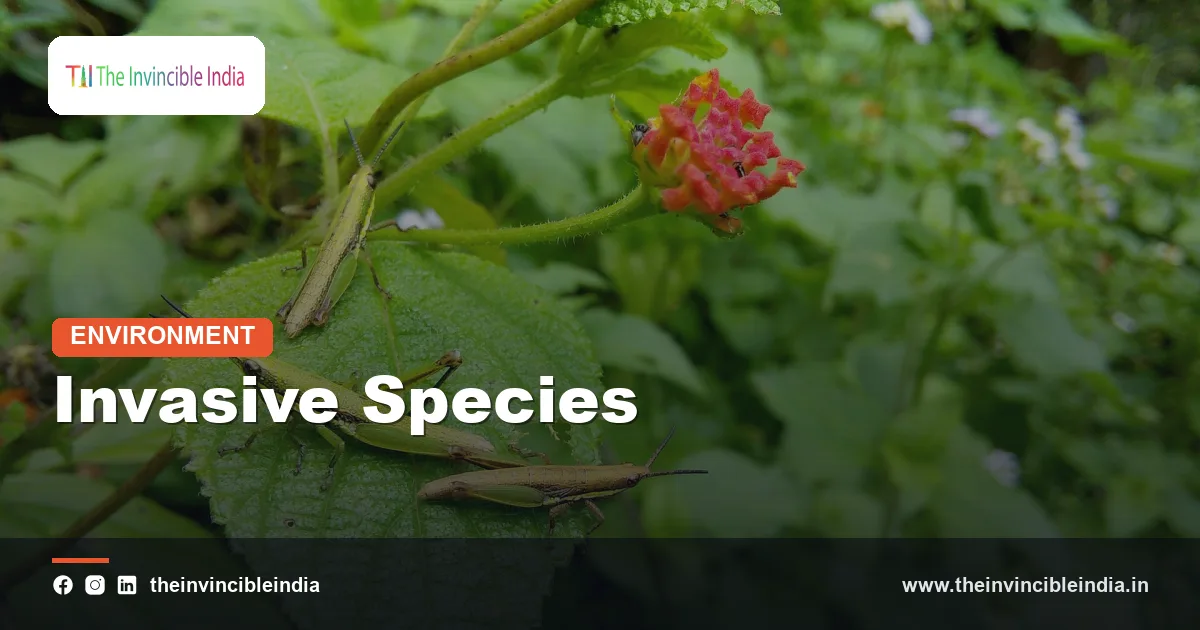
Invasive species are non-native plants, animals, fungi or microbes that have been carried by people into a new region, where they spread aggressively and harm native ecosystems, economies or human health. India has many of them, from the lantana thickets that choke its forests and the Prosopis juliflora scrub that has swallowed grasslands, to the water hyacinth that blankets its lakes, the Parthenium weed in its fields and the African catfish in its rivers.
This explainer sets out what makes a species invasive, how these species reached India, which ones do the most damage, what they do to ecosystems and livelihoods, and how India manages them. Last updated: 3 November 2026. Dates of introduction and areas covered are kept qualitative or hedged, since estimates vary between studies and some species are still spreading.
| Topic | Invasive alien species in India |
|---|---|
| Definition | Non-native species that establish, spread and cause ecological, economic or health harm |
| Well-known plants | Lantana, Prosopis juliflora, water hyacinth, Parthenium (congress grass), Mikania, Chromolaena, Senna spectabilis |
| Well-known animals | African catfish, tilapia, suckermouth catfish, golden apple snail, giant African snail, red-eared slider |
| Main pathways | Ornamental trade, forestry and soil-conservation planting, contaminated grain imports, aquaculture, aquarium and pet trade, ships |
| Main impacts | Loss of native plants and fish, reduced fodder, choked water bodies, crop losses, health effects |
| Legal hooks | Biological Diversity Act, plant and animal quarantine rules, and invasive species provisions added to the Wildlife (Protection) Act in 2022 |
| Management tools | Prevention, early detection, manual removal, biological control, habitat restoration, use of removed biomass |
Key Takeaways
- Invasive species are non-native organisms that spread and cause harm, and not every introduced species becomes invasive.
- Many of India’s worst invaders were deliberately introduced, such as lantana as a garden plant and Prosopis juliflora for fuelwood and greening.
- Invasive plants such as lantana and Prosopis degrade forests and grasslands, reducing food for herbivores and pushing wildlife and people into closer conflict.
- Water hyacinth, apple snails and alien fish damage wetlands, rice fields and fisheries, adding to the pressures behind wetland loss.
- Prevention is far cheaper than cure, because once an invader is widespread, complete removal is rarely possible.
- Control works best when it combines early detection, community labour, biological control where proven, and restoring native vegetation after removal.
What is an invasive species?
An invasive species is a non-native organism that has been introduced to a new area, established wild populations and begun to spread in ways that harm native biodiversity, livelihoods or health. The key word is harm. Plenty of introduced species, such as many food crops and garden plants, live quietly alongside native life, and the term invasive applies only to the small share that run out of control.
Ecologists often describe invasion in stages: arrival, establishment, spread and impact. Species succeed when they find few natural enemies in their new home, reproduce quickly, tolerate a range of conditions or release chemicals that suppress neighbours. Terms such as alien, exotic and introduced are often used loosely as synonyms, while native weeds, which are local species that boom under disturbance, are a different phenomenon. The distinction matters in India, where a country-specific list of high-risk invaders is still being developed and where some species widely called weeds are in fact native.
How do invasive species reach India?
Invasive species reach India through human activity, mostly through deliberate introductions for gardens, forestry, farming and fisheries, and also through accidental arrivals as stowaways and contaminants. India’s long trade links and its history of colonial botanical exchange made it an early destination for many plants, some of which escaped from botanical gardens and estates.
The main pathways can be grouped. Ornamental horticulture brought lantana and water hyacinth. Forestry and soil conservation brought Prosopis juliflora, Australian acacias and eucalyptus. Contaminated imports carried Parthenium, which is widely reported to have arrived in the 1950s in grain shipments. Aquaculture and the aquarium trade introduced African catfish, tilapia, suckermouth catfish and red-eared sliders. Ships spread species in ballast water and on hulls. Climate change and disturbed habitats help these species along, and online trade in exotic pets and plants is a growing route that is hard to monitor.
Which plants are India’s worst invaders?
India’s most notorious invasive plants include lantana, Prosopis juliflora, water hyacinth and Parthenium, along with Mikania, Chromolaena and, more recently, Senna spectabilis. Lantana camara, native to tropical America, was brought as an ornamental in the early nineteenth century and now forms dense thickets across forests in most states, from the Himalayan foothills to the Western Ghats. Its tangled growth suppresses grasses and young trees, and it burns readily, which changes forest fire patterns.
Prosopis juliflora, the thorny tree called vilayati babool or seemai karuvelam, was introduced from Central and South America and was promoted in arid regions for fuelwood and green cover, in some places by aerial seeding. It spread into the Banni grasslands of Kutch, parts of Tamil Nadu and Rajasthan, and into the Keoladeo wetland, drawing down groundwater and displacing grasses. Water hyacinth, a floating plant from the Amazon basin, arrived in the late nineteenth century and doubles quickly in warm, nutrient-rich water. Parthenium hysterophorus, called congress grass or gajar ghas, spreads along roadsides and fields. Mikania micrantha, nicknamed mile-a-minute, smothers trees and plantations in Kerala and the north-east, and Senna spectabilis has been spreading through forests in the southern states.
Which animals are invasive in India?
The most damaging invasive animals in India are mostly aquatic, including the African catfish, tilapia, suckermouth or armoured catfish, the golden apple snail and the giant African snail, along with the red-eared slider turtle. The African catfish, Clarias gariepinus, is a voracious predator that was promoted for fish farming but escapes into rivers and wetlands, where it eats native fish, and it was banned for culture in India around the turn of the century. Mozambique tilapia, introduced for fisheries, now dominates waters in parts of South India and competes with local species.
The giant African snail reached India in the nineteenth century and eats a wide range of crops and ornamentals. Apple snails, notably in rice-growing regions of Kerala, Assam and elsewhere, devour young rice seedlings and aquatic plants. Suckermouth catfish, discarded from the aquarium trade, now live in waters around Kolkata and in southern rivers, where they burrow into banks and outcompete native fish. On islands, introduced herbivores such as the spotted deer in the Andamans are reported to alter vegetation. Many other invaders are tiny, including crop pests such as the fall armyworm, first recorded in India in 2018.
What harm do invasive species cause?
Invasive species cause harm by outcompeting native species, altering habitats, spreading disease and costing farmers, fishers and governments large sums. In forests, a carpet of lantana or Senna replaces the grasses and herbs on which deer, gaur and elephants graze, so animals may range into fields in search of food, which increases human-wildlife conflict. Researchers have also linked heavy invasion with changes to soil chemistry and fire regimes, though the strength of these effects varies by site.
In water, floating weeds block sunlight, reduce oxygen, hinder boats and irrigation channels, and raise mosquito breeding, while invasive fish may displace native carps, mahseer and small indigenous fish that local people eat. On farmland, weeds such as Parthenium reduce crop yields and can trigger dermatitis and respiratory allergies in humans and livestock. Global modelling studies place India among the countries bearing very high cumulative costs from biological invasions, though such estimates are rough and likely understate the true burden. Invaders also deepen other crises: they add stress to wetlands already shrinking from drainage and make forest restoration harder.
| Species | Origin | Habitat hit | Main damage |
|---|---|---|---|
| Lantana | Tropical America | Forests, scrub, tiger reserves | Suppresses grasses and saplings; fuels fire |
| Prosopis juliflora | Central and South America | Grasslands, dry lands, wetland edges | Displaces native grasses; draws on groundwater |
| Water hyacinth | South America | Lakes, ponds, canals | Blocks light and oxygen; chokes fisheries and boats |
| Parthenium | Tropical America | Farms, roadsides, wasteland | Crop loss; skin and breathing allergies |
| African catfish | Africa | Rivers, ponds, wetlands | Preys on native fish |
| Golden apple snail | South America | Rice fields, wetlands | Eats seedlings and water plants |
Why is Prosopis juliflora so controversial?
Prosopis juliflora is controversial because it is both a destructive invader and a lifeline fuel and fodder source for many poor rural families. The tree was promoted for decades as the green answer to desertification, and it does grow where little else will, producing firewood, charcoal and pods that livestock eat. In regions of Tamil Nadu, Gujarat and Rajasthan, people have built whole charcoal-making economies around it.
The costs are heavy, though. Its dense stands shade out native grasses and herbs that pastoralists rely on, its deep roots draw down water, and its thorns injure people and animals. In Kutch’s Banni grassland, a classic pastoral landscape, the tree has covered large areas and reduced the quality of grazing. Court orders and state programmes in Tamil Nadu have called for its removal, while others argue for managed use through charcoal, power generation and restoration. The Prosopis debate is a reminder that invasive species management involves livelihood trade-offs, not only ecology, and removal plans work better when a replacement income is available.
Are native species also hurt by invasive plants like lantana?
Yes, native species are hurt by invasive plants like lantana, because the invaders change food supply, shelter and the structure of habitats on which native wildlife depends. Dense lantana can crowd out native grasses and shrubs, reducing browse for deer and other grazers, and it has been reported across many tiger reserves and other protected areas. Fewer prey animals in a forest can mean pressure on predators and shifts in how animals use space.
The picture is nuanced. Some birds and insects use lantana for nectar and cover, and it provides shelter to small animals, so a simple removal drive can have mixed local effects. The trade-off is that lantana is rarely a replacement for the diversity it displaces. Ecologists argue that where restoration is the goal, clearing must be followed by active replanting of native grasses and trees, or the weed returns. Success stories from places such as the Nilgiris, Mudumalai and Bandipur include removing lantana by hand and restoring grassland, though these require repeated effort over several years.
How does India control invasive species?
India controls invasive species through a mix of quarantine rules, manual removal, biological control and habitat restoration, though a single national strategy is still developing. At the border, plant and animal quarantine rules aim to stop dangerous pests and diseases entering, and the 2022 amendment to the Wildlife (Protection) Act added provisions allowing the central government to regulate or restrict the import, trade, possession and spread of invasive alien species. The Biological Diversity Act and the National Biodiversity Action Plan also point to the issue.
In the field, forest departments and community groups uproot lantana, Senna and Mikania by hand and use cut-and-treat methods on woody invaders such as Prosopis. Biological control has had notable successes: the Mexican beetle Zygogramma bicolorata has helped suppress Parthenium in some areas, weevils have controlled water hyacinth in many water bodies, and a weevil brought in against the floating fern Salvinia molesta was credited with clearing it in parts of Kerala. Care is needed, because any released control agent must be tested to ensure it does not attack crops or native plants. Under the global Kunming-Montreal biodiversity framework, India has also committed in principle to reducing the spread of invasive species.
Does climate change make biological invasions worse?
Climate change is expected to make biological invasions worse in many places, because warmer temperatures, altered rainfall and more frequent disturbance often favour fast-growing, adaptable invaders over slower native species. Higher carbon dioxide levels can boost the growth of some weeds, and warmer winters let tropical pests and plants creep to higher altitudes, so hill and mountain ecosystems that were once too cold for lantana or Parthenium may become suitable. Researchers modelling the future spread of lantana and other weeds in India have generally projected suitable habitat expanding in the Himalaya and the north-east, although the details depend on the model.
Extreme events add to the problem. Floods carry seeds and fragments of aquatic weeds along river systems, cyclones and landslides open up bare ground, and drought-stressed forests are easier for weedy species to colonise. Fires, which are becoming more common in many Indian forests, tend to favour invaders that regrow quickly. This is why invasive species management is increasingly treated as part of climate adaptation. Healthy, intact native forests, grasslands and wetlands resist invasion better than degraded ones, so protecting and restoring them is one of the most reliable defences.
Can invasive species be put to use?
Some invasive species can be put to productive use, which can fund control, but use should never become a reason to protect or spread the invader. Lantana stems are made into furniture and handicrafts by tribal communities in the Nilgiris, Corbett and elsewhere, while Prosopis wood is used for charcoal and fuel, and dried water hyacinth is turned into paper, rope, baskets and compost or biogas feedstock. Pods of Prosopis have been processed for animal feed in some trials.
Such uses can create jobs and make clearing economically attractive, especially where removal would otherwise cost a lot. Yet the risk is that people come to depend on the weed and resist eradication, or seeds are spread during harvest and transport. The best-practice approach is to treat harvesting as a tool for removal, ensure that biomass is processed in ways that destroy seeds, and combine it with restoration so that the long-term goal remains a healthy native ecosystem. Citizens can help too, by not planting known invasive ornamentals, not releasing pet turtles or aquarium fish into the wild and reporting new infestations to local forest or agriculture offices.
Bottom Line
Invasive species are a slow-moving but powerful driver of ecological damage in India, hitting forests, grasslands, wetlands and farms. Stopping new arrivals, acting quickly on small outbreaks and restoring native cover after removal offer the best returns for the money and effort spent.
Frequently Asked Questions
What are invasive species?
Invasive species are non-native organisms that have been introduced to a new area and spread in ways that harm native ecosystems, livelihoods or health. Only a minority of introduced species become invasive.
Which are the worst invasive plants in India?
Lantana, Prosopis juliflora, water hyacinth and Parthenium are among the best-known and most widespread invaders. Mikania, Chromolaena and Senna spectabilis are also serious problems in forests and plantations.
Is the African catfish invasive in India?
Yes. The African catfish is a voracious predator that escapes from fish farms into rivers and wetlands, where it eats native fish. India banned its culture around 2000 for this reason.
How did Parthenium reach India?
Parthenium, or congress grass, is widely reported to have arrived in the 1950s as a contaminant in imported grain. It then spread along roads and across farmland, where it reduces yields and can cause allergies.
Can invasive species be eradicated?
Complete eradication is rare once a species is widespread, but local control and containment are possible. Early detection, repeated removal, biological control and restoring native vegetation give the best results.
What can individuals do about invasive species?
Avoid planting known invasive ornamentals, never release pets or aquarium fish into the wild, and report new infestations to local forest or agriculture officials. Joining community removal drives also helps.
{“@context”:”https://schema.org”,”@graph”:[{“@type”:”FAQPage”,”mainEntity”:[{“@type”:”Question”,”name”:”What are invasive species?”,”acceptedAnswer”:{“@type”:”Answer”,”text”:”Invasive species are non-native organisms that have been introduced to a new area and spread in ways that harm native ecosystems, livelihoods or health. Only a minority of introduced species become invasive.”}},{“@type”:”Question”,”name”:”Which are the worst invasive plants in India?”,”acceptedAnswer”:{“@type”:”Answer”,”text”:”Lantana, Prosopis juliflora, water hyacinth and Parthenium are among the best-known and most widespread invaders. Mikania, Chromolaena and Senna spectabilis are also serious problems in forests and plantations.”}},{“@type”:”Question”,”name”:”Is the African catfish invasive in India?”,”acceptedAnswer”:{“@type”:”Answer”,”text”:”Yes. The African catfish is a voracious predator that escapes from fish farms into rivers and wetlands, where it eats native fish. India banned its culture around 2000 for this reason.”}},{“@type”:”Question”,”name”:”How did Parthenium reach India?”,”acceptedAnswer”:{“@type”:”Answer”,”text”:”Parthenium, or congress grass, is widely reported to have arrived in the 1950s as a contaminant in imported grain. It then spread along roads and across farmland, where it reduces yields and can cause allergies.”}},{“@type”:”Question”,”name”:”Can invasive species be eradicated?”,”acceptedAnswer”:{“@type”:”Answer”,”text”:”Complete eradication is rare once a species is widespread, but local control and containment are possible. Early detection, repeated removal, biological control and restoring native vegetation give the best results.”}},{“@type”:”Question”,”name”:”What can individuals do about invasive species?”,”acceptedAnswer”:{“@type”:”Answer”,”text”:”Avoid planting known invasive ornamentals, never release pets or aquarium fish into the wild, and report new infestations to local forest or agriculture officials. Joining community removal drives also helps.”}}]}]}


