

The Bhati dynasty of Jaisalmer, also called the Bhati Rajputs or the Bhatti rulers, governed a desert kingdom in the far west of present-day Rajasthan for many centuries. Their title was Maharawal, and their capital, Jaisalmer, rose from a yellow sandstone ridge in the Thar desert and became known as the Golden City. Bhati tradition places the family in the Yadava or Chandravanshi lineage and describes a long westward migration before settlement in the sands. Exact early dates are debated, so this guide uses general terms. The wider Rajput world is introduced in our guide to the Rajputs.
Quick answer: The Bhati dynasty of Jaisalmer was a Rajput ruling family that governed the Thar desert kingdom of Jaisalmer in western Rajasthan, with the title Maharawal, from the medieval period until the princely states merged with India after independence. They are remembered for founding Jaisalmer and its Golden Fort, for profiting from desert caravan trade, and for a rich culture of havelis, music and craft.
Key Takeaways
- The Bhatis were Rajputs who claimed Yadava descent and ruled the desert kingdom of Jaisalmer in western Rajasthan.
- Jaisalmer was founded by Rawal Jaisal, traditionally in the twelfth century, though early chronology is debated.
- Jaisalmer Fort, built of local yellow sandstone, is one of the few living forts in India, with homes and shops still inside its walls.
- The kingdom prospered from caravan trade routes linking India with Central Asia, Sindh and the Arabian coast.
- Merchant havelis with carved sandstone facades are the best-known civil architecture of the Bhati realm.
- Jaisalmer became part of the state of Rajasthan after Indian independence.
Read on for the history, culture, and legacy in detail.
Quick Facts
| Detail | Information |
|---|---|
| Dynasty | Bhati Rajputs (Bhatti), rulers of Jaisalmer |
| Title | Maharawal |
| Region | Thar desert, western Rajasthan |
| Capital | Jaisalmer (earlier seats included Lodurva and Derawar) |
| Landmark | Jaisalmer Fort, the Golden Fort |
| Legacy | Havelis, desert music, caravan trade heritage |
Who Were the Bhati Rajputs?
The Bhati Rajputs were a clan of the Rajput warrior order who became the ruling family of Jaisalmer in the Thar desert. Their name is spelled Bhati or Bhatti, and the family traditionally traced its origin to the Yadava line associated with Krishna, a claim typical of Rajput genealogies that linked ruling houses to the ancient lunar race. Bardic chronicles preserved the long family tree, and later court historians repeated it. Modern scholars treat the early parts of such genealogies with caution because they mix memory, poetry and political pride. What is clear is that the Bhatis emerged from the north-west, settled in the arid frontier of Rajasthan, and held that difficult land longer than most dynasties of the region. Their story is therefore one of adaptation to a harsh landscape.
What Is the Traditional Story of Bhati Migration?
The traditional Bhati story describes a movement from the north-west towards the Thar desert over several generations. Bardic accounts name early homes in the Punjab and Sindh regions and speak of a retreat in the face of rival powers, followed by the founding of strongholds on the desert edge. Places such as Tanot and Lodurva appear in these narratives, along with Derawar in the lands that now lie in Pakistan. Because the oldest sources are oral and poetic, the order of events and the names of early rulers are debated, and historians prefer to speak of a gradual consolidation rather than a single migration. The essential point is that the Bhatis became desert rulers by securing wells, trade routes and hill sites. Their power grew from control of scarce water and safe passage rather than from broad farmland.
Who Was Rawal Jaisal, Founder of Jaisalmer?
Rawal Jaisal is traditionally named as the founder of Jaisalmer, which takes its name from him, and the founding is placed in the twelfth century by most accounts. Tradition says Jaisal moved the Bhati capital from the older seat at Lodurva to a more defensible ridge called Trikuta, advised by a hermit according to local lore. The change gave the dynasty a naturally strong hill, a position near trade routes, and a new city that could grow around its fort. Historians accept the broad outline of a shift of capital in the medieval period but caution that exact years and the personal details in the legend rest on chronicles written later. Jaisal’s name nevertheless remained the symbol of the dynasty’s permanence, and the city bearing it became the lasting centre of Bhati identity.
Why Is Jaisalmer Called the Golden City?
Jaisalmer is called the Golden City because its fort and buildings are made of yellow sandstone that glows honey-gold in desert sunlight, especially at sunrise and sunset. The stone was quarried locally and used for walls, temples, houses and merchant mansions, which gives the whole town a single harmonious colour. This unity is rare among historic Indian cities and is one of the reasons Jaisalmer is so widely photographed and studied. The golden colour also reflects the dynasty’s building tradition, which valued stone carving over timber and plaster in a land with few forests. Craftsmen carved screens, balconies and brackets with such fine detail that stone seems to imitate lace. The city therefore stands as both a political centre and a work of collective craftsmanship.
What Is Jaisalmer Fort Known For?
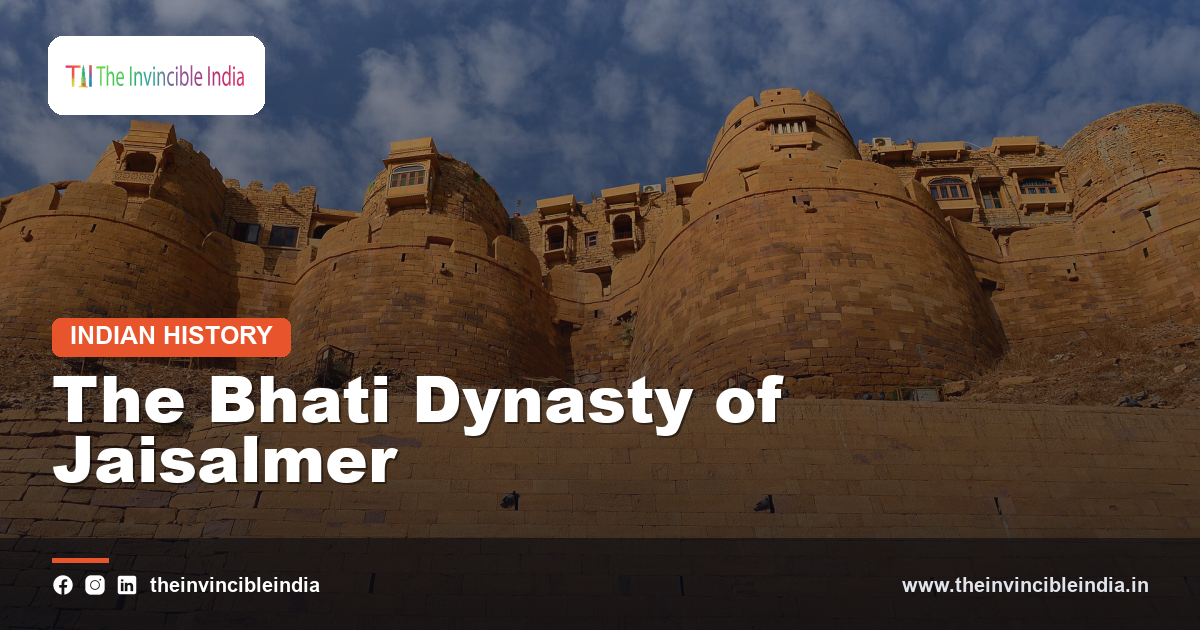
Jaisalmer Fort, often called Sonar Quila or the Golden Fort, is known as one of the few living forts in India, where families, shops, temples and guesthouses still occupy the old walls. It rises on Trikuta hill with massive ramparts and rounded bastions, and a series of gates leads visitors upward to the main square. Inside are the old royal palace, a group of Jain temples carved in stone, and narrow lanes lined with houses. The fort forms part of the Hill Forts of Rajasthan group recognised as a World Heritage Site. Its strong construction, adapted to desert conditions, kept it secure through many sieges. Today its main challenge is conservation, since the weight of modern use and water seepage can damage the old foundations.
How Did the Bhatis Profit From Desert Trade?
The Bhatis profited from desert trade by controlling caravan routes that crossed the Thar between the Indian plains, Sindh and the lands to the west. Camel caravans carried textiles, spices, grain, opium, dyes and other goods, and rulers collected tolls and offered protection in return. Merchant communities settled in Jaisalmer, built wealthy houses and financed temples, while the state gained steady revenue without relying on rainfall. This trade-based economy explains why a kingdom in such dry country could afford a large fort and fine architecture. When sea trade and later colonial railway routes shifted commerce away from the desert paths, Jaisalmer lost much of its old income, and the city declined in relative importance. The caravan economy nevertheless left its mark in the havelis and customs still seen in the city.
What Is the Jauhar Tradition Linked to Jaisalmer?
The jauhar tradition linked to Jaisalmer refers to accounts, preserved in Rajput chronicles, of mass self-sacrifice by women when a fort was about to fall, accompanied by a final sally by the warriors known as saka. Such traditions appear in the histories of several Rajput houses, and Jaisalmer chronicles describe episodes of this kind during sieges by powerful sultanate armies. The details of each episode, including dates and numbers, vary between sources and are debated by historians. These stories are best understood as part of Rajput memory about honour, loyalty and resistance, and they remain a sensitive subject in Rajasthan. A respectful reading recognises the tragedy at their core without turning them into spectacle. They also remind readers that the history of the desert frontier was shaped by repeated conflict with stronger neighbours.
How Did the Bhatis Deal With Delhi and the Mughals?
The Bhatis dealt with Delhi through a mix of resistance, tribute and marriage alliance, as did most Rajput houses. In the sultanate period the dynasty faced hostile armies and sometimes lost control of the fort, according to the chronicles. Under the Mughals, Jaisalmer accepted imperial overlordship in general terms, which allowed the Maharawal to keep the kingdom while sending service and tribute. Marriage ties with the imperial court and with other Rajput houses helped to secure the position. Because Jaisalmer was remote and poor in farmland, it was less often the target of direct imperial campaigns than richer Rajput states. This distance preserved the rulers’ local autonomy, and Bhati customs, court language and religious life developed along their own lines.
What Were the Rivalries Between Bhatis and Neighbouring Rajputs?
The Bhatis competed with neighbouring Rajput houses, especially the Rathores of Jodhpur and Bikaner, over land, wells and grazing rights. Border disputes were common in the desert, where control of a single water source could decide the fate of a village. Over the centuries Jaisalmer lost parts of its former territory to stronger neighbours, and the kingdom shrank to a core area around the capital. Family disputes over succession also weakened the court at times, as sons and brothers competed for the throne. These rivalries show that the Rajput world was not a united bloc but a network of kingdoms with shifting alliances. The Bhati story is therefore not only about heroic defence but also about the practical politics of a small state surrounded by larger powers.
What Is the Role of Havelis in Jaisalmer Culture?
The havelis of Jaisalmer are large merchant mansions with carved sandstone facades, balconies and courtyards, and they are among the most admired examples of civil architecture in Rajasthan. Families of wealthy traders commissioned them in the eighteenth and nineteenth centuries, employing stone carvers who covered windows and brackets with floral and geometric patterns. Well-known examples include Patwon ki Haveli, Nathmal ki Haveli and Salim Singh ki Haveli, each famous for particular details of carving and design. Tradition adds that rival craftsmen worked on neighbouring parts of a building, producing slightly different styles within one structure. These mansions show how trade wealth, state patronage and local craft combined to create a distinctive desert urban culture. Many are now museums or are still lived in, though upkeep remains a concern.
Which Jain Temples Stand Inside the Fort?
A cluster of Jain temples inside Jaisalmer Fort is among the finest stone-carved shrines in western India, and they reflect the strong role of the Jain merchant community in the city. The temples, dedicated to Tirthankaras, have richly sculpted pillars, ceilings and doorways carved from the same yellow sandstone as the fort. Their construction was supported by wealthy traders over generations, and the Bhati rulers allowed the community to practise freely, which fits a pattern of tolerance common in the region. The fort also preserves a famous manuscript library, a store of palm-leaf and paper texts kept by the Jain community. These temples remind visitors that Jaisalmer was a cosmopolitan trading town where merchants, rulers and craftsmen shared in the creation of a high culture. They remain active places of worship.
What Are Gadisar Lake and Bada Bagh?
Gadisar Lake and Bada Bagh are two landmarks outside the fort that show how the Bhatis managed water and remembered their dead. Gadisar is an artificial reservoir, associated with a Maharawal named Gadsi, which collected seasonal rain for the city and is now ringed by small temples, ghats and an elegant gateway. Bada Bagh is a garden complex north of the town with a long line of royal cenotaphs, called chhatris, built of the same golden stone to honour past rulers. Together they illustrate two themes of Bhati culture, the careful storage of scarce water and the monumental commemoration of kings. In a dry land, a lake was both a practical resource and a spiritual symbol. These sites are visited today for their calm, their architecture and their view of the city.
What Is the Culture of Music and Craft in Jaisalmer?
Jaisalmer is known for a desert culture of folk music, dance and craft that grew alongside the court. Communities such as the Manganiyar and Langa are celebrated hereditary musicians whose songs, sung with instruments like the kamaicha and the khartal, traditionally honoured patrons and marked family events. Craftspeople produce embroidery, mirror work, block-printed cloth, leather goods and woollen items, using skills passed down within families. Royal and merchant patrons supported these arts, and they flourished because the city drew buyers from the caravan trade. This living heritage is distinctive because it blends Rajput, Muslim and pastoral traditions without clear dividing lines. Its survival depends on continued audiences, fair markets for craftspeople and respect for the communities who carry the knowledge.
How Did British Rule Affect Jaisalmer?
British rule turned Jaisalmer into a princely state under indirect control, and it reduced both the kingdom’s independence and its trade income. In the early nineteenth century the Maharawal entered a treaty relationship with the East India Company, which protected the throne in exchange for acceptance of British supremacy in foreign affairs. The new colonial order also shifted trade towards railways and ports, and the old camel routes lost their value. Jaisalmer was left comparatively isolated and poor, though its architecture escaped the modern rebuilding that changed richer cities. Ironically, this poverty helped preserve the old town almost intact. The princely period therefore ended with Jaisalmer as a quiet, historic desert capital whose chief assets were its fort and its traditions.
What Happened After Independence?
After independence, the Bhati princely state joined the Indian Union and became part of Rajasthan when the former princely territories were merged into one state. The Maharawal lost sovereign powers, although the family retained its social standing and several properties. The border with Pakistan, newly drawn in the desert, affected old trade and kinship ties that had crossed the region for centuries. Later, infrastructure, tourism and a growing interest in heritage gave Jaisalmer a new economic life. The family of the former rulers remains associated with local cultural events and with the stewardship of historic buildings. The transition shows how a medieval desert kingdom adjusted to a modern democratic nation while keeping a strong sense of identity.
Jaisalmer and the Bhati Legacy Today
The Bhati legacy today lives in the fort, the havelis, the music and the customs of Jaisalmer, which together make the city one of India’s most recognisable heritage destinations. Tourism, including the annual desert festival and visits to the sand dunes near the town, brings visitors and income, but it also strains water supplies and old structures. Conservation groups, local residents and government bodies work to protect the fort and its drains, foundations and lanes. The dynasty’s story, from desert migration to a golden capital, shows how a small kingdom used trade, architecture and alliance to endure. Respectful visiting, careful restoration and support for local artists keep that heritage alive. Jaisalmer remains a lasting symbol of Rajput resilience in the Thar desert.
Sources & Further Reading
- Archaeological Survey of India (asi.nic.in).
- Ministry of Culture, Government of India (indiaculture.gov.in).
Frequently Asked Questions
Who founded Jaisalmer?
Jaisalmer was founded by Rawal Jaisal, a Bhati Rajput ruler, traditionally in the twelfth century. The exact year is debated because the early accounts come from later bardic chronicles.
What is the Bhati dynasty known for?
The Bhati dynasty is known for ruling the desert kingdom of Jaisalmer and building the Golden Fort. Its rulers also profited from caravan trade and supported craftsmen who created the city’s carved sandstone havelis.
Why is Jaisalmer Fort called a living fort?
Jaisalmer Fort is called a living fort because people still live and work inside its walls. Homes, shops, temples and guesthouses occupy the old streets, unlike most historic forts that are empty monuments.
Which title did the rulers of Jaisalmer use?
The rulers of Jaisalmer used the title Maharawal, a form of Rawal used by the Bhati line. The title marked their status as heads of the clan and kings of the desert state.
What are the main attractions linked to the Bhati rulers?
The main attractions include Jaisalmer Fort, the Jain temples inside it, Gadisar Lake, the royal cenotaphs at Bada Bagh and the merchant havelis. Together they show the royal, religious and commercial sides of Bhati culture.
Is the early history of the Bhatis fully documented?
No, the early history of the Bhatis is only partly documented. Bardic chronicles and local tradition provide most of the story, so historians treat early dates and genealogies as debated.


