

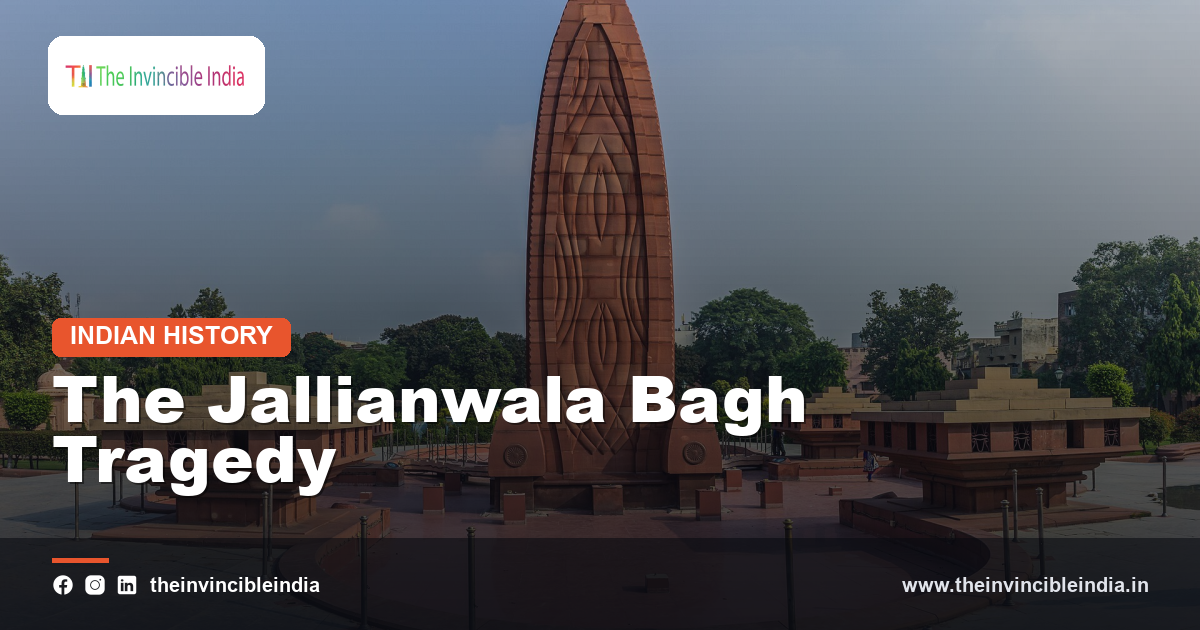
The Jallianwala Bagh tragedy of 1919 remains one of the most solemn and consequential events in the history of India’s freedom struggle, a moment of profound loss that permanently altered the relationship between colonial authority and the Indian people. Taking place in Amritsar amid rising tensions tied to wartime restrictions and the deeply resented Rowlatt Act, the tragedy came only decades after earlier acts of resistance such as the Revolt of 1857 had first exposed the depth of opposition to colonial rule. This guide examines the historical context that led to the tragedy, the events of that day, and the far-reaching impact it had on the course of the independence movement, with the respect and care the subject demands.
Quick Facts
| Detail | Information |
|---|---|
| Location | Jallianwala Bagh, Amritsar, Punjab |
| Year | 1919 |
| Context | Protests against the Rowlatt Act |
| Nature of Event | Firing on an unarmed public gathering |
| Inquiry | Hunter Commission |
| Legacy | Major turning point in the independence movement |
Punjab in the Aftermath of the First World War
In the years immediately following the First World War, Punjab experienced significant economic strain, including rising prices and the lingering effects of wartime recruitment and taxation on local communities. The province had contributed heavily to the war effort, and many families expected that this sacrifice would be met with meaningful political reform and greater civil liberties once the conflict ended. Instead, continued restrictions on public assembly and civil rights left many in Punjab feeling that their contributions had gone unrecognized by colonial authorities. This atmosphere of economic hardship and political disappointment created considerable tension in Punjab’s towns and cities in the early months of 1919. It was against this strained and uneasy backdrop that the events of that spring would unfold.
The Rowlatt Act and Public Protest
The passage of repressive wartime security legislation extending emergency detention powers, known widely as the Rowlatt Act, provoked outrage across India, including in Punjab, where it was seen as a clear betrayal of promises for expanded civil liberties after the war. Public meetings and hartals, or general strikes, were organized in cities including Amritsar to protest the legislation, drawing large crowds expressing widespread discontent with colonial policy. Local leaders in Amritsar who spoke at these gatherings were subsequently arrested by colonial authorities, an action that further inflamed public anger in the city. Protests against these arrests led to clashes in the days that followed, prompting local authorities to impose increasingly severe restrictions on public gatherings. This escalating cycle of protest and restriction formed the immediate backdrop to the tragedy that would soon take place.
Restrictions on Public Assembly in Amritsar
In response to the unrest, the local military commander in Amritsar issued an order prohibiting public gatherings of more than a small number of people, a restriction that was not widely or clearly communicated to the general population, many of whom remained unaware of its existence. This lack of effective public notice would later prove a significant and tragic factor in the events that followed, as many residents and visitors to the city had no knowledge that a public meeting could be treated as unlawful. The order reflected the increasingly severe security posture adopted by colonial authorities in Punjab during this period of heightened tension. Amritsar in mid-April 1919 was thus a city under significant strain, with civil liberties curtailed and public anxiety running high. These conditions set the stage for the gathering that would take place at Jallianwala Bagh.
The Gathering at Jallianwala Bagh
On a day coinciding with a significant regional festival, a large crowd gathered at Jallianwala Bagh, an enclosed public garden in Amritsar, for a peaceful public meeting, with many attendees including visitors to the city who were unaware of the recent prohibition on assembly. The gathering was unarmed and had assembled for the purpose of protest and public discussion rather than any act of violence or confrontation. Jallianwala Bagh, though referred to as a garden, was in fact a largely open, walled space with limited points of entry and exit, a feature that would prove of tragic significance given what followed. The presence of a substantial and peaceful crowd of ordinary men, women, and children in this enclosed space reflected the depth of public concern over recent political events. What took place next would transform this ordinary public gathering into one of the most solemn moments in modern Indian history.
The Firing on the Crowd
Without warning or an order to disperse that could reasonably reach or be understood by the assembled crowd, troops under the command of a British officer, Brigadier-General Reginald Dyer, opened fire directly into the gathering, continuing for a sustained period until ammunition was largely exhausted. The enclosed nature of the garden, with its limited exits, meant that many in the crowd had little or no means of escape from the sustained firing. Hundreds of unarmed men, women, and children were killed, and many hundreds more were wounded, in a tragedy that shocked India and much of the world when its full scale became known. The scale of the loss of life, inflicted upon a peaceful and unarmed gathering, marked the event as one of the gravest tragedies of the colonial period in India. It remains remembered with deep solemnity as a moment of immense and unjustifiable human loss.
The Enclosed Nature of the Garden
Jallianwala Bagh’s physical layout, a walled, largely enclosed public space with few narrow entry points, meant that those attending the gathering had extremely limited options for escape once the firing began, a factor that significantly increased the scale of the tragedy. Some who sought refuge from the gunfire were forced toward a deep well within the garden grounds, which later became one of the most solemn and widely recognized sites of memory associated with the tragedy. The physical constraints of the space meant that ordinary avenues of safety available in a more open setting simply did not exist for many present that day. This aspect of the tragedy is central to how the event is remembered, illustrating how the setting itself compounded an already grave act of violence against unarmed civilians. The garden’s layout remains preserved today as part of the memorial that honors those who lost their lives there.
Imposition of Martial Law in Punjab
In the aftermath of the tragedy, colonial authorities imposed martial law across significant parts of Punjab, subjecting the local population to a range of severe and humiliating restrictions under military administration. Public floggings, curfews, and other punitive measures were enforced in various localities, deepening the sense of grievance and injustice felt across the province in the weeks that followed. These measures, imposed in the immediate aftermath of the tragedy at Jallianwala Bagh, compounded the suffering already inflicted on the local population and drew further condemnation once details became more widely known. The severity of this response reflected the extent to which colonial authorities in Punjab had come to rely on coercive measures to maintain control during this period of unrest. The combination of the original tragedy and the subsequent martial law measures left a lasting and painful mark on the province.
The Crawling Order and Further Humiliation
Among the punitive measures imposed during martial law in Amritsar was an order requiring Indians passing through a particular street to crawl on the ground, a deeply humiliating directive connected to an earlier incident of violence in that location during the unrest preceding the tragedy. This order, alongside other public humiliations imposed during this period, was widely condemned as a further and unnecessary act of degradation inflicted upon the local population already reeling from the events at Jallianwala Bagh. Such measures reinforced growing perceptions across India that colonial administration in Punjab had adopted an approach defined by collective punishment rather than justice. News of these humiliating measures spread beyond Punjab, contributing significantly to the broader national outrage that followed. This episode remains remembered as a particularly stark example of the injustices associated with this period.
National and International Reaction
News of the tragedy at Jallianwala Bagh spread across India in the weeks that followed, provoking profound grief and outrage among people of all political persuasions, including many who had previously supported cooperation with colonial authorities. The scale and nature of the loss of life shocked public opinion both within India and, as details became known, in Britain and internationally, prompting widespread calls for accountability. Prominent Indian public figures publicly condemned the tragedy and the subsequent measures imposed under martial law, using it to draw broader attention to the injustices of colonial rule. This reaction cut across regional and religious lines, uniting diverse sections of Indian society in shared mourning and condemnation. The depth and breadth of this response reflected the truly national significance the tragedy had assumed within a very short time.
Rabindranath Tagore's Response
Among the most notable individual responses to the tragedy was that of the poet and Nobel laureate Rabindranath Tagore, who renounced the knighthood he had earlier received from the British Crown as a direct act of protest against the tragedy and the measures that followed. In his public statement explaining this decision, Tagore expressed profound anguish at the suffering inflicted upon his fellow countrymen and stated that he could no longer, in conscience, hold an honor bestowed by an authority responsible for such an event. This gesture, coming from a figure of significant international stature, drew considerable attention to the tragedy well beyond India’s borders. Tagore’s action is remembered as a powerful and dignified expression of protest, reflecting the depth of moral outrage the tragedy provoked among even those not directly involved in nationalist politics. It remains one of the most cited individual responses to the events of 1919.
The Hunter Commission Inquiry
In response to mounting public pressure, colonial authorities established a formal commission of inquiry to investigate the events at Jallianwala Bagh and the subsequent imposition of martial law in Punjab. The commission’s proceedings and findings drew significant public attention, though its conclusions and the limited nature of any accountability that followed were widely regarded by Indian public opinion as inadequate given the scale of the tragedy. Testimony gathered during the inquiry provided important documentation of the events of that day, contributing to the historical record even as many in India felt that genuine justice had not been served. The inquiry’s proceedings and their aftermath further deepened nationalist disillusionment with the colonial administration of justice. The commission remains an important, if widely criticized, part of the historical record surrounding the tragedy.
Impact on Public Trust in Colonial Rule
The tragedy at Jallianwala Bagh fundamentally altered public trust in colonial rule across India, convincing many moderate political figures who had previously favored cooperation and gradual reform that a more direct and assertive approach to the independence struggle had become necessary. The event is widely regarded by historians as a decisive turning point after which reconciliation between Indian nationalist aspirations and continued colonial administration became increasingly difficult to envision. For many ordinary Indians, the tragedy served as an unmistakable and deeply painful illustration of the fundamental inequality embedded in colonial governance. This shift in public sentiment following the tragedy helped create the conditions for the mass, nationwide campaigns of civil resistance that would follow in the ensuing years. Its impact on Indian political consciousness proved both immediate and lasting.
Influence on Gandhi and the Non-Cooperation Movement
The tragedy at Jallianwala Bagh weighed heavily on Gandhi and significantly influenced his subsequent decision to call for a nationwide campaign of non-cooperation with colonial institutions in the early 1920s. For Gandhi, the tragedy and the harsh measures that followed in Punjab confirmed his conviction that continued cooperation with colonial administration, even in limited constitutional forms, could no longer be reconciled with basic justice. The moral weight of the tragedy lent considerable urgency and public support to the mass mobilization that followed, helping the Non-Cooperation Movement achieve a scale of participation not previously seen in the nationalist struggle. This direct link between the tragedy and the subsequent shift toward mass civil resistance illustrates its profound and lasting influence on the strategic direction of the independence movement. It remains a frequently cited turning point in accounts of Gandhi’s political development.
The Jallianwala Bagh Memorial
In the decades following independence, the site of the tragedy was preserved and developed into a formal memorial, honoring those who lost their lives and providing a place of quiet reflection for visitors. The memorial incorporates original features of the garden, including the well associated with the tragedy and sections of a wall bearing marks from the firing, preserved as solemn reminders of the events that took place there. An eternal flame and commemorative structures at the site further honor the memory of those affected by the tragedy. The memorial today functions both as a historical site and as a place of national remembrance, visited by people from across India and beyond. Its careful preservation reflects the enduring importance placed on remembering this tragedy with dignity and respect.
Remembering the Tragedy with Dignity
Public commemoration of the Jallianwala Bagh tragedy emphasizes solemn remembrance and historical understanding rather than any spirit of division, reflecting a broadly shared recognition of the tragedy’s significance across Indian society. Educational materials and historical scholarship continue to examine the tragedy’s causes and consequences in careful detail, contributing to a fuller and more nuanced public understanding of the events of 1919. Annual commemorations at the memorial site draw attention to the tragedy’s continuing relevance as a reminder of the human cost of colonial rule and the importance of civil liberties. This approach to remembrance, grounded in respect for those who lost their lives, characterizes how the tragedy is generally discussed in both historical and public contexts today. Such careful, dignified remembrance remains central to the tragedy’s place in national memory.
Jallianwala Bagh Today
Today, Jallianwala Bagh stands as one of the most visited historical sites associated with India’s independence struggle, drawing visitors seeking to understand and reflect upon this pivotal chapter in the nation’s history. The site is maintained by national heritage authorities as a protected memorial, ensuring that its physical features and historical significance are preserved for future generations. Continued scholarly interest in the tragedy has produced increasingly detailed accounts of the events of 1919 and their far-reaching consequences for the independence movement. The site’s enduring role as a place of national remembrance reflects the profound and lasting significance the tragedy holds in India’s historical consciousness. Jallianwala Bagh remains, above all, a place of solemn memory and respect for those who lost their lives there.
Sources & Further Reading
- National Archives of India (nationalarchives.nic.in).
- Ministry of Culture, Government of India (indiaculture.gov.in).
Frequently Asked Questions
What was the Jallianwala Bagh tragedy?
It was an event in Amritsar in 1919 in which troops under British command fired upon a large, unarmed gathering assembled in an enclosed public garden, resulting in the deaths of hundreds of civilians and many more wounded.
Why were people gathered at Jallianwala Bagh?
A crowd had assembled for a peaceful public meeting amid widespread protest against the Rowlatt Act, a piece of wartime security legislation that had provoked outrage across India, including in Punjab.
What happened after the tragedy?
Colonial authorities imposed martial law across parts of Punjab, including harsh and humiliating measures, while news of the tragedy provoked widespread national and international condemnation and grief.
How did the tragedy affect the independence movement?
It profoundly shifted Indian public opinion against continued colonial rule and significantly influenced Gandhi’s decision to launch the Non-Cooperation Movement shortly afterward.
How is Jallianwala Bagh remembered today?
The site has been preserved as a national memorial in Amritsar, honoring those who lost their lives, and continues to be visited and studied as a solemn reminder of this chapter in India’s history.


