

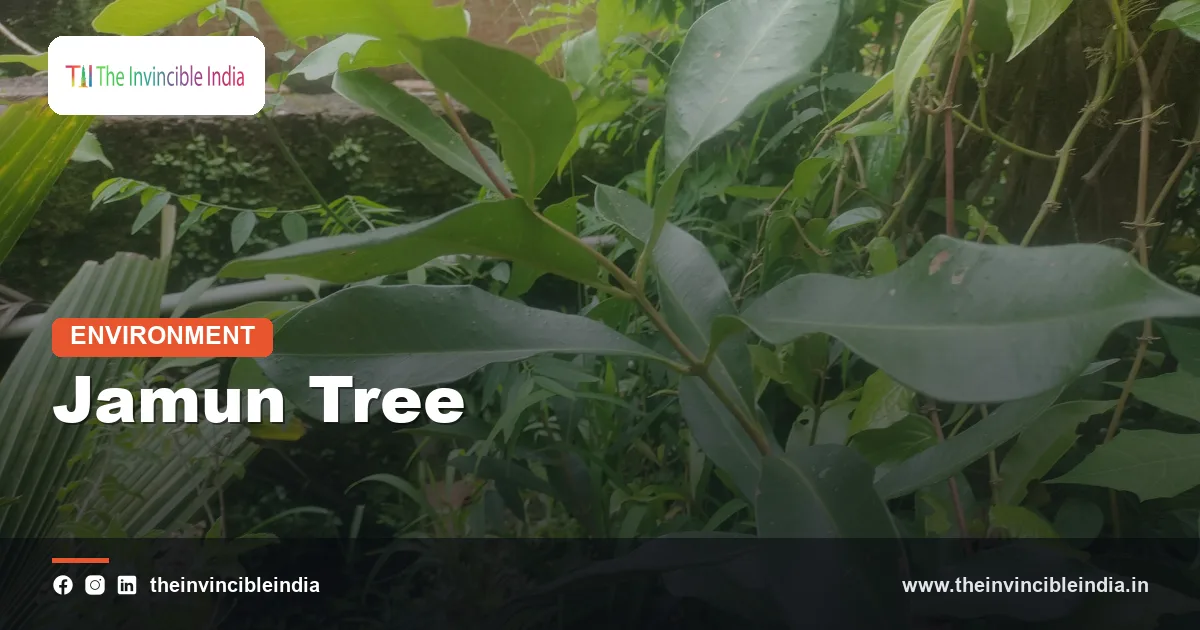
The jamun tree (Syzygium cumini) is a large, evergreen tree native to the Indian subcontinent that bears tangy, astringent, purple-black fruit every summer and is also widely planted for shade, avenue planting and timber. Known in English as the Indian blackberry, java plum or black plum, the jamun tree belongs to the myrtle family (Myrtaceae) and has been part of Indian orchards, village commons and city roadsides for many centuries.
This explainer covers what the jamun tree looks like, when it fruits, how the fruit is eaten, what its traditional reputation for diabetes actually amounts to, how its timber is used and how it is grown. 23 October 2026 is the date of the most recent review of this article.
| Attribute | Details |
|---|---|
| Scientific name | Syzygium cumini (earlier called Eugenia jambolana and Syzygium jambolanum) |
| Family | Myrtaceae (the myrtle family, which also includes guava and eucalyptus) |
| Common names | Jamun, jambul, java plum, black plum, Malabar plum, Indian blackberry |
| Native range | The Indian subcontinent, extending into Southeast Asia |
| Tree type | Evergreen, dense-crowned, often 15 to 30 metres tall |
| Flowering and fruiting | Small fragrant flowers in spring; fruit ripens from about May to July, around the monsoon onset |
| Fruit | Oblong berry, purple to nearly black when ripe, with one large seed |
| Main uses | Fresh fruit, juice and vinegar, shade and avenue tree, durable timber, traditional medicine, honey plant |
Key Takeaways
- The jamun tree is the common name for Syzygium cumini, an evergreen member of the myrtle family that is native to the Indian subcontinent.
- Jamun fruit ripens in the hot weeks before and around the monsoon, turns purple-black and stains the tongue and lips deep violet.
- Jamun seed powder has a long place in Ayurveda and folk practice for blood-sugar concerns, but jamun is not a substitute for prescribed diabetes treatment.
- Jamun timber is reddish-brown, hard and resistant to decay in water, which is why it has been used for well-curbs, boats and agricultural implements.
- A jamun tree grown from seed may take around eight to ten years to fruit, while a grafted tree can bear in roughly four to six years.
- The Sanskrit name Jambudvipa, traditionally used for the Indian subcontinent in older cosmology, is linked in tradition to the jambu tree.
What is the jamun tree and where does it grow?
The jamun tree is a tropical and subtropical evergreen, Syzygium cumini, that grows naturally across India, Bangladesh, Sri Lanka, Nepal, Pakistan and into Southeast Asia. In India it is found in plains forests, riverbanks, village edges, temple grounds and city avenues from the Himalayan foothills to the southern peninsula and the Andaman and Nicobar Islands.
The jamun tree prefers a warm, humid climate with a distinct dry spell before the rains. It tolerates a wide range of soils, including heavy, clayey and periodically waterlogged ground where many fruit trees would struggle. Young jamun trees are sensitive to hard frost, so the species is rare at high altitudes, but mature trees are otherwise hardy.
Because the tree is long-lived and bird-dispersed, it appears in many parts of the country without having been deliberately planted. Fruit bats, parakeets, mynas and bulbuls feed on the ripe berries and drop the seeds, which germinate readily in the monsoon.
The jamun tree has also travelled well beyond the subcontinent. Colonial-era planters and botanists carried it to the Caribbean, East Africa, Florida, Hawaii and Australia, where it is cultivated and, in some places, considered an invasive species because it spreads easily from seed.
What does a jamun tree look like?
A mature jamun tree has a short, stout trunk, a dense rounded crown and glossy, leathery leaves that give it a dark green look through the year. The trunk is often crooked or branched low, and the bark is rough and greyish near the base but becomes smoother and paler higher up.
Leaves, flowers and fruit
- Leaves are oval to elliptical, oppositely arranged, pinkish when young and dark glossy green when mature. Crushed leaves give off a mild turpentine-like smell.
- Flowers are small, whitish to greenish-white and fragrant, borne in clusters at the ends of branchlets. Their prominent stamens give them a fluffy look.
- Fruit is an oblong or oval berry, usually 1.5 to 3.5 centimetres long, that changes from green to pink to deep purple-black as it ripens.
- The single large seed takes up much of the fruit, so the edible pulp layer is thin in wild trees and thicker in improved varieties.
The tree can reach 30 metres in good conditions, though trees in orchards and along roadsides are usually shorter. A well-grown jamun can live for well over a century, and some very old roadside and village trees in India are protected locally as heritage trees.
When does the jamun tree flower and fruit?
The jamun tree flowers in spring, roughly March to April in most of northern and central India, and the fruit ripens from about May to July, so the fruit season often coincides with the arrival of the monsoon. In the south and in areas with earlier rains, fruiting may begin a little sooner.
The gap between flowering and ripe fruit is typically two to three months. Honey bees and other insects pollinate the flowers, and beekeepers value the tree because it offers a flush of nectar and pollen during a period when few other trees are in bloom.
The ripe fruit is highly perishable. Jamun berries soften, ooze and ferment within two or three days of picking, which is why they are sold quickly in local markets, often in leaf cups or on trays, and why the fruit rarely travels far in fresh form. Pickers shake the branches over spread cloth, because fruit dropped on the ground bruises easily.
Why does jamun colour the tongue?
Jamun colours the tongue and lips purple because the skin and pulp contain anthocyanins, the same class of water-soluble pigments found in blackberries, red cabbage and many other purple foods. The colour is harmless and fades within a short time. A pinch of black salt and a little chaat masala sprinkled on the fruit is a classic way to tame its astringency.
How is the jamun fruit eaten and what does it contain?
Jamun fruit is eaten fresh, usually with black salt, and is also turned into juice, squash, jam, jelly, wine and vinegar. The flavour is sweet-sour with a pronounced astringent, mouth-drying edge that comes from tannins, and it is strongest in underripe or wild fruit.
Nutritionally, ripe jamun is a low-calorie fruit that is mostly water. It contains modest amounts of vitamin C, some potassium and iron, small amounts of other minerals and a good load of plant pigments and polyphenols. Exact values vary by variety, ripeness and region, so any single figure should be treated as approximate.
- Fresh fruit: eaten whole, often chilled, sometimes with salt and spice.
- Jamun juice and squash: sold as a seasonal drink in many northern and western Indian cities.
- Jamun vinegar (jamun ka sirka): fermented fruit juice used in households as a tonic and in pickling.
- Jams, jellies and wines: made on a small scale, especially in Maharashtra, Gujarat and Goa.
- Dried jamun seed powder: sold in Ayurvedic and herbal shops and discussed below.
Jamun is sometimes confused with the unrelated black plum or with the jamun-sized fruit of other Syzygium species. The true jamun fruit has a distinctive oblong shape, a single seed and the characteristic purple staining effect.
Is jamun good for diabetes?
Jamun has a long traditional reputation in India as a food and remedy for people with raised blood sugar, but the scientific evidence is limited and jamun is not a replacement for medical treatment. Traditional Ayurvedic texts and folk practice, particularly the use of the dried seed powder, link jamun with sugar control, and that is why the seed powder is widely sold today.
Laboratory and small clinical studies have reported that extracts of jamun seed and pulp may have a modest effect on blood glucose, and researchers have looked at compounds such as jamboline and anthocyanins. However, results are inconsistent, doses and preparations differ greatly, and large well-controlled human trials are lacking. Researchers generally describe the findings as promising but not conclusive.
What should a person with diabetes keep in mind?
- Fresh jamun contains natural sugars, so portion size still matters.
- Jamun seed powder is not standardised, and its strength depends on the maker.
- Anyone taking diabetes medication should consult a doctor before using jamun products, because combining them with prescribed drugs could in theory lower blood sugar further.
- Pregnant women and children should also check with a doctor before using concentrated herbal products.
The sensible reading is that jamun is a nutritious seasonal fruit with a traditional reputation, not a treatment. Diabetes management rests on diet, activity and prescribed therapy under medical supervision.
What other traditional uses does the jamun tree have?
Almost every part of the jamun tree has a traditional use in Indian household practice, Ayurveda and rural craft. The bark, leaves, seeds and fruit are all used, though most of these uses rest on tradition rather than on rigorous clinical proof.
| Part of the tree | Traditional or practical use |
|---|---|
| Ripe fruit | Eaten fresh; made into juice, squash, jam, wine and vinegar |
| Seed | Dried and ground to powder in Ayurvedic and folk practice, associated in tradition with blood-sugar concerns |
| Bark | Rich in tannins; used in traditional preparations for astringent purposes and historically in tanning and dyeing |
| Leaves | Used as cattle fodder; used in some folk remedies; occasionally used as tooth-cleaning twigs |
| Flowers | Nectar and pollen source for honey bees, giving a dark, strongly flavoured honey |
| Wood | Construction, well-curbs, boat parts, farm tools and fuel |
Twigs and leaf extracts have also been tried in the past for oral hygiene, and the astringent bark has been used in simple home gargles. These uses reflect the high tannin content of the tree. As with other herbal practices, a doctor or qualified practitioner should be consulted for any health condition.
Why is the jamun tree planted along avenues and in cities?
The jamun tree is planted along avenues and in cities because it gives dense, year-round shade, tolerates difficult soils and supports a great deal of wildlife. Its evergreen canopy offers shade through the hottest months, which is a major reason that municipal planners and colonial-era road designers favoured it.
In Lutyens’ Delhi, the avenues designed in the early twentieth century for the new capital were planted with a limited palette of large native species. Jamun, neem, arjun, imli (tamarind) and a few others were chosen to create long, tunnel-like canopies. Many of these trees are now more than a century old, and the Delhi roads that carry them are still among the city’s coolest in summer.
- Shade: a dense, rounded evergreen crown that stays leafy through the hot season.
- Hardiness: tolerates heavy soils, seasonal waterlogging and the dust of city roads.
- Wildlife value: fruit and flowers feed birds, bats, bees and squirrels.
- Longevity: lives for a century or more, which suits avenue planting.
There are some trade-offs. Ripe fruit can stain pavements and parked vehicles purple, and the tree’s large size means it needs adequate space. Municipal agencies therefore plant it in wide verges, parks and campuses more than in narrow lanes.
What is jamun wood used for?
Jamun wood is a hard, reddish-brown timber that is valued for its durability in damp conditions, and it has traditionally been used for well-curbs, boat building, agricultural implements, carts and general construction. The heartwood is moderately heavy, takes a good polish and resists decay when kept wet or buried, which is the property that made it popular for structures in contact with water.
The timber is not among India’s premium furniture woods, partly because it can be difficult to season without cracking and partly because large straight logs are less common than in species such as teak or sal. It is nevertheless a useful local timber in many states, particularly where better-known timbers are scarce.
The branches and trimmings make good firewood, and the tree is sometimes pollarded or lopped for fodder. In forestry terms the jamun is classed as a multi-purpose tree because it supplies fruit, fodder, timber and fuel at once.
How is the jamun tree cultivated?
The jamun tree is cultivated mainly from seed, but grafted or air-layered plants are preferred for orchards because they fruit sooner and produce more uniform fruit. A seedling jamun may take around eight to ten years to bear, while a good grafted plant can begin fruiting in roughly four to six years.
Basic requirements
- Climate: warm tropical or subtropical, with a dry spell before flowering and humid weather during fruit development.
- Soil: deep, well-drained loam is best, but the tree copes with clay, mildly saline and seasonally wet soils.
- Spacing: orchard plantings are generally spaced widely, around 8 to 10 metres apart, because mature trees have large crowns.
- Watering: young trees need regular irrigation in their first dry seasons; established trees are largely rain-fed.
- Propagation: fresh seed germinates quickly, since jamun seed loses viability if it is dried for long.
Improved selections have been developed by agricultural universities and horticultural institutes in several states, such as large-fruited, thick-pulp and small-seeded types. These are sold by regional nurseries under local names. Jamun orchards remain small compared with mango or banana, but demand for fresh fruit and for processed products has made commercial planting more attractive in recent decades.
Common management concerns include fruit flies and leaf-eating caterpillars, which are generally controlled through orchard hygiene and standard horticultural practice. Because ripe fruit is so fragile, orchard owners usually plan harvesting, packing and quick sale or processing together.
What is the cultural and ecological role of the jamun tree?
The jamun tree holds a place in Indian tradition, literature and everyday ecology, appearing in religious cosmology, folk sayings, village life and wildlife habitats. Its Sanskrit name, jambu, gives rise to Jambudvipa, the traditional name for the continent that includes the Indian subcontinent in Hindu, Buddhist and Jain cosmology, and tradition associates the term with a great jambu tree.
In the Ramayana tradition and in regional folklore, jamun fruit appears in stories of forest life, and it remains a nostalgic symbol of the Indian summer for many families. Children collecting fallen fruit under a roadside tree is a familiar image in many Indian towns and villages.
Ecologically, a single large jamun tree can support an entire community of animals. Flowering supplies nectar to bees and butterflies, ripe fruit feeds birds, fruit bats, langurs and squirrels, and old hollows provide nesting sites. In towns where large old trees have disappeared, planting jamun is often recommended for urban biodiversity projects.
The fruit’s seasonal appearance also supports small livelihoods. Pickers, small orchard owners and street vendors earn a short seasonal income from jamun in many cities, and traditional preparations such as jamun vinegar continue in family kitchens.
Bottom Line
The jamun tree is one of India’s most useful native evergreens, valued at once as a shade tree, a seasonal fruit source, a durable timber tree and a wildlife habitat. Its fruit has a traditional place in Indian health practice, but it should be seen as a nutritious seasonal food rather than a medicine, and anyone with diabetes should follow their doctor’s advice first.
Frequently Asked Questions
What is the scientific name of the jamun tree?
The scientific name of the jamun tree is Syzygium cumini. It was previously classified as Eugenia jambolana and Syzygium jambolanum, and these older names still appear in many books and product labels. The tree belongs to the myrtle family, Myrtaceae.
When is jamun season in India?
Jamun season in India runs roughly from May to July, depending on the region and the arrival of the monsoon. Trees flower in spring and the fruit ripens two to three months later. Ripe fruit is highly perishable and is usually sold within a day or two of picking.
Is jamun good for diabetes?
Jamun has a long traditional reputation for blood-sugar concerns, but scientific evidence is limited and inconsistent. Some small studies on seed and fruit extracts have reported modest effects, though large human trials are lacking. Jamun should not replace prescribed treatment, and people on diabetes medicines should consult a doctor before using jamun products.
How long does a jamun tree take to bear fruit?
A jamun tree grown from seed typically takes about eight to ten years to bear fruit, while a grafted or air-layered plant may begin in roughly four to six years. The timing depends on the variety, soil, climate and care. Grafted trees are preferred for orchards because they also give more uniform fruit.
Why does jamun make your tongue purple?
Jamun makes the tongue purple because the fruit skin and pulp contain anthocyanin pigments. These are harmless water-soluble colour compounds that also occur in blackberries and red cabbage. The stain fades within a short time after eating.
What is jamun wood used for?
Jamun wood is used mainly for well-curbs, boat parts, agricultural implements, carts and general construction. The reddish-brown heartwood is hard and resists decay in water. It is also used as firewood, and the tree is regarded as a multi-purpose species that supplies fruit, fodder, timber and fuel.
{“@context”:”https://schema.org”,”@graph”:[{“@type”:”FAQPage”,”mainEntity”:[{“@type”:”Question”,”name”:”What is the scientific name of the jamun tree?”,”acceptedAnswer”:{“@type”:”Answer”,”text”:”The scientific name of the jamun tree is Syzygium cumini. It was previously classified as Eugenia jambolana and Syzygium jambolanum, and these older names still appear in many books and product labels. The tree belongs to the myrtle family, Myrtaceae.”}},{“@type”:”Question”,”name”:”When is jamun season in India?”,”acceptedAnswer”:{“@type”:”Answer”,”text”:”Jamun season in India runs roughly from May to July, depending on the region and the arrival of the monsoon. Trees flower in spring and the fruit ripens two to three months later. Ripe fruit is highly perishable and is usually sold within a day or two of picking.”}},{“@type”:”Question”,”name”:”Is jamun good for diabetes?”,”acceptedAnswer”:{“@type”:”Answer”,”text”:”Jamun has a long traditional reputation for blood-sugar concerns, but scientific evidence is limited and inconsistent. Some small studies on seed and fruit extracts have reported modest effects, though large human trials are lacking. Jamun should not replace prescribed treatment, and people on diabetes medicines should consult a doctor before using jamun products.”}},{“@type”:”Question”,”name”:”How long does a jamun tree take to bear fruit?”,”acceptedAnswer”:{“@type”:”Answer”,”text”:”A jamun tree grown from seed typically takes about eight to ten years to bear fruit, while a grafted or air-layered plant may begin in roughly four to six years. The timing depends on the variety, soil, climate and care. Grafted trees are preferred for orchards because they also give more uniform fruit.”}},{“@type”:”Question”,”name”:”Why does jamun make your tongue purple?”,”acceptedAnswer”:{“@type”:”Answer”,”text”:”Jamun makes the tongue purple because the fruit skin and pulp contain anthocyanin pigments. These are harmless water-soluble colour compounds that also occur in blackberries and red cabbage. The stain fades within a short time after eating.”}},{“@type”:”Question”,”name”:”What is jamun wood used for?”,”acceptedAnswer”:{“@type”:”Answer”,”text”:”Jamun wood is used mainly for well-curbs, boat parts, agricultural implements, carts and general construction. The reddish-brown heartwood is hard and resists decay in water. It is also used as firewood, and the tree is regarded as a multi-purpose species that supplies fruit, fodder, timber and fuel.”}}]}]}


