

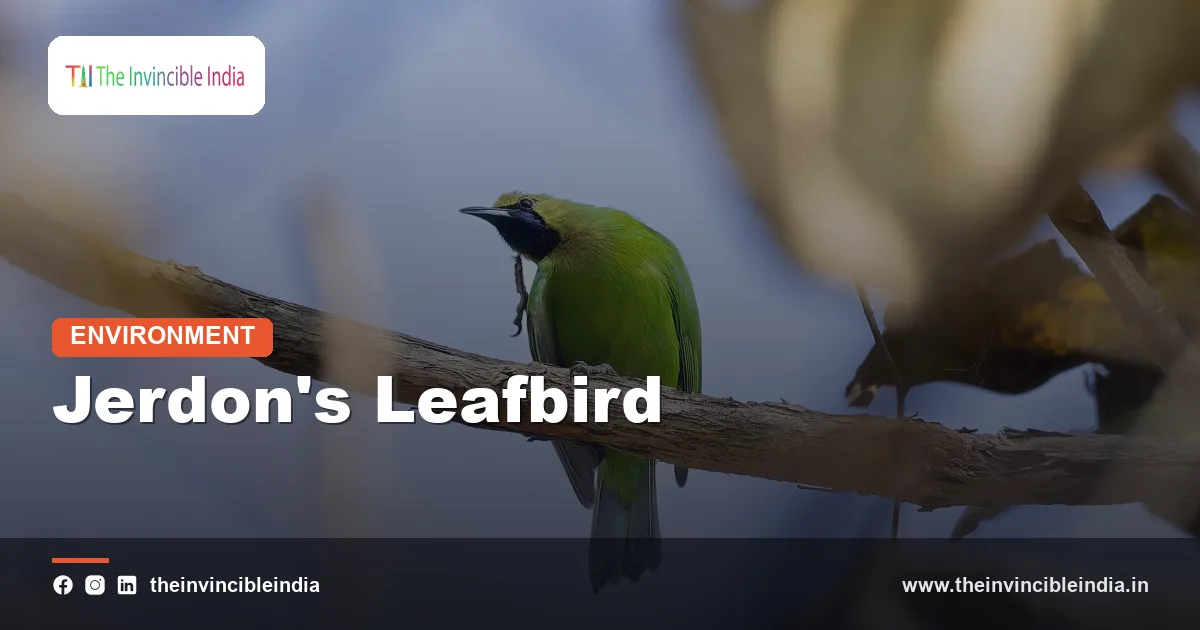
Jerdon’s leafbird (Chloropsis jerdoni) is a leaf-green songbird of Indian forests, groves and wooded gardens, famous for its habit of mimicking the calls of other birds and for its taste for nectar. Named after the nineteenth-century naturalist Thomas C. Jerdon, the species is one of the leafbirds, a small group of fruit-, nectar- and insect-eating birds that spend their lives high in the foliage.
Jerdon’s leafbird is perfectly camouflaged in the green canopy, so it is often detected by sound rather than sight. The male shows a black face and throat with a blue moustache stripe, while the female is a plainer green, and both feed on insects, berries and the nectar of flowering trees.
| Attribute | Detail |
|---|---|
| Common name | Jerdon’s leafbird |
| Scientific name | Chloropsis jerdoni |
| Family | Chloropseidae (leafbirds) |
| Size | About 18 to 20 cm long |
| India range and habitat | Wooded parts of peninsular and central India and other regions; open forest, groves, orchards and well-wooded gardens |
| Diet | Insects, berries, small fruit and flower nectar |
| Breeding | Shallow cup nest slung in a tree fork or branch; usually two to three eggs, mostly in the warmer months |
| Conservation status | Least Concern on the IUCN Red List |
Key Takeaways
- Jerdon’s leafbird (Chloropsis jerdoni) is a bright leaf-green songbird about 18 to 20 cm long, named after the naturalist Thomas C. Jerdon.
- The male Jerdon’s leafbird has a black face and throat with a blue moustache stripe, while the female is mostly green with a faint blue patch near the cheek.
- Jerdon’s leafbird is an excellent mimic that imitates the calls of many other forest birds, which makes it hard to identify by voice alone.
- The diet of Jerdon’s leafbird combines insects, small fruit and nectar, which it takes from flowering trees such as the silk-cotton and coral tree.
- Jerdon’s leafbird builds a delicate cup nest on a branch fork and usually lays two to three eggs.
- Jerdon’s leafbird is classified as Least Concern, but it needs trees, and forest loss and capture for the cage-bird trade can affect local populations.
What is Jerdon’s leafbird?
Jerdon’s leafbird is a medium-small passerine bird in the family Chloropseidae, which contains the leafbirds of tropical Asia. Its scientific name is Chloropsis jerdoni, and it was long treated as a form of a related Southeast Asian leafbird before being widely recognised in Indian field guides as a species in its own right.
The common name honours Thomas Claverhill Jerdon (1811 to 1872), a British surgeon and naturalist who worked in India and wrote major works on the birds and mammals of the subcontinent. Several Indian species carry his name, reflecting his role in documenting the region’s wildlife.
Leafbirds are known for their uniform green colour, curved bills and fondness for nectar. They look similar to each other, and Jerdon’s leafbird is typically separated from its relatives by the pattern of its face, the lack of a bright yellow forehead, and its range.
How do you identify Jerdon’s leafbird?
Jerdon’s leafbird can be identified by its overall bright green plumage, slightly curved dark bill, and, in the male, a black face and throat set off by a blue moustache stripe. The female lacks the black face and looks like a fully green bird with a hint of blue near the cheek.
The male
The male is the more striking sex. The head and body are leaf-green, but the face, chin and throat are black. A band of bright blue runs below the cheek like a moustache, and the shoulder and wing edges may show blue tones. The contrast of black and blue against the green makes the male unmistakable once the bird is in good light.
The female and young birds
The female is a duller green overall and usually shows no black. A small blue-tinged patch near the cheek or throat is sometimes visible. Young birds resemble the female, with a pale throat and less sharply defined facial pattern.
Confusion species
- The golden-fronted leafbird has a golden-orange forehead and a black throat bordered by blue, and it is slightly larger.
- The orange-bellied leafbird, found mainly in the Himalayan foothills and northeast, has an orange belly.
- The common iora is much smaller, with yellow underparts and white wing bars.
Where does Jerdon’s leafbird live in India?
Jerdon’s leafbird lives in wooded parts of India, including dry and moist deciduous forest, open woodland, orchards, groves and well-treed gardens. It also occurs in Sri Lanka, and it is found at low to moderate elevations rather than at the highest altitudes.
The bird is closely tied to trees. It needs tall trees with dense foliage for cover, and it often visits flowering and fruiting trees. In peninsular India it can be found in old mango groves, tamarind, banyan and fig trees, as well as in the forest edges of the Western Ghats foothills and the Eastern Ghats. It is often absent from treeless country and from very dry scrub.
Leafbirds are typically resident, although they may move locally to follow flowering and fruiting trees. In years when certain trees flower heavily, small groups of leafbirds may gather and feed together before dispersing again.
What does Jerdon’s leafbird eat?
Jerdon’s leafbird eats insects, berries, small fruits and flower nectar, with a particular fondness for nectar-rich blossoms in the dry season. The mixture of food types allows the bird to live in places where only one kind of food would not be available year-round.
Insects, including caterpillars, beetles, bugs and small flies, make up much of the protein in its diet and are especially important when young are being fed. Fruit comes from small berries, including figs and other wild fruit, and the bird often swallows them whole. The curved bill, with its slightly brush-like tongue, is well suited to probing flowers for nectar.
Nectar feeding and pollination
Leafbirds are regular visitors to flowering trees such as the silk-cotton (Bombax ceiba), the coral tree (Erythrina), the flame of the forest (Butea monosperma) and the mistletoe plants that grow on host trees. When the bird pushes its bill into the flowers, pollen sticks to the forehead and throat and is carried to other flowers. This makes Jerdon’s leafbird a minor but real pollinator.
Leafbirds and some other birds also spread the seeds of mistletoes and berries. Seeds pass through the gut or stick to the bill and are deposited on branches, where new plants can begin to grow.
Why does Jerdon’s leafbird mimic other birds?
Jerdon’s leafbird mimics other birds because vocal mimicry is part of its natural song, and the bird weaves imitated calls into a long, varied performance. Scientists have suggested that mimicry may help males advertise their quality, defend territory or attract mates, although the exact function is still debated.
The leafbird’s song is a rapid, jumbled, chattering sequence of musical notes, whistles and imitations. A single bird may copy the calls of drongos, bulbuls, babblers, shrikes, orioles and even small raptors. Because the repertoire changes from moment to moment, the song can sound like a whole flock of different species singing from one tree.
This ability can mislead birdwatchers. A person who hears a series of different bird calls from one patch of foliage, with no sign of the species that seem to be calling, may well be listening to a leafbird. Looking for the green bird with a curved bill, often perched quietly in a high tree, is the best way to confirm it.
How and when does Jerdon’s leafbird breed?
Jerdon’s leafbird breeds mainly in the warmer months in most of India, building a small cup-shaped nest in a tree and laying about two to three eggs. The timing varies by region and rainfall, but it generally occurs before or during the early monsoon.
The nest is a shallow cup made of fine roots, grass, fibres and similar material, often slung by its rim between thin twigs at the end of a branch. It is placed fairly high in a tree, hidden among leaves, and is difficult to see from the ground. The eggs are pale with darker spots, and the female does most of the incubation, though the male is often nearby and will help feed the young.
The chicks are fed insects and fruit and remain in the nest for roughly two weeks. After they leave, the family stays together for a short while, and the young birds learn the group’s feeding spots and song.
How is Jerdon’s leafbird different from other Indian leafbirds?
Jerdon’s leafbird differs from other Indian leafbirds mainly in face pattern, belly colour and range. The following table compares it with two similar species.
| Feature | Jerdon’s leafbird | Golden-fronted leafbird | Orange-bellied leafbird |
|---|---|---|---|
| Scientific name | Chloropsis jerdoni | Chloropsis aurifrons | Chloropsis hardwickii |
| Forehead | Green | Golden-orange | Green |
| Male throat | Black with blue moustache | Black with blue edge | Black with blue edge |
| Belly | Green | Green | Orange |
| General area | Peninsular and central India, Sri Lanka | Much of India and the foothills | Himalayan foothills and northeast |
All three species forage in the same way, are excellent mimics and feed on nectar, fruit and insects. In places where their ranges overlap, field marks such as the forehead colour and belly tone are the quickest guide.
Is Jerdon’s leafbird threatened?
Jerdon’s leafbird is not globally threatened and is assessed as Least Concern on the IUCN Red List thanks to its wide range and fairly adaptable habits. Nevertheless, its numbers can fall locally where woodlands are cleared and where birds are trapped for sale as cage birds.
The bird is protected, like other wild Indian birds, under the Wildlife (Protection) Act, 1972, and keeping wild leafbirds in captivity is illegal. Leafbirds have in the past been popular in the cage-bird trade because of their colour and song, and it is important to remember that taking them from the wild is a crime that harms populations.
Practical steps for gardeners
- Keep large, old trees in gardens and farms, since they provide nesting sites and nectar.
- Plant native flowering and fruiting trees such as figs, coral trees and silk-cotton.
- Avoid using pesticides that remove the insects on which birds feed their chicks.
- Report any illegal sale of wild birds to the local forest department.
Where can you see Jerdon’s leafbird?
The best place to see Jerdon’s leafbird is a well-wooded forest edge, grove or park with flowering trees, where you can listen for mimicking songs from the canopy in the early morning. Many national parks and sanctuaries across peninsular India have healthy populations, as do older campuses and botanical gardens.
Patience is essential. Scan the upper branches of a flowering tree with binoculars and look for a green bird with a slightly curved bill moving slowly among the blossoms. The black-and-blue face of the male becomes visible when he turns toward the light. Early morning, when the birds sing and feed most actively, is the best time to look.
Bottom Line
Jerdon’s leafbird is a bright green nectar-loving songbird that hides in plain sight in the canopies of Indian forests and groves, announcing itself through an impressive range of mimicked calls. Although it remains secure as a species, it depends on trees and should never be taken from the wild.
Frequently Asked Questions
Why is it called Jerdon’s leafbird?
Jerdon’s leafbird is named after Thomas C. Jerdon, a nineteenth-century British surgeon and naturalist who documented the birds and mammals of India. The word leafbird refers to the bird’s leaf-green plumage and its life among foliage.
How can you tell a male Jerdon’s leafbird from a female?
A male Jerdon’s leafbird has a black face and throat with a blue moustache stripe, while the female is mostly plain green. Young birds look like the female and acquire the black facial pattern as they mature.
What does Jerdon’s leafbird eat?
Jerdon’s leafbird eats insects, berries, small fruit and flower nectar. It frequently visits flowering trees such as the silk-cotton and coral tree, where it takes nectar and catches insects attracted to the blooms.
Can Jerdon’s leafbird mimic other birds?
Jerdon’s leafbird is a skilled mimic and imitates the calls of many other forest birds in its song. This can make the bird hard to identify by ear, as it may seem as if several species are calling from the same tree.
Where does Jerdon’s leafbird build its nest?
Jerdon’s leafbird builds a small cup nest in the fork of a thin branch, high in a tree and hidden among leaves. The nest is made of fine roots, grass and fibres, and the female usually lays two to three eggs.
Is Jerdon’s leafbird a protected species in India?
Jerdon’s leafbird is protected under the Wildlife (Protection) Act, 1972, and capturing or keeping wild birds is illegal. It is also assessed as Least Concern on the IUCN Red List, which reflects its wide range and adaptable habits.
{“@context”:”https://schema.org”,”@graph”:[{“@type”:”FAQPage”,”mainEntity”:[{“@type”:”Question”,”name”:”Why is it called Jerdon’s leafbird?”,”acceptedAnswer”:{“@type”:”Answer”,”text”:”Jerdon’s leafbird is named after Thomas C. Jerdon, a nineteenth-century British surgeon and naturalist who documented the birds and mammals of India. The word leafbird refers to the bird’s leaf-green plumage and its life among foliage.”}},{“@type”:”Question”,”name”:”How can you tell a male Jerdon’s leafbird from a female?”,”acceptedAnswer”:{“@type”:”Answer”,”text”:”A male Jerdon’s leafbird has a black face and throat with a blue moustache stripe, while the female is mostly plain green. Young birds look like the female and acquire the black facial pattern as they mature.”}},{“@type”:”Question”,”name”:”What does Jerdon’s leafbird eat?”,”acceptedAnswer”:{“@type”:”Answer”,”text”:”Jerdon’s leafbird eats insects, berries, small fruit and flower nectar. It frequently visits flowering trees such as the silk-cotton and coral tree, where it takes nectar and catches insects attracted to the blooms.”}},{“@type”:”Question”,”name”:”Can Jerdon’s leafbird mimic other birds?”,”acceptedAnswer”:{“@type”:”Answer”,”text”:”Jerdon’s leafbird is a skilled mimic and imitates the calls of many other forest birds in its song. This can make the bird hard to identify by ear, as it may seem as if several species are calling from the same tree.”}},{“@type”:”Question”,”name”:”Where does Jerdon’s leafbird build its nest?”,”acceptedAnswer”:{“@type”:”Answer”,”text”:”Jerdon’s leafbird builds a small cup nest in the fork of a thin branch, high in a tree and hidden among leaves. The nest is made of fine roots, grass and fibres, and the female usually lays two to three eggs.”}},{“@type”:”Question”,”name”:”Is Jerdon’s leafbird a protected species in India?”,”acceptedAnswer”:{“@type”:”Answer”,”text”:”Jerdon’s leafbird is protected under the Wildlife (Protection) Act, 1972, and capturing or keeping wild birds is illegal. It is also assessed as Least Concern on the IUCN Red List, which reflects its wide range and adaptable habits.”}}]}]}


