

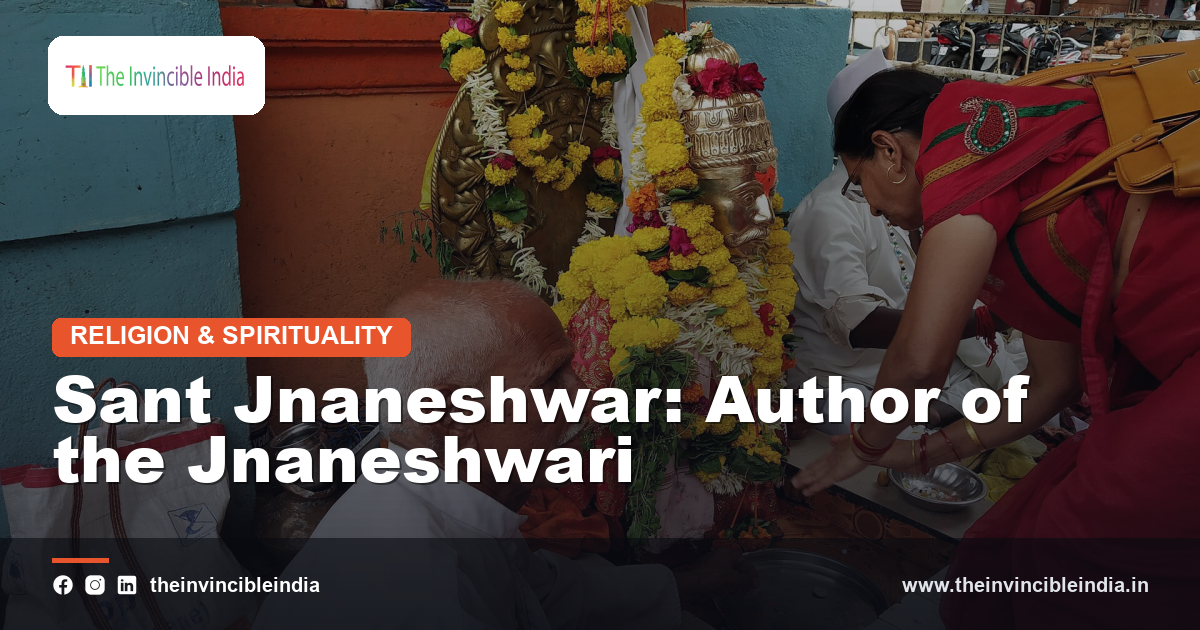
Sant Jnaneshwar, also called Dnyaneshwar and Jnanadeva and honoured by devotees as Mauli, meaning mother, is a thirteenth-century Varkari saint of Maharashtra who is revered as one of the founders of the Varkari tradition of devotion to Vitthal of Pandharpur. He is best known for the Jnaneshwari, his Marathi commentary on the Bhagavad Gita, which opened the teaching of the scripture to ordinary people in their own language. His life, his family of saints and his samadhi at Alandi are deeply woven into the Bhakti movement of Maharashtra. Many details of his life come from tradition, but his place as a foundational saint and poet is secure.
Quick answer: Sant Jnaneshwar, also called Dnyaneshwar, is a thirteenth-century Varkari saint and poet of Maharashtra, revered as one of the founders of the Varkari tradition of devotion to Vitthal of Pandharpur. He is best known for the Jnaneshwari, a Marathi commentary on the Bhagavad Gita that made the scripture accessible to ordinary people. His samadhi is at Alandi, near Pune, which remains a major centre of Varkari pilgrimage and devotion.
Key Takeaways
- Sant Jnaneshwar, also called Dnyaneshwar and Jnanadeva, is a thirteenth-century Varkari saint of Maharashtra.
- He is best known for the Jnaneshwari, a Marathi commentary on the Bhagavad Gita.
- He also composed the Amrutanubhav and many abhangas in Marathi.
- He is revered as one of the founders of the Varkari tradition of devotion to Vitthal.
- His samadhi is at Alandi, near Pune, a major centre of Varkari pilgrimage.
- He came from a family of saints, including his brothers Nivruttinath and Sopan and his sister Muktabai.
The sections below explain his life as told by tradition, his family of saints, his works and his continuing place in Maharashtrian devotion.
Quick Facts
| Detail | Information |
|---|---|
| Also known as | Dnyaneshwar, Jnanadeva, Mauli |
| Tradition | Varkari sampradaya, Bhakti movement |
| Era | Thirteenth century |
| Region | Maharashtra, samadhi at Alandi |
| Language of works | Marathi |
| Principal works | Jnaneshwari, Amrutanubhav, abhangas |
| Deity | Vitthal of Pandharpur |
| Observance | Alandi pilgrimage and the annual wari to Pandharpur |
Who Was Sant Jnaneshwar?
Sant Jnaneshwar was a Marathi saint, poet and philosopher of the thirteenth century who is honoured as one of the founders of the Varkari tradition of Maharashtra. He combined deep learning in the scriptures with a warm devotion to Vitthal and a gift for writing in the language of the people.
Though he is said to have lived only a short life, his influence on Marathi devotion and literature is immense. Devotees call him Mauli, meaning mother, a title of great affection that reflects the tenderness they feel for him. Many stories about his life are tradition, yet his writings and his enduring memory at Alandi give a clear picture of a saint of extraordinary insight whose work shaped the spiritual life of Maharashtra for centuries to come.
What Do the Names Jnaneshwar and Dnyaneshwar Mean?
The saint is known by several closely related names that help readers recognise the same figure across texts and regions. Jnaneshwar and its Marathi form Dnyaneshwar are often understood to mean the lord of knowledge, a name that honours his wisdom and his great commentary.
He is also called Jnanadeva, meaning the god of knowledge, and devotees address him with deep affection as Mauli, meaning mother. The variation in spelling arises from the difference between Sanskrit and Marathi forms and from different systems of transliteration. Keeping these names in mind helps a reader follow his story through Marathi books, temple notices and modern writing, where he may appear under any of them while remaining the same beloved saint of the Varkari tradition.
When and Where Did Sant Jnaneshwar Live?
Sant Jnaneshwar lived in the thirteenth century in the region that is now Maharashtra, and tradition links him with the town of Alandi, on the Indrayani river near Pune, as well as with Nevasa, where he is said to have composed his great commentary. The exact dates are given in tradition and are best described in general terms.
He belonged to an age when Marathi was emerging as a literary language and when the Varkari devotion to Vitthal of Pandharpur was taking shape. His short life unfolded against this background of spiritual and cultural growth. Because his biography is handed down chiefly through tradition, careful writers speak of his century and his region with confidence while treating precise dates and events as part of the sacred story.
What Was the Family of Sant Jnaneshwar Like?
Sant Jnaneshwar came from a remarkable family of saints, and tradition remembers his elder brother Nivruttinath, who was also his guru, his younger brother Sopan, and his sister Muktabai, all of whom are honoured as saints of the Varkari tradition. The four siblings are cherished together in Maharashtrian devotion.
Tradition tells that the family faced great hardship and social difficulty, which the children bore with faith and dignity. Their story of devotion in the face of adversity is deeply loved by devotees. The bond among the siblings, and especially the role of Nivruttinath as the spiritual teacher of Jnaneshwar, is a central feature of the tradition. These accounts are handed down as sacred biography and are treasured as examples of faith and family devotion.
Who Was Nivruttinath, the Guru of Jnaneshwar?
Nivruttinath was the elder brother of Sant Jnaneshwar and also his guru, and tradition honours him as the one who initiated the young saint into the spiritual path and the teaching that flowered in the Jnaneshwari. The relationship of brother and teacher is central to Jnaneshwar’s story.
Nivruttinath is said to have received his own teaching within the Nath tradition, a lineage of yogis, and to have passed its wisdom to Jnaneshwar, who then expressed it in his Marathi works. In his writings Jnaneshwar honours his guru with deep reverence and gratitude. Because many details of their lives are tradition, careful writers stress the respect and devotion that Jnaneshwar expressed towards his brother-teacher rather than asserting specific events as documented history.
What Is the Jnaneshwari?
The Jnaneshwari is Sant Jnaneshwar’s most famous work, a long commentary in Marathi verse on the Bhagavad Gita, written so that the teaching of the scripture could reach people who did not know Sanskrit. It is considered one of the greatest classics of Marathi literature and devotion.
Composed in the ovi metre, the work explains the Gita verse by verse with rich illustrations drawn from daily life and nature, combining deep philosophy with poetic beauty. It is admired both as a work of thought and as a masterpiece of language. For the Varkari tradition it is a foundational text, recited and studied by devotees across generations. The Jnaneshwari opened the wisdom of the Gita to the common people and remains at the heart of Marathi spiritual life.
What Other Works Did Jnaneshwar Write?
Besides the Jnaneshwari, Sant Jnaneshwar is credited with the Amrutanubhav, an original work of philosophy in Marathi that explores the nature of the Self and ultimate reality. He is also honoured as the author of many abhangas, the devotional songs of the Varkari tradition.
The Amrutanubhav, whose name is often understood as the experience of immortal bliss, is admired for its depth and independence of thought. His abhangas express love for Vitthal and the joys and longings of the devotional life. Authorship of every piece attributed to him cannot be verified with certainty, as is common with saints of this period. Together his works show a mind of rare philosophical power joined to a heart of warm and simple devotion.
Why Is Vitthal of Pandharpur Important to Jnaneshwar?
Vitthal, the deity of Pandharpur, is the focus of Jnaneshwar’s devotion, as for all Varkaris, and he is regarded as a form of Vishnu and Krishna who stands upon a brick with his hands upon his hips. Jnaneshwar’s abhangas praise Vitthal as a loving and approachable Lord.
Pandharpur, on the Bhima river, is the great centre of Varkari pilgrimage and a major sacred town of Maharashtra. Jnaneshwar is honoured at Alandi, yet his devotion points to Pandharpur and to the regular pilgrimage, the wari, undertaken in the Lord’s honour. His role in directing the devotion of Maharashtra towards Vitthal is one of the reasons he is remembered as a founder of the Varkari tradition that gathers around the shrine of Pandharpur.
What Is the Varkari Tradition?
The Varkari tradition is a devotional movement of Maharashtra whose followers undertake regular pilgrimages, called wari, to Pandharpur to worship Vitthal, also known as Vithoba. The word varkari means one who performs the wari, and the tradition is marked by song, simplicity and equality.
Its great saints include Jnaneshwar, Namdev, Eknath, Tukaram and Janabai, each of whom contributed songs and teaching in Marathi. The Varkaris sing abhangas, carry a tulsi garland and gather in large processions on pilgrimage. The movement welcomes people from all communities. Jnaneshwar holds a founding place within it, both for his great commentary and for the devotion he kindled, and the palanquin bearing his memory is carried in the annual pilgrimage to Pandharpur.
What Is the Significance of Alandi?
Alandi, a town on the Indrayani river near Pune, is the place most closely associated with Sant Jnaneshwar, for tradition holds that his samadhi, or final resting shrine, is there. It is one of the most sacred centres of the Varkari tradition.
Devotees gather at Alandi throughout the year and in great numbers on festival days to honour the saint whom they lovingly call Mauli. Each year a palanquin bearing his memory sets out from Alandi on the wari, the pilgrimage to Pandharpur, joining those of the other saints. The town is a place of quiet devotion and of great festival, and a visit to Alandi is for many Maharashtrian families an act of reverence to the founding saint of their tradition.
What Is the Wari Pilgrimage?
The wari is the great pilgrimage of the Varkari tradition, in which devotees travel on foot to Pandharpur to worship Vitthal, singing abhangas and carrying the palanquins that bear the memory of the saints, including Jnaneshwar from Alandi. It is one of the most striking expressions of devotion in India.
The pilgrimage takes place each year and draws great numbers of people who walk together for days, forming a moving community of faith, song and simplicity. The palanquin of Jnaneshwar is among the most honoured in the procession. The wari keeps alive the devotion that the saint helped to kindle and binds the Varkari community across generations. It is both a physical journey and a shared act of worship that lies at the heart of the tradition.
How Does Jnaneshwar Compare With Other Varkari Saints?
Jnaneshwar differs from other Varkari saints in his role as the founding philosopher-poet whose great commentary on the Gita gave the tradition its intellectual and spiritual foundation. Saints such as Namdev and Tukaram are known chiefly for their abhangas, while Eknath is remembered as a scholar-householder.
Together these saints form a chain of voices with distinct gifts. Jnaneshwar offers deep philosophy expressed in beautiful Marathi, Namdev loving song, Eknath learned and humorous teaching, and Tukaram direct and often fiery verse. This variety is one of the strengths of the Varkari tradition. Seeing them side by side helps readers understand how a single devotional movement produced a rich literature of philosophy, poetry and social reflection over several centuries.
Why Is Jnaneshwar Called Mauli?
Jnaneshwar is lovingly called Mauli, a Marathi word meaning mother, because devotees feel towards him the tenderness and care that a child feels from a mother. This title expresses the deep affection in which he is held across Maharashtra.
The name reflects the belief that the saint, through his Jnaneshwari and his compassion, nourishes the spiritual life of his devotees as a mother nourishes her children. It is used in prayer, in song and in the greetings of the wari, where the cry of Mauli echoes among the pilgrims. The title shows that Jnaneshwar is remembered not as a distant teacher but as a loving presence, and it captures the warmth that lies at the heart of Varkari devotion to him.
Why Does Jnaneshwar Still Matter Today?
Sant Jnaneshwar still matters today because the Jnaneshwari remains a living text of Marathi devotion and because his life offers a model of wisdom, humility and faith in the face of hardship. His works continue to be read, recited and studied across Maharashtra and beyond.
His gift for expressing the deepest philosophy in the common language has inspired teachers, poets and devotees for centuries, and his memory is carried each year in the great wari to Pandharpur. Scholars value his works as landmarks of Marathi literature and thought, while devotees treasure them as guides to the spiritual life. Careful readers honour the context of his time and treat the sacred stories of his life as tradition, while recognising the lasting power of his writing.
Sant Jnaneshwar Today
Sant Jnaneshwar today is remembered as a founding saint of the Varkari tradition and as the author of the Jnaneshwari, honoured at Alandi and carried in the annual wari to Pandharpur. His works remain central to the religious and literary life of Maharashtra.
Through his great commentary he opened the wisdom of the Gita to ordinary people, and through his devotion he helped to shape the movement that gathers around Vitthal of Pandharpur. Many details of his life are tradition, yet his writings and the love of his devotees give a clear and constant portrait of a saint of rare insight and tenderness. His legacy endures as a reminder that the highest knowledge and the simplest devotion can meet in a single heart.
Sources & Further Reading
- Ministry of Culture, Government of India (indiaculture.gov.in).
- Sahitya Akademi general references on Marathi devotional literature.
Frequently Asked Questions
Who was Sant Jnaneshwar?
Sant Jnaneshwar, also called Dnyaneshwar, was a thirteenth-century Varkari saint and poet of Maharashtra, revered as one of the founders of the tradition. He is best known for the Jnaneshwari, a Marathi commentary on the Bhagavad Gita.
What is the Jnaneshwari?
The Jnaneshwari is Sant Jnaneshwar’s most famous work, a long commentary in Marathi verse on the Bhagavad Gita. It made the teaching of the scripture accessible to ordinary people and is a foundational text of the Varkari tradition.
Where is the samadhi of Sant Jnaneshwar?
The samadhi of Sant Jnaneshwar is at Alandi, a town on the Indrayani river near Pune in Maharashtra. It is one of the most sacred centres of the Varkari tradition and a major place of pilgrimage.
Why is Jnaneshwar called Mauli?
Jnaneshwar is called Mauli, meaning mother, because devotees feel towards him the tender care that a child feels from a mother. The title expresses the deep affection in which he is held across Maharashtra.
Who was the guru of Sant Jnaneshwar?
The guru of Sant Jnaneshwar was his elder brother Nivruttinath, who initiated him into the spiritual path. Jnaneshwar honours his brother-teacher with deep reverence in his writings.
What is the Varkari tradition?
The Varkari tradition is a devotional movement of Maharashtra whose followers make a regular pilgrimage called the wari to Pandharpur to worship Vitthal. Its saints include Jnaneshwar, Namdev, Eknath and Tukaram.


