

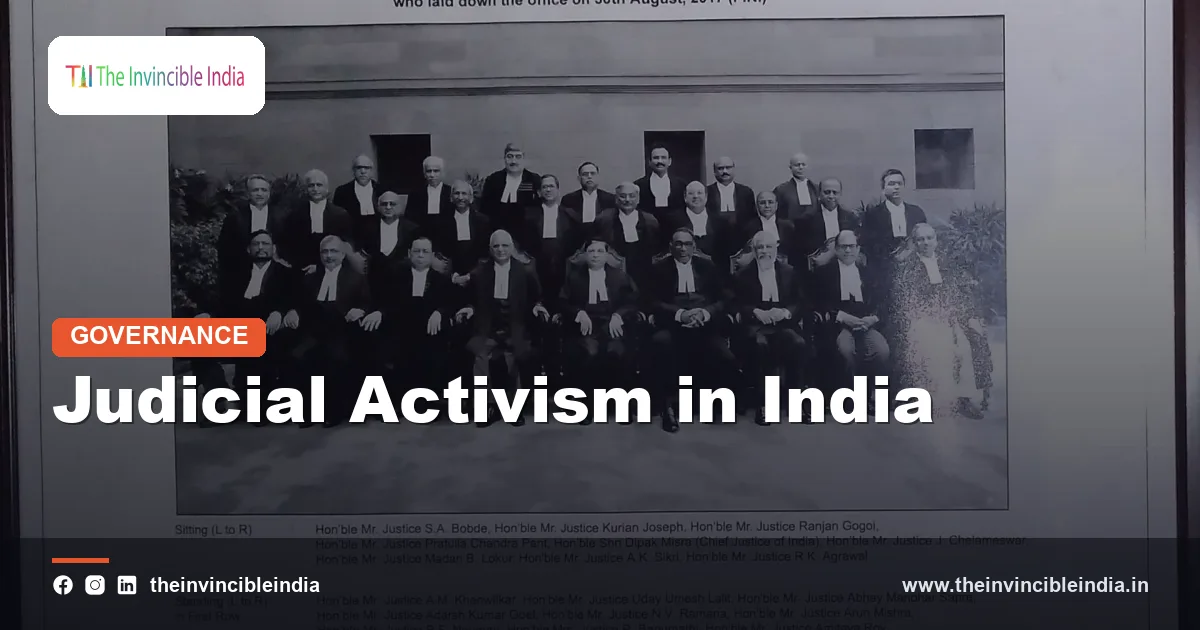
Judicial activism in India is the proactive role of the judiciary, especially the Supreme Court and the High Courts, in protecting fundamental rights and ensuring that governance follows the law, often by interpreting the Constitution liberally and by issuing directions that fill gaps left by the legislature and the executive. It gathered pace from the late 1970s with the expansion of Article 21 and the rise of Public Interest Litigation (PIL).
Supporters regard judicial activism as the means by which courts reached the poor, protected the environment and restrained arbitrary power. Critics describe some of its forms as judicial overreach that strains the separation of powers. This explainer sets out what judicial activism means, how it developed, its landmark cases and tools, and the continuing debate over its limits.
| Attribute | Detail |
|---|---|
| Meaning | Proactive judicial role in enforcing rights and ensuring lawful governance |
| Term first used | Popularised by American historian Arthur Schlesinger Jr. in 1947 |
| Key constitutional provisions | Articles 21, 32, 141, 142 and 226 |
| Main vehicle | Public Interest Litigation (PIL) |
| Pioneer judges | V.R. Krishna Iyer, P.N. Bhagwati, and others from the late 1970s |
| Landmark cases | Kesavananda Bharati (1973), Maneka Gandhi (1978), Hussainara Khatoon (1979), Vishaka (1997) |
| Key tools | Liberal interpretation, continuing mandamus, guidelines, monitoring committees |
| Opposite concept | Judicial restraint |
| Associated criticism | Judicial overreach and violation of separation of powers |
Key Takeaways
- Judicial activism in India means courts taking an active role in protecting rights and enforcing good governance, going beyond a narrow reading of statutes.
- Judicial activism in India expanded after the Maneka Gandhi case of 1978, when the Supreme Court held that the procedure under Article 21 must be fair, just and reasonable.
- Public Interest Litigation allows any public-spirited person to approach the Supreme Court under Article 32 or a High Court under Article 226 on behalf of those who cannot do so themselves.
- Article 142 of the Constitution lets the Supreme Court pass orders necessary to do complete justice in any matter before it.
- Landmark outcomes of judicial activism include the basic structure doctrine, the Vishaka guidelines on sexual harassment and the D.K. Basu guidelines on arrest and custody.
- Judicial overreach is the criticism that courts have, in some instances, made policy or run administration in areas that belong to the legislature or the executive.
What is judicial activism?
Judicial activism is the practice by which courts actively interpret laws and the Constitution to protect rights and correct failures of governance, instead of confining themselves to the literal text. In India it usually means that judges widen the meaning of fundamental rights, relax procedural barriers and issue directions to public authorities.
The phrase is generally traced to a 1947 magazine article by the American historian Arthur Schlesinger Jr., who described the judges of the US Supreme Court as divided between activists and champions of restraint. In India, the idea gained relevance as the courts began responding to public concerns that the political branches had left unaddressed.
Judicial activism is not itself a legal doctrine written in the Constitution. It is a descriptive label that commentators use for a style of adjudication, and its application to a given decision is often contested.
How is judicial activism different from judicial review and judicial restraint?
Judicial review is the constitutional power of courts to examine whether laws and executive actions comply with the Constitution, while judicial activism describes an energetic way of using that power, and judicial restraint describes a cautious way of using it. Judicial review is a feature of the Constitution, whereas activism and restraint are approaches to exercising it.
| Concept | Meaning | Typical feature |
|---|---|---|
| Judicial review | Power to test laws and actions against the Constitution | Part of the basic structure; exercised under Articles 13, 32, 226 and 227 |
| Judicial activism | Proactive, rights-expanding use of judicial power | Liberal reading of rights, PIL, detailed directions |
| Judicial restraint | Deference to the legislature and executive | Narrow reading, avoidance of policy questions |
| Judicial overreach | Alleged intrusion into legislative or executive domains | Courts framing policy or managing administration |
When and why did judicial activism begin in India?
Judicial activism in India began in earnest in the late 1970s, after the Emergency of 1975 to 1977, when the Supreme Court sought to restore public confidence by expanding the reach of fundamental rights. The decision in ADM Jabalpur v. Shivkant Shukla (1976), which accepted that habeas corpus could be suspended during the Emergency, was widely criticised, and later benches built a more rights-oriented jurisprudence.
Earlier steps had already shaped the ground. In Golaknath v. State of Punjab (1967), the Supreme Court held that Parliament could not amend fundamental rights, and in Kesavananda Bharati v. State of Kerala (1973), a thirteen-judge bench held by a narrow majority that Parliament cannot alter the “basic structure” of the Constitution. This gave the courts a lasting standard for reviewing constitutional amendments.
Several conditions encouraged the shift. Large sections of the population were poor, illiterate or unaware of their rights. Administrative delay, police excesses and environmental harm were widespread, and ordinary legal procedures were costly. Judges such as V.R. Krishna Iyer and P.N. Bhagwati argued that the Constitution required courts to be accessible to the weakest citizens.
What is Public Interest Litigation and how did it change the courts?
Public Interest Litigation (PIL) is a legal action brought to protect the rights of a group or the public at large, where the petitioner need not be the person directly affected. PIL relaxed the traditional rule of locus standi, which had required petitioners to show a personal injury, and so opened the Supreme Court and High Courts to social action groups, lawyers and journalists.
The decision in S.P. Gupta v. Union of India (1981), often called the Judges Transfer case, recognised that any member of the public with sufficient interest can move the court for the benefit of a person or class who is unable to do so because of poverty, disability or social disadvantage. Courts also began accepting letters and postcards as petitions, known as epistolary jurisdiction.
Features of PIL in India include the following.
- Petitions can be filed under Article 32 in the Supreme Court and Article 226 in High Courts.
- Courts may appoint commissioners, expert committees or amici curiae to gather facts.
- Technical rules of evidence and pleading are relaxed.
- Courts may pass continuing orders and supervise compliance over years.
- Petitions motivated by private, political or publicity interests may be dismissed, and costs may be imposed on petitioners.
How did Article 21 become the centre of judicial activism?
Article 21, which guarantees that no person shall be deprived of life or personal liberty except according to procedure established by law, became the centre of judicial activism after the Supreme Court gave it a broad reading in Maneka Gandhi v. Union of India (1978). The Court held that the procedure must be just, fair and reasonable, and linked Articles 14, 19 and 21 together as a connected set of guarantees.
From this base, the Court has read many unlisted rights into the right to life. The following are examples, with the decisions in which they were recognised.
| Right recognised under Article 21 | Illustrative case |
|---|---|
| Speedy trial and legal aid for undertrials | Hussainara Khatoon v. State of Bihar (1979) |
| Dignity and humane treatment in prison | Sunil Batra v. Delhi Administration (1978); Francis Coralie Mullin (1981) |
| Release of bonded labourers | Bandhua Mukti Morcha v. Union of India (1984) |
| Livelihood as part of life | Olga Tellis v. Bombay Municipal Corporation (1985) |
| Clean environment and pollution-free water and air | Subhash Kumar v. State of Bihar (1991) and related cases |
| Education up to age fourteen | Unni Krishnan v. State of Andhra Pradesh (1993) |
| Protection from sexual harassment at work | Vishaka v. State of Rajasthan (1997) |
| Right to privacy | K.S. Puttaswamy v. Union of India (2017) |
The Eighty-sixth Constitutional Amendment of 2002 later inserted Article 21A, which made education for children aged six to fourteen a fundamental right, building on the line of cases that began with Unni Krishnan.
What are the landmark examples of judicial activism in India?
Landmark examples of judicial activism in India include the basic structure doctrine, the prison reform cases, the environmental cases, the Vishaka guidelines and the guidelines on arrest and custody. Each of these shows courts acting where laws were silent or poorly enforced.
Environment and public health
In M.C. Mehta v. Union of India (1986), arising from a gas leak at a factory in Delhi, the Supreme Court developed the principle of absolute liability for hazardous industries. In later environmental cases, the Court applied principles such as the polluter pays principle and the precautionary principle, and it directed the shifting of polluting industries and the conversion of public transport in Delhi to compressed natural gas in the late 1990s. In T.N. Godavarman Thirumulpad v. Union of India (1996), the Court began a long-running supervision of forest conservation.
Prisons and custodial rights
In Hussainara Khatoon (1979), reports of thousands of undertrial prisoners held for periods longer than the maximum punishment for their alleged offences led to the release of many and the recognition of speedy trial as part of Article 21. In D.K. Basu v. State of West Bengal (1997), the Court laid down binding requirements for arrest and detention, including memos of arrest, medical examination and informing a relative.
Women’s rights and equality
In Vishaka v. State of Rajasthan (1997), the Court issued binding guidelines against sexual harassment at the workplace, relying on Articles 14, 15, 19 and 21 and on international conventions, because no domestic law existed. Parliament later enacted the Sexual Harassment of Women at Workplace (Prevention, Prohibition and Redressal) Act, 2013.
Clean governance
In Vineet Narain v. Union of India (1997), the Court monitored investigations by the Central Bureau of Investigation into high-level corruption allegations and issued directions to strengthen its independence. In Lily Thomas v. Union of India (2013), the Court struck down a provision that had allowed convicted legislators to continue in office while their appeals were pending.
What tools do courts use in judicial activism?
Courts use a set of procedural and substantive tools in judicial activism, including liberal interpretation, continuing mandamus, binding guidelines, monitoring committees and the wide powers under Articles 32, 141 and 142. These tools allow judges to act even where no specific statute exists.
- Liberal and purposive interpretation: reading rights broadly to serve their purpose, as with Article 21.
- Continuing mandamus: keeping a case open and issuing periodic orders to supervise compliance, as in forest conservation and Delhi’s air quality cases.
- Guidelines: laying down interim rules to apply until the legislature acts, as in Vishaka and D.K. Basu.
- Article 142: passing orders necessary for complete justice, which has been used for compensation schemes, directions for investigation and the dissolution of marriages.
- Article 141: making the law declared by the Supreme Court binding on all courts in India.
- Appointment of commissions and amici: collecting facts through independent persons.
- Compensation: awarding monetary relief for violation of fundamental rights by public authorities.
- Doctrine of the basic structure: testing constitutional amendments against core features.
What is judicial overreach and why do critics raise it?
Judicial overreach is the criticism that courts, in some cases, have gone beyond interpretation and have formulated policy or managed administration, thereby encroaching on the domain of the legislature and executive. Critics stress that judges are not elected and may lack the expertise, resources and accountability that policy decisions require.
The main arguments made by critics are listed below.
- The Constitution divides functions among the legislature, executive and judiciary, and courts should not make laws.
- Judicial orders on complex matters such as pricing, urban planning or resource allocation may have wide, unintended effects.
- Continuing supervision can strain administration and may blur accountability.
- Courts can be overloaded with PILs while the backlog of ordinary cases remains large.
- Appointment of judges through the collegium system, in place since the Second Judges case of 1993, is itself criticised as lacking external accountability.
The Supreme Court has itself recognised the risk. In various judgments, benches have reminded the judiciary to respect institutional boundaries, avoid micro-managing administration and treat PIL with care to prevent misuse.
What is the case for judicial activism?
The case for judicial activism is that courts act as the guardian of the Constitution and must step in when other institutions fail to protect rights, particularly of those who have little political voice. Supporters argue that without judicial intervention, undertrials, bonded labourers, pavement dwellers and women facing harassment might have found no remedy.
They also point out that the Constitution itself gives the Supreme Court the duty to enforce fundamental rights under Article 32, which Dr B.R. Ambedkar described as the “heart and soul” of the Constitution. In their view, activism is not a departure from the constitutional scheme but a use of the powers given to the courts.
Judicial activism has also led legislatures to act. The Right to Education Act, 2009, the Sexual Harassment at Workplace Act, 2013 and reforms in election disclosure all followed judicial directions or pressure from litigation.
How does the separation of powers apply to judicial activism?
Separation of powers in India is a flexible principle, under which the legislature, executive and judiciary have distinct functions but are not completely isolated from each other. The Supreme Court has held that separation of powers is part of the basic structure of the Constitution, even though the text does not use the phrase.
Checks and balances operate in several directions. Parliament can amend the Constitution or pass new laws to overcome a judgment, provided it respects the basic structure. The executive appoints and the legislature can remove judges through impeachment, which requires a special majority. The judiciary reviews laws and executive acts. In Kesavananda Bharati, the Court insisted that judicial review itself cannot be removed.
The balance between activism and restraint therefore shifts with time and context. In some periods courts have been more assertive, as in the 1980s and 1990s, and in others they have shown greater restraint on economic and policy matters, reflecting the principle that courts should decide legal questions and leave policy choices to elected bodies.
What is the current debate on judicial activism?
The current debate on judicial activism centres on how courts can protect rights and ensure accountability without taking over policy functions. Recent discussion has covered the use of Article 142, the monitoring of environmental clearances, the handling of PILs and the process for appointing judges.
The Supreme Court struck down the Ninety-ninth Amendment and the National Judicial Appointments Commission Act in the Fourth Judges case of 2015, retaining the collegium system. The ruling is cited by both sides: supporters view it as protection of judicial independence, and critics view it as an example of the judiciary deciding its own composition.
A balanced approach is widely proposed, in which courts act where there is a clear violation of rights or a gap in law, set time-bound directions rather than indefinite supervision, defer to expert and elected bodies on technical policy, and invite Parliament to legislate where a long-term framework is needed.
Bottom Line
Judicial activism in India has widened the meaning of the right to life, opened the courts to ordinary citizens through PIL and produced guidelines that later became law. It also raises legitimate questions about the limits of judicial power and accountability. The most durable view in constitutional practice is that activism is justified when it protects rights and fills genuine gaps, and that restraint is equally important when policy choices belong to elected institutions.
Frequently Asked Questions
What is judicial activism in simple words?
Judicial activism is when courts take a proactive role in protecting rights and fixing failures in governance, rather than only applying the text of laws narrowly. In India, it is seen in the broad reading of Article 21 and in Public Interest Litigation. It often involves courts issuing guidelines and directions to public authorities.
Which case started judicial activism in India?
No single case started judicial activism in India, but Kesavananda Bharati (1973), Maneka Gandhi (1978) and Hussainara Khatoon (1979) are widely seen as turning points. Kesavananda Bharati established the basic structure doctrine, and Maneka Gandhi widened Article 21. Hussainara Khatoon is regarded as the first major PIL on undertrial prisoners.
What is the difference between judicial activism and judicial overreach?
Judicial activism is the active use of judicial power to protect rights and enforce the law, while judicial overreach is the term used when critics believe courts have gone beyond their role and entered the domain of the legislature or executive. Both terms describe the same kind of court action from different viewpoints. Whether a particular decision is activism or overreach is a matter of opinion and legal debate.
What is Public Interest Litigation?
Public Interest Litigation is a legal petition filed to protect public or group interests, which can be brought by any person or organisation even if they are not personally affected. It can be filed under Article 32 in the Supreme Court or Article 226 in a High Court. Courts may dismiss PILs filed for personal or publicity motives.
What is continuing mandamus?
Continuing mandamus is a method in which a court keeps a case open after its first order and monitors compliance through repeated hearings and directions. The Supreme Court has used it in cases on forests, pollution and policing. Supporters see it as a way to ensure real implementation, while critics say it may turn courts into administrators.
What is the role of Article 142 in judicial activism?
Article 142 empowers the Supreme Court to pass any decree or order necessary for doing complete justice in a case before it. The Court has used it to provide compensation, give directions where laws are silent and settle complex disputes. The Court has said that Article 142 should not be used to override express statutory provisions on substantive matters, although the exact limits remain a subject of debate.
{“@context”:”https://schema.org”,”@graph”:[{“@type”:”FAQPage”,”mainEntity”:[{“@type”:”Question”,”name”:”What is judicial activism in simple words?”,”acceptedAnswer”:{“@type”:”Answer”,”text”:”Judicial activism is when courts take a proactive role in protecting rights and fixing failures in governance, rather than only applying the text of laws narrowly. In India, it is seen in the broad reading of Article 21 and in Public Interest Litigation. It often involves courts issuing guidelines and directions to public authorities.”}},{“@type”:”Question”,”name”:”Which case started judicial activism in India?”,”acceptedAnswer”:{“@type”:”Answer”,”text”:”No single case started judicial activism in India, but Kesavananda Bharati (1973), Maneka Gandhi (1978) and Hussainara Khatoon (1979) are widely seen as turning points. Kesavananda Bharati established the basic structure doctrine, and Maneka Gandhi widened Article 21. Hussainara Khatoon is regarded as the first major PIL on undertrial prisoners.”}},{“@type”:”Question”,”name”:”What is the difference between judicial activism and judicial overreach?”,”acceptedAnswer”:{“@type”:”Answer”,”text”:”Judicial activism is the active use of judicial power to protect rights and enforce the law, while judicial overreach is the term used when critics believe courts have gone beyond their role and entered the domain of the legislature or executive. Both terms describe the same kind of court action from different viewpoints. Whether a particular decision is activism or overreach is a matter of opinion and legal debate.”}},{“@type”:”Question”,”name”:”What is Public Interest Litigation?”,”acceptedAnswer”:{“@type”:”Answer”,”text”:”Public Interest Litigation is a legal petition filed to protect public or group interests, which can be brought by any person or organisation even if they are not personally affected. It can be filed under Article 32 in the Supreme Court or Article 226 in a High Court. Courts may dismiss PILs filed for personal or publicity motives.”}},{“@type”:”Question”,”name”:”What is continuing mandamus?”,”acceptedAnswer”:{“@type”:”Answer”,”text”:”Continuing mandamus is a method in which a court keeps a case open after its first order and monitors compliance through repeated hearings and directions. The Supreme Court has used it in cases on forests, pollution and policing. Supporters see it as a way to ensure real implementation, while critics say it may turn courts into administrators.”}},{“@type”:”Question”,”name”:”What is the role of Article 142 in judicial activism?”,”acceptedAnswer”:{“@type”:”Answer”,”text”:”Article 142 empowers the Supreme Court to pass any decree or order necessary for doing complete justice in a case before it. The Court has used it to provide compensation, give directions where laws are silent and settle complex disputes. The Court has said that Article 142 should not be used to override express statutory provisions on substantive matters, although the exact limits remain a subject of debate.”}}]}]}


