

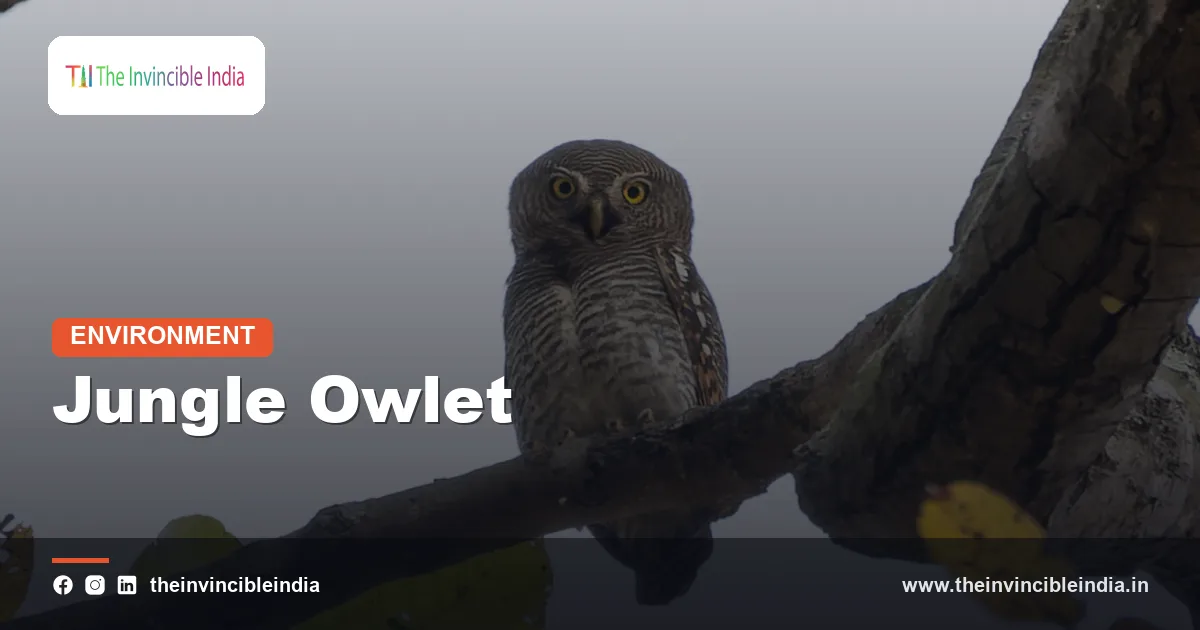
The jungle owlet (Glaucidium radiatum) is a small, heavily barred, round-headed owl of the Indian subcontinent that lives in deciduous forests and well-wooded country and, unlike most owls, is often active in daylight as well as at dusk. About the size of a myna, the jungle owlet has no ear tufts, bright yellow eyes and a dark brown body crossed by fine white bars, and it is best known for a ringing, accelerating call that carries far through the forest.
Because it perches openly on bare branches at dawn and late afternoon, the jungle owlet is one of the easier owls for beginners to see in Indian forests, plantations and tree-lined village edges. This explainer covers how to identify the bird, where it lives, what it eats, how it breeds and how it differs from similar small owls.
| Attribute | Details |
|---|---|
| Common name | Jungle owlet (also called barred jungle owlet) |
| Scientific name | Glaucidium radiatum |
| Family and order | Strigidae (typical owls), order Strigiformes |
| Size | Roughly 20 to 21 cm long; a small, compact owl with a rounded head |
| Range and habitat in India | Deciduous and mixed forest, scrub woodland, plantations and wooded farmland across much of peninsular and central India and the foothills of the north |
| Diet | Large insects, lizards, frogs, small rodents and small birds |
| Breeding | Nests in tree cavities, usually from winter into early summer; typically 3 to 5 white eggs |
| Conservation status | Least Concern on the IUCN Red List; legally protected in India |
Key Takeaways
- The jungle owlet is a small barred owl, about 20 to 21 cm long, with a round head, no ear tufts and yellow eyes.
- Jungle owlets are partly diurnal and are most active at dawn, dusk and on overcast days, which makes them easier to spot than most owls.
- The jungle owlet eats beetles, grasshoppers, crickets, lizards, frogs, mice and small birds, which it catches from a perch.
- Jungle owlets nest in natural tree holes or old woodpecker and barbet cavities and lay about three to five white eggs.
- The jungle owlet is classified as Least Concern by the IUCN, although loss of old hollow trees can reduce nesting sites locally.
- Owls, including the jungle owlet, are protected under India’s Wildlife (Protection) Act, 1972, and capturing or trading them is an offence.
What is the jungle owlet?
The jungle owlet is a small owl in the family Strigidae and the genus Glaucidium, a group commonly known as pygmy owls or owlets. The genus name refers to the owl’s bright, glaring eyes, and the species name radiatum refers to the radiating, barred pattern that covers its plumage.
Within India, the jungle owlet is a resident species, which means individuals stay in the same area through the year rather than migrating. Pairs hold territories and use the same patch of forest for roosting, hunting and nesting, often for several seasons.
The bird belongs to the same broad family as the spotted owlet, the brown fish owl and the great horned owl, but it is much smaller than most of its relatives. Owlets of the Glaucidium group are efficient predators for their size and are bold enough to attack prey close to their own body weight.
How can you identify a jungle owlet?
A jungle owlet can be identified by its small size, rounded head without ear tufts, yellow eyes and a body finely barred in dark brown and white. The upperparts are dark brown with narrow pale bars, the underparts are whitish with brown barring, and the tail carries several pale bands that show clearly when the bird flies or turns.
Several features help separate the bird from other owls in the field:
- Head shape: The head is round and smooth, with no feather tufts, and the facial disc is poorly defined compared with larger owls.
- Eyes and bill: The iris is bright yellow and the bill is a pale, greenish yellow, giving the bird a stern expression.
- Barring: Fine, even bars cover the back, wings and breast, which is the feature that gives the species its scientific name.
- Posture: The bird often sits upright and still, then bobs or jerks its tail when excited or alarmed.
- Nape markings: Like many pygmy owls, the back of the head carries pale markings that resemble a second pair of eyes, which may deter attacks from behind.
Male and female jungle owlets look alike, although females are often slightly larger. Juveniles resemble adults but may appear softer and fluffier, with less sharply defined barring.
Where does the jungle owlet live in India?
The jungle owlet lives in deciduous and mixed forests, open woodland and well-wooded farmland across large parts of India, from the plains and peninsular hills to the foothills of the north. Its range extends beyond India into neighbouring countries of the subcontinent, and it is generally a bird of low to middle elevations rather than the high mountains.
The species prefers habitats with mature trees, because it needs both open perches for hunting and cavities for nesting. Typical settings include:
- Dry and moist deciduous forests such as the sal and teak forests of central and eastern India
- Forest edges and clearings in the Western Ghats foothills
- Mango groves, teak plantations and old orchards
- Wooded river banks, temple groves and tree-lined village outskirts
The jungle owlet generally avoids dense, closed evergreen forest and open treeless land. It is more commonly found in forest than the spotted owlet, which prefers villages and towns, although the two sometimes occur within a short distance of each other where forest meets farmland.
Regional variation
Jungle owlets in different parts of the subcontinent show small differences in tone and barring, and ornithologists recognise more than one subspecies. Birds in the Western Ghats region are often described as slightly different in colour from those of the northern plains, although the overall barred pattern is the same everywhere.
What does the jungle owlet eat?
The jungle owlet eats mainly large insects, lizards, frogs, small rodents and small birds, hunting by sitting quietly on a perch and dropping onto prey it spots below. Beetles, grasshoppers, crickets and moths make up much of the diet, with vertebrates taken when the opportunity arises.
The hunting method follows a pattern known as sit-and-wait predation. The owlet watches from a branch or post, turns its head to track movement, then glides down silently to seize the prey in its talons. It sometimes catches flying insects in the air, especially around dusk when termites and moths are on the wing.
- Insects: Beetles, grasshoppers, crickets, cicadas and winged termites are common prey.
- Reptiles and amphibians: Small lizards such as garden lizards and skinks, and occasionally frogs, are caught on or near the ground.
- Mammals: Mice and other small rodents are taken at dusk or at night.
- Birds: Small songbirds are sometimes killed, although this is less frequent than insect feeding.
Like other owls, the jungle owlet swallows small prey whole or in large pieces and later coughs up a compact pellet containing indigestible fur, bones, feathers and insect parts. Naturalists study these pellets to learn what the bird has eaten.
What does a jungle owlet sound like?
The jungle owlet makes a loud, ringing series of notes that starts slowly, rises in pitch and speed, and often ends in a rapid run, and pairs frequently call together as a duet. The call is one of the most recognisable sounds of an Indian deciduous forest in the early morning and evening, and it often reveals the bird before it is seen.
The call has several functions:
- Advertising the territory to neighbouring owlets
- Maintaining contact between a mated pair
- Strengthening the pair bond before and during the breeding season
The jungle owlet calls more frequently in the breeding season and on cloudy days. Because the call is loud and distinctive, bird surveys often use it to find and count the species in forest areas where the bird itself stays hidden among leaves.
Why is the jungle owlet active in daylight?
The jungle owlet is active in daylight because it is a crepuscular and partly diurnal hunter, which means it hunts in the low light of dawn and dusk and also on bright or overcast days. Many small owls in the pygmy owl group share this behaviour, and it allows them to catch insects and reptiles that are most active in warm daytime conditions.
Daytime activity brings both benefits and risks. The owlet can use its sharp daytime vision to find lizards and large insects, yet it also draws attention from other birds. Drongos, babblers, mynas and tits often gather around a visible owlet and mob it with loud alarm calls. Mobbing behaviour is a useful clue for birdwatchers: a sudden, noisy flock of small birds in one tree often means an owl or another predator is perched nearby.
During the middle of the day, the jungle owlet usually rests in dense foliage or a shaded tree cavity, where its barred plumage blends into the pattern of light and bark.
How does the jungle owlet breed?
The jungle owlet breeds by nesting in tree cavities, typically between winter and early summer, and lays about three to five white eggs. The exact timing varies with region and climate, but most nests are found in the drier part of the year when forests are open and food is plentiful.
The breeding cycle follows several stages:
- Courtship: The pair calls together more often and the male may feed the female to strengthen the bond.
- Nest site: The pair chooses a natural hollow or an abandoned woodpecker, barbet or similar hole in a large tree, adding little or no lining.
- Incubation: The female sits on the white, rounded eggs while the male brings food.
- Chick rearing: Both parents feed the nestlings with insects, lizards and small prey until the young leave the hole.
- Fledging: Young birds leave the nest after several weeks but remain near the parents while they learn to hunt.
Nest holes are a limited resource. When old, hollow trees are cut for timber or firewood, jungle owlets and other cavity-nesting birds lose breeding sites, which is one reason that retaining old trees in plantations and farmland is helpful to wildlife.
How is the jungle owlet different from similar small owls?
The jungle owlet differs from similar small owls mainly in its barred plumage, its preference for forest habitat and its voice. The table below compares it with two small owls that are often confused with it in India.
| Feature | Jungle owlet | Spotted owlet | Asian barred owlet |
|---|---|---|---|
| Scientific name | Glaucidium radiatum | Athene brama | Glaucidium cuculoides |
| Plumage pattern | Fine dark and white bars | Brown with white spots | Broader brown bars, streaked belly |
| Typical habitat | Deciduous forest and wooded country | Villages, towns, farmland, old buildings | Hill forests of the Himalayan foothills and the north-east |
| Size | About 20 to 21 cm | About 21 cm | Larger, about 23 to 25 cm |
| Behaviour | Partly diurnal, perches on branches | Often roosts in holes in buildings | Active at dawn and dusk, also by day |
The simplest field test is the pattern: a spotted owlet is spotted, while a jungle owlet is barred. Habitat is a second clue, since jungle owlets are tied to forest and plantations rather than to human buildings.
Is the jungle owlet threatened?
The jungle owlet is not considered globally threatened and is listed as Least Concern on the IUCN Red List because it has a wide range and is reasonably common in suitable habitat. Even so, local populations can decline where forests are cleared, old trees are removed or owls are persecuted.
The main pressures on jungle owlets and other Indian owls include:
- Habitat loss: Conversion of forest to agriculture and the felling of old hollow trees reduce nesting and hunting sites.
- Pesticides: Chemicals used in farms can reduce insect prey and poison predators through the food chain.
- Superstition and illegal trade: Owls are caught or killed in parts of India because of folk beliefs, even though capturing or trading them is against the law.
- Road and window collisions: Owlets hunting at dusk near roads and clearings may be hit by vehicles.
All owls are protected under India’s Wildlife (Protection) Act, 1972, and international trade in owls is regulated under CITES. Conservation groups encourage awareness programmes that explain the benefits of owls, which control rodents and large insects.
How can you watch jungle owlets responsibly?
You can watch jungle owlets responsibly by looking and listening at dawn and dusk, keeping a respectful distance and never using flash or playback calls to lure the bird. Responsible watching protects nesting birds and keeps the experience natural for other observers.
- Best time: Visit forest edges and plantations in the early morning or the last hour of daylight.
- Listen first: The ringing call usually reveals the territory, and the bird can then be located on an open branch.
- Watch the small birds: A flock of agitated birds often gathers around a perched owlet.
- Keep distance: Use binoculars or a long lens and avoid approaching a nest hole.
- Avoid playback: Repeated recorded calls stress birds during nesting and can draw them away from feeding.
Forest rest-houses, tiger reserves and wooded national parks such as those of central India often give good chances of seeing the species during a morning safari or walk.
Bottom Line
The jungle owlet is a small, barred, yellow-eyed owl of Indian deciduous forests that hunts insects and small animals from perches and calls in a loud, rising duet. It is common enough to be classed as Least Concern, but depends on mature trees for nest holes, so protecting old trees helps it survive.
Frequently Asked Questions
What is a jungle owlet?
A jungle owlet is a small, barred, round-headed owl, Glaucidium radiatum, found in forests and wooded country across the Indian subcontinent. It is about 20 to 21 cm long, has yellow eyes and no ear tufts, and is partly active in daylight. It belongs to the owl family Strigidae.
Is the jungle owlet active during the day?
Yes, the jungle owlet is partly diurnal and is often seen in the early morning, late afternoon and on overcast days. It hunts lizards and large insects in good light as well as at dusk. During the midday heat it usually rests in shaded foliage or a tree cavity.
What does the jungle owlet eat?
The jungle owlet eats mainly large insects, lizards, frogs, small rodents and small birds. It hunts from a perch, watching for movement and dropping silently onto prey. Beetles, grasshoppers and crickets form much of its diet.
How do you tell a jungle owlet from a spotted owlet?
A jungle owlet is finely barred in brown and white, while a spotted owlet is brown with white spots. The jungle owlet lives mostly in deciduous forest and wooded country, whereas the spotted owlet is common around villages, towns and old buildings. Their calls also differ, with the jungle owlet giving a ringing, accelerating series of notes.
Where does the jungle owlet nest?
The jungle owlet nests in tree cavities, using natural hollows or old woodpecker and barbet holes. The female lays about three to five white eggs, usually between winter and early summer. Both parents feed the chicks after hatching.
Is the jungle owlet protected in India?
Yes, the jungle owlet is protected under India’s Wildlife (Protection) Act, 1972, which prohibits capturing, killing or trading owls. The species is classified as Least Concern by the IUCN because of its wide range. Loss of old hollow trees and superstition-driven hunting remain local threats.
{“@context”:”https://schema.org”,”@graph”:[{“@type”:”FAQPage”,”mainEntity”:[{“@type”:”Question”,”name”:”What is a jungle owlet?”,”acceptedAnswer”:{“@type”:”Answer”,”text”:”A jungle owlet is a small, barred, round-headed owl, Glaucidium radiatum, found in forests and wooded country across the Indian subcontinent. It is about 20 to 21 cm long, has yellow eyes and no ear tufts, and is partly active in daylight. It belongs to the owl family Strigidae.”}},{“@type”:”Question”,”name”:”Is the jungle owlet active during the day?”,”acceptedAnswer”:{“@type”:”Answer”,”text”:”Yes, the jungle owlet is partly diurnal and is often seen in the early morning, late afternoon and on overcast days. It hunts lizards and large insects in good light as well as at dusk. During the midday heat it usually rests in shaded foliage or a tree cavity.”}},{“@type”:”Question”,”name”:”What does the jungle owlet eat?”,”acceptedAnswer”:{“@type”:”Answer”,”text”:”The jungle owlet eats mainly large insects, lizards, frogs, small rodents and small birds. It hunts from a perch, watching for movement and dropping silently onto prey. Beetles, grasshoppers and crickets form much of its diet.”}},{“@type”:”Question”,”name”:”How do you tell a jungle owlet from a spotted owlet?”,”acceptedAnswer”:{“@type”:”Answer”,”text”:”A jungle owlet is finely barred in brown and white, while a spotted owlet is brown with white spots. The jungle owlet lives mostly in deciduous forest and wooded country, whereas the spotted owlet is common around villages, towns and old buildings. Their calls also differ, with the jungle owlet giving a ringing, accelerating series of notes.”}},{“@type”:”Question”,”name”:”Where does the jungle owlet nest?”,”acceptedAnswer”:{“@type”:”Answer”,”text”:”The jungle owlet nests in tree cavities, using natural hollows or old woodpecker and barbet holes. The female lays about three to five white eggs, usually between winter and early summer. Both parents feed the chicks after hatching.”}},{“@type”:”Question”,”name”:”Is the jungle owlet protected in India?”,”acceptedAnswer”:{“@type”:”Answer”,”text”:”Yes, the jungle owlet is protected under India’s Wildlife (Protection) Act, 1972, which prohibits capturing, killing or trading owls. The species is classified as Least Concern by the IUCN because of its wide range. Loss of old hollow trees and superstition-driven hunting remain local threats.”}}]}]}


