

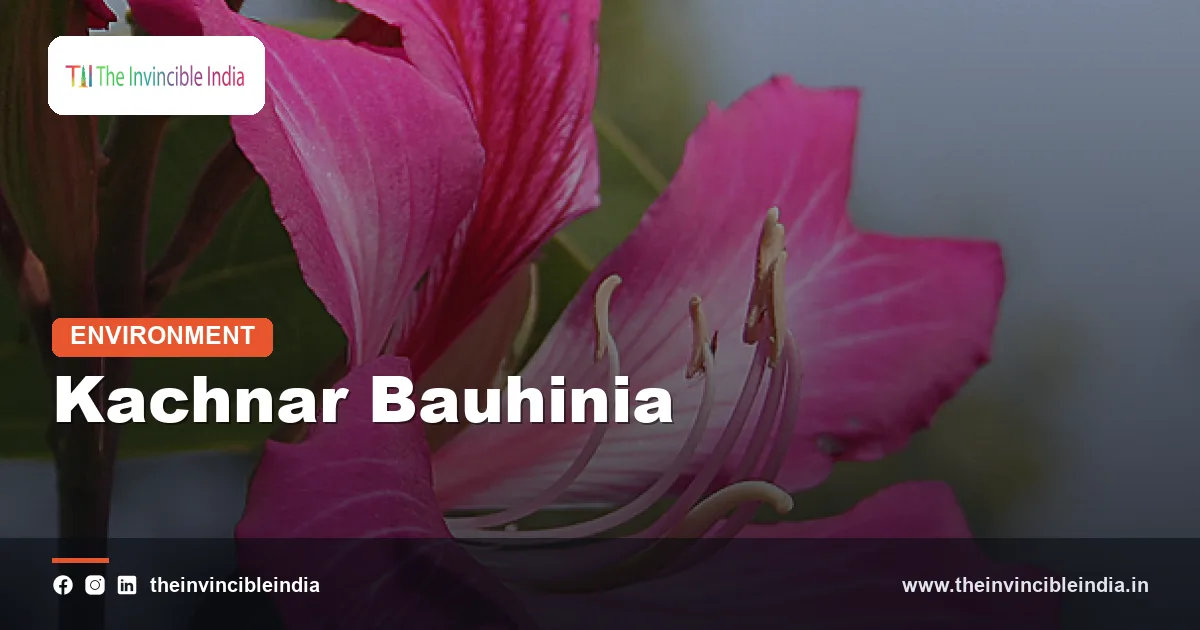
Kachnar (Bauhinia variegata), also called the orchid tree or mountain ebony, is a small to medium deciduous tree of the pea family that bears showy pink, purple or white orchid-like flowers in late winter and spring and is easily recognised by its two-lobed, camel-foot-shaped leaves. Native to the sub-Himalayan belt, the foothills and the plains of India, kachnar is planted widely along avenues and in gardens, and in the northern hills its unopened buds and flowers are cooked as a vegetable.
Kachnar therefore sits at the meeting point of ornamental horticulture, regional cuisine and traditional medicine. This explainer sets out what kachnar is, how to identify it, where and when it flowers, how the buds are cooked, how it differs from similar Bauhinia species and how to grow it.
| Attribute | Detail |
|---|---|
| Common names | Kachnar (Hindi), orchid tree, mountain ebony, camel’s foot tree, kanchanara (Sanskrit), kanchan (Bengali and Marathi) |
| Scientific name | Bauhinia variegata (sometimes placed in Phanera) |
| Plant family | Fabaceae (pea or legume family) |
| Native range | Indian subcontinent, extending into Southeast Asia and southern China |
| Tree type | Deciduous, up to about 10 to 12 metres tall |
| Flowering season | Roughly February to April |
| Flower colour | Pink, magenta or purple (a white form, var. candida, also occurs) |
| Distinctive leaf | Broad, rounded leaf with two lobes, resembling a camel’s foot |
| Culinary use | Buds and flowers cooked as a vegetable in the northern hills and plains |
Key Takeaways
- Kachnar (Bauhinia variegata) is a deciduous tree of the pea family that flowers from about February to April in pink, purple or white blooms resembling orchids.
- The kachnar leaf is divided into two rounded lobes, which gives the tree the common name camel’s foot tree and the genus name Bauhinia, after the twin Bauhin brothers.
- Kachnar buds and flowers are cooked as a vegetable in Himachal Pradesh, Uttarakhand, Punjab, Haryana and other northern regions.
- Kachnar bark appears in the Ayurvedic preparation Kanchanara Guggulu, which is traditionally used for glandular swellings and related complaints.
- Kachnar blooms in spring, while its relative Bauhinia purpurea blooms mainly in autumn, a difference that helps in identification.
- Kachnar produces long, flat, brown pods that split to release seeds and remain on the tree for months.
What is kachnar?
Kachnar is a deciduous tree, Bauhinia variegata, in the legume family Fabaceae, and it is valued as an ornamental, a vegetable plant and a source of traditional medicine. The tree is native to India and neighbouring countries and has been planted in warm regions around the world for its flowers.
In English, kachnar is often called the orchid tree because its five-petalled flowers, with one petal marked by darker veins, resemble orchid blooms. It is also called mountain ebony, although the wood is not ebony. In Sanskrit literature it is called kanchanara, a name reflected in the Hindi kachnar and the Bengali kanchan.
The genus name Bauhinia honours the Swiss botanist brothers Jean and Caspar Bauhin. The Swedish botanist Carl Linnaeus named the genus, and the two-lobed shape of the leaf is often described as a reference to the twin brothers.
How can you identify kachnar?
Kachnar can be identified by its broad, deeply notched leaves, orchid-like flowers and long flat pods. When the tree is leafless in late winter, the flowers appear directly on bare or nearly bare branches.
Leaves
The leaves are simple, rounded or heart-shaped at the base and divided at the tip into two lobes, so the outline resembles the cloven footprint of a camel. Each leaf is about 7 to 15 centimetres wide, with prominent veins radiating from the base. The leaves are shed in the cool dry season, and fresh pale green foliage appears soon after flowering.
Flowers
The flowers are about 5 to 8 centimetres across, with five slightly overlapping petals in shades of pink, magenta or lilac-purple. One petal, usually the central one, has darker streaks or a deeper blotch. White-flowered forms exist. The flowers grow in short clusters near branch tips and often have a faint fragrance.
Buds
The flower buds are fleshy, oval and tightly closed, and gather in clusters. They are the part of the tree used in cooking, and are collected before the flowers open.
Pods and seeds
The pods are flat, narrow and stiff, usually 15 to 30 centimetres long, and turn brown when ripe. They split along one side, releasing flat brown seeds. Old pods often hang on the tree well into the following season.
When does kachnar bloom?
Kachnar blooms from roughly February to April, during the transition from winter to summer, and in many places the flowering coincides with the tree’s brief leafless period. In colder foothill regions the flowers may open slightly later, whereas in warmer plains they can start by late January.
- Flowers open on leafless or sparsely leafy branches, so the display is easy to see.
- Individual flowers last a few days, but flowering continues for several weeks.
- New leaves appear during or after the main flush.
- Bees, butterflies and other insects visit for nectar, and some birds feed on the buds.
Spring flowering distinguishes kachnar from the closely related Bauhinia purpurea, which is usually in bloom between roughly September and December. This seasonal difference is one of the easiest ways to tell the two apart in the field.
Why is kachnar called the orchid tree?
Kachnar is called the orchid tree because its flowers have an orchid-like look: five spreading petals, the central one marked with darker veins, and a delicate, frilled appearance. The resemblance is only visual, because the tree is a legume and is unrelated to true orchids.
The name is used for several species in the genus Bauhinia, including Bauhinia variegata, Bauhinia purpurea and the Hong Kong orchid tree (Bauhinia x blakeana). The last of these is a sterile hybrid widely planted in southern China and is an emblem of Hong Kong, appearing on the region’s flag.
Gardeners often prefer the English name for the whole group, but Indian names are more specific. Kachnar normally means Bauhinia variegata, while other Bauhinia species may be called koiral, kanchan, apta or by regional names, so using the botanical name avoids confusion.
Where does kachnar grow in India?
Kachnar grows throughout the sub-Himalayan tract and across much of the Indian plains and peninsula, from low elevations up to roughly 1,300 to 1,500 metres in the outer Himalayas. It is common in forest edges, along streams, on scrubby hillsides and in villages, and is widely planted in towns.
The tree prefers a warm, moderately dry climate and tolerates poor and stony soil, provided drainage is good. Hard frost damages young growth, so the tree is not suited to the high mountains. In the plains it grows in full sun, but it also tolerates light shade.
The northern hill states of Himachal Pradesh and Uttarakhand, as well as Jammu, Punjab and Haryana, are the regions where kachnar buds feature most clearly in local food. In central and eastern India the tree is more often an ornamental or roadside tree.
How is kachnar eaten?
Kachnar is eaten as a vegetable by cooking its flower buds and sometimes its young flowers, which have a mild, slightly tangy, earthy taste and a firm, crisp texture. In northern India the buds are sold in spring markets as kachnar ki kali and are cooked within a day or two of picking.
Several well-known dishes use the buds:
- Kachnar ki sabzi: Buds are sauteed with onion, spices and sometimes potato.
- Kachnar pakora: Buds or petals are dipped in gram-flour batter and fried.
- Kachnar raita: Boiled buds are mixed with whisked yogurt and mild spices.
- Kachnar pickle: Buds are preserved in oil with spices for later use.
- Dried buds: In some hill communities the buds are dried for use out of season.
The buds are usually blanched or boiled briefly before frying to reduce any bitterness. Home cooks regard the dish as a seasonal speciality, and its appearance on the table is a sign that spring has arrived.
What is kachnar used for in traditional medicine?
Kachnar is used in traditional Indian medicine mainly through its bark, which features in the Ayurvedic formulation Kanchanara Guggulu, prescribed traditionally for glandular swellings and certain skin and digestive conditions. Ayurvedic texts name the plant kanchanara and describe the bark, buds and roots in various preparations.
These uses are traditional and have not been established to the standard of modern clinical medicine, so anyone interested in them should rely on a qualified practitioner. Laboratory studies of Bauhinia species have examined compounds such as flavonoids and tannins, but findings should not be treated as medical advice.
Other practical uses
- Leaves are lopped as fodder for cattle and goats in hill villages.
- Bark yields fibre that has been used to make rope and cordage.
- Bark and other parts contain tannins used in traditional tanning and dyeing.
- The wood is moderately hard and is used for small tools and fuel.
How is kachnar used in avenues and gardens?
Kachnar is used in avenues, parks and gardens as a compact spring-flowering tree, since its modest height, light shade and attractive flowers suit narrow roads and small compounds. The tree is relatively undemanding, tolerates traffic pollution better than many ornamentals and sheds leaves briefly before flowering.
City planners often combine kachnar with later-flowering trees such as amaltas and gulmohar, so a street can show colour for much of the spring and summer. Seed pods can look untidy in winter, and fallen petals and leaves require sweeping, but the tree is otherwise low-maintenance.
The white form, Bauhinia variegata var. candida, is popular in gardens that want a cooler colour scheme. It has pure white petals, with a pale green or yellow-green spot in the throat of the flower.
How do you grow kachnar?
Kachnar is grown from seed or from cuttings, in a sunny spot with well-drained soil, and it needs little care once established. Seeds benefit from soaking in warm water overnight or from gentle scarification, and they usually germinate within a few weeks.
- Site: Full sun to light shade, with space for a crown around 4 to 6 metres wide.
- Soil: Almost any well-drained soil; poor, stony ground is acceptable.
- Water: Regular watering for the first two years, then occasional deep watering in dry spells.
- Pruning: Light pruning after flowering to remove dead wood and shape the crown.
- Time to flower: A seed-grown tree often blooms within about four to six years.
Common problems include leaf-eating caterpillars, scale insects and fungal leaf spots, which seldom cause serious harm. Trees planted in cold, waterlogged soil may grow poorly.
How does kachnar differ from other Bauhinia species?
Kachnar differs from other Bauhinia species mainly in flowering season, petal shape and flower colour. Several species look alike at first glance, and the table below sets out the main points of comparison.
| Species | Local names | Flowering season | Key features |
|---|---|---|---|
| Bauhinia variegata | Kachnar, kanchanara | February to April | Broad petals in pink, purple or white; buds used as vegetable |
| Bauhinia purpurea | Camel’s foot tree, koiral | Roughly September to December | Narrower, often more widely spaced petals; autumn bloom |
| Bauhinia racemosa | Apta, ashta | Spring to early summer | Small white to pale yellow flowers; leaves exchanged at Dussehra in parts of Maharashtra |
| Bauhinia x blakeana | Hong Kong orchid tree | Autumn to winter | Large, rich magenta flowers; sterile hybrid |
Bottom Line
Kachnar is a graceful spring tree whose orchid-like flowers brighten roadsides and gardens, whose buds feed hill and plains kitchens, and whose bark has a place in Ayurveda. It is easy to grow and makes a good addition to avenues, provided it is chosen by its botanical name and not confused with related Bauhinia trees.
Frequently Asked Questions
What is kachnar called in English?
Kachnar is called the orchid tree or mountain ebony in English, and its botanical name is Bauhinia variegata. The name orchid tree refers to its orchid-like flowers, although the tree is a legume and has no botanical link with orchids.
Can you eat kachnar flowers?
Yes, kachnar flower buds and young flowers are eaten as a vegetable in northern India. They are cooked in sabzi, pakoras, raita and pickles, usually after brief boiling or blanching. The mature seeds and pods are not eaten.
When does kachnar flower?
Kachnar flowers from about February to April, in late winter and spring, often on bare branches. Its relative Bauhinia purpurea blooms mainly in autumn, which helps distinguish the two.
Is kachnar the same as the camel’s foot tree?
Kachnar and the camel’s foot tree are closely related, and the name is shared by several Bauhinia species with two-lobed leaves. Bauhinia variegata is the spring-flowering kachnar, while Bauhinia purpurea is the autumn-flowering camel’s foot tree commonly planted in cities.
What is kachnar used for in Ayurveda?
Kachnar bark is used in Ayurveda, notably in the formulation Kanchanara Guggulu, which is traditionally prescribed for glandular swellings and related complaints. These uses are traditional and should be followed only on the advice of a qualified practitioner.
How tall does a kachnar tree grow?
A kachnar tree typically grows to about 10 to 12 metres tall, though many garden trees stay smaller. It has a spreading, open crown and grows at a moderate rate, flowering in about four to six years from seed.
{“@context”:”https://schema.org”,”@graph”:[{“@type”:”FAQPage”,”mainEntity”:[{“@type”:”Question”,”name”:”What is kachnar called in English?”,”acceptedAnswer”:{“@type”:”Answer”,”text”:”Kachnar is called the orchid tree or mountain ebony in English, and its botanical name is Bauhinia variegata. The name orchid tree refers to its orchid-like flowers, although the tree is a legume and has no botanical link with orchids.”}},{“@type”:”Question”,”name”:”Can you eat kachnar flowers?”,”acceptedAnswer”:{“@type”:”Answer”,”text”:”Yes, kachnar flower buds and young flowers are eaten as a vegetable in northern India. They are cooked in sabzi, pakoras, raita and pickles, usually after brief boiling or blanching. The mature seeds and pods are not eaten.”}},{“@type”:”Question”,”name”:”When does kachnar flower?”,”acceptedAnswer”:{“@type”:”Answer”,”text”:”Kachnar flowers from about February to April, in late winter and spring, often on bare branches. Its relative Bauhinia purpurea blooms mainly in autumn, which helps distinguish the two.”}},{“@type”:”Question”,”name”:”Is kachnar the same as the camel’s foot tree?”,”acceptedAnswer”:{“@type”:”Answer”,”text”:”Kachnar and the camel’s foot tree are closely related, and the name is shared by several Bauhinia species with two-lobed leaves. Bauhinia variegata is the spring-flowering kachnar, while Bauhinia purpurea is the autumn-flowering camel’s foot tree commonly planted in cities.”}},{“@type”:”Question”,”name”:”What is kachnar used for in Ayurveda?”,”acceptedAnswer”:{“@type”:”Answer”,”text”:”Kachnar bark is used in Ayurveda, notably in the formulation Kanchanara Guggulu, which is traditionally prescribed for glandular swellings and related complaints. These uses are traditional and should be followed only on the advice of a qualified practitioner.”}},{“@type”:”Question”,”name”:”How tall does a kachnar tree grow?”,”acceptedAnswer”:{“@type”:”Answer”,”text”:”A kachnar tree typically grows to about 10 to 12 metres tall, though many garden trees stay smaller. It has a spreading, open crown and grows at a moderate rate, flowering in about four to six years from seed.”}}]}]}


