

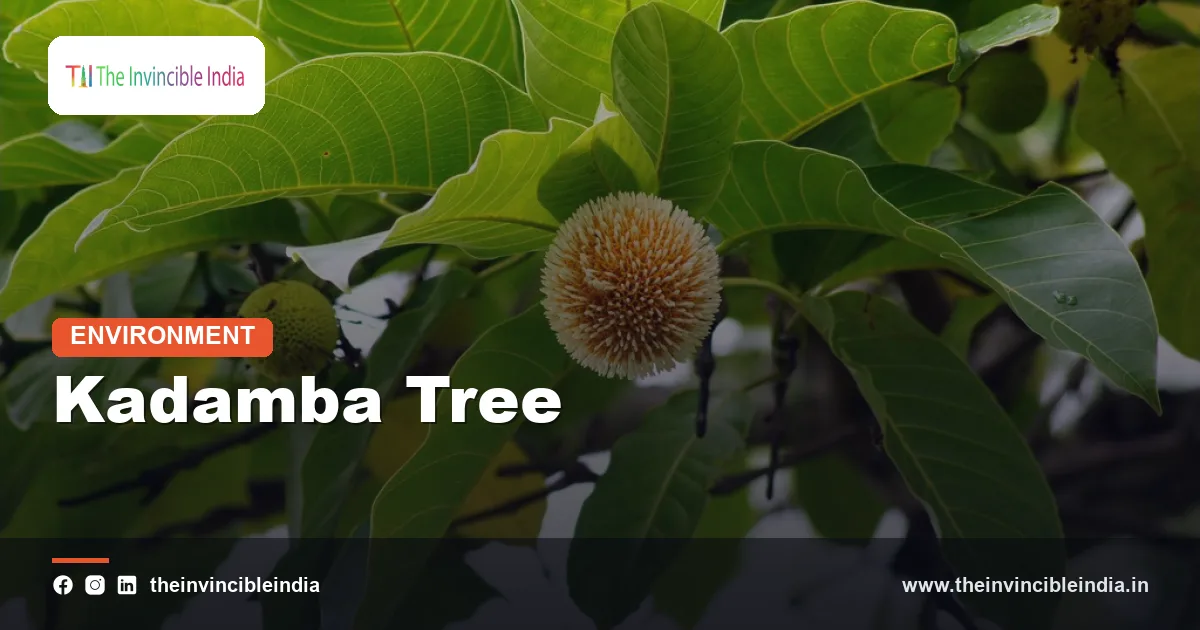
The kadamba tree (Neolamarckia cadamba) is a fast-growing, tall tropical tree of the Indian subcontinent that bears fragrant, orange, ball-shaped flower clusters at the start of the monsoon and holds a central place in Krishna legend, Sangam-era Tamil literature and temple tradition. Also called kadam, burflower tree or laran, the kadamba tree belongs to the coffee family (Rubiaceae) and is valued today for its light timber and pulpwood as much as for its culture.
This explainer covers what the kadamba tree looks like, where it grows, why it flowers with the rains, the stories attached to it, the Kadamba dynasty named after it, and its use in forestry and landscaping. 23 October 2026 marks the most recent review of the facts here.
| Attribute | Details |
|---|---|
| Scientific name | Neolamarckia cadamba (earlier Anthocephalus cadamba and Anthocephalus chinensis) |
| Family | Rubiaceae (the coffee and madder family) |
| Common names | Kadamba, kadam, burflower tree, laran, cadamba |
| Native range | South and Southeast Asia, including India, Nepal, Bangladesh, Sri Lanka and Indonesia |
| Size | Often 20 to 30 metres, occasionally taller, with a straight cylindrical trunk |
| Flowers | Orange to yellow globe-shaped heads, fragrant, appearing mainly in the monsoon months |
| Growth rate | Among the fastest-growing native trees in India |
| Main uses | Plywood and pulpwood, light timber, ornamental and avenue tree, perfumery, religious and cultural symbol |
Key Takeaways
- The kadamba tree is the common name for Neolamarckia cadamba, a fast-growing tree of the coffee family native to the Indian subcontinent and Southeast Asia.
- Kadamba trees produce orange, fragrant, spherical flower heads that open mainly in the monsoon season, which is why Indian poets have long linked the tree with the rains.
- In Hindu tradition the kadamba tree is associated with Krishna, who is said in the Vrindavan stories to have played his flute beneath its branches.
- The kadamba tree is the sthala vriksha (sacred temple tree) of the Meenakshi temple at Madurai, once known as Kadambavanam, the kadamba forest.
- The Kadamba dynasty, which ruled parts of present-day Karnataka from Banavasi from about the 4th century CE, took its name from the kadamba tree.
- Kadamba wood is light and pale, and is widely used for plywood, packing cases, matchsticks and paper pulp.
What is the kadamba tree?
The kadamba tree is a large tropical tree, Neolamarckia cadamba, that grows naturally in the moist forests of India, Sri Lanka, Nepal, Bangladesh and Southeast Asia and is cultivated far beyond that range. It is a member of the coffee family, Rubiaceae, which makes it a distant relative of coffee and of the haldu tree, rather than of the familiar fig or mango families.
The tree is known by a wide range of names. Kadamba or kadam is the usual name in Sanskrit, Hindi, Bengali, Marathi and Kannada, and the tree is called kadambu in Tamil. The older scientific names Anthocephalus cadamba and Anthocephalus indicus still appear in many books and forestry reports.
Some confusion is common. In parts of northern India the name kadam is also applied to haldu (Haldina cordifolia), a different tree with similar ball-like flower heads. True kadamba is distinguished by its bright orange flower globes, its glossy leaves, and its whorled, tiered branching when young.
What does the kadamba tree look like?
A kadamba tree is easy to identify by its tall, straight trunk, its neat horizontal tiers of branches when young and its round, orange, pom-pom-like flower balls. The trunk is cylindrical and clear of branches for a long length, which is why foresters value it as a timber tree.
Key features
- Bark: greyish and fairly smooth when young, becoming rough and longitudinally fissured on old trees.
- Leaves: large, glossy, bright green and oval, usually 15 to 30 centimetres long, arranged in opposite pairs.
- Flowers: hundreds of tiny orange or yellow flowers packed into a sphere about 4 to 6 centimetres across, with long protruding styles that give each ball a pincushion appearance.
- Fruit: a fleshy, compact fruiting head made up of many small capsules that break open to release large numbers of very small seeds.
- Crown: umbrella-shaped to rounded in mature trees, with horizontal branches.
The flowers carry a sweet fragrance, noticeable in the evening, and the ball-shaped heads often fall in numbers, forming carpets of orange-yellow beneath the tree. The fallen fruit heads are eaten by bats, birds, monkeys and other wildlife, and the seeds are dispersed in this way and by water.
When does the kadamba tree bloom?
The kadamba tree blooms mainly during the rainy season, typically from about June to August in much of India, although the exact timing varies with local rainfall. The flowers open as the monsoon arrives, which is the main reason the tree is a classical symbol of the rainy season.
Classical Sanskrit poetry associates the kadamba bud with the first rains. Poets such as Kalidasa describe the tree responding to the arrival of the clouds, and later Bengali, Hindi and Tamil writers use kadamba blossoms as shorthand for the monsoon mood, longing and romance. Rabindranath Tagore wrote of the kadamba flower in his monsoon songs and poems.
In practical terms, the monsoon bloom also suits the tree’s ecology. Rain supports seed germination, and the tiny seeds, which need moisture and light to sprout, are released during the wet months.
Why is the kadamba tree linked to Krishna?
The kadamba tree is linked to Krishna because Vaishnava tradition places Krishna beneath a kadamba tree as he plays the flute and sports with the gopis of Vrindavan. Paintings, poems and temple sculptures commonly show Krishna standing or sitting under a kadamba, often with Radha.
Several stories contribute to this association. One well-known episode, recounted in Puranic tradition, shows the child Krishna climbing a kadamba tree on the bank of the Yamuna and leaping into the river to subdue the serpent Kaliya. The groves of Vrindavan, Mathura and Braj are traditionally described as full of kadamba trees, and places such as Kadamba Kunj are pointed out in pilgrimage geography.
- Devotional poetry: Sanskrit, Hindi, Bengali and Braj writers return often to the image of Krishna beneath the kadamba.
- Miniature painting: Pahari, Rajasthani and Mughal-era Krishna paintings frequently include the kadamba, identifiable by its round flowers.
- Festivals: kadamba flowers and leaves feature in some Krishna-related celebrations in Braj and in Bengal.
Many temples in North India still plant kadamba trees in their groves or courtyards for this reason. The practice has helped keep the species common in religious landscapes where it might otherwise have disappeared.
What is the kadamba tree’s role in Tamil and temple tradition?
In the Tamil tradition, the kadamba tree is associated with Murugan, the war god, and with the Madurai Meenakshi temple, where it is the sthala vriksha. Sangam-era and later Tamil literature describe Murugan wearing garlands of kadamba flowers, and the tree appears in devotional hymns to Murugan, including the poetry of the Tamil Saiva and Vaishnava traditions.
Madurai is traditionally called Kadambavanam, the kadamba forest, in temple legend, which relates that the city grew from a forest of kadamba trees where the goddess Meenakshi appeared. The sthala vriksha is the tree associated with the founding legend of a temple, and the kadamba at Madurai remains central to that tradition.
Elsewhere in South India, kadamba trees are commonly found in temple precincts dedicated to Murugan, Devi and Krishna, and the leaves and flowers are used in worship. In Kerala and Karnataka, local folk traditions also treat the tree as auspicious.
What is the Kadamba dynasty and how is it related to the tree?
The Kadamba dynasty was an early ruling family of southwestern India, based at Banavasi in present-day Uttara Kannada, Karnataka, that took its name from the kadamba tree. It is traditionally dated from around the 4th century CE and is often described as the first indigenous kingdom to use Kannada as an administrative language.
According to tradition, the family’s founder, Mayurasharma, belonged to a Brahmin lineage that lived near a kadamba tree, and his descendants adopted the tree’s name. The dynasty ruled for roughly two centuries as an independent power before being overshadowed by the Chalukyas of Badami and later dynasties.
- Capital: Banavasi, one of the oldest towns in Karnataka.
- Founder: Mayurasharma, in the 4th century CE.
- Legacy: early temples, inscriptions and an influential architectural idiom that fed into later Karnataka styles.
- Later branches: smaller Kadamba families of Goa and the Konkan, who ruled in the medieval period.
The tree itself thus appears in the royal tradition of Karnataka, and the name remains common in the region for institutions and public places.
Why is the kadamba tree such a fast grower?
The kadamba tree grows quickly because it is a light-loving pioneer species adapted to colonise open, disturbed forest ground, and it can add well over a metre in height per year in good conditions. In plantations it may reach a harvestable size for pulpwood and plywood in as little as 6 to 10 years, far sooner than slow hardwoods such as teak or sal.
This speed has made the tree a plantation favourite across South and Southeast Asia. In Indonesia it is known as jabon and in Malaysia as laran, and it is planted on a large scale for light timber. In India the species is used in farm forestry, agroforestry and roadside planting in Kerala, Karnataka, Assam, West Bengal, Odisha and other states.
What does the tree need?
- Light: kadamba needs full sun and does poorly in deep shade.
- Water: it prefers moist, well-drained soil and a good rainy season.
- Soil: deep, fertile loam is best, though the tree tolerates a range of soils.
- Propagation: from seed, which is extremely small and is usually mixed with fine sand before sowing in a nursery bed, and from stem cuttings in some programmes.
The tree has limits. It does not tolerate prolonged drought or waterlogging, and young plants are vulnerable to frost and to termite attack in some regions. It also grows best where annual rainfall is ample.
What is kadamba wood used for?
Kadamba wood is a light, pale, soft-textured timber used mainly for plywood, veneer, matchboxes, packing cases and paper pulp. The sapwood and heartwood are both pale yellowish to creamy white, and the wood is easy to work with hand and machine tools.
| Use | Why kadamba suits it |
|---|---|
| Plywood and veneer | Straight, clear trunks peel cleanly into thin sheets |
| Pulpwood and paper | Fast growth and light fibre make pulping economical |
| Packing cases and crates | Light weight and easy nailing |
| Matches and pencils | Fine, uniform grain and low density |
| Light furniture and toys | Easy to cut, plane and finish, though not very durable outdoors |
| Musical instruments and crafts | Used in some regions for drums and carved items |
The wood is not naturally durable in contact with soil or moisture, and it is not suited to heavy construction. Properly dried and treated, however, it provides an affordable and renewable material for the plywood and paper industries, and it relieves pressure on slower-growing natural forests.
What are the other uses of the kadamba tree?
Besides timber, the kadamba tree is used for ornamental planting, perfumery, fodder and traditional medicine. Its straight trunk, shady crown and monsoon blooms make it a popular choice for avenues, parks, temples and campuses.
- Landscaping: planted along roads and in gardens for shade and display.
- Perfumery: the fragrant flowers are used to prepare kadamba attar, a traditional floral perfume in North India.
- Fodder: the leaves are eaten by cattle and goats in some regions.
- Traditional medicine: bark and leaves appear in Ayurvedic and folk preparations, for example as astringent and cooling remedies. Scientific evidence for these uses is limited.
- Wildlife: flowers supply nectar and pollen, and the fruiting heads feed fruit-eating birds and bats.
The fruit is sometimes described as edible, and it is eaten locally in small amounts or used in village preparations, but it is not a commercial food crop. Medicinal use should follow qualified advice, as it does with any herbal product.
Bottom Line
The kadamba tree is a tall, rapidly growing tree whose orange monsoon blossoms made it a favourite of poets, devotees and royal families, from the Krishna stories of Braj to the temple of Madurai and the Kadamba dynasty of Banavasi. Today it also matters as a quick source of plywood and pulpwood, and as a shade tree that sits comfortably in Indian landscapes.
Frequently Asked Questions
What is the scientific name of the kadamba tree?
The scientific name of the kadamba tree is Neolamarckia cadamba. It was formerly called Anthocephalus cadamba and Anthocephalus chinensis, which still appear in older books. The tree belongs to the coffee family, Rubiaceae.
When does the kadamba tree flower?
The kadamba tree flowers mainly during the monsoon, usually from about June to August in much of India. The orange, ball-shaped flower heads open as the rains arrive. This timing is the reason the tree is associated with the rainy season in Indian poetry.
Why is the kadamba tree important in Hinduism?
The kadamba tree is important in Hinduism because Vaishnava tradition associates it with Krishna, who is said to have played his flute beneath it in Vrindavan. It is also the sacred tree of the Meenakshi temple at Madurai, and Tamil tradition links it with Murugan. Its flowers and leaves are used in worship in several regions.
How fast does a kadamba tree grow?
A kadamba tree grows very fast and can add more than a metre of height per year in good conditions. In plantations it can reach harvestable size for pulpwood or plywood in about 6 to 10 years. It needs full sun and ample rainfall to grow at this rate.
What is kadamba wood used for?
Kadamba wood is used mainly for plywood, veneer, paper pulp, packing cases and matchboxes. It is light, pale and easy to work, but it is not very durable when exposed to moisture or soil. It is therefore used for light construction and manufacturing rather than for heavy structures.
Which dynasty is named after the kadamba tree?
The Kadamba dynasty of Banavasi in present-day Karnataka is named after the kadamba tree. It was founded by Mayurasharma around the 4th century CE and is regarded as an early indigenous kingdom of the Kannada country. Later branches of the family ruled parts of Goa and the Konkan.
{“@context”:”https://schema.org”,”@graph”:[{“@type”:”FAQPage”,”mainEntity”:[{“@type”:”Question”,”name”:”What is the scientific name of the kadamba tree?”,”acceptedAnswer”:{“@type”:”Answer”,”text”:”The scientific name of the kadamba tree is Neolamarckia cadamba. It was formerly called Anthocephalus cadamba and Anthocephalus chinensis, which still appear in older books. The tree belongs to the coffee family, Rubiaceae.”}},{“@type”:”Question”,”name”:”When does the kadamba tree flower?”,”acceptedAnswer”:{“@type”:”Answer”,”text”:”The kadamba tree flowers mainly during the monsoon, usually from about June to August in much of India. The orange, ball-shaped flower heads open as the rains arrive. This timing is the reason the tree is associated with the rainy season in Indian poetry.”}},{“@type”:”Question”,”name”:”Why is the kadamba tree important in Hinduism?”,”acceptedAnswer”:{“@type”:”Answer”,”text”:”The kadamba tree is important in Hinduism because Vaishnava tradition associates it with Krishna, who is said to have played his flute beneath it in Vrindavan. It is also the sacred tree of the Meenakshi temple at Madurai, and Tamil tradition links it with Murugan. Its flowers and leaves are used in worship in several regions.”}},{“@type”:”Question”,”name”:”How fast does a kadamba tree grow?”,”acceptedAnswer”:{“@type”:”Answer”,”text”:”A kadamba tree grows very fast and can add more than a metre of height per year in good conditions. In plantations it can reach harvestable size for pulpwood or plywood in about 6 to 10 years. It needs full sun and ample rainfall to grow at this rate.”}},{“@type”:”Question”,”name”:”What is kadamba wood used for?”,”acceptedAnswer”:{“@type”:”Answer”,”text”:”Kadamba wood is used mainly for plywood, veneer, paper pulp, packing cases and matchboxes. It is light, pale and easy to work, but it is not very durable when exposed to moisture or soil. It is therefore used for light construction and manufacturing rather than for heavy structures.”}},{“@type”:”Question”,”name”:”Which dynasty is named after the kadamba tree?”,”acceptedAnswer”:{“@type”:”Answer”,”text”:”The Kadamba dynasty of Banavasi in present-day Karnataka is named after the kadamba tree. It was founded by Mayurasharma around the 4th century CE and is regarded as an early indigenous kingdom of the Kannada country. Later branches of the family ruled parts of Goa and the Konkan.”}}]}]}


