

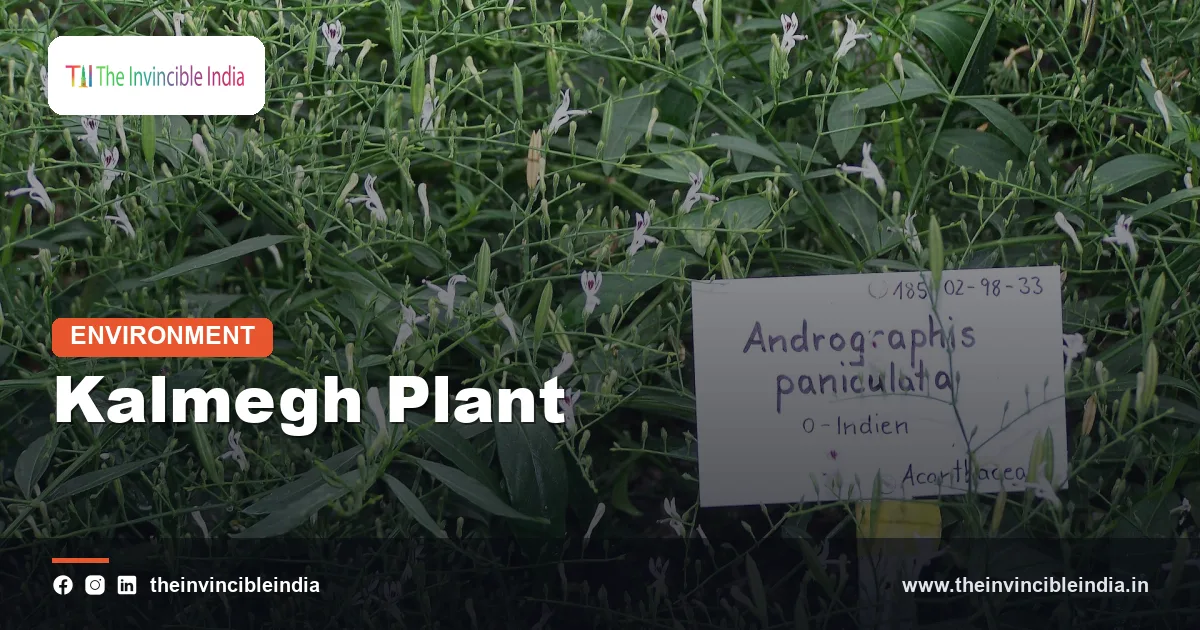
The herb called kalmegh (Andrographis paniculata) is an erect, annual, intensely bitter plant of India that Ayurveda and other traditional systems have long used for fevers, digestive complaints and liver support, which is why it is often called the “king of bitters”. Kalmegh grows as a slender, branching herb with narrow leaves and small white flowers, and its extreme bitterness comes from a compound named andrographolide.
This article explains what kalmegh is, how to recognise it, where it grows, what it contains, how it has been used in traditional medicine and how it is cultivated. The medicinal uses described here are traditional and are not proven medical claims.
Quick Facts
| Botanical name | Andrographis paniculata (Burm.f.) Nees |
|---|---|
| Family | Acanthaceae |
| Common names | Kalmegh, Bhunimba, Nilavembu (Tamil), Kiryat, creat, king of bitters |
| Part used | Leaves and the whole aerial herb; sometimes the root |
| Where grown in India | Found wild and cultivated across the plains and lower hills, including Tamil Nadu, Kerala, Karnataka, Andhra Pradesh, Madhya Pradesh, Chhattisgarh, Odisha, West Bengal and Uttar Pradesh |
| Active compounds | Diterpenoid lactones, mainly andrographolide, neoandrographolide and 14-deoxyandrographolide; also flavonoids |
| Traditional uses | Ayurvedic and Siddha use for fever, digestive disorders, liver complaints, skin conditions and as a blood purifier and general bitter tonic |
| Cultivation | Annual herb raised from seed in a nursery and transplanted at the start of the monsoon; harvested after about three to four months |
Key Takeaways
- Kalmegh is the Hindi name for Andrographis paniculata, an annual herb of the family Acanthaceae that is native to India and Sri Lanka.
- Kalmegh is known as the “king of bitters” because its leaves contain andrographolide, one of the most bitter plant compounds used in traditional medicine.
- Ayurveda and Siddha medicine have traditionally used kalmegh, also called bhunimba and nilavembu, in remedies for fever, liver complaints and digestive trouble.
- The leaves of kalmegh are the richest part of the plant in andrographolide, and farmers therefore harvest the crop at or around flowering.
- Kalmegh is raised from seed and is a short-duration crop that is ready within about three to four months.
- The uses of kalmegh are traditional and not proven medical treatments, and it can cause allergic reactions or interact with medicines, so a qualified practitioner should be consulted.
What is kalmegh?
Kalmegh is an annual medicinal herb of the Acanthaceae family, known botanically as Andrographis paniculata and famous across South Asia for its extremely bitter taste. It is among the most widely used bitter herbs in Indian traditional medicine.
The Hindi name kalmegh is generally translated as dark cloud, a reference to the deep green of the plant or to its association with the rainy season, when it grows strongly. In Sanskrit the plant is called bhunimba, meaning the neem of the ground, because its bitterness is comparable to that of the neem tree while the plant itself is a low herb. In Tamil and in Siddha medicine it is called nilavembu, which carries a similar meaning, and in English it is sometimes called creat or green chiretta.
The plant is native to India and Sri Lanka and has been introduced into many tropical countries. In China, Thailand, Malaysia and elsewhere in Asia it is also used in traditional practice, and the name king of bitters is widely used for it in international literature.
What does the kalmegh plant look like?
The kalmegh plant is an erect, much-branched herb that usually grows between thirty and one hundred centimetres tall, with dark green leaves and a square stem. The stem is slender, smooth and has narrow wings or ridges along its angles, a feature that helps in identification.
The leaves are lance-shaped, pointed at the tip, glossy and arranged in opposite pairs along the stem. When chewed they taste intensely bitter, and the bitterness stays in the mouth for a long time. The flowers are small, in loose branching clusters called panicles, which gives the species name paniculata. Each flower is white with pink or purple markings on the lip.
The fruit is a narrow, flattened capsule that splits open when ripe to release many small, yellowish-brown seeds. The plant completes its life cycle within one growing season, flowering and seeding in the later months of the year before it dries out.
Where does kalmegh grow in India?
Kalmegh grows across much of India, mostly in plains, lower hills, forest edges, wasteland, roadsides and cultivated fields where the soil is moist and the climate warm. It is a plant of tropical and subtropical regions and does not tolerate frost.
The herb is found in the southern states of Tamil Nadu, Kerala, Karnataka and Andhra Pradesh, and in central and eastern India, including Madhya Pradesh, Chhattisgarh, Odisha, Jharkhand and West Bengal, as well as in Uttar Pradesh and other northern plains. It is often seen growing as a seasonal weed in the monsoon, which makes it a familiar plant in village life.
Commercial cultivation has grown in several of these states because demand from Ayurvedic, Siddha and herbal manufacturers is steady. Cultivated kalmegh reduces the need to collect from the wild and gives farmers a short-duration crop with a medicinal market.
The plant prefers temperatures between roughly twenty and thirty-five degrees Celsius and grows best with the rains of the south-west monsoon. In cooler northern regions it is grown only in the warm season. Its dependence on warm, moist weather explains why kalmegh is a plant of the monsoon landscape and why its harvest is generally timed for the post-monsoon months.
What compounds does kalmegh contain?
Kalmegh contains diterpenoid lactones, chiefly andrographolide, which is the main bitter principle and the compound most often used as a quality marker. Other related compounds in the plant include neoandrographolide, 14-deoxyandrographolide and andrographiside.
The plant also contains flavonoids, such as those found in the roots and aerial parts, and other plant chemicals. Of all these, andrographolide has been studied most, and laboratory and clinical research on it continues. The amount of andrographolide in a plant depends on its age, the season, the soil, the climate and the part tested, with leaves usually richest in the compound.
The bitter taste is itself a characteristic of the herb. Ayurveda groups bitter-tasting herbs, known as tikta rasa, among substances that are traditionally believed to cleanse the system, reduce fever and stimulate digestion.
How has kalmegh been used in traditional medicine?
Kalmegh has been used in Ayurveda, Siddha and folk medicine as a bitter tonic for fever, liver and digestive complaints, skin conditions and as a blood purifier. It appears in many classical and modern herbal formulations and in the Indian Pharmacopoeia, which lists the whole plant as an official drug.
| Traditional use | Description |
|---|---|
| Fevers | Used as a decoction or powder in remedies for fever, especially seasonal fevers |
| Liver and digestion | Taken as a bitter tonic to support digestion, appetite and the liver |
| Skin conditions | Used internally and externally as a blood purifier in boils, rashes and itching |
| Worm infestations | Traditional remedy for intestinal worms, especially in children |
| Respiratory complaints | Used in preparations for cough, cold and sore throat |
In Tamil Nadu, nilavembu kudineer, a Siddha decoction containing nilavembu and other herbs, has been widely distributed during seasonal fever outbreaks. Its public use is an example of the importance of the herb in regional health traditions. These are traditional uses, and kalmegh is not an approved treatment for fever, infection or liver disease.
How is kalmegh taken?
Kalmegh is taken in traditional medicine as a fresh juice, a dried leaf powder, a water decoction called kashaya or kudineer, or as tablets and capsules. Because of its strong bitterness, it is often mixed with honey, combined with other herbs or taken in capsule form.
- Decoction (kashaya or kudineer): dried herb boiled in water and reduced, the most traditional form.
- Powder (churna): dried leaf powder taken with water or honey in small amounts.
- Tablets and capsules: extracts sold by herbal manufacturers, often standardised to andrographolide.
- Compound formulations: combined with herbs such as giloy, neem and tulsi in classical and proprietary mixtures.
Doses differ widely between products, so the label and a qualified practitioner should guide use, not general articles such as this one.
Many households in southern India keep dried nilavembu or kalmegh at home and prepare a weak decoction when the seasons change. The practice is part of a wider culture of domestic herbal care. Even so, a very strong or prolonged intake is discouraged in traditional guidance because the herb is considered cooling and extremely bitter.
How is kalmegh cultivated?
Kalmegh is cultivated as a rainy-season annual raised from seed in a nursery and transplanted into well-prepared fields at the start of the monsoon. It grows well in a warm, humid climate and in a wide range of soils, from sandy loam to clay loam, if drainage is good.
Seeds are sown in nursery beds in late spring or early summer, and seedlings of about four to six weeks are transplanted with regular spacing between plants. The crop needs light irrigation if the rains are delayed, and weeding in the early weeks. It has few serious pests, and it is a relatively low-input crop.
Farmers harvest the herb at or near flowering, roughly three to four months after planting, because andrographolide content in the leaves tends to be highest at this stage. The cut plant is dried in shade, and the dried leafy herb is sold to processors. In some regions a second cut is possible, but the plant is generally treated as a single-season crop.
Is kalmegh safe, and who should be careful?
Kalmegh is generally used in traditional medicine in modest amounts, but it can cause side effects including nausea, vomiting, stomach discomfort, headache and, rarely, allergic reactions. Its use should always be discussed with a doctor or qualified Ayurvedic practitioner.
Pregnant women, people trying to conceive, those with low blood pressure, bleeding disorders or autoimmune conditions, and people taking blood thinners, blood pressure medicines or immunosuppressants should be especially careful. Traditional texts also advise caution in people with weak digestion because of the herb’s strong bitterness and cooling nature. Allergic reactions, including rashes and, very rarely, serious reactions, have been reported with concentrated andrographolide products.
This article is general information only. Please consult a qualified Ayurvedic practitioner or doctor before using kalmegh for any health purpose, and do not stop prescribed medicine in favour of a herbal remedy.
Why does kalmegh matter to India?
Kalmegh matters to India because it is a widely used traditional medicinal herb, a source of income for farmers and a documented part of Ayurvedic, Siddha and folk practice. It is one of the commonly cultivated medicinal plants in the country and a regular ingredient in herbal products.
The herb is also an example of how traditional knowledge and modern research interact. Andrographolide has attracted scientific attention in laboratories in India and abroad, and a number of studies are ongoing. At the same time, the evidence available for many claims is still limited, and responsible sources describe kalmegh as a traditional remedy and not as a proven cure.
How does kalmegh compare with other bitter herbs?
Kalmegh is one of several bitter herbs in Indian traditional medicine, and it is usually described as the most intensely bitter of the group, along with chiretta, neem and giloy. Each herb has its own plant family, parts used and traditional reputation, so they are not interchangeable.
| Herb | Botanical name | Part commonly used | Traditional reputation |
|---|---|---|---|
| Kalmegh | Andrographis paniculata | Leaves and whole herb | Fever, liver and digestion; blood purifier |
| Neem | Azadirachta indica | Leaves, bark, seed oil | Skin conditions and general purification |
| Giloy | Tinospora cordifolia | Stem | Recurrent fever and general tonic |
| Chirayata | Swertia chirayita | Whole herb | Fever, digestion and liver complaints |
Chirayata, a Himalayan herb, is sometimes confused with kalmegh because both are intensely bitter and both have been described as fever herbs. Kalmegh was in the past also called Indian or green chiretta, which added to the confusion, although the two belong to different plant families. Many traditional fever formulas combine several of these bitter herbs, because Ayurveda often prefers compound mixtures over single ingredients.
Kalmegh is also a lowland plant that is easy to cultivate in a single season, whereas chirayata grows at high altitude and is slow to propagate. This difference in supply is one reason that kalmegh is more widely available in the market.
Bottom Line
Kalmegh, or Andrographis paniculata, is a bitter annual herb that India’s traditional medicine systems have long used for fevers, digestion and the liver. It is an important and easily cultivated medicinal crop, but its uses are traditional and should be guided by a qualified professional.
Frequently Asked Questions
What is kalmegh?
Kalmegh is the Hindi name for Andrographis paniculata, an annual herb of the family Acanthaceae. It is native to India and Sri Lanka and is known for its extreme bitterness. It is widely called the king of bitters.
Why is kalmegh called the king of bitters?
Kalmegh is called the king of bitters because its leaves contain andrographolide, an exceptionally bitter compound. The bitterness is stronger than that of many other medicinal herbs. The name is used widely in Indian and international literature.
What is kalmegh used for in Ayurveda?
Kalmegh is used in Ayurveda traditionally for fever, liver and digestive complaints, skin conditions and as a blood purifier. It is also known as bhunimba and, in Siddha medicine, as nilavembu. These are traditional uses and not proven medical claims.
What is the main active compound in kalmegh?
The main active compound in kalmegh is andrographolide, a diterpenoid lactone. It is the substance responsible for the intense bitter taste and is used as a quality marker for products. Related compounds include neoandrographolide and 14-deoxyandrographolide.
How is kalmegh grown?
Kalmegh is grown from seed, raised in a nursery and transplanted into the field at the start of the monsoon. It is harvested about three to four months later, around flowering, when the leaves are richest in andrographolide. The herb is then dried in shade.
Does kalmegh have side effects?
Kalmegh can cause side effects in some people, such as nausea, vomiting, stomach upset and allergic reactions. It may also interact with medicines for blood pressure, blood thinning and immune conditions. A doctor or qualified Ayurvedic practitioner should be consulted before use.
{“@context”:”https://schema.org”,”@graph”:[{“@type”:”FAQPage”,”mainEntity”:[{“@type”:”Question”,”name”:”What is kalmegh?”,”acceptedAnswer”:{“@type”:”Answer”,”text”:”Kalmegh is the Hindi name for Andrographis paniculata, an annual herb of the family Acanthaceae. It is native to India and Sri Lanka and is known for its extreme bitterness. It is widely called the king of bitters.”}},{“@type”:”Question”,”name”:”Why is kalmegh called the king of bitters?”,”acceptedAnswer”:{“@type”:”Answer”,”text”:”Kalmegh is called the king of bitters because its leaves contain andrographolide, an exceptionally bitter compound. The bitterness is stronger than that of many other medicinal herbs. The name is used widely in Indian and international literature.”}},{“@type”:”Question”,”name”:”What is kalmegh used for in Ayurveda?”,”acceptedAnswer”:{“@type”:”Answer”,”text”:”Kalmegh is used in Ayurveda traditionally for fever, liver and digestive complaints, skin conditions and as a blood purifier. It is also known as bhunimba and, in Siddha medicine, as nilavembu. These are traditional uses and not proven medical claims.”}},{“@type”:”Question”,”name”:”What is the main active compound in kalmegh?”,”acceptedAnswer”:{“@type”:”Answer”,”text”:”The main active compound in kalmegh is andrographolide, a diterpenoid lactone. It is the substance responsible for the intense bitter taste and is used as a quality marker for products. Related compounds include neoandrographolide and 14-deoxyandrographolide.”}},{“@type”:”Question”,”name”:”How is kalmegh grown?”,”acceptedAnswer”:{“@type”:”Answer”,”text”:”Kalmegh is grown from seed, raised in a nursery and transplanted into the field at the start of the monsoon. It is harvested about three to four months later, around flowering, when the leaves are richest in andrographolide. The herb is then dried in shade.”}},{“@type”:”Question”,”name”:”Does kalmegh have side effects?”,”acceptedAnswer”:{“@type”:”Answer”,”text”:”Kalmegh can cause side effects in some people, such as nausea, vomiting, stomach upset and allergic reactions. It may also interact with medicines for blood pressure, blood thinning and immune conditions. A doctor or qualified Ayurvedic practitioner should be consulted before use.”}}]}]}


