

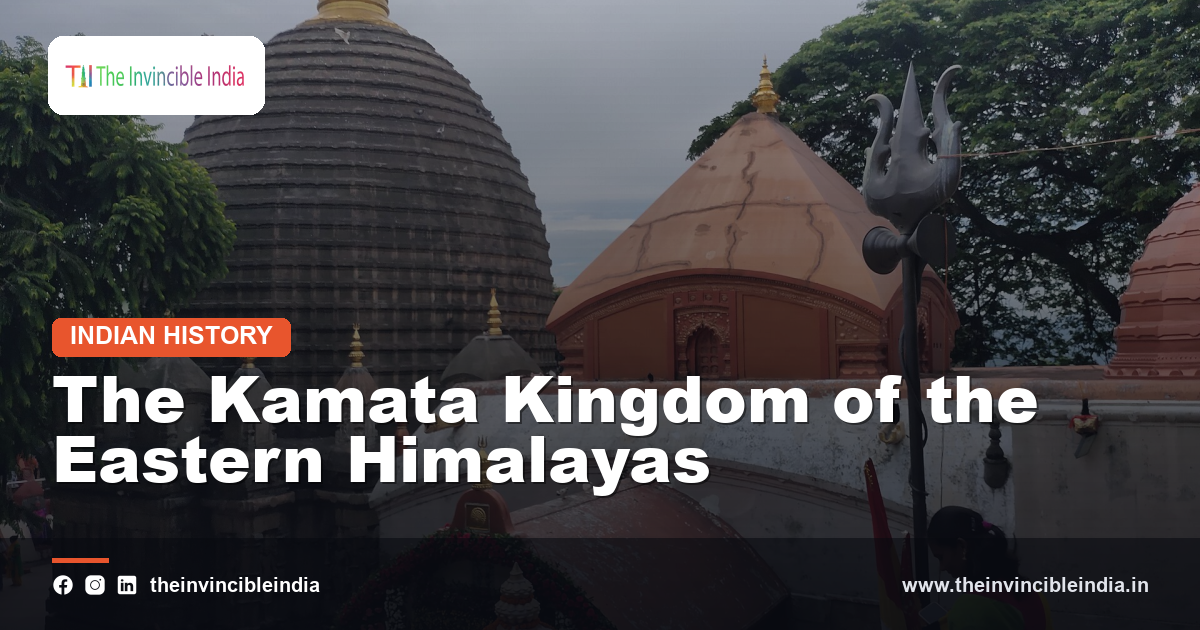
The Kamata kingdom, also known as Kamata-Kamrup, was a kingdom of the eastern Himalayan foothills that arose in the region of western Assam and north Bengal as the ancient kingdom of Kamarupa declined. Emerging around the thirteenth century, as the older order of Kamarupa gave way, the Kamata kingdom established its authority over this frontier country, with its capital at Kamatapur, generally identified with the ruins at Gosanimari, near present-day Cooch Behar. The kingdom is especially associated with the Khen dynasty, whose rulers, remembered by names such as Niladhwaj, Chakradhwaj and Nilambar, governed in its later period. Around the close of the fifteenth century the Khen kingdom was conquered by Alauddin Husain Shah, the sultan of Bengal, generally dated to about 1498, after which the region was in time succeeded by the rising power of the Koch. As a kingdom of the eastern frontier, Kamata belongs to the broad span of Indian history that includes the ancient empire described in our guide to the Gupta Empire. Because several dates and details rest on tradition, this account keeps to general terms where the record is uncertain.
Quick answer: The Kamata kingdom, also known as Kamata-Kamrup, was a kingdom of the eastern Himalayan foothills that arose in western Assam and north Bengal as the ancient kingdom of Kamarupa declined, emerging around the thirteenth century. Its capital was at Kamatapur, generally identified with the ruins at Gosanimari, near present-day Cooch Behar. It is especially associated with the Khen dynasty, whose rulers included Niladhwaj, Chakradhwaj and Nilambar. Around 1498 the Khen kingdom was conquered by Alauddin Husain Shah, the sultan of Bengal, and the region was in time succeeded by the Koch.
Key Takeaways
- The Kamata kingdom, also known as Kamata-Kamrup, arose in western Assam and north Bengal as the ancient kingdom of Kamarupa declined.
- It emerged around the thirteenth century as the older order of Kamarupa gave way.
- Its capital was at Kamatapur, generally identified with the ruins at Gosanimari, near present-day Cooch Behar.
- The kingdom is especially associated with the Khen dynasty, whose rulers included Niladhwaj, Chakradhwaj and Nilambar.
- Around the close of the fifteenth century, generally dated to about 1498, the Khen kingdom was conquered by Alauddin Husain Shah, the sultan of Bengal.
- The region was in time succeeded by the rising power of the Koch.
Read on for the history, culture, and legacy in detail.
Quick Facts
| Detail | Information |
|---|---|
| Kingdom | Kamata kingdom (Kamata-Kamrup) |
| Period | From around the thirteenth century; dates debated |
| Region | Western Assam and north Bengal |
| Capital | Kamatapur (identified with Gosanimari) |
| Notable Dynasty | The Khen dynasty |
| Khen Rulers | Niladhwaj, Chakradhwaj, Nilambar |
| Conquered By | Alauddin Husain Shah of Bengal, about 1498 |
| Succeeded By | The Koch |
What Was the Kamata Kingdom?
The Kamata kingdom, also known as Kamata-Kamrup, was a kingdom of the eastern Himalayan foothills that arose in the region of western Assam and north Bengal as the ancient kingdom of Kamarupa declined. Emerging around the thirteenth century, the kingdom established its authority over this frontier country, inheriting in part the mantle of the older Kamarupa. Its name, Kamata-Kamrup, reflects its connection with the ancient region of Kamarupa, whose traditions it carried forward in a new form. The kingdom had its capital at Kamatapur and is especially associated with the Khen dynasty of its later period. It endured until the close of the fifteenth century, when it was conquered by the sultan of Bengal, and was in time succeeded by the Koch. As a kingdom of the eastern frontier, Kamata holds an important place in the history of the northeast and north Bengal. Its history reflects the transition from the ancient order of Kamarupa to the later kingdoms of the region.
Where Was the Kamata Kingdom Located?
The Kamata kingdom was located in the eastern Himalayan foothills and plains, in the region of western Assam and north Bengal, a frontier country between the northeast and the plains of Bengal. The kingdom controlled a tract of the lower Brahmaputra valley and the adjoining lands of north Bengal, a region of rivers, plains and foothills. Its capital at Kamatapur, generally identified with the ruins at Gosanimari, lay in the area near present-day Cooch Behar. This position placed the kingdom at an important meeting point between the northeast and Bengal, giving it contact and contest with the powers of both regions. The rivers, plains and foothills of the region shaped the character and fortunes of the kingdom. Its centre at Kamatapur anchored the kingdom in the historical geography of the eastern frontier. Kamata was thus firmly rooted in the borderlands of western Assam and north Bengal, as heir to the ancient region of Kamarupa.
How Did Kamata Arise from Kamarupa?
The Kamata kingdom arose from the decline of the ancient kingdom of Kamarupa, the great early power of the region, whose order gave way around the thirteenth century. Kamarupa had been a famous kingdom of the eastern frontier in ancient and early medieval times, but over time its authority weakened and its old order dissolved. As Kamarupa declined, new powers emerged in the region, and the Kamata kingdom rose to establish its authority over the western part of the old Kamarupa country. The name Kamata-Kamrup reflects this inheritance, linking the new kingdom to the ancient region. The rise of Kamata thus marked a transition from the ancient order of Kamarupa to the later medieval kingdoms of the region. The details of this transition are drawn from tradition and the records of the period and are described in general terms. The emergence of Kamata forms an important chapter in the long history of the eastern frontier.
What Was Kamatapur?
Kamatapur was the capital of the Kamata kingdom, a centre whose remains are generally identified with the ruins at Gosanimari, near present-day Cooch Behar in north Bengal. As the seat of the kingdom, Kamatapur was the focus of its political, administrative and cultural life, a fortified city from which the rulers governed their frontier realm. The site is remembered for its extensive remains, including earthen ramparts and other structures that bear witness to the scale and importance of the city. These ruins are counted among the notable archaeological sites of the region and offer a window onto the history of the kingdom. Kamatapur thus holds an important place in the memory of the Kamata kingdom as its principal centre. The identification of the site with Gosanimari rests on tradition and archaeological study. Kamatapur stands as an enduring symbol of the history of the Kamata kingdom and its rulers.
Who Were the Khen Dynasty?
The Khen dynasty was the ruling house most closely associated with the Kamata kingdom, a line of kings who governed the kingdom in its later period before its conquest by Bengal. The Khen rulers, remembered in tradition by names such as Niladhwaj, Chakradhwaj and Nilambar, held authority over the Kamata country from the capital at Kamatapur. The dynasty is remembered as the house under which the kingdom reached a notable height before its fall. As rulers of the eastern frontier, the Khen kings governed a realm at the meeting point of the northeast and Bengal, facing the pressures of powerful neighbours. The dynasty came to an end with the conquest of the kingdom by the sultan of Bengal around the close of the fifteenth century. The details of the Khen rulers are drawn from tradition and the records of the period and are treated with care. The Khen dynasty thus gave the Kamata kingdom its most remembered ruling line.
Who Were Niladhwaj, Chakradhwaj and Nilambar?
Niladhwaj, Chakradhwaj and Nilambar are the names by which the rulers of the Khen dynasty of the Kamata kingdom are remembered in tradition. According to the traditional account, these kings governed the Kamata country in succession from the capital at Kamatapur, and they are remembered as the principal rulers of the Khen line. Nilambar, in particular, is remembered as the last of the Khen kings, under whom the kingdom faced its conquest by the sultan of Bengal around the close of the fifteenth century. These rulers presided over the kingdom in its later period, before the dramatic end of the dynasty. As with other early rulers, the details of their reigns rest largely on tradition and the records of the period and are treated with scholarly care, with several points debated. The names of Niladhwaj, Chakradhwaj and Nilambar thus preserve the memory of the Khen dynasty and its rule over the Kamata kingdom.
Why Is the Kamata Kingdom Called Kamata-Kamrup?
The Kamata kingdom is called Kamata-Kamrup because of its connection with the ancient region and kingdom of Kamarupa, whose traditions it carried forward in a new form. Kamarupa, the famous early kingdom of the eastern frontier, had given its name to the region, and as it declined the new kingdom of Kamata rose over the western part of that country. The compound name Kamata-Kamrup reflects both the new identity of the kingdom and its inheritance from the ancient order. This naming expresses the continuity between the ancient region of Kamarupa and the later medieval kingdom of Kamata. It reflects the way in which the new power claimed and carried forward the heritage of the old. The details of this connection are drawn from tradition and the records of the period and are described in general terms. The name Kamata-Kamrup thus preserves the link between the ancient kingdom of Kamarupa and its medieval successor in the region.
How Was the Kamata Kingdom Governed?
The Kamata kingdom was governed by its king, whose authority rested on control of the frontier country of western Assam and north Bengal, its people and its resources, from the capital at Kamatapur. The kingdom managed the resources of a land of rivers, plains and foothills, drawing revenue from agriculture and the lands of the region. The fortified capital at Kamatapur, with its ramparts, was central to the defence and control of the kingdom. The ruler depended on the support of nobles, chiefs and officials who held responsibilities within the administration and the military. As heir to the traditions of Kamarupa, the kingdom drew on the established forms of kingship of the region. The details of the administration are drawn from tradition and the records of the period and are described in general terms. This system of governance enabled the Kamata kingdom to hold its frontier realm through the medieval period until its conquest by Bengal.
How Did Kamata Relate to Its Neighbours?
The Kamata kingdom related to its neighbours through the patterns of rivalry, warfare and diplomacy that characterised the politics of the eastern frontier, between the northeast and the plains of Bengal. As a kingdom at this meeting point, Kamata engaged with the powers of the Brahmaputra valley to the east, with the emerging powers of the region, and above all with the sultanate of Bengal to the west. These relations involved conflict, alliance and the contest for territory in the frontier country. The kingdom’s position exposed it to the ambitions of the powerful sultanate of Bengal, whose pressure grew over time. The most decisive of these relations was the eventual conquest of the kingdom by the sultan of Bengal around the close of the fifteenth century. The details of these relations are drawn from tradition and the records of the period and are described in general terms. Kamata thus navigated the complex politics of the eastern frontier between the northeast and Bengal.
How Was Kamata Conquered by Bengal?
The Kamata kingdom, under the Khen dynasty, was conquered by Alauddin Husain Shah, the sultan of Bengal, around the close of the fifteenth century, generally dated to about 1498. As the sultanate of Bengal extended its power eastward along the frontier, its forces advanced against the Kamata kingdom and its capital at Kamatapur. According to the generally accepted account, the sultan overcame the last of the Khen kings, Nilambar, and brought the kingdom under the authority of Bengal, bringing the Khen dynasty to an end. This conquest marked a dramatic turning point in the history of the eastern frontier, ending the independent kingdom of Kamata. The hold of Bengal over the distant frontier country proved difficult to maintain, however, and the region soon passed into a new phase of its history. The details of the conquest are drawn from the records of the period and are described in general terms. The conquest by Bengal thus closed the era of the Khen kingdom of Kamata.
How Did the Koch Succeed the Kamata Kingdom?
After the conquest of the Khen kingdom by Bengal, the region of Kamata was in time succeeded by the rising power of the Koch, who established a notable kingdom in the frontier country. As the authority of distant Bengal over the frontier proved difficult to sustain, new powers emerged in the region, and the Koch rose to build a kingdom that inherited much of the Kamata country. The Koch kingdom, centred in the area of present-day Cooch Behar, became an important power of the eastern frontier in the period that followed, carrying forward the traditions of the region. The rise of the Koch thus marked the next chapter in the long history of the frontier country after the fall of the Khen kingdom of Kamata. The details of this succession are drawn from tradition and the records of the period and are described in general terms. The Koch kingdom thus succeeded the Kamata kingdom as the leading power of the region.
What Was the Culture of the Region?
The culture of the Kamata country was shaped by its position on the eastern frontier, its inheritance from the ancient kingdom of Kamarupa, and the traditions of its people, forming a distinctive heritage of the borderlands of western Assam and north Bengal. The region shared in the religious and cultural traditions of the wider area, including the worship associated with the famous shrines of the eastern frontier and the devotional life of the region. As heir to Kamarupa, the kingdom carried forward elements of the ancient culture of the region in a new form. The frontier position of the kingdom brought it into contact with the traditions of both the northeast and Bengal. The arts, religion and customs of the region reflected this meeting of influences. The details of this culture are described in general terms, reflecting the broadly known heritage of the region. Through this culture the Kamata kingdom contributed to the rich and varied heritage of the eastern frontier.
Why Is the Kamata Kingdom Significant?
The Kamata kingdom is significant as the power that arose on the eastern frontier as the ancient kingdom of Kamarupa declined, carrying forward its heritage in a new form. Its emergence around the thirteenth century, its capital at Kamatapur, and its association with the Khen dynasty illustrate the transition from the ancient order of Kamarupa to the later medieval kingdoms of the region. Its conquest by the sultan of Bengal around the close of the fifteenth century, and its succession by the Koch, mark important turning points in the history of the eastern frontier. The kingdom’s history offers a window onto the politics of the borderlands between the northeast and Bengal, often less prominent in the general narrative of Indian history. Its remains at Kamatapur stand among the notable archaeological sites of the region. For students of Indian history, Kamata offers a vivid example of a frontier kingdom. Its significance rests on this role as heir to Kamarupa and forerunner of the Koch.
The Kamata Kingdom Today
The Kamata kingdom is remembered today through the ruins of its capital and the heritage of the frontier country of western Assam and north Bengal. The remains at Gosanimari, generally identified with Kamatapur, including its earthen ramparts and structures, draw visitors and students of history, standing as enduring symbols of the kingdom and its rulers. The memory of the Khen dynasty, with its rulers Niladhwaj, Chakradhwaj and Nilambar, remains part of the historical identity of the region. The history of the kingdom, as heir to ancient Kamarupa and forerunner of the Koch, continues to be studied for the light it sheds on the eastern frontier. Scholars continue to examine the ruins, traditions and records of the kingdom to refine the understanding of its history. For readers of Indian history, the Kamata kingdom offers a striking example of a frontier power. Its legacy endures in the ruins of Kamatapur and in the history of the eastern Himalayan borderlands.
Sources & Further Reading
- Archaeological Survey of India (asi.nic.in).
- Ministry of Culture, Government of India (indiaculture.gov.in).
- Directorate of Tourism, Government of Assam (assamtourism.gov.in).
Frequently Asked Questions
What was the Kamata kingdom?
The Kamata kingdom, also known as Kamata-Kamrup, was a kingdom of the eastern Himalayan foothills that arose in western Assam and north Bengal as the ancient kingdom of Kamarupa declined. It emerged around the thirteenth century and endured until its conquest by Bengal at the close of the fifteenth century.
Where was the capital of the Kamata kingdom?
The capital of the Kamata kingdom was Kamatapur, which is generally identified with the ruins at Gosanimari, near present-day Cooch Behar in north Bengal. The site preserves extensive remains, including earthen ramparts.
Who were the Khen dynasty?
The Khen dynasty was the ruling house most closely associated with the Kamata kingdom, governing in its later period. Its rulers are remembered by names such as Niladhwaj, Chakradhwaj and Nilambar, the last of whom faced the conquest of the kingdom by Bengal.
Who conquered the Kamata kingdom?
The Kamata kingdom, under the Khen dynasty, was conquered by Alauddin Husain Shah, the sultan of Bengal, around the close of the fifteenth century, generally dated to about 1498. This brought the Khen dynasty to an end.
How did the Koch succeed the Kamata kingdom?
After the conquest by Bengal, whose hold over the distant frontier proved difficult to maintain, the rising power of the Koch established a notable kingdom in the region. The Koch kingdom, centred near present-day Cooch Behar, inherited much of the Kamata country.
Why is it called Kamata-Kamrup?
The kingdom is called Kamata-Kamrup because of its connection with the ancient region and kingdom of Kamarupa, whose traditions it carried forward. The name reflects both the new identity of the kingdom and its inheritance from the ancient order of the region.


