

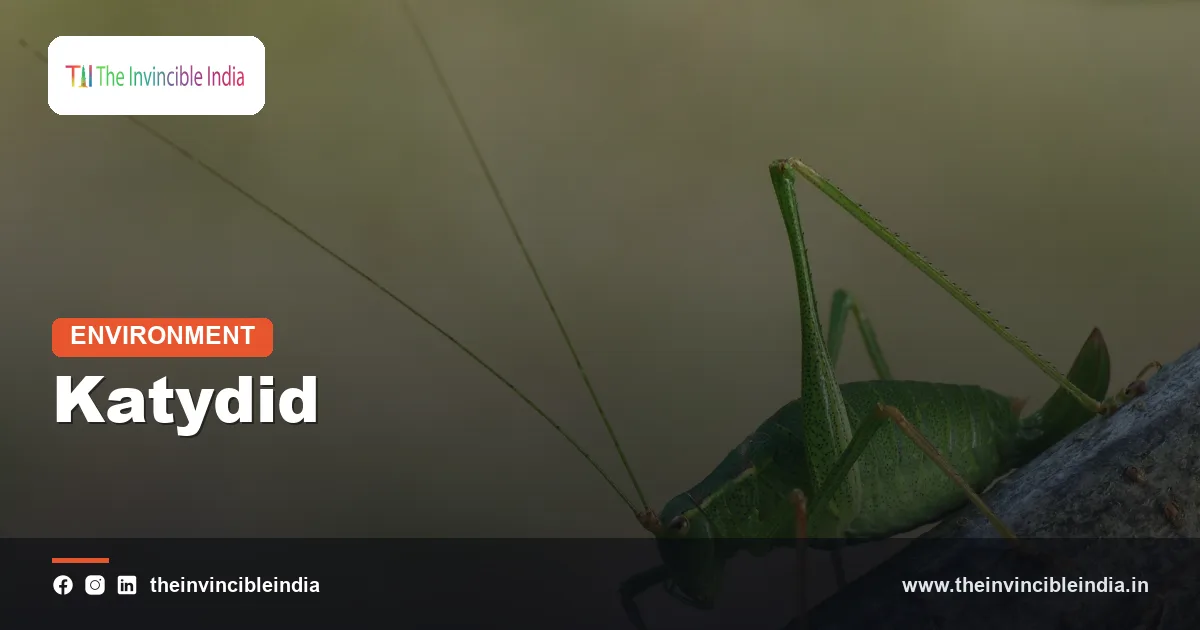
A katydid is a green, leaf-mimicking insect of the family Tettigoniidae, also called a bush cricket, that hides among foliage by day and sings from the vegetation at night. Its folded, leaf-shaped wings, often complete with vein-like markings and even imitation blemishes, make it one of the most convincing camouflage artists among Indian insects.
India’s forests, scrub and gardens, and above all the Western Ghats and the north-eastern hills, are home to many katydid species, most of which are heard far more often than they are seen. This article explains what a katydid is, how it differs from a cricket and a grasshopper, how it hides and sings, what it eats and how it breeds and grows.
| Attribute | Details |
|---|---|
| Order and family | Orthoptera (suborder Ensifera), family Tettigoniidae |
| Other names | Bush cricket (the usual name in British English), long-horned grasshopper |
| Typical size | From about 1 cm in small species to well over 6 cm in large forest species, excluding antennae |
| Habitat in India | Forest canopy and understorey, shrubs, tall grass, crop fields and gardens, with high diversity in the Western Ghats and the north-east |
| Diet | Mostly leaves, flowers, seeds and fruit; some species also eat insects and other small animals |
| Life cycle | Incomplete metamorphosis: egg, nymph (several moults), winged adult; eggs are laid in plant tissue, bark or soil |
| Ecological role | Plant eater and, in some species, predator; prey for birds, bats, lizards, spiders and primates |
| Notable features | Leaf-like forewings, antennae often longer than the body, ears on the front legs, four-segmented feet and a blade-like ovipositor in females |
Key Takeaways
- A katydid is a long-horned member of the order Orthoptera whose feet have four segments and whose antennae are usually longer than its body.
- Many katydids resemble leaves so closely that their wings carry vein patterns, and some copy chewed edges or mould spots.
- Male katydids sing by rubbing the forewings together, and the song attracts females and, in some species, is answered in rhythm by other males.
- Katydids have ears on their front legs and respond to the ultrasonic calls of hunting bats.
- Female katydids lay eggs with a sword-shaped or sickle-shaped ovipositor, placing them in leaves, stems, bark or soil.
- Katydids are harmless to people and are valued as food for birds, bats, reptiles and monkeys.
What Is a Katydid?
A katydid is a medium-to-large insect of the family Tettigoniidae in the order Orthoptera, generally green, long-legged and long-antennaed, with wings that resemble leaves. The group contains several thousand species worldwide and is closely related to crickets, though it forms a separate family.
In British English and in much of Asia and Australia, katydids are known as bush crickets. The name “katydid” itself is American and imitates the three-note rasp of a North American species. India has many katydid species in several subfamilies, ranging from slender, delicate species of tall grass to heavy-bodied giants of the forest floor.
Most katydids are nocturnal. During the day they remain motionless on a leaf or twig, while after dark they move, feed and call. Because they are so well hidden, a katydid is often found only when it flies to a lamp or porch light on a monsoon night.
How Does a Katydid Mimic a Leaf?
A katydid mimics a leaf by holding its forewings over its back like a roof, shaping them as flat green blades with veins that match those of real foliage, and then staying completely still. The result is a creature that looks like a leaf to a hunting bird or lizard.
The disguise goes beyond colour. In many species the wing edges are slightly crinkled, the midrib runs as a pale line along the wing, and the hind margin carries small marks that resemble holes, insect bites, rust-coloured patches or fungal spots. Some forest species look like dry brown leaves instead of green ones, and a few resemble bark, moss or lichen.
This kind of camouflage is called crypsis, and when a living thing copies a particular object such as a leaf, it is also known as mimesis or masquerade. The insect adds to the effect with its behaviour: it sways gently like a leaf in the breeze, tucks its legs close to the body and avoids moving in daylight.
Other defences
- Sudden escape: a startled katydid may drop to the ground or leap away on its strong hind legs.
- Warning display: some species flash brightly coloured hindwings or raise spiny legs to startle a predator.
- Spines and bites: large ground-dwelling katydids have spiny legs and strong jaws and can pinch a handling finger.
- Chemical defence: certain species release a foul fluid when seized.
How Is a Katydid Different From a Cricket and a Grasshopper?
A katydid differs from a cricket mainly in its leaf-like, tent-shaped wings, mostly plant-eating diet and four-segmented feet, and it differs from a grasshopper in its much longer antennae and nocturnal habits. All three are Orthoptera, but katydids and crickets are long-horned, while grasshoppers are short-horned.
| Feature | Katydid | Cricket | Grasshopper |
|---|---|---|---|
| Antennae | Very long, thread-like | Long, thread-like | Short and thick |
| Foot segments | Four | Three | Three |
| Wing posture | Held roof-like over the back | Held flat over the back | Folded along the body |
| Main habitat | Foliage, shrubs and trees | Ground and burrows | Grass and open ground |
| Typical activity | Mostly night | Mostly night | Mostly day |
| Ears | On the front legs | On the front legs | On the abdomen |
| Main diet | Plants, some predation | Omnivorous | Plants |
How Does a Katydid Sing?
A male katydid sings by stridulation, rubbing one forewing against the other so that a scraper on one wing strikes a row of teeth on the other, and thin membranes on the wings radiate the sound. Females generally do not sing, although in some groups they answer a male’s call with a short click or tick.
Katydid songs vary greatly. Some are continuous, high-pitched buzzes or trills, others are rhythmic ticks or rasps, and many are short repeated phrases. Several species call in the ultrasonic range that people cannot hear without equipment, and others produce a loud, penetrating sound that carries through a forest.
Singing is costly, because it uses energy and can reveal the singer to predators such as bats and owls. Studies of large Asian forest katydids, including species in the genus Mecopoda, have recorded males adjusting the timing of their calls so that nearby singers alternate or synchronise, a behaviour that makes each male’s call easier for females to pick out in the chorus.
Like crickets, katydids hear through small ear drums on their front legs. The same ears allow them to detect the ultrasonic calls of insect-hunting bats, and many katydids stop singing or drop into vegetation when they sense one.
Where Do Katydids Live in India?
Katydids live in nearly every vegetated habitat in India, from evergreen rainforest and moist deciduous woodland to dry scrub, grassland, orchards, crop fields and city gardens. Diversity is highest in the humid, forested regions, especially the Western Ghats, the Eastern Himalaya and the hills of the north-east.
Different subfamilies occupy different layers. Delicate, narrow-winged species such as those in the genus Phaneroptera, often called sickle-bearing bush crickets, live in low herbage and are attracted to lights. Heavily built, leaf-winged species of the subfamily Pseudophyllinae live in the forest canopy and understorey, where they imitate broad leaves. Meadow-dwelling forms live in tall grasses and reeds, and some thick-bodied, flightless species spend their lives on or near the ground.
Many katydid species have small geographic ranges and depend on specific kinds of forest. This makes them useful indicators of habitat quality, and it also means that the clearing of native forest can remove species before scientists have described them.
What Does a Katydid Eat?
Most katydids eat leaves, flowers, buds, seeds and soft fruit, while a significant minority are partly or wholly predatory and eat other insects, snails or even small vertebrates. Diet depends on the subfamily and the species.
Plant-feeding katydids
Leaf-mimicking species generally feed on the foliage of the trees and shrubs on which they hide, taking small bites from the leaf margin and moving on. A few feed on pollen and flower parts, and some chew grass seeds in meadows. Their feeding is usually too light to harm a plant seriously, but a few species have been recorded damaging crops such as rice, sugarcane, oil palm and tea when numbers are high.
Predatory katydids
Predatory species, often with spiny forelegs for gripping, hunt caterpillars, moths, beetles and other katydids at night. Some large forest species are capable of killing small lizards or frogs. They help control insect populations, in much the same way as mantises.
What Is the Life Cycle of a Katydid?
The life cycle of a katydid has three stages, egg, nymph and adult, and its development is called incomplete metamorphosis because the young resemble small wingless adults rather than larvae. A katydid never forms a pupa.
- Mating: the male attracts a female by song, and mating follows once she approaches.
- Nuptial gift: in many species the male passes a sperm packet, the spermatophore, with a jelly-like attached food mass, the spermatophylax, which the female eats while the sperm transfers.
- Egg laying: the female uses her blade-like ovipositor to insert eggs into plant tissue, bark, stems or soil, or glues them to the surface of a leaf or twig.
- Nymph stage: the eggs hatch into tiny, wingless nymphs that feed and moult several times, growing wing pads.
- Adult stage: after the last moult the insect has full wings, matures and begins to breed.
Many temperate katydids overwinter as eggs, whereas tropical species may breed through much of the warm, wet period. In India, adult numbers peak during and after the monsoon, when new leaf growth supplies abundant food.
Why Does the Female Katydid Have a Sword-Like Tail?
The female katydid has a sword-like tail, called an ovipositor, because she uses it to cut into plant tissue and soil to place her eggs in a protected spot. The shape depends on where the species lays: long and sickle-shaped for slipping eggs into leaves or stems, straighter and stronger for soil.
The ovipositor is not a sting and is harmless to people. Newcomers sometimes mistake it for a weapon and avoid the insect unnecessarily. Its shape is often one of the clearest ways for naturalists to tell a female katydid from a female grasshopper, whose egg-laying valves are short and hooked.
Hidden eggs are well protected from rain, heat and egg-hunting insects, and in leaf-laying species the egg row often follows the leaf margin so neatly that it looks like part of the leaf itself.
What Is the Ecological Role of the Katydid?
The katydid plays three ecological roles: it feeds on plants and recycles leaf material, it hunts smaller insects in the case of predatory species, and it serves as nutritious prey for many animals. Its presence links plants, insects and larger wildlife.
Predators of katydids include bats, owls, nightjars, frogs, lizards, geckos, spiders, praying mantises, hornets, snakes and primates such as macaques and lorises. Parasitic flies and wasps also use katydids as hosts for their young. Because the insects are abundant at night, many nocturnal hunters depend on them seasonally.
Katydids also matter to science. Their hearing, communication and mating systems have been studied extensively, and their call patterns help researchers survey forest biodiversity by sound without capturing the insects.
Are Katydids Dangerous or Harmful?
Katydids are not dangerous to people. They do not sting, carry no venom and are not known to spread disease. The largest species can give a brief pinch with their jaws if handled roughly, but this is not harmful.
Occasional crop damage is the only real concern. A few species feed on rice, tea, sugarcane or fruit crops and can be local pests, but outbreaks are modest compared with those of locusts. Because katydids are well camouflaged and nocturnal, farmers rarely see them, and natural predators generally keep numbers in balance.
The best way to treat a katydid found indoors is to guide it gently onto a leaf or paper and release it outside. It will not damage furniture, clothing or food.
How Can You Spot a Katydid?
The easiest way to spot a katydid is to follow its night-time song with a torch, look for a leaf that seems slightly unusual in shape, and watch for long, thread-like antennae poking out. Searching near lights on warm, humid nights also produces many visitors.
- Search shrubs and tall grass after dark during and just after the monsoon.
- Check leaves for unusually regular edges, vein-like lines or tiny bite marks that do not change.
- Look near outdoor lamps for fluttering green insects that land motionless.
- Photograph the insect in place instead of handling it, and avoid breaking branches.
Citizen-science platforms in India accept katydid photographs, which helps scientists map the ranges of species that are still poorly known.
Bottom Line
The katydid is a master of disguise, a night-time singer and a quiet link in the Indian food web. Recognising its leaf-like wings, long antennae and night song helps people notice a group of insects that is both diverse and sensitive to forest health.
Frequently Asked Questions
What is a katydid?
A katydid is a green, leaf-like insect of the family Tettigoniidae in the order Orthoptera, also called a bush cricket. It has long antennae, strong hind legs and wings shaped like leaves. Most katydids are active at night and sing from foliage.
Is a katydid the same as a grasshopper?
No, a katydid is not a grasshopper, although the two are related. Katydids have very long antennae, four-segmented feet and ears on the front legs, whereas grasshoppers have short antennae and ears on the abdomen. Katydids are also mostly nocturnal and often plant-eating or predatory, while grasshoppers are mostly day-active plant-eaters.
How does a katydid look like a leaf?
A katydid looks like a leaf because its folded forewings are flat, green and marked with vein-like lines and sometimes imitation blemishes. The insect also holds still and sways gently like foliage. This camouflage helps it avoid birds, lizards and other predators.
Do katydids bite or sting?
Katydids do not sting, and they are not venomous. Large species can pinch with their jaws if handled roughly, but the bite is brief and harmless. The sword-like organ on the female’s tail is an egg-laying tool, not a stinger.
What do katydids eat?
Most katydids eat leaves, flowers, seeds and fruit, while some species hunt other insects and small animals. Leaf-mimicking species usually feed on the foliage where they hide. A few can occasionally damage crops such as rice, tea or sugarcane.
Why do katydids make noise at night?
Male katydids make noise at night to attract females and to advertise their position to rival males. They produce the sound by rubbing their forewings together. Calling at night helps them avoid some day-active predators, although it can attract bats and owls.
{“@context”:”https://schema.org”,”@graph”:[{“@type”:”FAQPage”,”mainEntity”:[{“@type”:”Question”,”name”:”What is a katydid?”,”acceptedAnswer”:{“@type”:”Answer”,”text”:”A katydid is a green, leaf-like insect of the family Tettigoniidae in the order Orthoptera, also called a bush cricket. It has long antennae, strong hind legs and wings shaped like leaves. Most katydids are active at night and sing from foliage.”}},{“@type”:”Question”,”name”:”Is a katydid the same as a grasshopper?”,”acceptedAnswer”:{“@type”:”Answer”,”text”:”No, a katydid is not a grasshopper, although the two are related. Katydids have very long antennae, four-segmented feet and ears on the front legs, whereas grasshoppers have short antennae and ears on the abdomen. Katydids are also mostly nocturnal and often plant-eating or predatory, while grasshoppers are mostly day-active plant-eaters.”}},{“@type”:”Question”,”name”:”How does a katydid look like a leaf?”,”acceptedAnswer”:{“@type”:”Answer”,”text”:”A katydid looks like a leaf because its folded forewings are flat, green and marked with vein-like lines and sometimes imitation blemishes. The insect also holds still and sways gently like foliage. This camouflage helps it avoid birds, lizards and other predators.”}},{“@type”:”Question”,”name”:”Do katydids bite or sting?”,”acceptedAnswer”:{“@type”:”Answer”,”text”:”Katydids do not sting, and they are not venomous. Large species can pinch with their jaws if handled roughly, but the bite is brief and harmless. The sword-like organ on the female’s tail is an egg-laying tool, not a stinger.”}},{“@type”:”Question”,”name”:”What do katydids eat?”,”acceptedAnswer”:{“@type”:”Answer”,”text”:”Most katydids eat leaves, flowers, seeds and fruit, while some species hunt other insects and small animals. Leaf-mimicking species usually feed on the foliage where they hide. A few can occasionally damage crops such as rice, tea or sugarcane.”}},{“@type”:”Question”,”name”:”Why do katydids make noise at night?”,”acceptedAnswer”:{“@type”:”Answer”,”text”:”Male katydids make noise at night to attract females and to advertise their position to rival males. They produce the sound by rubbing their forewings together. Calling at night helps them avoid some day-active predators, although it can attract bats and owls.”}}]}]}


