

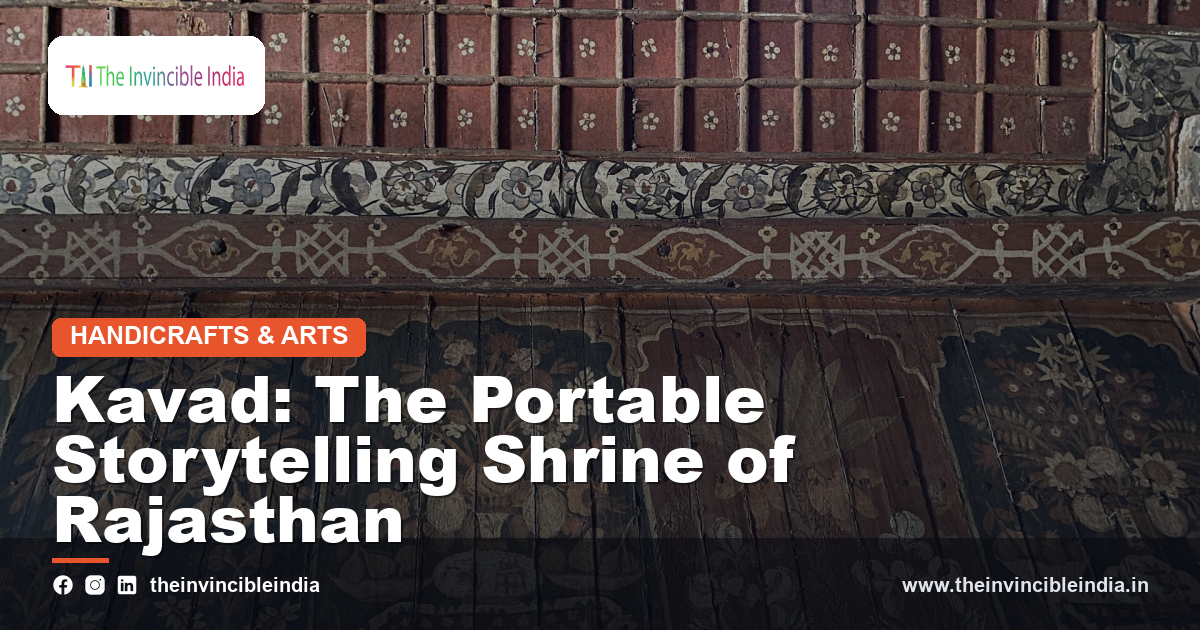
The Kavad is the portable wooden storytelling shrine of Rajasthan, a brightly painted box fitted with many hinged doors that open, one after another, to reveal painted panels telling epic and devotional stories. The craft is associated especially with Bassi, in the Chittorgarh region of Rajasthan, and the painted boxes are made by the Suthar, or carpenter, community. A travelling narrator, the kavadiya bhat, carries the Kavad from place to place and, as the audience gathers, opens its panels one by one, each painted scene prompting a part of the tale, so that the box becomes both a shrine and a moving storybook. Combining woodwork, vivid painting and oral storytelling, the Kavad is a remarkable living tradition of Rajasthan. Readers who enjoy India’s painted and folk-art traditions may also explore the Madhubani painting guide. This guide describes the Kavad, its form, its makers, its narrators, its stories and its present-day place.
Quick answer: The Kavad is a portable wooden storytelling shrine of Rajasthan, India: a brightly painted box with many hinged doors that open panel by panel to reveal painted scenes of epic and devotional stories. It is associated especially with Bassi in the Chittorgarh region and is made by the Suthar (carpenter) community. A travelling narrator, the kavadiya bhat, opens the panels to tell the tales.
Key Takeaways
- The Kavad is the portable wooden storytelling shrine of Rajasthan, India.
- It is a brightly painted box with many hinged doors that open one after another.
- Each panel reveals painted scenes that prompt a part of an epic or devotional story.
- It is associated especially with Bassi, in the Chittorgarh region of Rajasthan.
- The painted boxes are made by the Suthar, or carpenter, community.
- A travelling narrator, the kavadiya bhat, opens the panels to tell the stories.
The sections below explain what the Kavad is, where it comes from, how it is made and painted, how the storytelling works, who the narrators are, what stories it tells and why it still matters.
Quick Facts
| Detail | Information |
|---|---|
| Craft type | Painted wooden storytelling shrine (woodwork and painting) |
| Region of origin | Rajasthan, especially Bassi in the Chittorgarh region |
| Also known as | Kavad, Kaavad; storytelling box or shrine |
| Materials | Wood, with bright paint; hinged panels |
| Technique | Carpentry of a many-doored box, then vivid hand painting |
| Known for | Multi-paneled box opened by a narrator to tell epic and devotional tales |
| GI status | A recognised traditional craft of Rajasthan; confirm GI details with the Registry |
| Community | Made by the Suthar (carpenter) community; narrated by the kavadiya bhat |
What Is the Kavad?
The Kavad is a portable wooden storytelling shrine of Rajasthan, a brightly painted box with many hinged doors that open panel by panel to reveal painted scenes of epic and devotional stories. Also spelled Kaavad, it combines woodwork, vivid painting and oral storytelling into a single living tradition. The box is built with several layers of hinged panels, and as each door is opened a new painted scene is revealed, prompting the next part of the tale. Carried from place to place by a travelling narrator, the Kavad serves as both a portable shrine and a moving storybook, bringing sacred and epic stories to its audience. Its bright colours, hinged panels and narrated tales make it a remarkable and distinctive craft. The Kavad unites carpentry, painting and storytelling. Its many-doored, painted form defines its character. It is a singular tradition of Rajasthan.
Where Does the Kavad Come From?
The Kavad comes from Rajasthan, and is associated especially with Bassi, in the Chittorgarh region, where the painted boxes are traditionally made. Bassi is particularly known as a centre for the craft, and the Kavad is identified with this part of Rajasthan. The making of the boxes by the Suthar, or carpenter, community and their use by travelling narrators are rooted in the region’s traditions of folk craft, devotion and oral storytelling. The combination of skilled woodworking, vivid folk painting and the custom of itinerant narration gave rise to this distinctive tradition. The Kavad is therefore tied closely to Rajasthan and to Bassi in particular. Its home gives the craft its identity and context. Bassi and Chittorgarh are central to the Kavad tradition. The craft belongs to Rajasthan. Place and tradition together shape it.
Who Makes the Kavad?
The Kavad is made by the Suthar, or carpenter, community of Rajasthan, who build the wooden boxes and paint them with the scenes that the storytelling requires. The Suthar craftspeople construct the box with its many hinged panels, a task that demands skill in carpentry to make the doors open and fold correctly, and then paint the panels in bright colours with the figures and scenes of the stories. This union of carpentry and painting in a single craft is a distinctive feature of the Kavad tradition. The knowledge of making and painting the boxes is passed down within the Suthar community over generations. For these makers, the craft is both an inherited tradition and a livelihood, tied to the storytelling custom it serves. The Suthar carpenters are the makers of the Kavad. Their skill in wood and paint creates the shrine. They are central to the tradition.
How Is the Kavad Made?
The Kavad is made by constructing a wooden box with multiple hinged doors or panels and then painting it brightly with the scenes of the stories it will tell. The Suthar carpenter builds the box from wood, fitting it with several layers of panels joined by hinges so that the doors can be opened one after another to reveal successive scenes, which calls for skill and precision in the woodwork. Once the box is built, the panels are painted in vivid colours with figures, deities and scenes arranged in the order of the storytelling. The painting follows the conventions of the tradition, with bright folk-art colour and composition. The whole process, from carpentry to painting, is done by hand within the craft tradition. Because practices vary, the exact methods and designs differ between makers. The making unites woodwork and painting. The result is a painted, many-doored shrine. The craft is both built and painted.
What Does the Kavad Look Like?
The Kavad looks like a brightly painted wooden box or cabinet fitted with many hinged doors that open outward to reveal painted panels within. Its exterior and interior surfaces are covered with vivid folk paintings, typically dominated by bright colours, showing figures, deities and scenes from the stories. The box is built in layers, so that opening one set of doors reveals further painted panels and doors behind, leading the viewer deeper into the shrine as the story unfolds. The innermost panel often holds a central sacred image. The whole object is compact and portable, designed to be carried and opened before an audience. Its combination of a many-doored wooden form and dense, bright painting makes it immediately striking and distinctive. The Kavad is a painted, folding, portable shrine. Its layered doors and vivid scenes define its look. It is both object and storybook.
How Does the Storytelling Work?
The storytelling works by the narrator opening the Kavad’s panels one after another, each painted scene prompting the next part of the tale told aloud to the gathered audience. As the audience gathers, the kavadiya bhat begins the narration and opens the first doors, pointing to the painted scenes and recounting the story they depict, then opening further panels as the tale advances. Each layer of doors reveals new scenes, so that the physical act of opening the box moves the story forward, step by step, towards its sacred or climactic conclusion at the innermost panel. The painted images thus serve as both illustration and prompt for the oral narration. This union of a moving, painted object and spoken storytelling is the heart of the Kavad tradition. The box unfolds the story panel by panel. The narrator brings the painted scenes to life. Image and word work together.
Who Is the Kavadiya Bhat?
The kavadiya bhat is the travelling narrator who carries the Kavad from place to place and tells its stories to audiences by opening its painted panels. The kavadiya bhat is a storyteller within the folk tradition of Rajasthan, moving between communities and households and performing the narration that brings the Kavad to life. As the narrator opens the doors of the box and points to the painted scenes, the kavadiya bhat recounts the epic and devotional tales, often connecting the stories to the patrons and listeners. This role of itinerant storyteller is central to the Kavad tradition, for without the narration the painted box would be only an object. The kavadiya bhat thus carries both the shrine and the living story. The narrator is the voice of the Kavad. The storytelling depends on this role. The kavadiya bhat keeps the tradition moving from place to place.
What Stories Does the Kavad Tell?
The Kavad tells epic and devotional stories, drawn from sacred tradition, legend and the narration of the storyteller, illustrated by the painted panels. The scenes painted on the doors and panels depict figures, deities and episodes from epic and religious tales, so that opening the box unfolds a sacred or heroic narrative before the audience. As a portable shrine, the Kavad brings these devotional and epic stories to communities and households, combining worship, storytelling and art. The narration by the kavadiya bhat may also weave in the listeners and patrons, linking the sacred tales to the lives of the audience. The particular stories reflect the devotional and epic traditions of the region and the repertoire of the narrator. Whatever the tale, the painted panels and the spoken narration together carry it. The Kavad tells sacred and epic stories. Its panels illustrate the narration. Story and shrine are one.
Why Is the Kavad Both a Shrine and a Storybook?
The Kavad is both a shrine and a storybook because it serves as a portable sacred object and, at the same time, as an illustrated narrative opened and told before an audience. As a shrine, it holds sacred images, often with a central deity at its innermost panel, and brings devotion directly to communities and households that the narrator visits. As a storybook, its painted panels illustrate epic and devotional tales that the kavadiya bhat recounts, with each opened door advancing the story. This dual nature, uniting worship and storytelling in a single portable object, is what makes the Kavad so distinctive. The act of opening the box is both a revealing of the sacred and a telling of the tale. The Kavad thus serves devotion and narration together. It is shrine and storybook in one. This union is the heart of its tradition. It brings sacred stories to the people.
What Is the History of the Kavad Tradition?
The Kavad tradition has a long history in Rajasthan, rooted in the region’s customs of folk craft, devotion and itinerant storytelling, though its precise early origins rest on tradition rather than exact record. For a long time, the Suthar carpenters of the region, associated especially with Bassi, have made the painted boxes, and travelling narrators have carried them to tell their sacred and epic stories. The tradition unites the craft of making and painting the boxes with the oral tradition of the storyteller, sustained over generations within these communities. Over time, the Kavad has come to be recognised as a remarkable folk tradition of Rajasthan, admired both as a craft and as a form of storytelling. Because much of the early story rests on tradition, it is best described in general terms. What is clear is that the Kavad is a long-rooted tradition of folk craft and storytelling. Its history unites makers and narrators.
What Makes the Kavad Distinctive?
The Kavad is distinctive for uniting woodwork, vivid painting and oral storytelling in a single portable shrine with many hinged, opening panels. Few crafts combine, as the Kavad does, the carpentry of a multi-doored box, the bright folk painting of its panels and the living narration of a travelling storyteller. Its layered, opening form, in which each door reveals a new painted scene and advances the tale, is unlike any ordinary painting or shrine. Its roots in Bassi and the Chittorgarh region, its making by the Suthar community and its narration by the kavadiya bhat give it a strong regional and cultural identity. Its nature as both shrine and storybook adds to its uniqueness. These qualities together make the Kavad remarkable and instantly recognisable. Its union of craft and storytelling is central to its appeal. The Kavad is a singular tradition of Rajasthan.
Does the Kavad Have a GI Tag?
The Kavad is recognised as a distinctive traditional craft and storytelling tradition of Rajasthan, associated especially with Bassi in the Chittorgarh region. It is valued and supported as a remarkable folk craft that unites woodwork, painting and oral narration. Whether the Kavad holds a specific Geographical Indication is best confirmed with the official Geographical Indications Registry and the relevant state authorities, since the status of individual crafts can vary and change over time, and details should be checked rather than assumed. Whatever the formal position, the Kavad is clearly identified with Rajasthan, with Bassi and with the Suthar makers and kavadiya bhat narrators. Recognition and cultural interest help protect the craft and sustain its makers and narrators. They also encourage the valuing of genuine work. The bond between the craft and its region remains central to its identity. The Kavad is a cherished tradition of Rajasthan.
How Does the Kavad Compare with Other Storytelling Traditions?
The Kavad shares with several Indian folk traditions the union of painted images and oral storytelling, but it is distinguished by its portable, many-doored wooden shrine opened panel by panel. India has a rich heritage of painted storytelling, in which narrators use painted scrolls, cloths or panels to illustrate tales told aloud, each tradition with its own form and region. The Kavad stands out for its three-dimensional wooden box, built with layers of hinged doors that open to reveal successive scenes, so that the object itself unfolds the story. Comparing these traditions shows the great variety of ways in which Indian folk art has joined image and narration. The Kavad contributes a distinctive, sculptural storytelling voice from Rajasthan. Each storytelling tradition has its own form. The Kavad, with its opening wooden panels, is distinctly its own. It holds a special place among India’s narrative folk arts.
How Can You Buy an Authentic Kavad?
An authentic Kavad can be bought from recognised Rajasthan handicraft emporiums, cooperatives, craft fairs and trusted sources that identify the work as genuine Kavad from Bassi or the Chittorgarh region and support the Suthar makers. A genuine Kavad is a hand-built wooden box with many hinged, opening panels, hand-painted in bright folk colours with figures and scenes, showing the character and slight variation of handwork. Mass-produced or imitation pieces may lack the proper construction, the hand painting or the connection to the tradition. Buyers can examine the woodwork and the opening panels, look at the quality and style of the painting, and ask about the maker and the region. Buying from recognised emporiums, cooperatives or Suthar artisans helps income reach the makers and supports the storytelling tradition. Careful buying rewards genuine craftsmanship. It also secures a true example of this remarkable Rajasthani craft.
The Kavad Tradition Today
The Kavad tradition today survives as a remarkable folk craft and storytelling practice of Rajasthan, admired both as a painted shrine and as a form of narration. The Suthar carpenters of Bassi and the Chittorgarh region continue to build and paint the many-doored boxes, and the tradition of the kavadiya bhat narrator, who opens the panels to tell the tales, is cherished as part of the region’s living heritage. Growing interest in folk art, storytelling and handmade craft has brought wider attention to the Kavad, which is now valued by collectors and admirers as well as within its tradition. At the same time, the craft and its storytelling face real challenges, including changing patronage for narrators, fair returns for makers and the need to sustain both the carving-and-painting and the narration for new generations. Readers can support the tradition by valuing and buying genuine Kavad through recognised sources. The Kavad endures as a living union of craft and story. Its opening panels keep the tradition alive.
Sources & Further Reading
- Development Commissioner (Handicrafts), Ministry of Textiles, Government of India (handicrafts.nic.in).
- Geographical Indications Registry, Government of India (ipindia.gov.in).
- Department of Industries and Commerce, Government of Rajasthan.
Frequently Asked Questions
What is the Kavad?
The Kavad is a portable wooden storytelling shrine of Rajasthan, a brightly painted box with many hinged doors that open panel by panel to reveal painted scenes of epic and devotional stories. It is associated especially with Bassi in the Chittorgarh region. A travelling narrator opens the panels to tell the tales.
Who makes the Kavad?
The Kavad is made by the Suthar, or carpenter, community of Rajasthan, who build the wooden boxes with their many hinged panels and paint them in bright colours with the scenes of the stories. This union of carpentry and painting is distinctive. The knowledge is passed down within the community over generations.
Who is the kavadiya bhat?
The kavadiya bhat is the travelling narrator who carries the Kavad from place to place and tells its stories by opening its painted panels before an audience. As the narrator opens the doors and points to the scenes, the tale unfolds. Without this narration, the painted box would be only an object.
How does Kavad storytelling work?
Kavad storytelling works by the narrator opening the box’s hinged panels one after another, each painted scene prompting the next part of the tale told aloud. Each layer of doors reveals new scenes, so opening the box moves the story forward towards its sacred conclusion. The painted images serve as both illustration and prompt for the narration.
Where does the Kavad come from?
The Kavad comes from Rajasthan and is associated especially with Bassi, in the Chittorgarh region, where the painted boxes are traditionally made by the Suthar community. Its making and its use by travelling narrators are rooted in the region’s traditions of folk craft, devotion and oral storytelling.
Does the Kavad have a GI tag?
The Kavad is recognised as a distinctive traditional craft and storytelling tradition of Rajasthan. Whether it holds a specific Geographical Indication is best confirmed with the official Geographical Indications Registry and the relevant state authorities, as the status of individual crafts can vary and should be checked rather than assumed.


