

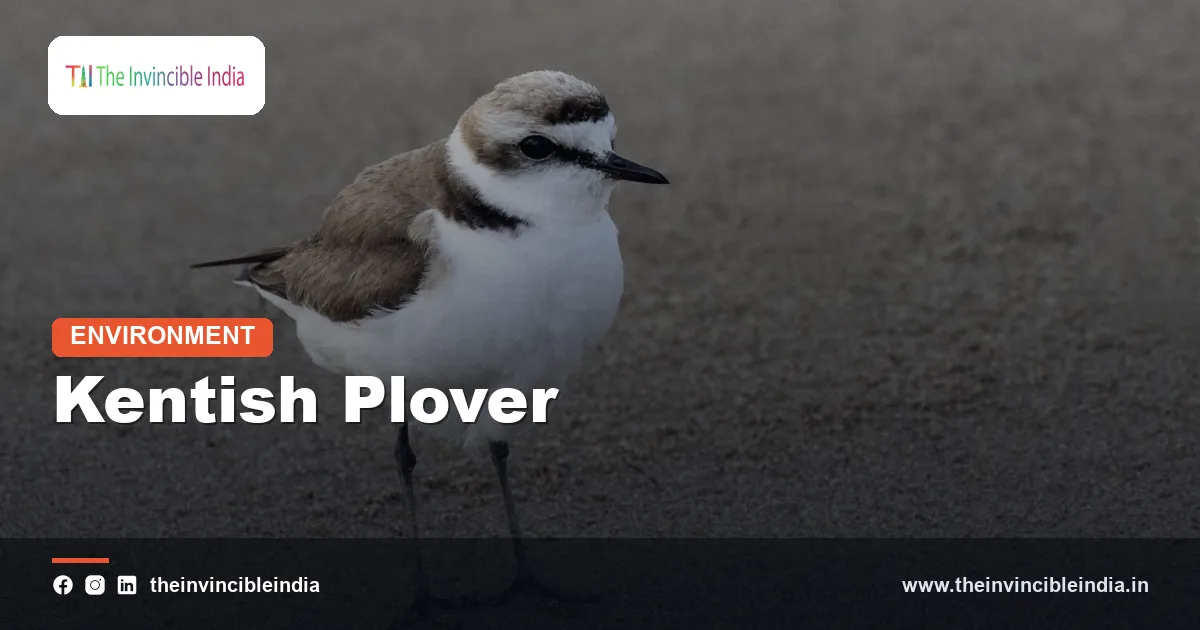
The Kentish plover (Charadrius alexandrinus) is a small, pale, sand-coloured wading bird of the plover family that nests on open beaches, salt pans, lagoon edges and riverbanks across India and much of the Old World. It is easy to overlook, because its sandy back and white underparts blend into dry mud and shell sand, and it often reveals itself only when it sprints a few steps, stops and then sprints again.
In India the Kentish plover is a familiar bird of the coast and of large inland wetlands, where resident birds are joined in the cooler months by visitors from colder regions. This explainer covers its appearance, range, food, breeding, migration, look-alike species, threats and the simple habits that help it survive.
| Attribute | Details |
|---|---|
| Common name | Kentish plover |
| Scientific name | Charadrius alexandrinus |
| Family | Charadriidae (plovers and lapwings) |
| Size | About 15 to 17 cm in length, with a wingspan of roughly 42 to 45 cm |
| India range and habitat | Sandy and muddy coasts, estuaries, salt pans, saline flats, lake shores and river sandbanks |
| Diet | Small insects, crustaceans, worms and molluscs picked from the surface of wet sand and mud |
| Breeding | Ground scrape on bare sand or dried mud, usually three eggs, with both parents sharing duties |
| Migration | Partly resident and partly a winter visitor in India |
| Conservation status | Least Concern on the IUCN Red List, though many local populations are declining |
Key Takeaways
- The Kentish plover is a small plover, only about 15 to 17 cm long, with pale sandy upperparts and white underparts.
- The Kentish plover has a dark bill, dark legs and an incomplete breast band that shows as a dark patch on each side of the chest rather than a full ring.
- The Kentish plover nests directly on the ground in a shallow scrape, which makes its eggs and chicks vulnerable to trampling, dogs and high tides.
- The Kentish plover feeds by a run, stop and peck routine on open sand and mud, taking insects, crustaceans and worms.
- The Kentish plover is found on coasts and large inland wetlands across India, and its numbers swell in winter with migrant visitors.
- The Kentish plover is listed as Least Concern globally, but beach disturbance and habitat change are shrinking its nesting sites in many places.
What is the Kentish plover?
The Kentish plover is a small shorebird in the family Charadriidae, the group that also includes the ringed plovers, sand plovers and lapwings. Its scientific name is Charadrius alexandrinus, and the English name comes from the English county of Kent, where the species was recorded and described in early natural history writing. In India it is one of the commonest of the small, pale plovers on open sand.
Like other plovers, the Kentish plover is built for life on flat, open ground. It has a rounded head, large dark eyes, a short bill and fairly long legs that allow quick running. Plovers use sight rather than touch to find food, which is why they favour bare, well-lit shores where prey is easy to spot.
The species has an enormous range across Europe, Africa, Asia and parts of the Middle East, and it lives mostly at the edge of water, whether salt, brackish or fresh. Birds that were once grouped with it in the Americas and East Asia are now widely treated as separate species, a point covered further below.
What does the Kentish plover look like?
The Kentish plover is a compact, short-bodied plover with sandy brown upperparts, a clean white belly and an incomplete dark breast band. The bill is short, thin and black, and the legs are dark grey to blackish, which is one of the most useful features for identification.
The sexes differ most in the breeding season. Breeding males show a black bar across the forecrown, a dark line through the eye and a rufous or chestnut tint on the crown and nape. Females and non-breeding birds are plainer, with brown rather than black markings and a less defined head pattern. Juveniles resemble females but look scaly on the back, because each feather has a pale edge.
Key field marks
- Pale sand-brown back that matches dry shores
- White collar and white underparts
- Dark patches at the sides of the chest instead of a full breast ring
- Black bill and dark legs
- A white wing bar and white outer tail edges, visible in flight
In flight the Kentish plover shows a narrow white bar along the wing and white sides to the tail. The flight is fast and low, often in loose twisting flocks, and the birds drop quickly back onto the sand.
How can you tell the Kentish plover from similar waders?
The Kentish plover is separated from other small plovers mainly by its dark legs, thin black bill and incomplete breast band. Several look-alikes share Indian shores, and comparing a few features avoids most mistakes.
| Species | Breast band | Legs | Other clue |
|---|---|---|---|
| Kentish plover | Incomplete, patches at the sides | Dark grey to black | Pale sandy back, thin black bill |
| Little ringed plover | Complete black band | Pinkish to yellowish | Yellow ring around the eye |
| Lesser sand plover | Incomplete or rusty, depending on season | Dark grey | Larger and heavier, with a thicker bill |
| Common ringed plover | Complete band | Orange-yellow | Orange base to the bill |
The Kentish plover is also smaller and paler than the lesser sand plover, and its body looks more upright and neat. Because the bird holds very still when it senses danger, it is often easier to detect by its tiny moving shadow than by its colour.
Where does the Kentish plover live in India?
The Kentish plover lives along sandy and muddy coasts, estuaries, salt pans and the shores of large inland wetlands across India. It prefers bare or sparsely vegetated ground close to water, and it avoids tall grass and dense scrub.
Typical Indian habitats include:
- Open beaches and tidal flats along the Gujarat, Maharashtra, Karnataka, Kerala, Tamil Nadu, Andhra Pradesh, Odisha and West Bengal coasts
- Commercial and traditional salt pans, where shallow evaporation ponds and dry dykes resemble natural saline flats
- Lagoons and brackish lakes such as Chilika in Odisha and Pulicat on the Andhra Pradesh and Tamil Nadu border
- Large inland saline and freshwater lakes, reservoirs and the Rann of Kutch
- Exposed sandbars on big rivers during the dry season
The species has also been reported at some high-altitude lakes in the Himalayan region, which shows how adaptable the Kentish plover is as long as it finds open, bare shoreline. The common thread across all these places is flat ground with a clear view, because the bird relies on spotting predators early.
What does the Kentish plover eat and how does it feed?
The Kentish plover eats small invertebrates, mainly insects, small crustaceans, marine worms and tiny molluscs, which it picks from the surface of wet sand, mud and shallow water. It sometimes takes small amounts of plant matter and seeds, but animal prey makes up most of its diet.
Its feeding method is distinctive. The bird runs a few quick steps, freezes with its head tilted, scans the ground with its large eyes and then pecks at a visible target. Then it repeats the cycle. This run, stop and peck pattern is shared by many plovers and is a good clue even from a distance.
Where the food comes from
- Tide lines and wet sand left behind by retreating water
- Algal mats and mud at the edges of shallow pools
- Insects and small crustaceans in salt pan channels
- Flies and other insects attracted to drying seaweed
Because the Kentish plover feeds by sight, it is active in daylight and also on bright moonlit nights. Foraging rhythms often follow the tides on the coast, so a beach that looks empty at high tide can be busy with feeding plovers a few hours later.
How does the Kentish plover breed?
The Kentish plover breeds by laying its eggs in a shallow scrape on bare ground, usually a hollow in sand, shingle or dried mud, often lined with a few shell fragments, pebbles or bits of plant debris. A typical clutch has three eggs, and the eggs are cream or buff with fine dark speckles, which makes them almost invisible on the shore.
Both parents generally take turns incubating, which lasts roughly three and a half weeks. The chicks are precocial, which means they hatch with their eyes open, covered in down, and leave the nest within hours to feed themselves under parental watch. They are able to fly after about four weeks.
The breeding season in India depends on the region. On much of the coast it falls in the drier months before the monsoon, when beaches and salt pan dykes are exposed. The timing helps ensure that the nest sites stay dry until the chicks have hatched.
Defensive tricks
- Parents lead intruders away by pretending to have a broken wing, fluttering along the ground
- The eggs and chicks use camouflage, and chicks crouch motionless when an alarm call sounds
- Adults may shade the eggs in hot weather to prevent overheating
Studies of Kentish plovers elsewhere in the world have shown a flexible mating system, in which a female may leave a brood with the male and seek a new partner, while the male stays to guard the chicks. This behaviour has made the species a favourite subject for researchers studying parental care.
Does the Kentish plover migrate?
The Kentish plover is partly resident and partly migratory in India, which means some birds stay near their breeding sites all year while others arrive from colder northern regions for the winter. Resident birds simply move short distances along the coast or between wetlands depending on water levels.
Winter visitors usually arrive in the cooler months and leave by spring, joining large mixed flocks of waders on estuaries and lakes. Counts of waterbirds in the cold season therefore often record higher numbers of Kentish plovers than in summer.
Because the species breeds across such a large part of Eurasia, birds seen in India may come from several different populations, and the exact origin of any individual is hard to tell without ringing or tracking. What is clear is that a coastline in India works as both a nursery for local birds and a winter refuge for travellers.
How is the Kentish plover related to the snowy plover and white-faced plover?
The Kentish plover has close relatives that were once treated as the same species, notably the snowy plover of the Americas and the white-faced plover of East Asia. Many modern checklists now list these as separate species because of differences in plumage, behaviour and genetics.
The split matters for identification and for conservation, since each population has its own range and risks. Birds in India are generally regarded as the true Kentish plover, although the complex of alexandrinus-type plovers is still studied by taxonomists, and lists differ in their treatment.
The plover genus Charadrius also includes the little ringed plover, the common ringed plover, the lesser sand plover and the greater sand plover. All of them are built for open ground, and all share the same quick, stop-start feeding style.
Why do Kentish plover nests fail?
Kentish plover nests fail mainly because the birds nest on open ground that people, animals and the sea all use. A scrape on a public beach is exposed to trampling, vehicles, stray dogs, crows and the highest tides of the season.
The main threats can be grouped as follows:
- Disturbance from beach tourism, picnics, events and off-road vehicles
- Free-ranging dogs and other predators, including crows, gulls and foxes
- Loss and conversion of salt pans, mudflats and lagoon edges for construction and aquaculture
- Coastal erosion, storm surges and rising seas that flood low nest sites
- Pollution and litter that degrade feeding grounds
The adult birds can usually escape trouble, but eggs and small chicks cannot. When parents are repeatedly flushed from the nest in hot weather, the eggs can overheat or be taken by predators within minutes. For this reason, even harmless-looking walks along a nesting beach can lower breeding success.
How can people watch and help Kentish plovers?
People can watch Kentish plovers best by keeping a respectful distance, using binoculars and avoiding the dry upper beach where nests are hidden. Early morning and late afternoon offer good light, and a slow approach along the water line disturbs the birds far less than walking across the dunes.
- Keep dogs on a lead or away from nesting beaches in the dry season
- Do not drive on sandy shores or salt pan dykes during the breeding months
- Take litter home and avoid leaving food waste that attracts crows
- Report sightings and nest locations to local bird groups or citizen science platforms
- Support the protection of salt pans, lagoons and mudflats as bird habitat
Citizen science records of Kentish plover numbers, nests and chick survival help conservationists decide where to place signs, fences or seasonal closures. The bird needs little to survive other than quiet, open ground above the high-tide line.
Bottom Line
The Kentish plover is a small, pale shorebird that nests on bare ground along Indian coasts and large wetlands. Its camouflage and speed are its main defences, and quiet, undisturbed shoreline is what it needs most.
Frequently Asked Questions
What is a Kentish plover?
A Kentish plover is a small sand-coloured wading bird, about 15 to 17 cm long, belonging to the plover family Charadriidae. It lives on beaches, salt pans, lake shores and riverbanks and is found across India and much of the Old World. It is known for its dark legs, thin black bill and incomplete breast band.
Where can I see a Kentish plover in India?
You can see a Kentish plover on open sandy and muddy coasts, salt pans, lagoons such as Chilika and Pulicat, and large inland lakes and rivers. Low tide on a quiet beach is often the best time. Look for a small pale bird that runs, stops and pecks at the sand.
How is a Kentish plover different from a little ringed plover?
A Kentish plover has dark legs and an incomplete breast band, while a little ringed plover has pinkish or yellowish legs and a full black breast band. The little ringed plover also shows a yellow ring around the eye. The Kentish plover looks paler and sandier overall.
What does a Kentish plover eat?
A Kentish plover eats small invertebrates such as insects, crustaceans, worms and tiny molluscs. It finds them by sight on wet sand and mud and picks them up with a quick peck. It follows a run, stop and peck routine as it feeds.
Where does a Kentish plover lay its eggs?
A Kentish plover lays its eggs in a shallow scrape on bare sand, shingle or dried mud, usually above the high-tide line. A typical clutch is three speckled eggs that blend into the ground. Both parents help to incubate and guard the nest.
Is the Kentish plover endangered?
The Kentish plover is not endangered globally and is rated Least Concern by the IUCN because of its huge range. However, many local populations are declining because beaches and wetlands are disturbed or lost. Protecting nesting shores is important for its long-term survival in India.
{“@context”:”https://schema.org”,”@graph”:[{“@type”:”FAQPage”,”mainEntity”:[{“@type”:”Question”,”name”:”What is a Kentish plover?”,”acceptedAnswer”:{“@type”:”Answer”,”text”:”A Kentish plover is a small sand-coloured wading bird, about 15 to 17 cm long, belonging to the plover family Charadriidae. It lives on beaches, salt pans, lake shores and riverbanks and is found across India and much of the Old World. It is known for its dark legs, thin black bill and incomplete breast band.”}},{“@type”:”Question”,”name”:”Where can I see a Kentish plover in India?”,”acceptedAnswer”:{“@type”:”Answer”,”text”:”You can see a Kentish plover on open sandy and muddy coasts, salt pans, lagoons such as Chilika and Pulicat, and large inland lakes and rivers. Low tide on a quiet beach is often the best time. Look for a small pale bird that runs, stops and pecks at the sand.”}},{“@type”:”Question”,”name”:”How is a Kentish plover different from a little ringed plover?”,”acceptedAnswer”:{“@type”:”Answer”,”text”:”A Kentish plover has dark legs and an incomplete breast band, while a little ringed plover has pinkish or yellowish legs and a full black breast band. The little ringed plover also shows a yellow ring around the eye. The Kentish plover looks paler and sandier overall.”}},{“@type”:”Question”,”name”:”What does a Kentish plover eat?”,”acceptedAnswer”:{“@type”:”Answer”,”text”:”A Kentish plover eats small invertebrates such as insects, crustaceans, worms and tiny molluscs. It finds them by sight on wet sand and mud and picks them up with a quick peck. It follows a run, stop and peck routine as it feeds.”}},{“@type”:”Question”,”name”:”Where does a Kentish plover lay its eggs?”,”acceptedAnswer”:{“@type”:”Answer”,”text”:”A Kentish plover lays its eggs in a shallow scrape on bare sand, shingle or dried mud, usually above the high-tide line. A typical clutch is three speckled eggs that blend into the ground. Both parents help to incubate and guard the nest.”}},{“@type”:”Question”,”name”:”Is the Kentish plover endangered?”,”acceptedAnswer”:{“@type”:”Answer”,”text”:”The Kentish plover is not endangered globally and is rated Least Concern by the IUCN because of its huge range. However, many local populations are declining because beaches and wetlands are disturbed or lost. Protecting nesting shores is important for its long-term survival in India.”}}]}]}


