

A keystone species is a plant or animal whose influence on its ecosystem is far greater than its numbers or body mass would suggest, so that removing it causes the community around it to change dramatically or even collapse. In India the Asian elephant, the fig tree, the tiger and the vulture are among the most important examples. Last reviewed on 3 November 2026, this guide explains the idea, shows how it plays out in Indian forests, grasslands and wetlands, and looks at what happens when a keystone disappears.
The name comes from architecture. In a stone arch, the keystone is the wedge at the top that locks the other stones in place. Take it out and the whole arch falls, even though the keystone is not the biggest or heaviest block. Ecologists borrowed the image to describe species that quietly hold a community together.
Quick Facts
| Definition | A species with a disproportionately large effect on its ecosystem relative to its abundance |
|---|---|
| Term coined by | American ecologist Robert Paine, in 1969, after work on a predatory starfish |
| Indian examples | Asian elephant, fig trees, tiger, dhole, vultures, mangrove-building species, some bats and bees |
| Roles keystones play | Predator, ecosystem engineer, mutualist, scavenger, pollinator, seed disperser |
| Related concepts | Umbrella species, flagship species, foundation species, indicator species |
| Typical effect of loss | Trophic cascade, loss of food plants, spread of disease or pests, simplified habitat |
| Famous Indian case | The collapse of vulture populations from the 1990s after the veterinary drug diclofenac |
| Why it matters | Protecting a keystone often protects many other species at the same time |
Key Takeaways
- A keystone species has an outsized effect on its ecosystem compared with how many individuals it has or how much it weighs.
- Keystones act in different ways: as top predators, as ecosystem engineers, as year-round food providers, or as scavengers and cleaners.
- The Asian elephant, fig trees, tigers and dholes, and vultures are among India’s clearest keystone species.
- When a keystone species disappears, the effects often spread through the food web in a trophic cascade, which can change vegetation, wildlife numbers and even human health.
- Keystone species are not the same as flagship or umbrella species, although the three ideas overlap.
- Whether a species is truly keystone depends on the ecosystem, so scientists test the idea with careful field evidence rather than assuming it.
What is a keystone species in ecology?
A keystone species in ecology is a species that plays a role so important that its removal would trigger a major change in the structure and function of its community. The central idea is disproportion: the effect is large relative to the species’ abundance.
The concept was introduced by Robert Paine in the late 1960s. He kept removing a starfish that preyed on mussels from patches of rocky shore on the Pacific coast of North America. Without the starfish, mussels spread and crowded out other organisms, and the number of species in the plots fell sharply. A single predator had been keeping the community diverse by holding a dominant competitor in check.
Since then, ecologists have identified keystones that are not predators at all. Some are plants that supply critical food, some are animals that engineer the physical environment, and some are tiny pollinators or microbes. The label is always context-specific: a species can be a keystone in one habitat and ordinary in another.
What are the different types of keystone species?
Keystone species fall into several functional types: keystone predators, ecosystem engineers, keystone mutualists and plant resources, and keystone scavengers or decomposers. Each type holds the ecosystem together in a different way.
Keystone predators regulate the numbers of prey or competitors, which prevents any one species from dominating. Ecosystem engineers physically modify the environment, creating habitat for others. Keystone mutualists, such as key pollinators or seed dispersers, supply services that many plants depend on. Keystone resources, such as certain fruiting trees, offer food at critical times of year. Scavengers clear carcasses and recycle nutrients while limiting the spread of disease.
| Type | How it holds the system together | Indian example |
|---|---|---|
| Keystone predator | Controls herbivore numbers, preserving vegetation | Tiger, dhole, snow leopard |
| Ecosystem engineer | Reshapes habitat for other species | Asian elephant, one-horned rhinoceros, sloth bear digging for termites |
| Keystone plant resource | Feeds many animals in lean seasons | Fig trees (Ficus species), mahua |
| Keystone scavenger | Removes carcasses and breaks disease cycles | Vultures |
| Keystone pollinator or disperser | Enables reproduction of many plants | Bats, hornbills, bees |
Why is the Asian elephant a keystone species?
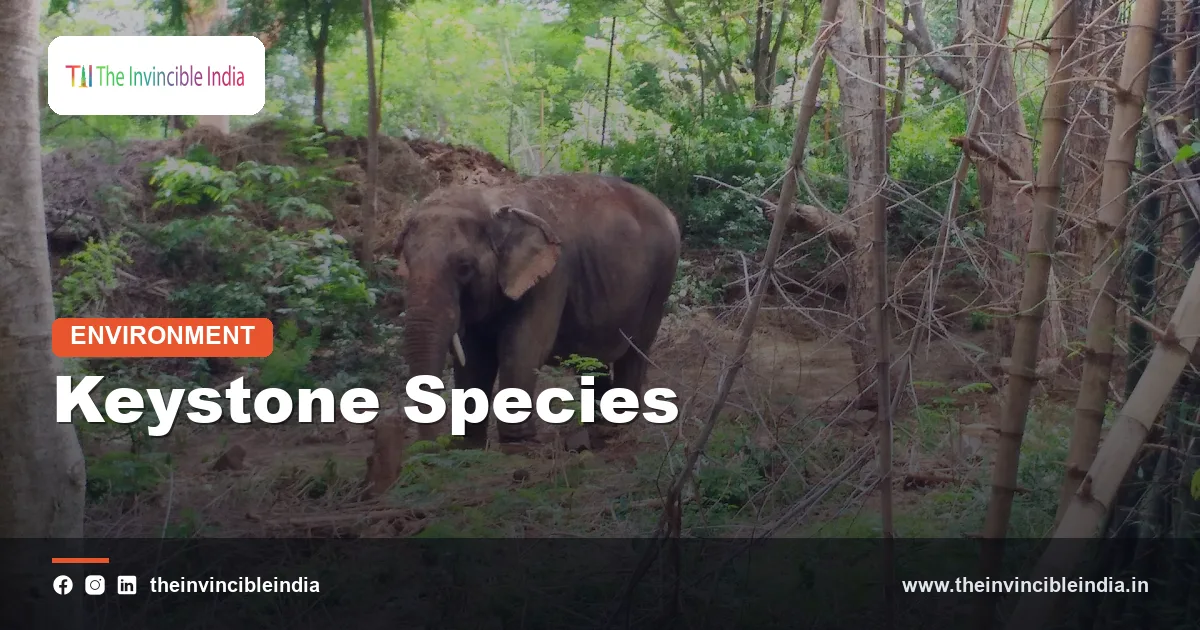
The Asian elephant is a keystone species because it is an ecosystem engineer that shapes forests and grasslands, spreads seeds over long distances and creates water sources and pathways that countless other animals use. It is the largest land animal in Asia, and India holds the majority of the world’s wild Asian elephants.
Elephants eat huge quantities of vegetation and travel widely, so they act as long-distance gardeners. Many tree seeds, including those of large-fruited species, pass through their gut and are deposited far from the parent tree in a bed of dung, an excellent germination setting. Some large seeds are dispersed effectively only by animals of this size.
They also open up the forest. By pushing over trees, breaking branches and trampling undergrowth, elephants create clearings and edges where grasses and shrubs sprout, which benefits deer, gaur and other grazers. In dry seasons they dig into dry riverbeds to reach groundwater, and the water holes they create are then used by other animals. Their trails become corridors that smaller animals follow through dense vegetation.
This is why conserving elephants is not just about one animal. India’s elephant landscapes, stretching across the Western Ghats, the north-east, central India and the Himalayan foothills, also shelter an enormous variety of other life. At the same time, growing human-elephant conflict in farming areas shows how difficult keystone conservation is when the animal’s needs overlap with human settlement.
How do fig trees support entire forests?
Fig trees support entire forests because they bear fruit when little else does and they feed an enormous range of birds, mammals, bats and insects. Fig species in the genus Ficus, such as banyan, peepal, gular and many forest figs, are often called keystone resources in tropical forests.
Different fig species fruit at different times, and some trees fruit more than once a year, so across a forest there is usually a fig tree in fruit somewhere even during the lean season. Hornbills, barbets, fruit bats, monkeys, langurs, squirrels, parakeets and many other animals rely on this supply. Studies in tropical forests around the world have shown that a relatively small number of fig trees can sustain a large fraction of the fruit-eating animals during scarcity, so their loss would hit many species at once.
The partnership works both ways. Each fig species depends on a specialised tiny wasp to pollinate its flowers, and the wasp breeds inside the fig. This is a classic mutualism, and it means that protecting figs also means protecting their wasps. The wild figs also seed new trees through the droppings of the animals that eat them, so the fig is part of a cycle that regenerates forest.
In Indian culture, banyans and peepals are revered, and this protection has long conserved big fig trees in villages and along roads, an unintentional boost to local wildlife.
Are tigers and dholes keystone predators?
Tigers and dholes are widely regarded as keystone predators because they regulate the numbers and behaviour of large herbivores such as deer and wild pigs, which in turn protects vegetation and keeps the forest community balanced. Top predators at the head of the food web exert what ecologists call top-down control.
When tigers are present, deer and other prey tend to avoid overgrazing in particular areas for fear of ambush, and prey populations stay within the limits the habitat can support. Where large predators are removed, herbivore numbers can boom, saplings are eaten before they can grow, and forest regeneration suffers. A healthy tiger population usually indicates a healthy prey base and a functioning forest, which is why tiger reserves help protect many other species and the watersheds they sit in. For this reason tigers are also called an umbrella species.
The dhole, or Asian wild dog, hunts in packs and takes medium-sized prey such as chital, sambar and wild pig, which gives it a similar regulating role in the forests of central India, the Western Ghats and the north-east. Along the Sundarbans coast the tiger sits at the top of a mangrove food web, and in the high Himalaya the snow leopard plays a comparable part by keeping herds of blue sheep and ibex in check. In some systems the exact strength of such cascades is debated, and the effect depends on prey diversity and habitat, which is why scientists test the claim locally.
Why are vultures a keystone species in India?
Vultures are a keystone species because they are nature’s rapid-response clean-up crew, consuming carcasses quickly and in doing so removing a major source of disease from the environment. A group of vultures can strip a large carcass in a short time, leaving little for disease organisms to multiply in.
India’s vulture story is one of the sharpest examples of what happens when a keystone disappears. From the 1990s, populations of three common resident species, the white-rumped, long-billed and slender-billed vultures, crashed by the great majority in just over a decade. The cause was eventually traced to diclofenac, a painkiller used on cattle. Vultures feeding on treated carcasses suffered kidney failure and died. The drug was banned for veterinary use in India in 2006, and conservation breeding programmes were started, but recovery is slow because vultures breed at a low rate.
With fewer vultures, carcasses were left to rot or were taken over by feral dogs and other scavengers. Researchers and public health experts have linked this shift to concerns about increased risks of disease such as rabies, although the precise scale of such effects is still studied and debated. There was also a cultural impact: communities that traditionally exposed their dead to vultures, such as the Parsi community, faced a crisis when the birds vanished. The vulture case shows how a keystone species provides a free service whose value only becomes obvious after it is lost.
What happens when a keystone species disappears?
When a keystone species disappears, the ecosystem typically changes in a cascade, with some species increasing, others declining and the community becoming simpler and less stable. The size of the effect depends on how many other species rely on the keystone.
A cascade is the best-known pattern. If a top predator vanishes, herbivores may multiply and strip the vegetation, which then affects birds, insects and soil. If a keystone food plant is lost, the animals that depend on its fruit in lean months may starve or leave. If an engineer such as the elephant disappears from a landscape, dense growth can close up open habitats, water holes silt up, and the large seeds that only big animals disperse may stop regenerating.
Ecologists use several terms for these changes: trophic cascade, ecological release, regime shift. Often the damage becomes visible only after a delay, making early warning difficult. Because of that delay, conservationists try to protect keystone species before their numbers fall too low, rather than wait for visible effects.
How is a keystone species different from a flagship or umbrella species?
A keystone species is defined by its ecological role, a flagship species by its public appeal, and an umbrella species by the large area whose protection also shelters other species. The three labels often apply to the same animal, but they describe different ideas.
The tiger is a good illustration of all three. It is a flagship because people love it and donate to protect it. It is an umbrella because saving enough habitat for tigers saves hundreds of other species. It is arguably a keystone because it shapes the herbivore community. A species like the fig tree, by contrast, is a keystone with little flagship power, since few people campaign for trees that feed hornbills.
Foundation species are a related idea: organisms that create the habitat itself and dominate its structure, such as mangroves in the Sundarbans, corals on Lakshadweep reefs or forest-forming sal and teak. The difference is subtle, and ecologists sometimes disagree on where to draw the line. What matters in practice is recognising which species the ecosystem leans on most heavily.
Are there keystone species in water and on coasts?
Yes, keystone species occur in rivers, wetlands and the sea as well as on land. Predators such as the Ganges river dolphin and large fish influence the food web of rivers, while mangroves, seagrasses and corals physically build habitat for hundreds of other organisms.
In India, mangroves such as those of the Sundarbans and Bhitarkanika stabilise shorelines, trap silt and provide nursery grounds for fish and prawns. Seagrass meadows in the Gulf of Mannar support dugongs and fish, and coral reefs support enormous marine biodiversity. In some reef systems, grazing fish such as parrotfish help keep algae from smothering corals, which can make them locally important. Otters and fish-eating birds also exert influence in wetlands. Because freshwater systems are heavily altered by dams and pollution, the loss of such species can quickly reshape river life.
How are keystone species identified?
Keystone species are identified through field experiments, long-term monitoring and ecological modelling that test what happens when the species is removed or absent. The gold standard is a removal experiment, but this is rarely possible or ethical for large, rare animals.
In practice, scientists often rely on natural experiments, such as comparing areas with and without a species, or on food-web analysis that shows how many other species depend on it. They look for signs like high consumption by many other animals, large effects on vegetation structure, or loss of diversity where the species is missing. Because ecosystems differ, a species that is a keystone in one place may not be in another, and claims should be treated as hypotheses supported by evidence.
What can be done to protect keystone species in India?
Protecting keystone species means safeguarding their habitat, reducing direct threats and managing conflict with people so that they can keep performing their ecological roles. The vulture programme shows that fixing a single threat, such as a harmful drug, can make a difference when it is targeted precisely.
For elephants, it means maintaining forest corridors, reducing crop-raiding conflict through early warning, fencing and compensation, and protecting migratory routes. For tigers and dholes, it means safeguarding prey populations and large connected habitats. For fig trees, it means leaving large old trees standing in forests, orchards and villages. For vultures, it means keeping toxic veterinary drugs out of the food chain and protecting safe feeding sites. Citizens can support these efforts by backing local conservation, avoiding the use of harmful pesticides and veterinary drugs, and taking an interest in planning decisions affecting forests and wetlands.
Bottom Line
Keystone species show that not all species in an ecosystem count equally. A few, whether giants like elephants or small and quiet like figs and vultures, carry a heavy load. Identifying and protecting them is one of the most efficient ways to keep India’s forests, grasslands and wetlands working.
Frequently Asked Questions
What is a keystone species in simple terms?
A keystone species is one that has a much bigger effect on its ecosystem than its numbers would suggest. If it is removed, the community around it can change dramatically.
What are examples of keystone species in India?
Examples include the Asian elephant, fig trees, the tiger and the dhole, vultures, and habitat builders such as mangroves. Each holds its ecosystem together in a different way.
Why are vultures considered a keystone species?
Vultures quickly consume carcasses, which removes a major source of disease and recycles nutrients. When their numbers crashed in India from the 1990s because of the drug diclofenac, it exposed how much the ecosystem relied on them.
Is the tiger a keystone species?
The tiger is widely treated as a keystone predator because it helps regulate deer and wild pig numbers and thus protects vegetation. It is also an umbrella and flagship species, so the labels overlap.
What is the difference between a keystone species and an umbrella species?
A keystone species is defined by its large ecological role, while an umbrella species is one whose protected habitat shelters many other species. An animal can be both, as the tiger often is.
What happens if a keystone species goes extinct?
The ecosystem usually changes in a cascade, with some species booming, others declining and the community becoming simpler and less stable. The exact outcome depends on how many other species depend on the keystone.
{“@context”:”https://schema.org”,”@graph”:[{“@type”:”FAQPage”,”mainEntity”:[{“@type”:”Question”,”name”:”What is a keystone species in simple terms?”,”acceptedAnswer”:{“@type”:”Answer”,”text”:”A keystone species is one that has a much bigger effect on its ecosystem than its numbers would suggest. If it is removed, the community around it can change dramatically.”}},{“@type”:”Question”,”name”:”What are examples of keystone species in India?”,”acceptedAnswer”:{“@type”:”Answer”,”text”:”Examples include the Asian elephant, fig trees, the tiger and the dhole, vultures, and habitat builders such as mangroves. Each holds its ecosystem together in a different way.”}},{“@type”:”Question”,”name”:”Why are vultures considered a keystone species?”,”acceptedAnswer”:{“@type”:”Answer”,”text”:”Vultures quickly consume carcasses, which removes a major source of disease and recycles nutrients. When their numbers crashed in India from the 1990s because of the drug diclofenac, it exposed how much the ecosystem relied on them.”}},{“@type”:”Question”,”name”:”Is the tiger a keystone species?”,”acceptedAnswer”:{“@type”:”Answer”,”text”:”The tiger is widely treated as a keystone predator because it helps regulate deer and wild pig numbers and thus protects vegetation. It is also an umbrella and flagship species, so the labels overlap.”}},{“@type”:”Question”,”name”:”What is the difference between a keystone species and an umbrella species?”,”acceptedAnswer”:{“@type”:”Answer”,”text”:”A keystone species is defined by its large ecological role, while an umbrella species is one whose protected habitat shelters many other species. An animal can be both, as the tiger often is.”}},{“@type”:”Question”,”name”:”What happens if a keystone species goes extinct?”,”acceptedAnswer”:{“@type”:”Answer”,”text”:”The ecosystem usually changes in a cascade, with some species booming, others declining and the community becoming simpler and less stable. The exact outcome depends on how many other species depend on the keystone.”}}]}]}


