

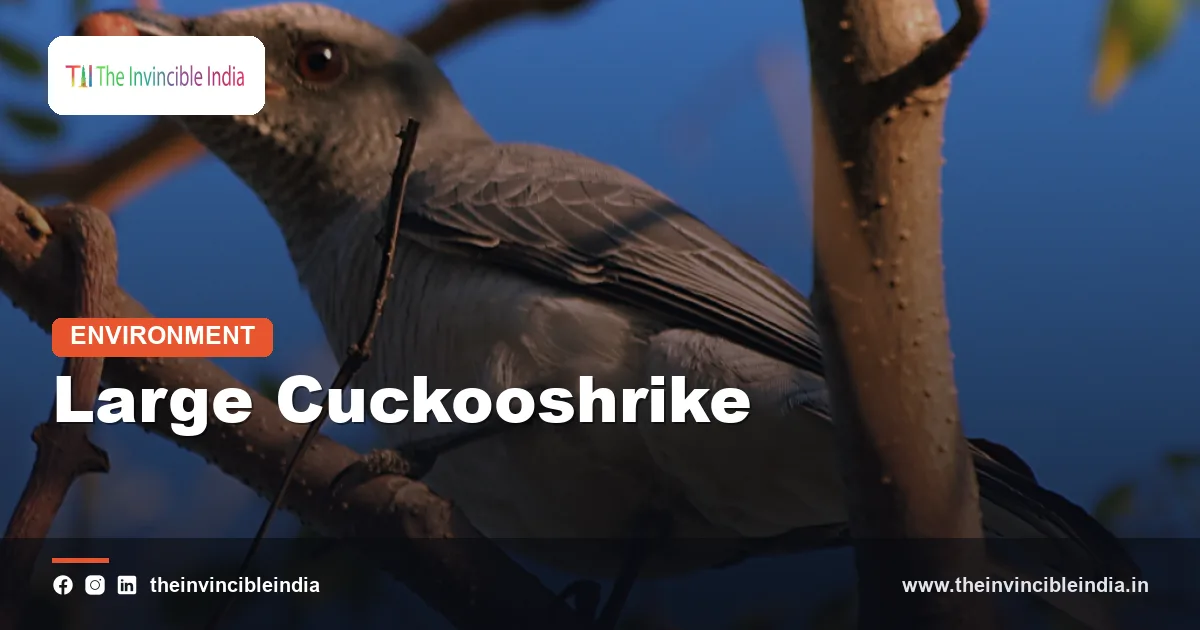
The large cuckooshrike (Coracina macei) is a big, grey, shrike-like songbird of the family Campephagidae that perches on high branches of open forest and gives a loud, ringing call as it hunts for caterpillars and other insects. Found across much of India from the Himalayan foothills to the southern peninsula, the large cuckooshrike is one of the largest members of its family in the region and is easy to recognise by its dark face-mask, pale grey plumage and finely barred belly.
The large cuckooshrike is a common bird of woodland, orchards and tree-lined roads, yet many people overlook it because it keeps to the upper branches. This article explains how to identify the species, where it lives in India, how it feeds and flies, what its call sounds like, how it nests and why the unusual name “cuckooshrike” is used.
| Fact | Detail |
|---|---|
| Common name | Large cuckooshrike |
| Scientific name | Coracina macei |
| Family | Campephagidae (cuckooshrikes, minivets and trillers) |
| Size | About 28 to 30 cm long; a long-tailed, upright, thrush-sized or larger bird |
| Range and habitat in India | Open deciduous and semi-evergreen forest, wooded country, orchards, groves and tree-lined roads across most of India except the driest north-west |
| Diet | Mainly caterpillars and other insects; figs and other soft fruit are also eaten |
| Breeding | Builds a shallow cup of twigs bound with spider web on a high horizontal branch; a small clutch of eggs; mostly in the warmer months |
| Conservation status | Least Concern on the IUCN Red List; protected under the Wildlife (Protection) Act, 1972 |
Key Takeaways
- The large cuckooshrike is a pale grey bird of about 28 to 30 cm with a black face-mask and a faintly barred belly.
- The large cuckooshrike belongs to the family Campephagidae, whose name means “caterpillar eaters”, and it feeds heavily on caterpillars.
- The large cuckooshrike has a loud, ringing, whistled call that often gives away its presence high in the treetops.
- The large cuckooshrike flies with a swooping, undulating flight and typically shuffles its wings after landing.
- The large cuckooshrike is found across most of India in open forest, orchards and tree-lined roads, and is classified as Least Concern.
- The large cuckooshrike builds a small, shallow twig nest bound with spider web, high on a horizontal branch.
What is the large cuckooshrike?
The large cuckooshrike is a large, grey, insect-eating songbird whose scientific name is Coracina macei. It belongs to the family Campephagidae, a group of tree-dwelling birds that includes cuckooshrikes, minivets and trillers, and the family name literally means “caterpillar eaters”.
The common name combines two ideas. “Cuckoo” refers to the barred underparts and grey colour of some members of the group, which resemble those of cuckoos, while “shrike” refers to the stout, slightly hooked bill that looks like that of a shrike. The birds are not close relatives of either group, but the name is long established in the English-speaking world.
The species is a resident, which means that most birds stay in the same region through the year, although some local seasonal movements are known in the hills.
What is a cuckooshrike?
A cuckooshrike is a medium to large arboreal songbird of the family Campephagidae that feeds on insects and fruit in the tree canopy. Most members of the group have a strong, slightly hooked bill, long wings, a fairly long tail and an upright posture on a branch. The feathers on the lower back and rump of cuckooshrikes are stiff and have a spiny texture, which is a trait found across the family.
How can you identify the large cuckooshrike?
The large cuckooshrike can be identified by its pale to medium grey body, black face-mask around the eye and bill, darker wings and tail with pale edges, and faintly barred grey-white belly. It is a large bird for a canopy species, with an upright stance and a long, graduated tail that is tipped with white.
The upperparts are an even bluish-grey, and the underparts are paler. The dark mask starts at the bill, passes around the eye and gives the face a sharp, intent look. The lower breast and belly show fine dark barring when seen at close range, and the undertail is dark with white tips on the outer feathers. The bill is stout and black with a slight hook at the tip.
How do males, females and young birds differ?
Male and female large cuckooshrikes look similar, although the female is often a little paler or browner on the face. Juveniles are different, with brownish upperparts spotted or barred with buff, and with more heavily barred underparts. These marks fade as the bird matures.
| Feature | Adult | Juvenile |
|---|---|---|
| Upperparts | Even bluish-grey | Grey-brown with buff spots or bars |
| Face | Black mask around the bill and eye | Mask less clear |
| Underparts | Pale grey with faint barring on the belly | Heavily barred or scaled |
| Tail | Dark with white tips on the outer feathers | Similar but with duller tips |
Which birds look similar?
The black-headed cuckooshrike is smaller and slimmer, and the male has a black hood that extends to the upper breast. The black-winged cuckooshrike is smaller, and the male is dark slate-grey with glossy black wings and tail. Drongos and shrikes are other perching birds of similar tone, but they differ in posture and tail shape.
Where does the large cuckooshrike live in India?
The large cuckooshrike lives in open forest, wooded plains and hills across most of India, from the Himalayan foothills through the peninsula, and it avoids the driest deserts and treeless land. It is a bird of the mid-elevation and lowland tree canopy rather than of high mountains.
The species also occurs in Sri Lanka, Nepal, Bangladesh, Myanmar and much of Southeast Asia and southern China, and several regional forms are recognised. In India it is most often recorded in deciduous woodland and semi-evergreen forest, but it also appears in orchards, groves, large gardens and the wooded edges of towns.
What habitats does it use?
- Open deciduous forest with tall trees and a broken canopy.
- Semi-evergreen forest edges and clearings.
- Mango groves, orchards and plantations.
- Tree-lined avenues, campuses and large gardens.
- Wooded foothills and hill slopes up to moderate elevations.
The common feature of these habitats is large trees with an open canopy. The large cuckooshrike often perches on the top of a tree or on a bare branch, from which it can scan the surroundings and move quickly to another feeding tree.
What does the large cuckooshrike eat?
The large cuckooshrike eats mainly caterpillars and other insects, along with some fruit, especially figs and other soft wild fruit. It picks prey from leaves and twigs in the canopy or snatches it in a short flight, and it often works through a tree methodically from one branch to the next.
Caterpillars are the most important food, and they are taken in large numbers, particularly during the monsoon and in the weeks that follow, when the leaves of many trees produce a flush of larvae. The bird also eats grasshoppers, beetles, bugs, mantises and other large insects. When fruit-bearing figs are in season the species may join other birds at the tree, which is why it is sometimes seen alongside barbets, bulbuls and mynas.
Why are cuckooshrikes useful?
Cuckooshrikes are useful because they consume many leaf-eating caterpillars, which can damage the foliage of forest and orchard trees. By removing larvae before they mature, the large cuckooshrike helps to limit damage to trees, and it is a good indicator of a canopy that still supports a normal range of insects.
How does the large cuckooshrike fly and behave?
The large cuckooshrike flies with a swooping, undulating action, alternating a few flaps with a short glide, and it usually moves from tree to tree in this way. After landing it often shuffles its wings alternately, a habit that is typical of cuckooshrikes and that helps in identification.
The bird is usually seen alone, in pairs or in small loose groups, and it spends most of its time high in the trees. It perches in an upright posture and watches for movement. It may be slightly wary of people on foot, but it often tolerates a quiet observer, particularly in orchards and gardens. Outside the breeding season it may join mixed flocks of birds that move through the forest together.
- Flight: undulating, with a few deep wingbeats and a glide.
- Posture: upright and alert, often on a high bare branch.
- Wing habit: alternate shuffling or flicking of the wings after landing.
- Social behaviour: single birds, pairs or small groups.
What does the large cuckooshrike sound like?
The large cuckooshrike has a loud, ringing, whistled call, often rendered as a series of clear notes that carry far across open woodland. The call is usually the first sign of the bird, as it perches high in the canopy where it is not easy to see against the sky.
The voice may also include a harsher, more rattling or chattering note, which is used when the bird is alarmed or is calling to its mate. Experienced birdwatchers often locate the species by ear and then scan the highest bare branches. The call is especially noticeable in the early morning and in the breeding season, and it is a pleasant feature of many Indian orchards and forests.
How does the large cuckooshrike breed?
The large cuckooshrike builds a shallow, saucer-like nest of fine twigs and roots, which it binds together with spider web and places on a high horizontal branch. The nest is small for the size of the bird and is often hard to see from below, since it sits on the branch like a knot.
The female lays a small clutch, usually of two to four eggs, and the pair share the care of the young. The breeding season depends on the region, but in much of India it covers the warmer months and the early monsoon, when caterpillars are plentiful. The parents feed their chicks mainly on caterpillars and other soft insects, and the young leave the nest after a few weeks.
What is the nesting sequence?
- The pair chooses a branch fork high in a tall tree.
- Fine twigs, roots and plant material are bound together with spider web to form a shallow cup.
- The eggs are incubated, and the parents take turns to guard the nest.
- Both birds bring caterpillars and insects to the chicks.
- The young are fed for a while after leaving the nest.
Is the large cuckooshrike threatened?
The large cuckooshrike is not threatened and is classified as Least Concern by the International Union for Conservation of Nature (IUCN). It is widespread, it is fairly common in suitable woodland and it adapts to orchards and tree-lined roads, and in India it is protected under the Wildlife (Protection) Act, 1972.
The bird depends on large trees, so it can be affected where mature woodland is cleared or where avenue trees are felled. Heavy use of pesticides in orchards can also reduce its insect food. The simplest help is to keep tall native trees in fields, along roads and in town parks.
Where and how can you see a large cuckooshrike?
You can see a large cuckooshrike by walking through open forest, orchards or wooded parks in the early morning and listening for its loud, ringing call. Scan the highest branches and bare treetops, where the bird often perches in an upright pose.
- Visit in the morning, when the birds call most often.
- Look up at exposed branches, since the bird rarely comes low.
- Watch for the alternate wing-shuffling after landing.
- Check fruiting fig trees, where the species may feed with other birds.
- Use binoculars to see the mask and faint belly barring.
The species is widely recorded in forest reserves, national parks and wooded campuses, and it is often one of the first cuckooshrikes a new birdwatcher learns to identify.
Bottom Line
The large cuckooshrike is a big, grey, black-masked canopy bird with a loud, ringing call, an appetite for caterpillars and a distinctive habit of shuffling its wings. It is common and secure in India, and it is best supported by keeping tall trees in forests, farmland and towns.
Frequently Asked Questions
What is a large cuckooshrike?
A large cuckooshrike is a grey, shrike-like songbird, Coracina macei, of the family Campephagidae. It has a black face-mask, a faintly barred belly and a loud, ringing call. It lives in open forests, orchards and wooded country across India.
How big is the large cuckooshrike?
The large cuckooshrike is about 28 to 30 cm long. It is much larger than a minivet or a small shrike and has a long, white-tipped tail. It sits upright on high branches.
What does the large cuckooshrike eat?
The large cuckooshrike eats mainly caterpillars and other insects, along with some fruit such as figs. It picks prey from leaves and twigs or takes it in short flights. Its heavy consumption of caterpillars makes it useful to forests and orchards.
Why is it called a cuckooshrike?
The large cuckooshrike is called a cuckooshrike because its grey, barred plumage resembles that of a cuckoo and its stout, hooked bill resembles that of a shrike. The birds are not closely related to either group. They belong to the family Campephagidae, which includes minivets and trillers.
Where is the large cuckooshrike found in India?
The large cuckooshrike is found across most of India in open forest, orchards, groves and tree-lined roads, from the Himalayan foothills to the southern peninsula. It avoids the driest deserts and treeless regions. It also occurs in Sri Lanka and in much of Southeast Asia.
How does the large cuckooshrike nest?
The large cuckooshrike builds a shallow cup of fine twigs and roots, bound with spider web, on a high horizontal branch. The female lays a small clutch of about two to four eggs. Both parents feed the chicks with caterpillars and other insects.
{“@context”:”https://schema.org”,”@graph”:[{“@type”:”FAQPage”,”mainEntity”:[{“@type”:”Question”,”name”:”What is a large cuckooshrike?”,”acceptedAnswer”:{“@type”:”Answer”,”text”:”A large cuckooshrike is a grey, shrike-like songbird, Coracina macei, of the family Campephagidae. It has a black face-mask, a faintly barred belly and a loud, ringing call. It lives in open forests, orchards and wooded country across India.”}},{“@type”:”Question”,”name”:”How big is the large cuckooshrike?”,”acceptedAnswer”:{“@type”:”Answer”,”text”:”The large cuckooshrike is about 28 to 30 cm long. It is much larger than a minivet or a small shrike and has a long, white-tipped tail. It sits upright on high branches.”}},{“@type”:”Question”,”name”:”What does the large cuckooshrike eat?”,”acceptedAnswer”:{“@type”:”Answer”,”text”:”The large cuckooshrike eats mainly caterpillars and other insects, along with some fruit such as figs. It picks prey from leaves and twigs or takes it in short flights. Its heavy consumption of caterpillars makes it useful to forests and orchards.”}},{“@type”:”Question”,”name”:”Why is it called a cuckooshrike?”,”acceptedAnswer”:{“@type”:”Answer”,”text”:”The large cuckooshrike is called a cuckooshrike because its grey, barred plumage resembles that of a cuckoo and its stout, hooked bill resembles that of a shrike. The birds are not closely related to either group. They belong to the family Campephagidae, which includes minivets and trillers.”}},{“@type”:”Question”,”name”:”Where is the large cuckooshrike found in India?”,”acceptedAnswer”:{“@type”:”Answer”,”text”:”The large cuckooshrike is found across most of India in open forest, orchards, groves and tree-lined roads, from the Himalayan foothills to the southern peninsula. It avoids the driest deserts and treeless regions. It also occurs in Sri Lanka and in much of Southeast Asia.”}},{“@type”:”Question”,”name”:”How does the large cuckooshrike nest?”,”acceptedAnswer”:{“@type”:”Answer”,”text”:”The large cuckooshrike builds a shallow cup of fine twigs and roots, bound with spider web, on a high horizontal branch. The female lays a small clutch of about two to four eggs. Both parents feed the chicks with caterpillars and other insects.”}}]}]}


