

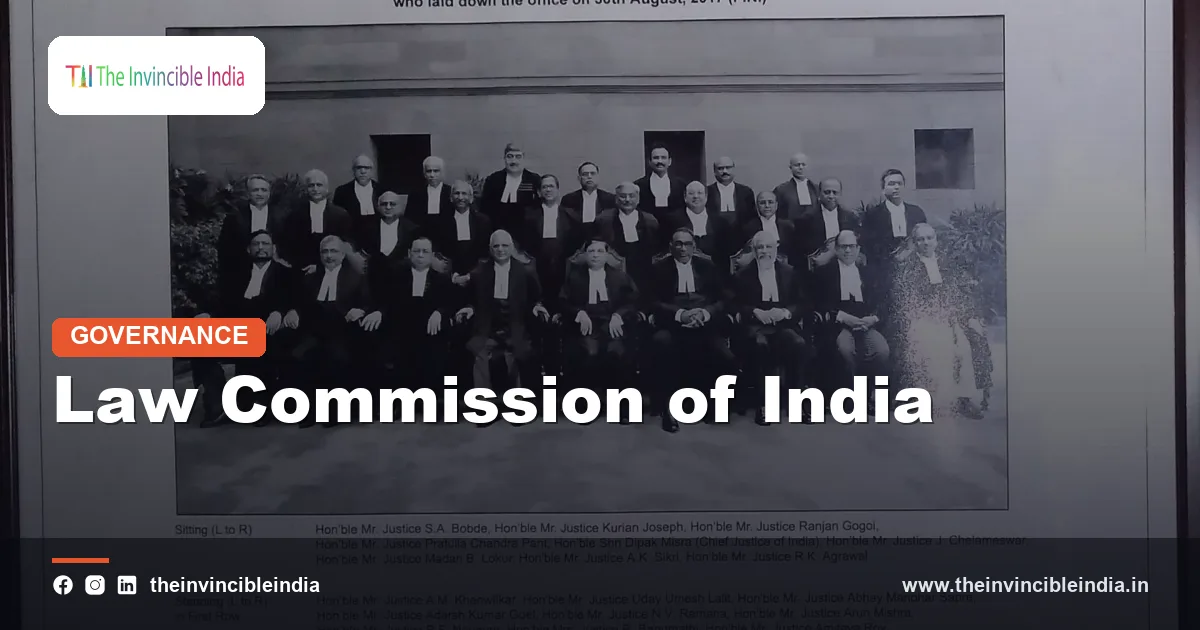
The Law Commission of India is a non-statutory advisory body, constituted by the Union Government through an executive order, that studies existing laws and recommends reform, repeal or fresh legislation in the interest of justice and good governance. It is neither created by the Constitution nor by an Act of Parliament, and it is set up afresh for a fixed term, usually three years, with a terms-of-reference document issued by the Ministry of Law and Justice.
The Law Commission of India has a lineage that stretches back to 1834, when the first commission was formed under British rule with Thomas Babington Macaulay as its leading figure. The first commission of independent India was constituted in 1955, and its reports have since shaped debates on criminal procedure, evidence, capital punishment, family law and judicial administration, even though the Government is under no obligation to accept them.
| Attribute | Details |
|---|---|
| Full name | Law Commission of India |
| Legal status | Non-statutory, non-constitutional executive body |
| First commission (colonial era) | 1834, under the Charter Act of 1833, with Macaulay as president |
| First commission of independent India | 1955, chaired by M.C. Setalvad, then Attorney General of India |
| Administrative ministry | Department of Legal Affairs, Ministry of Law and Justice |
| Typical tenure of each commission | Three years, renewable by a fresh notification |
| Chairperson | Often a retired Supreme Court judge or a retired High Court Chief Justice |
| Nature of reports | Advisory and non-binding on the Government and Parliament |
| Headquarters | New Delhi |
Key Takeaways
- The Law Commission of India is an executive-constituted advisory body, not a constitutional or statutory authority, and its recommendations do not bind the Government of India.
- The first Law Commission in India was formed in 1834 under the Charter Act of 1833, and Thomas Babington Macaulay guided its drafting of what became the Indian Penal Code of 1860.
- The first Law Commission of independent India was constituted in 1955 under M.C. Setalvad, the then Attorney General, and each later commission has been appointed for a fixed term of about three years.
- The Law Commission of India is usually headed by a retired judge of the Supreme Court or a retired Chief Justice of a High Court, assisted by full-time and part-time members and a member-secretary.
- Landmark reports of the Law Commission of India include the 14th Report on judicial administration (1958), the 35th Report on capital punishment (1967) and the 262nd Report on the death penalty (2015).
- The Law Commission of India examines subjects on a reference from the Government, from the Supreme Court or a High Court, or on its own motion, and publishes numbered reports and consultation papers.
What is the Law Commission of India?
The Law Commission of India is a body of legal experts appointed by the Central Government to review the country’s laws and suggest how they can be simplified, updated, harmonised or repealed. Its work is analytical and advisory: it studies a subject, consults stakeholders, and submits a written report to the Ministry of Law and Justice.
Unlike the Election Commission or the Union Public Service Commission, the Law Commission of India finds no mention in the Constitution. Unlike the Securities and Exchange Board of India or the Telecom Regulatory Authority of India, it has no parent Act of Parliament. It exists because the executive branch issues a resolution creating it, which is why it is described as an ad hoc and non-statutory body.
In practical terms, the Law Commission of India works as the legal research arm of the Government. Ministries, courts and Parliament often turn to its reports as reasoned, well-documented starting points for drafting new legislation or amending old statutes.
When and how did the Law Commission of India begin?
The Law Commission of India began in 1834, when the British Parliament’s Charter Act of 1833 provided for a commission to examine and codify the laws of British India. Macaulay, who had arrived in India as the Law Member of the Governor-General’s Council, was its most influential figure, and the commission’s drafting work produced the penal code that came into force in 1860 as the Indian Penal Code.
Three further commissions followed under the Crown and the East India Company, in 1853, 1861 and 1879. These bodies continued the work of codification and contributed to foundational statutes in procedure, contract, property and trusts that remained in force long after independence.
After 1947, the idea of a standing legal reform body was revived. The Government of India constituted the first Law Commission of independent India in 1955, with M.C. Setalvad as chairman. Since then, successive commissions, numbered from the first onward, have been appointed one after another, each with its own chair and mandate.
Timeline of the Law Commission of India
| Period | Development |
|---|---|
| 1833 | Charter Act provides for a law commission to examine the laws of British India |
| 1834 | First Law Commission constituted, with Macaulay as its leading member |
| 1853 | Second Law Commission appointed to continue codification |
| 1861 | Third Law Commission appointed after the transfer of power to the Crown |
| 1879 | Fourth Law Commission appointed, contributing to commercial and property laws |
| 1955 | First Law Commission of independent India, chaired by M.C. Setalvad |
| 1958 | 14th Report on reform of judicial administration |
| 1967 and 1969 | 35th Report on capital punishment and 41st Report on the Code of Criminal Procedure |
| 2015 | 262nd Report on the death penalty, recommending abolition for all offences other than terrorism-related ones |
How is the Law Commission of India constituted?
The Law Commission of India is constituted by a notification or resolution of the Government of India, issued through the Ministry of Law and Justice, which names the chairperson, the members and the period for which the commission will function. Because it is not created by a statute, each commission lapses at the end of its term unless the Government extends it or appoints a new one.
The usual structure includes a full-time chairperson, a small number of full-time members, a member-secretary, and ex officio members such as the Law Secretary and the Secretary of the Legislative Department. Part-time members, often senior lawyers or academics, may also be appointed. The Commission is assisted by research officers and support staff drawn largely from the legal services.
Appointments are made by the executive, so there is no fixed constitutional procedure for selecting the chairperson. By long convention the chair has been a retired judge of the Supreme Court or a retired Chief Justice of a High Court, which lends the body judicial credibility and experience.
What does the Law Commission of India do?
The Law Commission of India performs a set of tasks defined in the terms of reference issued with each constitution notification: it reviews existing laws, recommends the repeal of obsolete ones, and suggests legislative changes to improve justice delivery. Typical tasks include the following.
- Identifying laws that are no longer relevant or necessary and recommending their repeal.
- Examining laws that affect the poor and reviewing whether welfare legislation achieves its social-justice aims.
- Reviewing the legal aspects of judicial administration, including delays, arrears and procedure.
- Studying references on specific subjects sent by the Ministry of Law and Justice.
- Considering the impact of economic, technological and international developments on domestic law.
- Revising Central Acts of general importance so that they are simple, consistent and free of anomalies.
The Commission does not make laws, interpret them or decide cases. Its output is knowledge and advice: reports, working papers and consultation papers that frame options for lawmakers.
Who heads the Law Commission of India and who sits on it?
The Law Commission of India is headed by a chairperson who, by established practice, is a retired judge of the Supreme Court of India or a retired Chief Justice of a High Court. The chairperson sets the agenda in consultation with members, presides over deliberations and signs the final reports submitted to the Government.
Other members typically include a member-secretary, who coordinates administration and research, and two or more full-time members with legal or academic backgrounds. Ex officio members from the Department of Legal Affairs and the Legislative Department link the Commission to the Government. Part-time members contribute subject expertise on particular studies.
Past chairpersons have included some of the country’s most respected jurists. The first commission of independent India under M.C. Setalvad, a leading advocate, set a tradition of distinguished leadership, and later commissions were headed by former Supreme Court judges. The identity of the current chair changes with each new constitution, so the latest official notification should be checked for the present composition.
How does the Law Commission of India prepare its reports?
The Law Commission of India prepares a report by first receiving or choosing a subject, then researching it, then publishing a consultation or working paper, and finally submitting a considered report to the Government. The process is deliberately consultative, because the Commission has no authority to enforce its views and must rely on persuasion.
Typical stages
- A reference arrives from the Government, the Supreme Court or a High Court, or the Commission takes up a subject on its own motion.
- Research staff and members study statutes, case law, earlier reports and foreign comparisons.
- A questionnaire or consultation paper is released to invite views from lawyers, academics, bar associations, civil society and the public.
- The Commission may hold seminars and discussions with stakeholders and State governments.
- A final report is adopted, numbered in sequence, and submitted to the Ministry of Law and Justice, often with a draft Bill.
Reports are typically tabled in Parliament by the Government, and many are published on the Commission’s website. Numbering is continuous across commissions, so a report such as the 262nd refers to its place in the entire series since 1955.
What are the landmark reports of the Law Commission of India?
The landmark reports of the Law Commission of India include comprehensive studies on judicial administration, criminal procedure, capital punishment, rape law, electoral reform and wrongful prosecution. Several have been cited by courts and have influenced legislation, though many remain only partly implemented.
| Report | Subject and significance |
|---|---|
| 1st Report (1955-56) | Liability of the State in tort, an early study of the State’s accountability for wrongful acts by officials |
| 14th Report (1958) | Reform of judicial administration, a wide survey of courts, procedure and delay |
| 35th Report (1967) | Capital punishment, which concluded that abolition was not then advisable |
| 41st Report (1969) | Code of Criminal Procedure, which led to the revised Code of 1973 |
| 170th Report (1999) | Reform of electoral laws |
| 172nd Report (2000) | Review of rape laws, which influenced later amendments |
| 262nd Report (2015) | The death penalty, recommending abolition for all crimes except terrorism-related offences |
| 277th Report (2018) | Wrongful prosecution, covering miscarriage of justice and compensation |
| 279th Report (2023) | Usage of the law of sedition, which suggested retaining the offence with procedural safeguards |
The 41st Report is often cited as a model of effective influence, because its recommendations on criminal procedure fed directly into the new Code of Criminal Procedure enacted in 1973. By contrast, the 262nd Report on capital punishment remains a reference point in public debate rather than a blueprint that Parliament has adopted.
Are the recommendations of the Law Commission of India binding?
No, the recommendations of the Law Commission of India are not binding on the Government, Parliament or the courts. The Commission is advisory in the strictest sense, so its reports have the force of expert opinion and nothing more.
The Government may accept a report in full, accept parts of it, refer it to a ministry or a committee for further study, or leave it unimplemented. Parliament remains free to enact, amend or ignore any recommendation, and State legislatures retain their own powers over subjects in their lists.
The courts also treat the reports as persuasive material. The Supreme Court and High Courts have often referred to Law Commission of India reports when interpreting statutes or examining reforms, and the Supreme Court has at times asked the Commission to study a question, as it did on matters such as hate speech. A report is therefore influential when it is well reasoned, widely consulted and politically timely.
Why does the Law Commission of India matter?
The Law Commission of India matters because it provides independent, evidence-based legal analysis that helps Parliament and the executive reform laws in an orderly way. It brings together judges, lawyers, academics and citizens’ views in a process that individual ministries often cannot replicate.
Its contribution can be seen in four areas.
- Cleaning up the statute book: recommending the repeal of outdated colonial-era and redundant laws, which Parliament has acted on through repealing and amending Acts.
- Improving access to justice: examining delays, procedure, legal aid and judicial vacancies.
- Shaping codes: contributing to revisions of criminal and civil procedure and evidence law.
- Framing public debate: offering structured arguments on sensitive subjects such as capital punishment, hate speech and family law.
What are the criticisms and limits of the Law Commission of India?
The main limit of the Law Commission of India is that it lacks any legal power to ensure its reports are acted upon, and its term-by-term existence can interrupt long research projects. Observers have noted that many reports remain unimplemented, and that gaps between commissions can slow work.
Other commonly raised concerns include the executive’s control over appointments, the absence of statutory status that could give the body continuity and stronger independence, and the limited staff and research resources available. Supporters of the current arrangement point out that its flexibility allows the Government to focus each commission on priority tasks, and that a non-statutory status keeps it free of procedural rigidity.
Proposals to give the Commission statutory or constitutional status have been discussed from time to time, but its position as an executive advisory body has remained unchanged.
How does the Law Commission of India differ from other legal bodies?
The Law Commission of India differs from a court, a legislature or a regulator because it neither adjudicates, legislates nor enforces. It sits beside these institutions as a source of expert advice.
| Body | Role | Binding force |
|---|---|---|
| Law Commission of India | Reviews laws and recommends reform | Advisory only |
| Parliament | Makes and amends laws | Binding once enacted |
| Supreme Court and High Courts | Interpret laws and decide disputes | Binding judgments |
| Statutory regulators | Enforce rules in a sector | Binding within their statutes |
| State Law Commissions | Review State laws, where constituted | Advisory to State governments |
Some State governments have also set up their own law commissions to examine State legislation, and these follow a similar advisory model.
Bottom Line
The Law Commission of India is the Union Government’s principal advisory body on legal reform, with roots in the 1834 commission of the colonial era and a continuous line of commissions since 1955. Its reports carry weight through the quality of their reasoning rather than through any legal compulsion, which makes it a respected but non-binding voice in India’s legal system.
Frequently Asked Questions
What is the Law Commission of India?
The Law Commission of India is an executive-constituted, non-statutory body that advises the Government of India on legal reform. It reviews existing laws, recommends the repeal of obsolete ones and suggests new legislation. Its reports are submitted to the Ministry of Law and Justice.
Is the Law Commission of India a constitutional or statutory body?
No, the Law Commission of India is neither a constitutional nor a statutory body. It is created by an executive resolution of the Government of India and is appointed for a fixed term, usually three years. It continues only as long as the Government keeps renewing or reconstituting it.
When was the first Law Commission of India established?
The first Law Commission in India was established in 1834 under the Charter Act of 1833, with Macaulay as its leading figure. The first Law Commission of independent India was constituted in 1955 under M.C. Setalvad. Since then, many commissions have followed, each numbered in sequence.
Who heads the Law Commission of India?
A chairperson who is usually a retired judge of the Supreme Court or a retired High Court Chief Justice heads the Law Commission of India. The chair works with full-time members, a member-secretary, ex officio members and part-time members. The holder changes with each reconstitution of the Commission.
Are Law Commission of India reports binding on the Government?
No, Law Commission of India reports are not binding on the Government, Parliament or the courts. They serve as expert recommendations that the Government may accept, modify or set aside. Courts and legislators often cite them as persuasive authority.
What are some famous reports of the Law Commission of India?
Well-known reports include the 14th Report on judicial administration (1958), the 35th Report on capital punishment (1967), the 41st Report on criminal procedure (1969) and the 262nd Report on the death penalty (2015). The 172nd Report on rape laws and the 277th Report on wrongful prosecution are also widely cited. Each report is numbered in a single continuous series that began in 1955.
{“@context”:”https://schema.org”,”@graph”:[{“@type”:”FAQPage”,”mainEntity”:[{“@type”:”Question”,”name”:”What is the Law Commission of India?”,”acceptedAnswer”:{“@type”:”Answer”,”text”:”The Law Commission of India is an executive-constituted, non-statutory body that advises the Government of India on legal reform. It reviews existing laws, recommends the repeal of obsolete ones and suggests new legislation. Its reports are submitted to the Ministry of Law and Justice.”}},{“@type”:”Question”,”name”:”Is the Law Commission of India a constitutional or statutory body?”,”acceptedAnswer”:{“@type”:”Answer”,”text”:”No, the Law Commission of India is neither a constitutional nor a statutory body. It is created by an executive resolution of the Government of India and is appointed for a fixed term, usually three years. It continues only as long as the Government keeps renewing or reconstituting it.”}},{“@type”:”Question”,”name”:”When was the first Law Commission of India established?”,”acceptedAnswer”:{“@type”:”Answer”,”text”:”The first Law Commission in India was established in 1834 under the Charter Act of 1833, with Macaulay as its leading figure. The first Law Commission of independent India was constituted in 1955 under M.C. Setalvad. Since then, many commissions have followed, each numbered in sequence.”}},{“@type”:”Question”,”name”:”Who heads the Law Commission of India?”,”acceptedAnswer”:{“@type”:”Answer”,”text”:”A chairperson who is usually a retired judge of the Supreme Court or a retired High Court Chief Justice heads the Law Commission of India. The chair works with full-time members, a member-secretary, ex officio members and part-time members. The holder changes with each reconstitution of the Commission.”}},{“@type”:”Question”,”name”:”Are Law Commission of India reports binding on the Government?”,”acceptedAnswer”:{“@type”:”Answer”,”text”:”No, Law Commission of India reports are not binding on the Government, Parliament or the courts. They serve as expert recommendations that the Government may accept, modify or set aside. Courts and legislators often cite them as persuasive authority.”}},{“@type”:”Question”,”name”:”What are some famous reports of the Law Commission of India?”,”acceptedAnswer”:{“@type”:”Answer”,”text”:”Well-known reports include the 14th Report on judicial administration (1958), the 35th Report on capital punishment (1967), the 41st Report on criminal procedure (1969) and the 262nd Report on the death penalty (2015). The 172nd Report on rape laws and the 277th Report on wrongful prosecution are also widely cited. Each report is numbered in a single continuous series that began in 1955.”}}]}]}


