

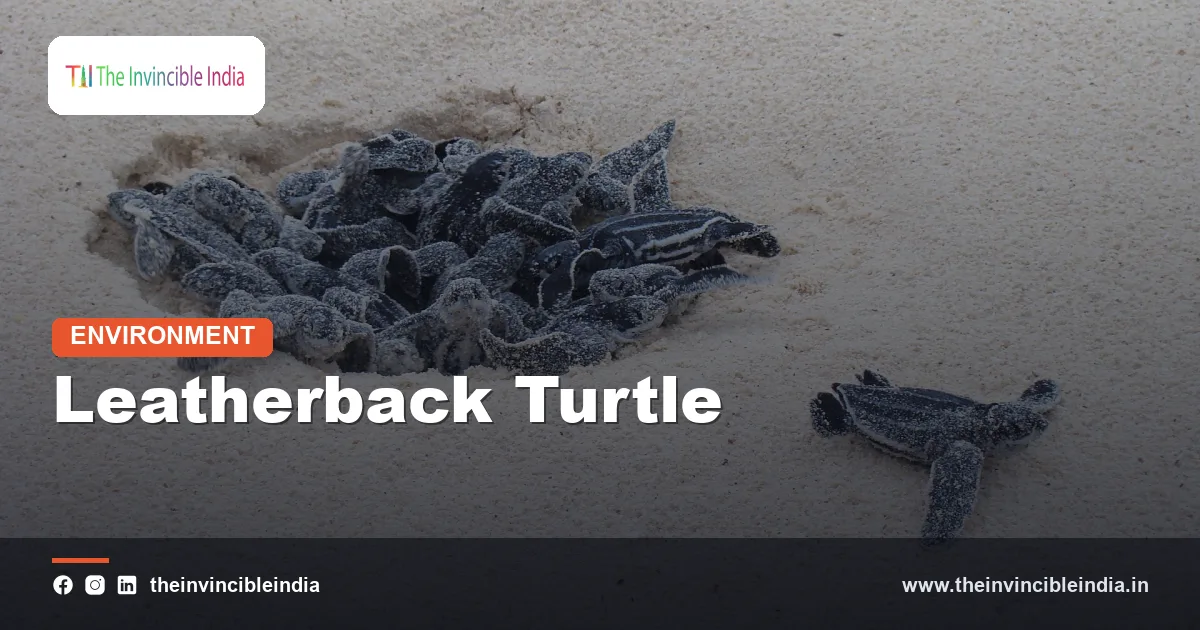
The leatherback turtle (Dermochelys coriacea) is the largest sea turtle in the world, easily recognised by its leathery, ridged shell instead of a hard bony carapace, and a key Indian Ocean nesting population breeds in the Andaman and Nicobar Islands, especially on Great Nicobar. It is the only living species in its family and one of the deepest-diving reptiles known.
In India the leatherback turtle is a rare, strictly protected nester, and its beaches on Great Nicobar are central to ongoing debates about development on the island. This explainer covers what the species is, how it lives, how the 2004 tsunami affected it, what the debate over the Galathea Bay project is about and how the species is protected. Figures are given as rounded or hedged estimates because counts are uncertain. Last reviewed: 17 October 2026.
| Attribute | Detail |
|---|---|
| Common name | Leatherback turtle (also leatherback sea turtle, luth) |
| Scientific name | Dermochelys coriacea |
| Family | Dermochelyidae (the only living species in the family) |
| Size | Adults commonly around 1.3 to 1.8 metres in shell length, and several hundred kilograms in weight; the largest recorded individuals exceed 2 metres in overall length |
| Diet | Mainly jellyfish and other soft-bodied planktonic animals |
| Key Indian nesting area | Andaman and Nicobar Islands, especially Great Nicobar (including Galathea Bay) and other Nicobar islands |
| Typical Indian nesting season | Roughly November to February |
| Global IUCN status | Vulnerable overall; some Pacific subpopulations are Critically Endangered |
| Legal protection in India | Wildlife (Protection) Act, 1972 (among the most strictly protected species) |
Key Takeaways
- The leatherback turtle (Dermochelys coriacea) is the largest living sea turtle and the only one with a flexible, leathery shell rather than hard shell plates.
- India’s leatherback turtle nesting is concentrated in the Andaman and Nicobar Islands, with Great Nicobar, including Galathea Bay, regarded as one of the most important sites in the northern Indian Ocean.
- The leatherback turtle feeds almost entirely on jellyfish and can dive to depths of well over a thousand metres, making it one of the deepest-diving reptiles.
- The 2004 Indian Ocean tsunami altered Nicobar coastlines and nesting beaches, and the leatherback turtle’s recovery on the islands has been monitored since then.
- A proposed transhipment port and related development at Galathea Bay on Great Nicobar has led to a public debate about the future of leatherback turtle nesting beaches.
- The leatherback turtle faces threats from fishing bycatch, plastic ingestion, coastal development, nest predation and climate change, and is protected under India’s Wildlife (Protection) Act, 1972.
What is the leatherback turtle?
The leatherback turtle is the largest of the world’s sea turtles and the sole surviving member of the family Dermochelyidae, distinguished by a shell made of thick, oil-rich connective tissue covered by leathery skin. It is a wide-ranging ocean traveller found in tropical and temperate seas on every continent except Antarctica.
Other sea turtles belong to the family Cheloniidae and have hard shells made up of bony plates covered by scutes. The leatherback instead has a mosaic of tiny bones embedded in its skin, with seven prominent ridges running along the back. This structure gives its body a streamlined, flexible form that can tolerate the pressure of deep dives.
The species has an ancient lineage and is thought to resemble turtle relatives that existed many millions of years ago. Today it is highly migratory, and individuals tagged on nesting beaches have been tracked across entire ocean basins.
How is the leatherback turtle different from other sea turtles in India?
The leatherback turtle differs from other sea turtles in India by its larger size, its soft ridged shell, its jellyfish diet and its ability to stay warm in cold water. Five sea turtle species are generally recorded from Indian waters, though they differ greatly in where and how they nest.
| Species | Shell | Main diet | Main Indian nesting areas |
|---|---|---|---|
| Leatherback turtle | Leathery, ridged | Jellyfish | Andaman and Nicobar Islands, mainly Great Nicobar |
| Olive ridley | Hard, olive-grey | Crabs, shrimps, other prey | Odisha coast and other eastern coastal stretches, with mass nesting |
| Green sea turtle | Hard, smooth | Seagrass and algae | Lakshadweep, Andaman and Nicobar Islands, Gujarat |
| Hawksbill | Hard, overlapping scutes | Sponges | Small numbers on island beaches, including the Andamans |
| Loggerhead | Hard, reddish-brown | Shellfish and crabs | Rare or occasional records only |
Unlike the olive ridley, which nests in synchronous mass arribadas, leatherbacks nest alone and in small numbers, so a nesting beach can be missed unless it is surveyed carefully at night.
How deep and how far does the leatherback turtle dive and travel?
The leatherback turtle can dive to depths of more than a thousand metres and stay underwater for well over an hour, which is deeper than any other sea turtle. Most dives, however, are shorter and shallower, following the daily movements of jellyfish and other prey that rise and fall in the water.
Its deep-diving ability depends on a collapsible lung and flexible rib cage, an oil-rich shell and body, and efficient use of oxygen stored in blood and muscle. Researchers using satellite tags have recorded leatherbacks travelling thousands of kilometres between nesting beaches and feeding grounds.
The species also has an unusual ability to maintain body temperature well above that of the surrounding water. This is achieved through its large body size, thick insulating fat, blood vessel arrangement and activity, a strategy called gigantothermy. Because of this, leatherbacks can travel into cold waters at high latitudes where other sea turtles seldom go.
What does the leatherback turtle eat?
The leatherback turtle eats mainly jellyfish and other soft-bodied animals such as salps, sea squirts and siphonophores. Its diet is much narrower than that of other sea turtles, and it has no hard crushing jaws.
The leatherback’s mouth and throat are lined with backward-pointing spines (papillae), which prevent slippery prey from escaping once swallowed. Because jellyfish are mostly water, a leatherback must eat very large quantities to meet its energy needs, and an adult may eat a mass of jellyfish equal to a large part of its body weight in a day.
This diet makes the leatherback vulnerable to plastic pollution. A floating plastic bag can look like a jellyfish, and swallowed plastic can block the digestive tract. By controlling jellyfish populations, leatherbacks are also thought to play a role in marine food webs, and some scientists suggest they help prevent jellyfish blooms that compete with fish larvae.
Where does the leatherback turtle nest in India?
The leatherback turtle nests in India mainly on beaches in the Andaman and Nicobar Islands, with the strongest nesting on Great Nicobar, including Galathea Bay, and with additional nesting reported on Little Andaman and other Nicobar islands. These remote beaches are among the most important leatherback nesting areas in the northern Indian Ocean.
Nesting generally takes place during the northeast monsoon season, roughly from November to February, when females come ashore at night. A female digs a deep egg chamber, lays around 80 to 100 fertile eggs, often accompanied by smaller yolkless eggs, and covers the nest. She may return several times in a season at intervals of about ten days and then rest for a couple of years before nesting again.
The incubation period is roughly two months, depending on temperature. Hatchlings are dark with pale ridges and flippers, and they scramble to the sea at night. Compared with the great nesting colonies of the Atlantic and the Pacific, Indian nesting numbers are modest, but the islands are regionally significant because few other beaches in the northern Indian Ocean are used regularly.
Estimates of nest numbers vary by year and survey effort, and remote beaches are not monitored continuously, so any count should be treated as indicative.
How did the 2004 tsunami affect leatherback turtles in the Andaman and Nicobar Islands?
The 26 December 2004 Indian Ocean earthquake and tsunami altered large stretches of the Andaman and Nicobar coastline, changing or destroying nesting beaches used by leatherback turtles, although the species survived the event. The Nicobar Islands, close to the epicentre, were among the worst-affected parts of India.
Parts of the southern Nicobar Islands sank by one or more metres due to tectonic movement, while other areas were lifted. These changes shifted shorelines, flooded forest edges, eroded sand and reshaped bays. Some beaches that had been used by nesting turtles disappeared or became unsuitable, while others were altered in slope and sand quality.
Because the tsunami struck during the leatherback nesting season, scientists feared direct losses of eggs and adults, though the full impact is difficult to measure. Surveys after the event documented the changes to beaches and later detected continued nesting, which suggested that the population was resilient but that suitable nesting habitat had become more limited. The event also highlighted how a small, localised population can be affected by natural hazards.
What is the debate over the Galathea Bay project on Great Nicobar?
The debate concerns a large infrastructure plan for Great Nicobar, often called the Great Nicobar Island project, which includes an international container transhipment port at Galathea Bay, an airport, a township and power infrastructure, and which environmentalists say could affect leatherback turtle nesting beaches. The government says the project has strategic and economic value and includes safeguards.
Galathea Bay is a known leatherback nesting area. The Galathea Bay Wildlife Sanctuary, originally created to protect nesting turtles and other wildlife, was denotified in 2021 as part of the process of clearing the project. The project, whose cost has often been cited as tens of thousands of crores of rupees, has been reviewed by environmental authorities and by the National Green Tribunal, and it has also drawn attention from scientists, tribal rights advocates and political groups.
Arguments commonly made
- In favour: Supporters argue that a transhipment port near major shipping routes could reduce India’s reliance on foreign ports, boost trade and strengthen strategic presence in the region. They note that mitigation plans for turtles and other species have been proposed.
- Against: Critics argue that port construction, dredging, lighting, traffic and population growth could degrade a rare and fragile nesting habitat. They also raise concerns about forest loss, seismic risk and the welfare of indigenous communities.
- Science question: Researchers note that leatherbacks show strong fidelity to certain beaches and that it is not clear whether turtles can shift to other sites if the bay is altered.
The project’s design, approvals and legal status have changed over time, and readers should consult current official sources for the latest position.
What threats does the leatherback turtle face?
The main threats to the leatherback turtle are accidental capture in fishing gear, loss and alteration of nesting beaches, ingestion of plastic, nest predation and climate change. Because the species migrates widely, threats at sea in one country can affect nesting populations in another.
- Fisheries bycatch: Leatherbacks are caught in gillnets, longlines and trawl nets, and entanglement in ropes and floats can injure or drown them.
- Plastic and marine debris: Plastic bags are easily mistaken for jellyfish, and ingestion can cause blockage and starvation.
- Beach loss: Port and road construction, sand mining, erosion, sea-level rise and storms reduce usable nesting space.
- Light and disturbance: Artificial lights disorient hatchlings, and noise or activity on beaches can deter nesting females.
- Predation: Eggs and hatchlings may be eaten by monitor lizards, feral dogs, pigs, crabs and, in some places, crocodiles.
- Climate change: Warmer sand skews hatchling sex ratios toward females and can cause egg mortality, and changes in ocean temperature may alter jellyfish abundance.
- Human take: Eggs and adults have been taken in some regions, although this is less documented in the Nicobar Islands than in some other countries.
How is the leatherback turtle protected in India?
The leatherback turtle is protected in India under the Wildlife (Protection) Act, 1972, which prohibits hunting, capture, trade and egg collection, and it also benefits from international conventions and protected areas in the Andaman and Nicobar Islands. Sea turtles are among the most strictly protected animals in the country’s wildlife law, though the current schedules should be checked for exact placement.
- International: The leatherback turtle is listed in CITES Appendix I, which bans commercial international trade, and in the Convention on Migratory Species appendices. India also takes part in the Indian Ocean and South-East Asia (IOSEA) Marine Turtle Memorandum of Understanding.
- Protected areas: The Great Nicobar Biosphere Reserve, established in 1989 and recognised in UNESCO’s network of biosphere reserves, covers parts of the island’s forests and coasts, and national parks on Great Nicobar provide further protection.
- Coastal rules: Coastal Regulation Zone rules restrict construction near the shore, and nesting beaches are treated as sensitive areas.
- Monitoring and action plans: The Andaman and Nicobar administration, forest department and research groups, including the Wildlife Institute of India and non-profit bodies, monitor beaches. Project clearances for Great Nicobar have required leatherback conservation measures, whose effectiveness is itself a subject of discussion.
Is the leatherback turtle endangered?
The leatherback turtle is classified as Vulnerable on the IUCN Red List globally, although some regional populations, especially in the Pacific, are Critically Endangered. Indian Ocean subpopulations are less well studied and have been harder to assess.
Atlantic populations have been recovering in places after long-term protection of nesting beaches, whereas Pacific populations have seen steep declines because of fisheries bycatch and egg harvest. The relatively small size of the Great Nicobar group means that even a limited loss of nesting beaches could be significant for the Indian region.
Conservation biologists emphasise that long-term monitoring is the key to understanding the leatherback’s true status in India. Without regular surveys of remote beaches, it is difficult to know whether numbers are rising, stable or falling.
Bottom Line
The leatherback turtle is the giant of the sea turtle world, and the nesting beaches of Great Nicobar are one of its few regular strongholds in the northern Indian Ocean. The species has survived the 2004 tsunami, but it now faces the challenge of balancing development plans with the protection of a rare nesting habitat. Careful monitoring, strong legal protection and transparent environmental assessment will shape its future in India.
Frequently Asked Questions
Where does the leatherback turtle nest in India?
The leatherback turtle nests in India mainly in the Andaman and Nicobar Islands, with Great Nicobar, including Galathea Bay, being the most important site. Nesting also occurs on other Nicobar islands and Little Andaman. The nesting season is roughly November to February.
Why is the leatherback turtle called leatherback?
The leatherback turtle is called leatherback because its shell is made of flexible, leathery skin and oily tissue rather than hard bony plates. Seven ridges run along its back. This unique structure sets it apart from all other sea turtles.
How big is the leatherback turtle?
The leatherback turtle is the largest sea turtle, with adults commonly reaching a shell length of around 1.3 to 1.8 metres and weighing several hundred kilograms. The biggest individuals recorded exceed two metres in length and can be heavier still.
What do leatherback turtles eat?
Leatherback turtles eat mainly jellyfish and other soft-bodied animals, such as salps. Backward-pointing spines in the throat help them swallow slippery prey. Because plastic bags resemble jellyfish, leatherbacks are especially vulnerable to plastic pollution.
How did the 2004 tsunami affect leatherback turtles?
The 2004 tsunami changed the coastline and nesting beaches of the Nicobar Islands, which reduced the amount of suitable nesting habitat for leatherback turtles. Some beaches were eroded or submerged, while the land itself shifted in places. The species continued to nest afterwards, and monitoring has continued since.
How does the Galathea Bay project affect leatherback turtles?
The Galathea Bay project, a proposed transhipment port and related development on Great Nicobar, could affect leatherback turtles by altering or disturbing a known nesting area. Supporters say mitigation measures will protect turtles, while critics say the risks to a rare nesting site are too high. The project’s status has changed over time, so current official information should be checked.
{“@context”:”https://schema.org”,”@graph”:[{“@type”:”FAQPage”,”mainEntity”:[{“@type”:”Question”,”name”:”Where does the leatherback turtle nest in India?”,”acceptedAnswer”:{“@type”:”Answer”,”text”:”The leatherback turtle nests in India mainly in the Andaman and Nicobar Islands, with Great Nicobar, including Galathea Bay, being the most important site. Nesting also occurs on other Nicobar islands and Little Andaman. The nesting season is roughly November to February.”}},{“@type”:”Question”,”name”:”Why is the leatherback turtle called leatherback?”,”acceptedAnswer”:{“@type”:”Answer”,”text”:”The leatherback turtle is called leatherback because its shell is made of flexible, leathery skin and oily tissue rather than hard bony plates. Seven ridges run along its back. This unique structure sets it apart from all other sea turtles.”}},{“@type”:”Question”,”name”:”How big is the leatherback turtle?”,”acceptedAnswer”:{“@type”:”Answer”,”text”:”The leatherback turtle is the largest sea turtle, with adults commonly reaching a shell length of around 1.3 to 1.8 metres and weighing several hundred kilograms. The biggest individuals recorded exceed two metres in length and can be heavier still.”}},{“@type”:”Question”,”name”:”What do leatherback turtles eat?”,”acceptedAnswer”:{“@type”:”Answer”,”text”:”Leatherback turtles eat mainly jellyfish and other soft-bodied animals, such as salps. Backward-pointing spines in the throat help them swallow slippery prey. Because plastic bags resemble jellyfish, leatherbacks are especially vulnerable to plastic pollution.”}},{“@type”:”Question”,”name”:”How did the 2004 tsunami affect leatherback turtles?”,”acceptedAnswer”:{“@type”:”Answer”,”text”:”The 2004 tsunami changed the coastline and nesting beaches of the Nicobar Islands, which reduced the amount of suitable nesting habitat for leatherback turtles. Some beaches were eroded or submerged, while the land itself shifted in places. The species continued to nest afterwards, and monitoring has continued since.”}},{“@type”:”Question”,”name”:”How does the Galathea Bay project affect leatherback turtles?”,”acceptedAnswer”:{“@type”:”Answer”,”text”:”The Galathea Bay project, a proposed transhipment port and related development on Great Nicobar, could affect leatherback turtles by altering or disturbing a known nesting area. Supporters say mitigation measures will protect turtles, while critics say the risks to a rare nesting site are too high. The project’s status has changed over time, so current official information should be checked.”}}]}]}


