

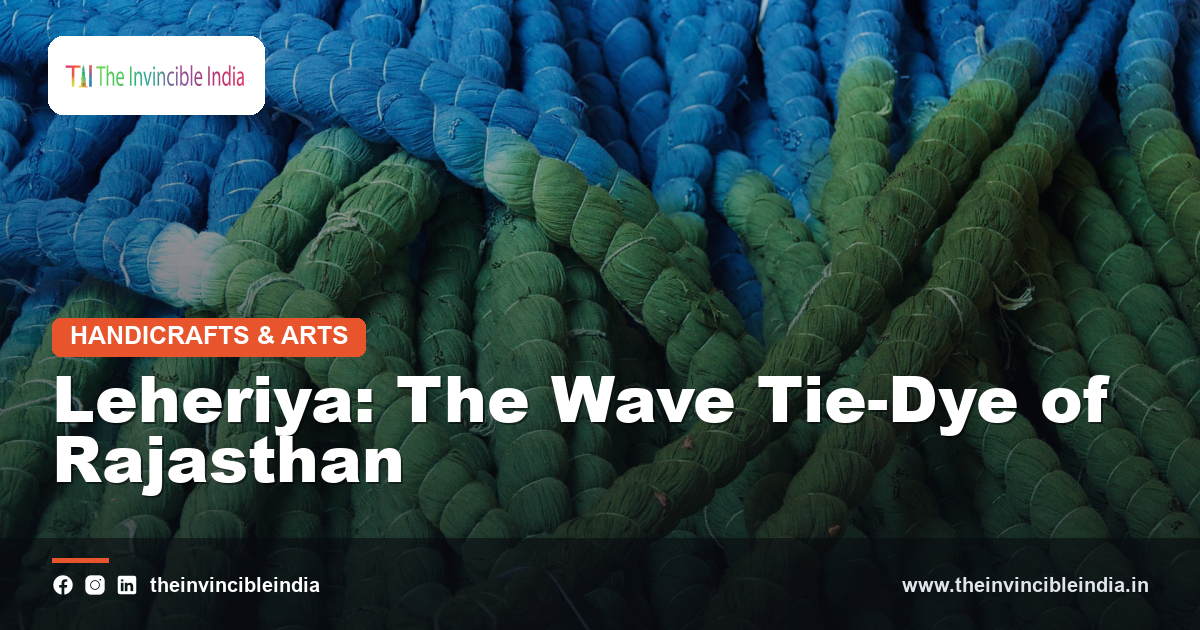
Leheriya is a resist-dyeing tradition from Rajasthan that produces fine diagonal stripes resembling waves, achieved not by tying individual dots as in Bandhani but by rolling cloth tightly on the diagonal and binding it at intervals before dyeing. Long practised in cities such as Jodhpur and Jaipur, the technique is closely associated with the monsoon season, festive turbans, and lightweight cotton and silk fabrics suited to Rajasthan’s hot climate. The rolling and binding method allows dyers to create rhythmic, evenly spaced wave patterns across a length of cloth, producing fabric with a distinctive sense of movement that has made Leheriya a recognisable part of Rajasthani dress for generations.
Quick Facts
| Detail | Information |
|---|---|
| Also Known As | Leheria, wave tie-dye |
| Primary Region | Rajasthan (Jodhpur, Jaipur) |
| Core Technique | Diagonal rolling and binding resist-dye |
| Typical Fabrics | Fine cotton, silk, georgette |
| Signature Pattern | Diagonal wave stripes |
| Common Uses | Turbans, sarees, odhnis, festive dress |
Origins and Historical Roots
Leheriya has long been practised by dyeing communities in Rajasthan, particularly in and around Jodhpur and Jaipur, where the technique developed alongside other regional tie-dye traditions such as Bandhani. Historical textile evidence and paintings from Rajasthan depict diagonal striped fabrics consistent with Leheriya work, indicating that the craft has deep roots in the region’s dyeing economy.
The technique became closely associated with particular dyeing castes and family lineages who specialised in the precise rolling and binding methods it requires. Leheriya’s strong connection to Rajasthan’s arid climate and its role in seasonal festivities helped the craft maintain a consistent place in regional dress, distinguishing it from tie-dye traditions practised elsewhere in India.
What the Word Leheriya Means
The word Leheriya derives from the Hindi and Rajasthani term leher, meaning wave, a direct reference to the diagonal, rippling stripe pattern that defines the technique. This naming reflects the visual effect at the heart of the craft rather than any specific colour or fabric type, allowing the term to apply broadly across the many colour combinations Leheriya artisans produce.
Related terms such as Mothra describe a more complex variant that layers waves running in two directions to create a grid-like check pattern, extending the same rolling and binding principle into more elaborate compositions. This shared vocabulary illustrates how Rajasthan’s dyeing communities have developed a nuanced language for describing variations within a single resist-dyeing family of techniques.
The Diagonal Rolling Technique
Unlike Bandhani, which relies on tying thousands of individual points, Leheriya is created by rolling the fabric tightly along a diagonal line and then binding the rolled length at regular intervals before dyeing. This rolling method resists dye penetration along the bound sections while allowing colour to reach the exposed folds, producing continuous diagonal stripes rather than discrete dots.
The angle and tightness of the roll determine the width and regularity of the finished stripes, requiring considerable skill to achieve even, well-spaced results across a long length of cloth. Because the entire fabric is rolled rather than worked point by point, Leheriya can be produced somewhat more quickly than heavily tied Bandhani work, though achieving fine, consistent stripes still demands significant experience.
Fabric Preparation
Fine, lightweight fabrics such as cotton voile, silk, and georgette are most commonly chosen for Leheriya, since these materials fold and roll easily while still taking dye evenly across their surface. Before dyeing, the fabric is washed to remove starch and impurities, ensuring consistent colour absorption once the rolling and binding process begins.
The cloth is typically folded into a long diagonal strip before rolling begins, with the width of this initial fold influencing the spacing of the eventual wave pattern. Careful, even folding at this preparatory stage is essential, since any inconsistency will be magnified once the fabric is dyed and unrolled to reveal the finished stripes.
Binding and the Dyeing Sequence
Once rolled, the cloth is bound at regular intervals using thread, creating alternating sections that will resist and accept dye. As with other resist-dyeing traditions, Leheriya dyeing typically proceeds from lighter to darker colours, with additional binding sometimes added between dye baths to build up multiple colours within the same length of cloth.
Traditional dyes drawn from natural sources have historically been used, though many contemporary workshops rely on synthetic dyes for consistency and a wider colour range. After the final dye bath, the binding thread is removed and the fabric carefully unrolled and smoothed, revealing the diagonal wave pattern that has developed along the length of the cloth.
Mothra and Layered Wave Patterns
Mothra is a more elaborate variant of Leheriya in which the fabric is rolled and dyed twice, first along one diagonal and then along the opposite diagonal, creating a checked or diamond-like grid where the two sets of waves intersect. This layered approach requires greater precision, since the second rolling and dyeing stage must align accurately with the first to produce a clean, regular grid.
Because of its added complexity, Mothra fabric is generally considered a more refined and higher-value product than single-direction Leheriya, often reserved for special occasions. The technique demonstrates how Rajasthan’s dyeing communities have extended a relatively simple resist principle into increasingly intricate visual outcomes through repeated, carefully coordinated processes.
Traditional Colour Combinations
Leheriya fabric is traditionally associated with bright, saturated colours such as yellow, orange, pink, and red, often combined with white or a contrasting hue to make the diagonal stripes stand out clearly. These vivid colour choices reflect the fabric’s strong association with festivity and celebration in Rajasthani culture.
Certain colour combinations are traditionally linked to specific seasons or occasions, with particular palettes considered appropriate for monsoon festivities and others reserved for weddings or religious observances. This layered system of colour meaning adds a further dimension of cultural significance to Leheriya beyond its visual pattern alone, guiding how and when particular pieces are worn.
Association with the Monsoon Season
Leheriya holds a particularly strong association with the monsoon season in Rajasthan, where the diagonal wave pattern is often understood as an evocation of rain and flowing water in a region defined by aridity and water scarcity. Seasonal festivals celebrating the arrival of rain frequently feature Leheriya turbans and garments worn specifically for the occasion.
This symbolic connection between pattern and season has helped sustain demand for Leheriya fabric at particular times of year, reinforcing its place within the broader rhythm of Rajasthani festive life. The association also illustrates how a textile technique rooted in practical dyeing methods can accumulate rich symbolic meaning over generations of cultural use.
Leheriya Turbans
Turbans represent one of the most iconic applications of Leheriya fabric, worn by men across Rajasthan as a marker of regional identity, occasion, and sometimes social status. The diagonal stripe pattern is particularly well suited to the long, narrow lengths of cloth used for turban winding, since the wave pattern remains visually coherent as the fabric is wrapped around the head.
Different colour combinations and stripe densities are associated with particular communities, regions, or festive occasions, allowing a turban’s Leheriya pattern to communicate information at a glance to those familiar with local conventions. This practical and symbolic role has helped keep hand-dyed Leheriya turbans in continuous demand despite competition from printed imitations.
Leheriya Sarees and Odhnis
Beyond turbans, Leheriya is widely used for sarees and odhnis, the long veils traditionally worn by women in Rajasthan, often dyed in bright festive colours suited to weddings and seasonal celebrations. A Leheriya saree typically displays the diagonal wave pattern across its full length, sometimes combined with a Bandhani-style dotted border for added visual contrast.
These garments are frequently associated with particular festivals and are considered appropriate seasonal wear during the monsoon and related celebrations. The combination of vivid colour and rhythmic pattern makes Leheriya sarees and odhnis instantly recognisable, reinforcing the fabric’s strong ties to Rajasthani regional identity and festive tradition.
Artisan Communities and Family Workshops
Leheriya production has traditionally been concentrated within specific dyeing communities in cities such as Jodhpur and Jaipur, where families have practised the rolling, binding, and dyeing process across generations. Workshops are typically small and family-run, with skills transmitted through direct apprenticeship rather than formal instruction.
These communities often practise both Leheriya and related techniques such as Bandhani within the same household, allowing skilled dyers to move between different resist-dyeing methods depending on market demand. This flexibility has helped sustain artisan livelihoods even as demand for particular techniques fluctuates with fashion trends and seasonal buying patterns.
Relationship to Bandhani and Other Tie-Dye Crafts
Leheriya is closely related to Bandhani, sharing the same broad family of resist-dyeing techniques practised across Rajasthan and Gujarat, though the two differ significantly in method and visual outcome. While Bandhani relies on tying individual points to create dotted patterns, Leheriya achieves its effect through rolling and binding along a diagonal fold.
The two techniques are sometimes combined on a single piece of cloth, with a Bandhani-dotted border framing a Leheriya-striped body, demonstrating the flexibility of Rajasthan’s dyeing traditions. This close relationship means that skills such as dye sequencing and colour judgment often transfer readily between artisans practising either craft.
Modern Fashion and Adaptations
In recent decades, Leheriya fabric has moved beyond traditional turbans and sarees into contemporary fashion, appearing on dupattas, kurtas, and accessories designed for a wider domestic and international market. Designers have paired the diagonal wave pattern with modern silhouettes, introducing the technique to audiences unfamiliar with its regional origins.
This expansion has created new commercial outlets for dyeing families while also increasing competition from machine-printed imitations that replicate the wave pattern without the labour of genuine rolling and binding. Genuine hand-dyed Leheriya continues to be valued for the subtle irregularities that distinguish it from mechanically produced alternatives.
Identifying Genuine Hand-Dyed Leheriya
Authentic hand-dyed Leheriya typically shows slight irregularities in stripe width and spacing, along with soft, slightly blurred edges where the resist binding was not perfectly uniform, features that distinguish it from the crisp, evenly repeated lines produced by printing. Examining the reverse side of the fabric can also reveal whether colour has penetrated in a manner consistent with genuine resist-dyeing.
Buyers seeking authentic pieces often look for these subtle imperfections as markers of quality and craftsmanship, reflecting the value placed on handmade textiles within Rajasthan’s dyeing tradition. This attention to authenticity has become increasingly important as printed imitations have become more widely available in general textile markets.
Craft Support and Recognition
Government craft development programmes and heritage textile initiatives have supported Leheriya artisans in Rajasthan, offering training, marketing assistance, and platforms to connect dyeing families with wider markets. Such support has helped sustain interest in genuine hand-dyed Leheriya amid competition from cheaper printed alternatives.
Craft fairs, exhibitions, and collaborations with fashion designers have further raised awareness of Leheriya as a distinct and valuable textile tradition, helping ensure that the specialised rolling and binding skills required to produce it continue to be practised and passed down within Rajasthan’s artisan communities.
Leheriya Today
Leheriya today remains a vivid and recognisable part of Rajasthani textile culture, valued for its distinctive wave patterns and strong seasonal and festive associations. The craft continues to be practised by hereditary dyeing families in cities such as Jodhpur and Jaipur, whose rolling and binding skills remain difficult to replicate through mechanised processes.
Growing interest in handmade, traceable textiles, combined with continued demand for turbans and festive garments, has helped sustain Leheriya production into the present. As long as Rajasthan’s dyeing communities continue to practise the technique, Leheriya is likely to remain one of the region’s most visually distinctive textile traditions.
Sources & Further Reading
- Ministry of Textiles, Government of India (texmin.nic.in).
- Ministry of Culture, Government of India (indiaculture.gov.in).
Frequently Asked Questions
What does the word Leheriya mean?
Leheriya comes from the Hindi word leher, meaning wave, referring to the diagonal wave-like stripe pattern created through the technique’s rolling and binding resist-dye process.
How is Leheriya different from Bandhani?
Leheriya is created by rolling fabric diagonally and binding it at intervals to produce wave-like stripes, while Bandhani involves tying thousands of individual points to create a dotted pattern; the two are related but visually distinct resist-dyeing techniques.
What is Mothra fabric?
Mothra is a more elaborate Leheriya variant created by rolling and dyeing the fabric twice along opposite diagonals, producing a checked or diamond-like grid where the two sets of waves intersect.
Why is Leheriya associated with the monsoon season?
Leheriya’s diagonal wave pattern is often understood as an evocation of rain and flowing water, and the fabric is traditionally worn during monsoon festivals celebrated across Rajasthan.
Which cities are known for Leheriya production?
Jodhpur and Jaipur are the cities most closely associated with Leheriya, home to dyeing communities that have practised the rolling and binding technique across many generations.


