

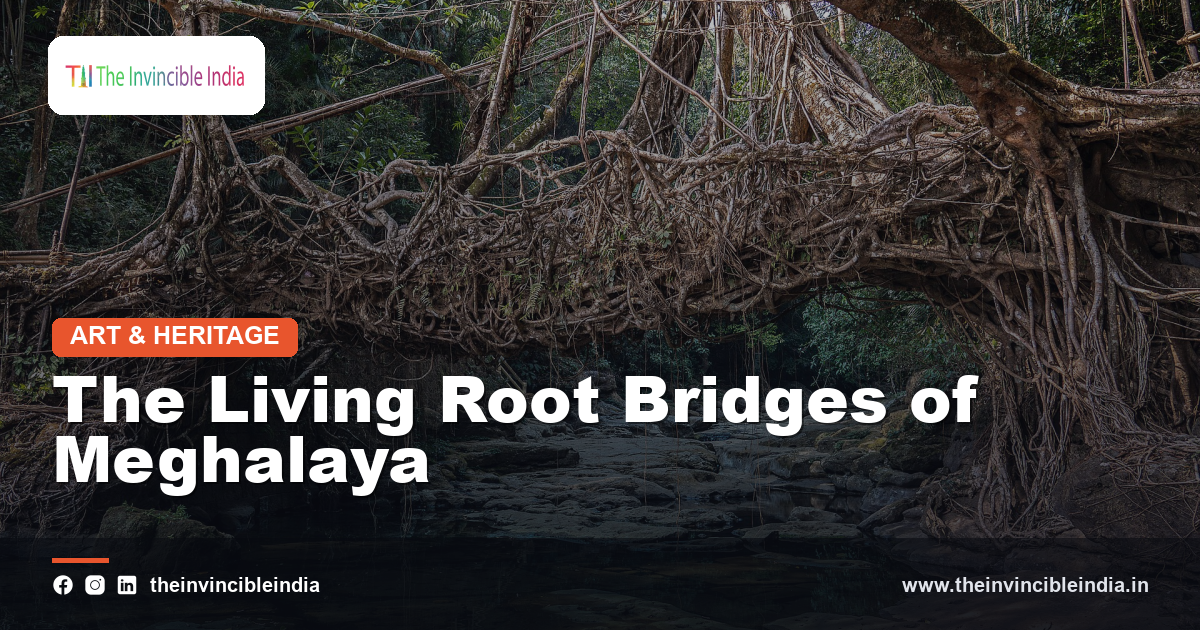
Deep in the hills of Meghalaya, where steep valleys are cut by fast-flowing streams and monsoon rains fall in extraordinary abundance, local communities have developed a remarkable solution to the problem of crossing water: bridges made not of timber or stone but of living tree roots. Grown patiently over many years by guiding the aerial roots of a particular fig tree across a stream, these structures continue to grow stronger with age, a living counterpart to the vernacular ingenuity seen in the stepwells of India. Their unusual method of construction has drawn admiration from around the world. This guide explores their construction, famous examples and enduring heritage.
Quick Facts
| Detail | Information |
|---|---|
| Location | Meghalaya, in the Khasi and Jaintia Hills |
| Type | Bridges grown from living tree roots |
| Material | Aerial roots of the rubber fig tree |
| Builders | Khasi and Jaintia tribal communities |
| Famous example | The double-decker root bridge near Cherrapunji |
| Heritage | A living tradition of vernacular engineering |
Bridges That Grow
Deep in the hills of Meghalaya, where steep valleys are cut by fast-flowing streams and monsoon rains fall in extraordinary abundance, local communities have developed a remarkable solution to the problem of crossing water: bridges made not of timber or stone but of living tree roots. Grown patiently over many years by guiding the aerial roots of a particular fig tree across a stream, these structures continue to grow stronger with age rather than decaying as an ordinary wooden bridge would. Their unusual method of construction has drawn admiration from around the world. As bridges that are quite literally alive and growing, the living root bridges of Meghalaya represent one of the most distinctive traditions of vernacular engineering found anywhere in India.
What Is a Living Root Bridge
A living root bridge is a footbridge formed by training the aerial roots of a fig tree, most commonly the rubber fig, to grow across a stream or river until they knit together into a structure strong enough to bear the weight of people crossing it. Unlike a conventional bridge built in a single episode of construction, a living root bridge takes many years, often stretching across more than one generation, to reach full strength and usable form. The process is one of patient guidance rather than rapid building. This definition of the living root bridge as a slowly cultivated, ever-strengthening structure sets it apart from virtually every other bridge-building tradition found elsewhere in the world.
The Landscape of Meghalaya
The living root bridges are found chiefly in the Khasi and Jaintia Hills of Meghalaya, a region of steep, densely forested terrain that receives some of the heaviest rainfall recorded anywhere on earth during the monsoon season. In such conditions, streams can swell rapidly and unpredictably, making conventional wooden bridges vulnerable to being washed away by sudden floods, a problem the living root bridge, firmly rooted on both banks, is far better able to withstand. The landscape itself thus shaped the solution that emerged. This distinctive environment of Meghalaya, with its heavy rainfall and challenging terrain, provided both the necessity and the natural materials from which the tradition of living root bridges could develop.
The Rubber Fig Tree
Central to the tradition is the rubber fig tree, a species whose long, flexible aerial roots can be guided and trained over considerable distances while remaining alive and capable of continued growth. These roots are naturally suited to gripping and interweaving with other surfaces, a quality that local builders exploit by directing new growth along a chosen path until the roots reach the opposite bank of a stream. Over time, additional roots are added to reinforce the structure further. This reliance on the particular growth habits of the rubber fig tree is fundamental to the entire tradition of living root bridge construction in Meghalaya.
Guiding the Roots Across a Stream
To create a living root bridge, builders typically begin by directing young aerial roots of a fig tree along a support, often a hollowed betel nut trunk or a similar guide, laid across the stream to be bridged. As the roots grow, they follow this guide toward the far bank, where they take hold and continue to thicken and multiply, gradually forming a dense, interwoven mass strong enough to support a walking surface. This careful early guidance shapes the future form of the bridge. This method of guiding young roots along a temporary support until they reach and anchor on the opposite bank represents the essential first stage in the long process of growing a living root bridge.
Generations of Patient Cultivation
Because the roots require many years to grow thick and strong enough to bear regular foot traffic, a single living root bridge may take a generation or more to become fully usable, with the work of guiding and reinforcing the structure sometimes passed down from one family member to the next. This long timescale means that those who begin a bridge may not live to see it reach its full strength, building instead for the benefit of their descendants and community. Such patience reflects a particular relationship with time and nature. This intergenerational nature of living root bridge construction, in which builders work for a future they may not personally witness, is one of the most striking aspects of the tradition.
Strength and Durability
Once mature, a living root bridge is remarkably strong and durable, capable of bearing the weight of many people at once and, unlike a wooden structure, becoming stronger rather than weaker as the years pass, since the living roots continue to grow and thicken indefinitely. This ongoing growth also allows the bridge to adapt to its surroundings, with roots capable of self-repair in ways no built structure of timber or stone could replicate. Some bridges are believed to have stood in continuous use for well over a century. This exceptional strength and self-renewing durability of the living root bridge is central to its enduring practical value in the communities that depend on it.
The Double-Decker Root Bridge
The most famous example of the tradition is the double-decker root bridge near Cherrapunji, a structure in which two separate bridges have been grown one above the other across the same stream, connected by a network of interwoven roots of remarkable complexity. This unusual arrangement, believed to have developed as an additional bridge was grown to replace or supplement an older one below it, has become the most widely photographed and visited of Meghalaya’s living root bridges. Its intricate structure draws visitors from far beyond the region. This double-decker root bridge near Cherrapunji stands as the most celebrated single example of the living root bridge tradition and a powerful symbol of Khasi ingenuity.
Khasi and Jaintia Tribal Knowledge
The knowledge required to grow and maintain a living root bridge belongs to the Khasi and Jaintia communities of Meghalaya, passed down through generations as part of a broader body of traditional ecological knowledge about the local forest and its plants. This knowledge covers not only the technique of guiding roots but also an understanding of which trees are suitable, how to select a favourable crossing point, and how to maintain a bridge as it continues to grow over decades. Such expertise is not formally documented but transmitted through practice. This tribal knowledge underlying the living root bridges represents an important and still-living body of indigenous engineering skill specific to the Khasi and Jaintia Hills.
Root Bridges in Daily Life
Far from being simply a curiosity for visitors, living root bridges continue to serve a genuinely practical purpose for the communities who built them, providing safe crossings over streams that would otherwise be difficult or dangerous to ford, particularly during the heavy rains of the monsoon season. Villagers use these bridges daily to reach fields, markets and neighbouring settlements, maintaining and reinforcing them as a routine part of community life rather than as a special undertaking. Their everyday use keeps the tradition genuinely alive. This continued practical use of living root bridges in daily village life distinguishes the tradition from a purely historical or ceremonial practice, keeping it rooted in ongoing necessity.
Root Ladders and Other Living Structures
Alongside root bridges, the same technique of guiding and training tree roots has been used to create root ladders and other structures that help villagers negotiate the steep and difficult terrain of the Khasi Hills, extending the underlying principle beyond bridges alone. These structures, though less famous than the celebrated root bridges, demonstrate the wider applicability of the technique and the depth of local ecological knowledge that supports it. Some villages maintain several such living structures at once. This broader tradition of root ladders and related living structures shows that the ingenuity behind Meghalaya’s root bridges extends into a wider practice of shaping living plants for practical, everyday purposes.
Root Bridges and the Monsoon
The heavy monsoon rains that define the climate of Meghalaya make reliable stream crossings especially important, since rivers that are easily forded in the dry season can become dangerous, fast-flowing torrents for much of the year. Living root bridges, firmly rooted into the banks on either side, are far less vulnerable to being swept away than a temporary wooden structure would be, offering communities a dependable crossing throughout the most difficult months of the year. This resilience during the monsoon is central to their continued value. This particular suitability of living root bridges to the extreme monsoon conditions of Meghalaya explains why the tradition developed and persisted specifically in this region.
Recognition and Growing Fame
In recent years, the living root bridges of Meghalaya have attracted growing attention from researchers, engineers and travellers, drawn by their unusual combination of biology and construction and by growing interest in sustainable, low-impact building techniques worldwide. This attention has brought a measure of international recognition to a tradition that, for centuries, was known chiefly within the local Khasi and Jaintia communities themselves. Documentation and study of the bridges have expanded considerably as a result. This growing recognition of the living root bridges as a significant example of vernacular and sustainable engineering has helped raise awareness of a tradition once known mainly to those who lived among the hills that produced it.
Tourism and Its Challenges
The rising fame of the living root bridges has brought a considerable increase in tourism to the villages of Meghalaya where they are found, providing valuable income to local communities but also placing new pressures on the bridges and the paths leading to them. Heavier foot traffic than the bridges were originally intended to bear raises questions about long-term wear, while the influx of visitors has required careful management to protect both the structures and the everyday life of the villages around them. Balancing benefit and burden remains an ongoing concern. This tension between the economic benefits and physical pressures of tourism is a significant challenge now facing the communities responsible for maintaining Meghalaya’s living root bridges.
Conservation of a Living Tradition
Because a living root bridge depends on the continued health and growth of its constituent trees, conservation of the tradition involves far more than protecting a static structure; it requires sustaining the forest ecosystem, the specific tree species and the traditional knowledge needed to guide and maintain new growth. Community-led conservation efforts, sometimes supported by researchers and heritage organisations, aim to record traditional techniques and encourage the continued cultivation of new bridges alongside the preservation of existing ones. This living, ecological dimension makes conservation here distinctive. This conservation approach, treating the living root bridge as a living system rather than a fixed monument, reflects the unique challenges of preserving a genuinely biological form of heritage.
The Living Root Bridges Today
Today the living root bridges of Meghalaya stand as one of the most remarkable examples of vernacular engineering found anywhere in the world, admired for the patience, ecological knowledge and ingenuity that created them across many generations. From the famous double-decker bridge near Cherrapunji to the many smaller bridges still in daily use across the Khasi and Jaintia Hills, this tradition continues to grow, quite literally, into the future. Each new bridge begun today extends a practice already many generations old. As a living tradition of vernacular engineering, the root bridges of Meghalaya remain among the most extraordinary and inspiring achievements of India’s cultural and ecological heritage.
Sources & Further Reading
- Ministry of Culture, Government of India (indiaculture.gov.in).
- Meghalaya Tourism, Government of Meghalaya, on the living root bridges (meghalayatourism.in).
Frequently Asked Questions
What are living root bridges?
Living root bridges are footbridges formed by training the aerial roots of a fig tree, usually the rubber fig, to grow across a stream until they knit together into a structure strong enough to carry people, a process that can take many years.
Where are living root bridges found?
Living root bridges are found chiefly in the Khasi and Jaintia Hills of Meghalaya, a region of steep terrain and exceptionally heavy monsoon rainfall where conventional wooden bridges are especially vulnerable to flooding.
What is the double-decker root bridge?
The double-decker root bridge near Cherrapunji is the most famous living root bridge, consisting of two bridges grown one above the other across the same stream, connected by an intricate network of interwoven roots.
How long does it take to grow a living root bridge?
Growing a living root bridge can take a generation or more, since the aerial roots must be guided across a stream and allowed to thicken over many years before the structure becomes strong enough for regular use.
Who builds and maintains the living root bridges?
The living root bridges are built and maintained by Khasi and Jaintia communities in Meghalaya, who pass down the specialised knowledge of guiding and reinforcing root growth from one generation to the next.


