

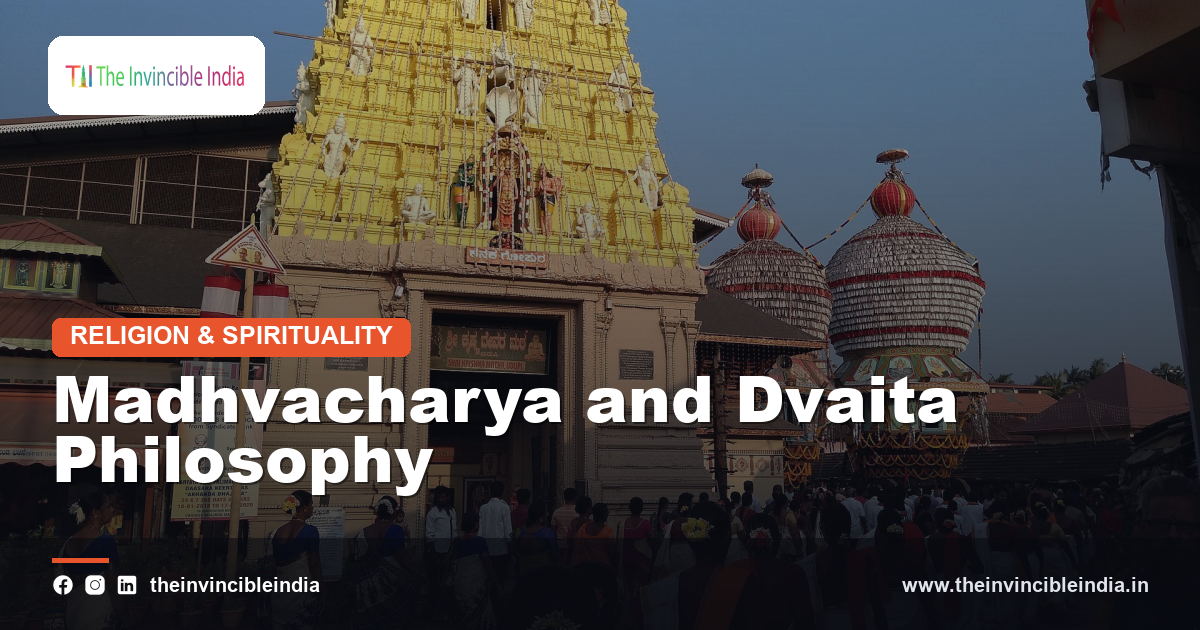
Madhvacharya was a medieval South Indian philosopher-saint remembered as the founder of Dvaita Vedanta, a school of thought that emphasizes an eternal and real distinction between the individual soul, God, and the material world. Associated closely with the coastal town of Udupi in present-day Karnataka, Madhvacharya’s teachings offered a distinctive alternative within the broader tradition of Vedanta, standing apart from non-dualist interpretations of Hindu philosophy. His writings, commentaries, and the monastic institutions he established continue to shape religious and philosophical life in the region today. This guide surveys his life, teachings, and legacy in general terms, describing Dvaita philosophy as one of the significant schools of thought within Hindu philosophical inquiry.
Quick Facts
| Detail | Information |
|---|---|
| Philosopher | Madhvacharya, founder of Dvaita Vedanta |
| Tradition | Dvaita, the dualist school of Vedanta |
| Era | Medieval period of South Indian philosophy |
| Region | Associated with Udupi, coastal Karnataka |
| Core teaching | Eternal distinction between soul, God, and matter |
| Legacy | Udupi Krishna Matha and the Dvaita monastic tradition |
Life and Background
Madhvacharya is remembered in tradition as a philosopher-saint who lived in the medieval period and is associated with the coastal region of present-day Karnataka in South India. Accounts describe him as a person of deep learning and spiritual conviction from an early age, drawn toward philosophical inquiry and religious life. He is said to have studied extensively within the broader Vedantic tradition before articulating his own distinct philosophical position.
His teaching career centered on the town of Udupi, where he established institutions that continue to function to this day. As with many historical religious figures from this period, specific biographical details vary across traditional accounts, and it is appropriate to treat individual episodes with general caution. What remains clear and widely acknowledged is his lasting influence as the founder of a major school of Vedantic philosophy, a legacy that endures in both written works and living monastic institutions.
Vedanta and Its Schools
Vedanta refers to a broad tradition of Hindu philosophy rooted in the philosophical portions of the Vedas, particularly the Upanishads, along with the Brahma Sutras and the Bhagavad Gita. Over the centuries, various thinkers offered differing interpretations of these foundational texts, giving rise to distinct schools within the Vedantic tradition. These schools differ chiefly in how they understand the relationship between the individual soul, the material world, and the ultimate reality referred to as Brahman.
Some schools emphasize non-duality, holding that soul and ultimate reality are fundamentally one, while others maintain a qualified or complete distinction between them. Madhvacharya’s Dvaita school represents the latter position. Understanding this broader context of Vedantic debate helps clarify his contribution as one of several influential, carefully reasoned responses to the same foundational scriptures.
The Philosophy of Dvaita
Dvaita, meaning duality, is the name given to the philosophical system articulated by Madhvacharya, which holds that reality consists of eternally distinct categories rather than a single undifferentiated whole. According to this view, God, individual souls, and the material universe are all real and remain forever distinct from one another, even though souls depend entirely on God for their existence and sustenance.
This stands in contrast to non-dualist schools that regard apparent distinctions as ultimately illusory. Dvaita philosophy places strong emphasis on devotion, or bhakti, as the primary means by which individuals relate to the divine, given that merging with God is not considered the final goal. The system is characterized by careful logical argumentation and extensive engagement with scripture.
The Five Eternal Distinctions
A central feature of Dvaita philosophy is its articulation of five fundamental and eternal distinctions that structure all of reality. These are commonly described as the distinction between the individual soul and God, between one soul and another, between the soul and matter, between God and matter, and between one material object and another. According to this framework, none of these distinctions are illusory or temporary; they are considered permanent features of existence that remain even after a soul attains liberation.
This framework underlies the Dvaita understanding of individuality, insisting that souls retain their distinct identity rather than merging into a single undifferentiated reality, and it supports the tradition’s strong devotional orientation toward a lasting relationship with the divine.
The Concept of God in Dvaita
In Dvaita philosophy, God is understood as the supreme, independent, and perfect reality upon whom all other things depend for their existence. God is typically identified with Vishnu, described as possessing infinite auspicious qualities and complete independence from any other cause. Souls and matter, by contrast, are described as dependent realities that exist only through God’s continual support, even though they remain distinct from God in essence.
This conception emphasizes God’s transcendence and supremacy while also affirming a personal and approachable dimension through which devotees can cultivate a relationship of loving devotion, providing the philosophical basis for the tradition’s emphasis on worship and service.
The Individual Soul and Liberation
Within Dvaita philosophy, the individual soul is regarded as real, eternal, and distinct from both God and other souls, retaining its unique identity across successive lives and even after attaining liberation. Liberation, in this framework, is understood as the soul’s release from the cycle of rebirth and its attainment of a state of eternal, blissful proximity to and service of God, rather than a dissolving of individual identity into a universal oneness.
The tradition also describes gradations among liberated souls according to their inherent nature and spiritual attainment, a distinctive feature that sets Dvaita apart from several other schools of Vedanta. Devotion, right knowledge, and righteous conduct are together considered essential means toward this ultimate goal.
Scriptural Basis and Commentaries
Madhvacharya grounded his philosophical system in careful interpretation of the Vedas, the Upanishads, the Brahma Sutras, and the Bhagavad Gita, alongside the Puranas associated with the worship of Vishnu. He composed detailed commentaries on these texts, arguing that a close and consistent reading supported the dualist position rather than non-dualist interpretations offered by other schools.
His scholarly method involved rigorous textual analysis combined with logical argumentation intended to demonstrate the coherence of his philosophical position. These commentaries remain foundational texts for the Dvaita tradition and continue to be studied by scholars and practitioners, reflecting a broader feature of classical Indian philosophy in which new positions were presented as faithful readings of shared, authoritative texts.
The Udupi Krishna Matha
The town of Udupi in coastal Karnataka is closely associated with Madhvacharya and remains the spiritual center of the Dvaita tradition today. According to tradition, he established worship of a deity of Krishna at Udupi, and the temple associated with this worship continues to be an important pilgrimage site for followers of the tradition. The Krishna Matha, as the institution is known, functions as both a place of worship and a center of religious administration and learning.
Its distinctive rituals and management structure have been maintained and adapted over many generations by the monastic lineages associated with Madhvacharya, drawing pilgrims and visitors from across India who come to participate in worship.
The Eight Mathas of Udupi
Madhvacharya is remembered for establishing a set of eight monastic institutions, known as the Ashta Mathas, based in and around Udupi to oversee worship and preserve his teachings. These mathas, each headed by its own monastic leader, take turns managing the rituals and administration of the Krishna temple according to a rotating system maintained over many generations.
The heads of these institutions are also responsible for training students, preserving philosophical texts, and guiding the religious life of their followers. This organizational structure has allowed the Dvaita tradition to maintain institutional continuity across centuries, providing a stable framework for the transmission of teachings and practices into the present day.
Worship Practices in the Dvaita Tradition
Worship within the Dvaita tradition centers on devotion to Vishnu, often in the form of Krishna, expressed through structured temple rituals, personal prayer, and communal religious gatherings. Daily worship at institutions associated with the tradition typically follows a detailed and carefully maintained ritual calendar, reflecting the tradition’s emphasis on disciplined religious practice.
Devotees are encouraged to cultivate humility, service, and heartfelt devotion as means of drawing closer to the divine, consistent with the tradition’s theological emphasis on a real and lasting relationship between soul and God. Musical devotion, recitation of hymns, and participation in temple festivals also form an important part of religious life within the tradition.
Dvaita in Relation to Other Vedanta Schools
Dvaita is often discussed alongside other major schools of Vedanta, particularly the non-dualist school associated with Adi Shankaracharya, in order to illustrate the range of philosophical positions developed within this broader tradition. While non-dualist schools emphasize the ultimate oneness of soul and reality, Dvaita insists on real and permanent distinctions between them.
A further school, associated with qualified non-dualism, occupies something of a middle position, affirming both unity and distinction in different respects. These differing schools engaged with one another over centuries through detailed philosophical debate, enriching the overall tradition and reflecting the depth and vitality of Vedantic philosophy as a living tradition of inquiry.
Literary and Philosophical Works
Madhvacharya is credited with an extensive body of philosophical and commentarial writing composed in Sanskrit, covering topics ranging from metaphysics to scriptural interpretation. His works include commentaries on the Brahma Sutras, the Bhagavad Gita, and selected Upanishads, alongside independent treatises setting out the core positions of Dvaita philosophy.
These texts are noted for their concise, logically structured style, often engaging directly with rival philosophical positions in order to defend the dualist interpretation of scripture. Later scholars within the tradition composed extensive sub-commentaries elaborating and defending his positions, contributing to a rich and continuing scholarly literature that remains actively studied within traditional centers of learning today.
Disciples and Monastic Succession
Following Madhvacharya, his teachings were carried forward by a succession of disciples and monastic leaders who preserved, elaborated, and transmitted Dvaita philosophy across subsequent generations. Prominent later scholars within the tradition composed influential commentaries and independent works that further developed the philosophical and theological positions associated with the school.
Monastic succession within institutions such as the Ashta Mathas has ensured continuity of leadership and teaching authority over many centuries, allowing the tradition to adapt to changing historical circumstances while preserving its core doctrines, sustained by ongoing scholarship and institutional support rather than remaining a purely historical body of thought.
Festivals and Temple Traditions
Udupi and its associated institutions observe a calendar of religious festivals that draw pilgrims and visitors throughout the year, reflecting the vitality of the Dvaita devotional tradition. Festivals connected to the worship of Krishna, along with observances marking significant occasions in the life and legacy of Madhvacharya, are celebrated with special rituals, processions, and communal gatherings.
The rotation of temple management among the Ashta Mathas is itself marked by ceremonial observance, drawing attention to the institutional structure underlying religious life in the town. Such occasions serve not only as religious observances but also as important events for the cultural and economic life of the region, sustaining traditions that have continued for many centuries.
Influence on South Indian Religious Life
The influence of Madhvacharya and Dvaita philosophy extends well beyond Udupi, shaping devotional and philosophical currents across South India over many centuries. His teachings contributed to the wider development of bhakti, or devotional worship, within the region, resonating with later devotional movements that emphasized personal relationship with the divine.
Temples, monastic institutions, and scholarly communities associated with the Dvaita tradition can be found across Karnataka and neighboring regions, reflecting the geographic spread of his teachings. Its emphasis on structured worship and disciplined religious practice has influenced temple traditions and devotional culture well beyond the immediate community of formal Dvaita adherents.
Madhvacharya's Legacy Today
Today, the philosophical and devotional tradition founded by Madhvacharya continues to be actively practiced, studied, and transmitted across South India and beyond. The Krishna Matha at Udupi remains an active pilgrimage site, drawing devotees who participate in its distinctive rituals and observe its long-maintained traditions. Scholars continue to study Dvaita philosophy both within traditional centers of learning and in academic settings interested in the history of Indian philosophy.
The tradition’s emphasis on devotion, disciplined practice, and a personal relationship with the divine continues to resonate with practitioners today, and Madhvacharya’s legacy remains an important, living part of India’s diverse philosophical and religious heritage.
Sources & Further Reading
- Ministry of Culture, Government of India (indiaculture.gov.in).
- Sahitya Akademi.
Frequently Asked Questions
Who was Madhvacharya?
Madhvacharya was a medieval South Indian philosopher-saint remembered as the founder of Dvaita Vedanta, a school of Hindu philosophy that emphasizes real and eternal distinctions between soul, God, and matter.
What does Dvaita mean?
Dvaita means duality. It refers to the philosophical position that God, individual souls, and the material world are eternally distinct realities rather than aspects of a single undifferentiated whole.
What is the Udupi Krishna Matha?
The Udupi Krishna Matha is a temple and monastic institution associated with Madhvacharya, considered the spiritual center of the Dvaita tradition and a major site of pilgrimage in coastal Karnataka.
How does Dvaita differ from Advaita?
Dvaita holds that soul, God, and matter remain eternally distinct, while Advaita, associated with Adi Shankaracharya, teaches the ultimate non-duality of soul and reality. Both are respected schools within Vedanta.
What are the Ashta Mathas?
The Ashta Mathas are eight monastic institutions established in the Udupi tradition to oversee temple worship, religious education, and the preservation of Dvaita philosophy across generations.


