

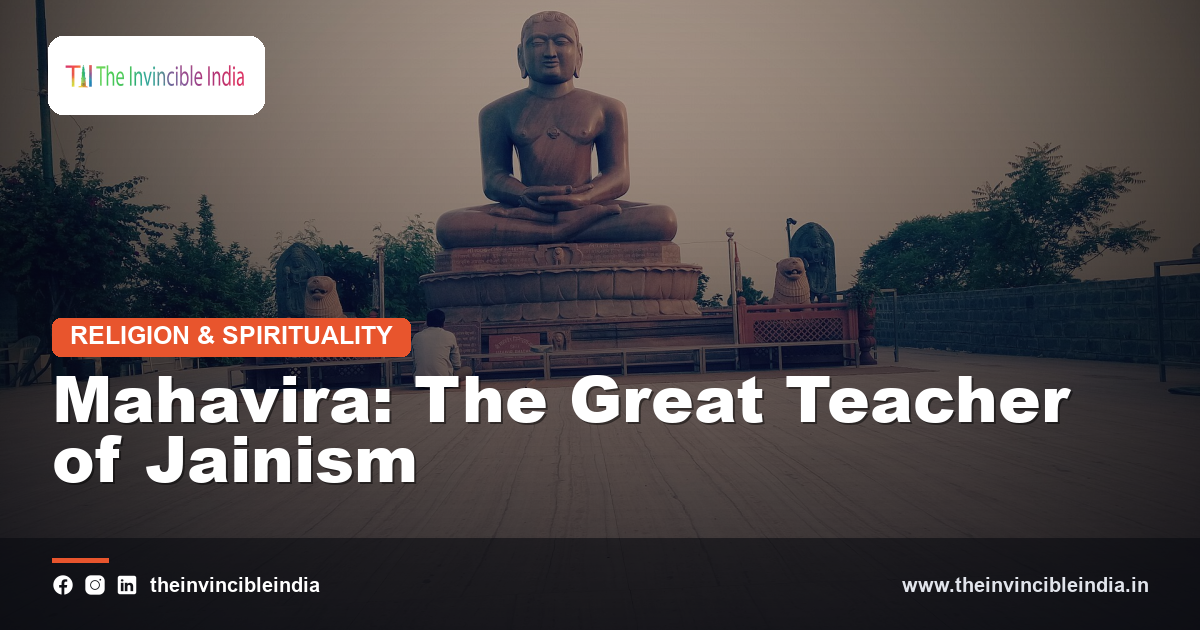
Mahavira is revered within the Jain tradition as its great teacher and the last of the twenty-four Tirthankaras, spiritual guides believed to have attained perfect liberation and shown the path for others to follow. Born into a noble family, he is remembered as having renounced a life of comfort in his search for spiritual truth, undertaking years of rigorous ascetic practice before attaining the profound spiritual insight that Jains know as Kevala Jnana. His subsequent teachings, centred on non-violence, truth, non-attachment and disciplined self-restraint, shaped the ethical and philosophical foundations of Jainism that continue to guide the Jain community today. This guide traces his life, teachings and enduring legacy.
Quick Facts
| Detail | Information |
|---|---|
| Known as | The great teacher and last Tirthankara of Jainism |
| Birth | Traditionally born into a noble family in ancient India |
| Core teaching | Ahimsa, or non-violence, and self-discipline |
| Spiritual attainment | Kevala Jnana, complete spiritual knowledge |
| Followers | The Jain monastic and lay community |
| Legacy | Foundational teacher of Jain philosophy and ethics |
Birth into a Noble Family
Mahavira is traditionally remembered as having been born into a noble or princely family in ancient India, a household of considerable comfort and social standing. According to Jain tradition, his early life was marked by the privileges typical of noble birth, providing him with security and material comfort from a young age. This noble origin is remembered as significant within Jain tradition, underscoring the scale of the renunciation he would later choose in pursuit of spiritual liberation. His early years, spent amid comfort and privilege, set the stage for the profound spiritual transformation that would define the rest of his life and shape the teachings he would eventually deliver.
Early Life and Upbringing
During his early years, Mahavira is remembered as having received the upbringing appropriate to his noble status, including education and training suited to a life of responsibility within his community. Jain tradition remembers him as showing, even in these early years, an unusual depth of reflection and a strong inclination toward spiritual and ethical questions. Despite the comfort of his circumstances, he is remembered as increasingly drawn toward questions of the meaning of existence and the nature of suffering, setting him apart from the ordinary expectations of noble life. This early spiritual sensitivity foreshadowed the decisive turn toward renunciation and ascetic practice that would follow later in his life.
The Path of Renunciation
At a significant point in his life, Mahavira is remembered as having renounced his worldly possessions, family ties and social position in pursuit of spiritual liberation, embracing a life of homeless wandering and ascetic discipline. This renunciation, undertaken deliberately and completely, marked the beginning of a long period of spiritual seeking devoted entirely to self-discipline and reflection. Jain tradition regards this act of total renunciation as an essential step on the path toward the highest spiritual attainment, reflecting the tradition’s broader emphasis on detachment from worldly life. Mahavira’s example of complete renunciation continues to serve as an inspiring model within the Jain monastic tradition to this day.
Years of Rigorous Asceticism
Following his renunciation, Mahavira is remembered as having spent many years engaged in intense ascetic practice, enduring considerable physical hardship and maintaining strict self-discipline in his pursuit of spiritual liberation. This extended period of austerity is remembered within Jain tradition as reflecting his complete dedication to overcoming worldly attachment and achieving the highest possible state of spiritual purity. His willingness to endure such prolonged hardship in the pursuit of spiritual truth is remembered as an extraordinary demonstration of discipline and resolve. This period of ascetic practice laid the essential groundwork for the profound spiritual insight he would eventually attain, and it remains a central part of his traditional life story.
Attaining Kevala Jnana
According to Jain tradition, Mahavira eventually attained a state of complete and perfect spiritual knowledge known as Kevala Jnana, understood as the highest possible level of spiritual realisation, free from the limitations of ordinary human perception and understanding. This attainment marked the culmination of his long years of ascetic practice and self-discipline, and it is remembered as the pivotal moment that qualified him to teach others the path he had discovered. Following this realisation, Mahavira is remembered as having devoted the remainder of his life to sharing his insight with others, establishing the teachings that would come to define the Jain tradition. This moment of spiritual attainment stands at the very heart of Mahavira’s significance within Jainism.
The Twenty-Four Tirthankaras
Within Jain tradition, Mahavira is revered as the twenty-fourth and final Tirthankara of the current cosmic cycle, a lineage of spiritual teachers believed to have each attained liberation and shown the path for others across the vast span of Jain cosmological time. As the most recent Tirthankara, Mahavira’s teachings are regarded as the most immediately accessible articulation of the eternal Jain path for the present era. This concept of a lineage of enlightened teachers reflects the Jain understanding of spiritual truth as timeless, periodically re-taught to humanity by successive Tirthankaras. Mahavira’s place at the culmination of this lineage gives his teaching particular authority and centrality within the Jain tradition.
The Teaching of Ahimsa
Central to Mahavira’s teaching is the principle of Ahimsa, or non-violence, understood not merely as the avoidance of physical harm but as a comprehensive ethical commitment to avoiding harm to all living beings in thought, word and deed. This principle shaped every aspect of Jain practice, from dietary customs to daily conduct, reflecting a deep reverence for the sanctity of all forms of life. Mahavira’s articulation of Ahimsa as a central spiritual and ethical value has had an influence extending well beyond the Jain community itself, shaping broader currents of Indian ethical thought. This teaching remains the most widely recognised and admired aspect of Mahavira’s philosophical legacy, both within Jainism and in the wider world.
Truth and Non-Attachment
Alongside non-violence, Mahavira taught the importance of truthfulness, non-attachment to material possessions, and disciplined self-restraint as essential elements of the spiritual path. He emphasised that attachment to worldly things and desires was a principal source of suffering and spiritual bondage, and that liberation required a disciplined effort to reduce such attachment through simplicity and self-control. These teachings, together with non-violence, formed the ethical core of Jain philosophy, providing a comprehensive framework for both monastic and lay spiritual practice. This emphasis on truth and detachment, alongside non-violence, reflects the depth and coherence of the ethical vision that Mahavira articulated for his followers.
The Five Great Vows
Mahavira’s teaching gave rise to a structured set of ethical commitments known as the Five Great Vows, observed most rigorously by Jain monks and nuns and, in an adapted form, by lay followers as well. These vows address non-violence, truthfulness, non-stealing, chastity and non-attachment, together forming a comprehensive ethical and spiritual discipline central to Jain religious life. The vows provide a practical framework through which Mahavira’s broader philosophical teachings could be translated into concrete daily conduct. This structured ethical system remains foundational to Jain religious practice today, observed with varying degrees of intensity by monastics and laypeople across the Jain community.
Establishing the Fourfold Jain Community
Mahavira is credited with organising his followers into a structured fourfold community comprising monks, nuns, laymen and laywomen, each with defined roles and levels of religious observance appropriate to their circumstances. This structure allowed Jain teaching and practice to be sustained across different levels of commitment, from the rigorous asceticism of monastics to the more moderate observance possible within lay life. The establishment of this organised community provided institutional continuity for Mahavira’s teachings following his own lifetime, ensuring their transmission across many generations. This structured fourfold community remains a defining feature of Jain religious organisation to the present day.
Anekantavada: The Doctrine of Many-Sidedness
Among the philosophical contributions associated with the broader Jain tradition shaped by Mahavira’s teaching is the doctrine of Anekantavada, the principle that reality is complex and multifaceted, and that any single viewpoint captures only a partial truth. This philosophical approach encouraged intellectual humility and open-mindedness, recognising the limitations of any one perspective in fully grasping the nature of reality. Anekantavada reflects the broader Jain emphasis on non-attachment, extended here to attachment to fixed viewpoints and opinions. This distinctive philosophical contribution continues to be studied and admired for its sophisticated approach to questions of truth, perspective and intellectual tolerance.
Jain Monastic Life
The monastic tradition established under Mahavira’s guidance involves a life of considerable austerity, including strict adherence to non-violence, simplicity of possessions, and disciplined practices of meditation and self-restraint. Jain monks and nuns continue to observe rigorous codes of conduct inspired directly by Mahavira’s own example of renunciation and ascetic discipline. This monastic tradition is regarded within Jainism as the most complete expression of the spiritual path Mahavira taught, requiring exceptional dedication and discipline from those who undertake it. The continued vitality of Jain monasticism today reflects the enduring influence of the disciplined spiritual model that Mahavira established through his own life and practice.
Influence on Indian Culture and Ethics
Mahavira’s teaching of non-violence has had a profound and lasting influence on Indian culture and ethical thought extending well beyond the Jain community itself, shaping attitudes toward diet, animal welfare and non-violent conduct across broader Indian society. The principle of Ahimsa, first given systematic ethical expression within Jain teaching, has resonated across many strands of Indian philosophy and social thought in the centuries since. This wide-reaching cultural influence illustrates how a teaching rooted in one particular religious tradition can shape ethical sensibilities across an entire civilisation. Mahavira’s emphasis on non-violence remains one of his most significant and widely felt contributions to Indian intellectual and cultural history.
Jain Temples and Sacred Sites
Numerous temples and pilgrimage sites across India are associated with the memory and teaching of Mahavira, including sites linked to key episodes of his life as well as later monuments built in his honour by the Jain community. These sites, renowned for their intricate architecture and craftsmanship, serve as important centres of worship, pilgrimage and Jain cultural heritage. Jain temples across the country reflect centuries of devoted artistic and architectural effort inspired by reverence for Mahavira and the broader lineage of Tirthankaras. The continued significance of these sacred sites underscores the deep and lasting devotion that Mahavira’s teaching continues to inspire among the Jain community.
Festivals and Commemoration
Mahavira’s life and teachings continue to be commemorated through festivals and observances within the Jain community, marked by prayer, fasting, charitable giving and renewed commitment to his ethical teachings. These occasions provide opportunities for reflection on the principles of non-violence, truth and self-discipline that Mahavira taught, reinforcing their continued relevance to daily Jain life. Community gatherings and temple observances associated with his memory help sustain a living connection between the historical teacher and the contemporary practice of Jain faith. This ongoing commemoration reflects the central and enduring place that Mahavira continues to hold within Jain religious and cultural identity.
Mahavira Today
Today Mahavira is revered as the great teacher and final Tirthankara of Jainism, his teachings on non-violence, truth and self-discipline continuing to guide the beliefs and daily conduct of Jain communities in India and around the world. His emphasis on Ahimsa remains one of the most widely recognised and admired contributions of Jain philosophy to global ethical thought, extending far beyond the boundaries of the Jain community itself. Temples, monastic institutions and festivals associated with his memory continue to sustain a vibrant living tradition rooted directly in his teaching. Mahavira’s legacy endures as a testament to the enduring power of disciplined non-violence and truthful conduct as a path toward spiritual liberation.
Sources & Further Reading
- Ministry of Culture, Government of India, on Jain heritage and philosophy (indiaculture.gov.in).
- Archaeological Survey of India, on Jain temples and pilgrimage sites (asi.nic.in).
Frequently Asked Questions
Who was Mahavira?
Mahavira was the great teacher and the last of the twenty-four Tirthankaras of Jainism, revered for attaining perfect spiritual knowledge and teaching the path of non-violence and self-discipline.
What is Ahimsa?
Ahimsa, or non-violence, is the central ethical principle taught by Mahavira, calling for the avoidance of harm to all living beings in thought, word and deed, and shaping Jain practice and philosophy.
What are the Five Great Vows?
The Five Great Vows are ethical commitments taught by Mahavira addressing non-violence, truthfulness, non-stealing, chastity and non-attachment, observed rigorously by Jain monks and nuns and, in adapted form, by lay followers.
What is Kevala Jnana?
Kevala Jnana is the state of complete and perfect spiritual knowledge that Mahavira is said to have attained after years of ascetic practice, qualifying him to teach the Jain path to others.
What is Anekantavada?
Anekantavada is the Jain philosophical doctrine of many-sidedness, holding that reality is complex and multifaceted and that any single viewpoint captures only a partial truth.


