

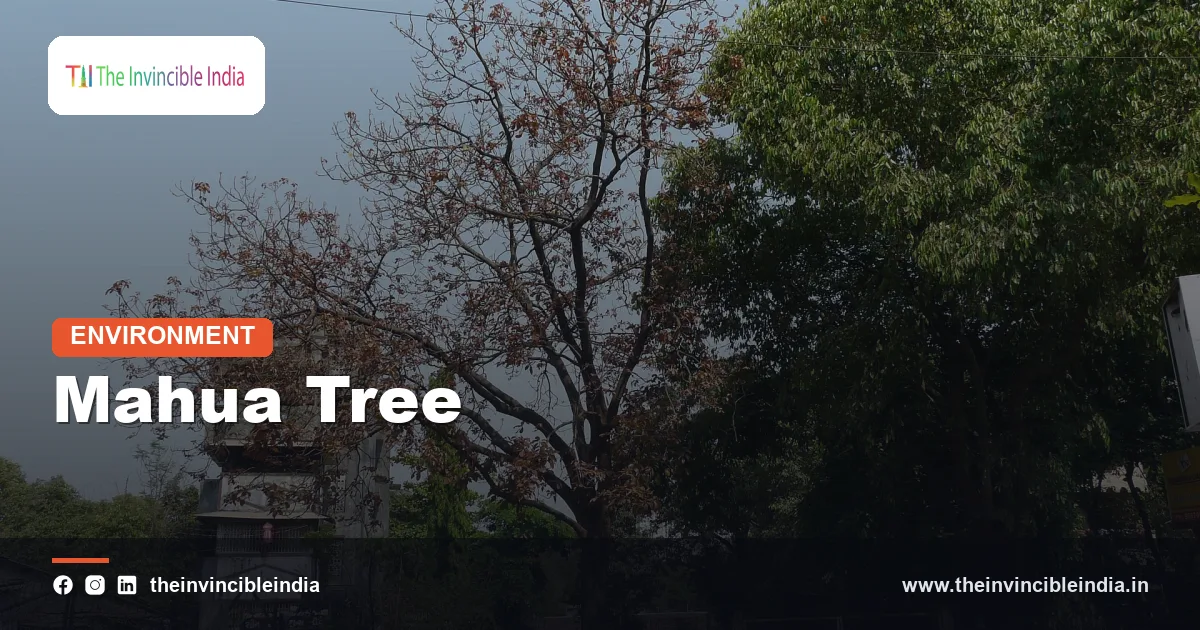
The mahua tree (Madhuca longifolia) is a large tropical tree of the central and eastern Indian forests whose sweet, fleshy, edible flowers, oil-rich seeds and timber have supported tribal and rural communities for centuries. Known as mahua or mahuwa in Hindi and madhuka in Sanskrit, the mahua tree gives flowers that are eaten, fed to livestock and fermented into a traditional country liquor, along with seeds that yield a cooking and lamp oil.
The mahua tree is among the most important minor forest produce species in India and is woven into the festivals, songs and household economy of tribal communities from Gujarat to Odisha. This explainer, last updated 23 October 2026, covers the botany, distribution, uses, cultural role and conservation outlook of the mahua tree.
| Quick Fact | Detail |
|---|---|
| Scientific name | Madhuca longifolia (often Madhuca longifolia var. latifolia; formerly Madhuca indica) |
| Plant family | Sapotaceae (the sapota or chikoo family) |
| Common names | Mahua, mahuwa, mahula (Odia), madhuka (Sanskrit), ippa (Telugu), ippe (Kannada), iluppai (Tamil) |
| Tree type | Large, semi-evergreen to deciduous tree, commonly 15 to 20 metres tall |
| Flowering season | Roughly March to April, when the tree is nearly leafless |
| Fruiting season | Roughly May to July |
| Main products | Edible flowers, seed oil, fermented liquor, timber, seed cake |
| Key regions | Madhya Pradesh, Chhattisgarh, Jharkhand, Odisha, Maharashtra, Gujarat, Rajasthan, Uttar Pradesh |
| Legal category | Minor forest produce (non-timber forest produce) under forest and forest rights laws |
Key Takeaways
- The mahua tree, scientifically Madhuca longifolia, is a large tree of the sapota family that grows mainly in the dry deciduous forests of central and eastern India.
- Mahua flowers are cream-coloured, fleshy and sweet, and they fall to the ground at night or at dawn in March and April, when villagers collect them by hand.
- Mahua flowers are eaten fresh, dried, cooked or ground into flour, and they are also fermented to make a traditional distilled liquor known as mahua daru.
- Mahua seeds contain a large proportion of fat, and cold-pressing them yields an edible and industrial oil that is also called mahua butter.
- The mahua tree is classified as minor forest produce, and gathering its flowers and seeds is an important seasonal income for tribal households across India.
- Mahua is culturally significant among many tribal communities, including the Gond, Baiga, Santhal, Munda and Bhil peoples, who use the tree in festivals, marriages and rituals.
What is the mahua tree?
The mahua tree is a large, long-lived tree of the sapota family (Sapotaceae) that is native to India and is best known for its sweet, edible flowers and fat-rich seeds. The scientific name Madhuca longifolia is often used with the variety name latifolia, and older sources use Madhuca indica or Bassia latifolia for the same tree.
A mature mahua tree typically stands 15 to 20 metres tall with a short, thick trunk, dark grey, deeply fissured bark and a dense, rounded crown. The leaves are leathery, oblong and clustered at the ends of the branches. New coppery-pink leaves appear in spring, and in many regions the tree sheds its old leaves just before or during flowering. Like other members of the sapota family, mahua exudes milky latex when cut.
The tree is slow-growing and can live for well over a hundred years. Mahua trees are often left standing when forests are cleared for farming, so large, old specimens are a familiar feature of village fields and field boundaries across central India.
The name mahua comes from the Sanskrit madhuka, which is related to madhu, meaning honey or sweetness, and it refers to the honey-like sweetness of the tree’s flowers. Several other Indian languages have names with a similar sweet root, such as mahula in Odia and mohwa in some Hindi dialects.
In southern India the tree is known by different names, such as ippa in Telugu, ippe in Kannada and iluppai in Tamil, which usually refer to the related southern species Madhuca longifolia var. longifolia. The English names include Indian butter tree, honey tree and mahwa.
Where does the mahua tree grow in India?
The mahua tree grows mainly in the dry deciduous forests and open woodlands of central and eastern India, with the densest populations in Madhya Pradesh, Chhattisgarh, Jharkhand, Odisha and eastern Maharashtra. The tree also occurs in Gujarat, Rajasthan, Uttar Pradesh, Bihar, West Bengal and parts of the southern peninsula, mostly at low to medium elevations below about 1,200 metres.
Mahua prefers dry tropical climates with a pronounced hot season, and it tolerates poor, shallow and rocky soils. It is a hardy tree that is mostly found growing alongside sal, teak, tendu and other deciduous species in forests, and as isolated trees in village lands. Tribal belts such as the Gondwana region, the Chota Nagpur Plateau and the Dandakaranya region are especially known for their mahua groves.
How does the mahua tree flower?
The mahua tree flowers in spring, mostly in March and April, producing clusters of small, cream-coloured, bell-shaped flowers that drop to the ground in the early morning hours. The flowers hang in bunches at the tips of branches, and the tree is usually almost leafless at this time, so the flowering crown looks like an offering of pale, drooping blossoms.
Each flower has a thick, fleshy, juicy corolla that contains a good amount of sugar, which is why the flowers taste sweet and smell strongly of honey and fermented fruit. Collection is a daily activity: families rise before dawn, sweep the ground under the tree and gather the fallen flowers into baskets for drying in the sun. A single mature tree can yield a substantial quantity of flowers in a season, though yield varies widely from tree to tree and year to year.
After flowering, the mahua tree produces oval, fleshy, green fruit, also called the mahua berry, which contain one to four shiny brown seeds. The fruit ripens around May to July. The tree flowers and sets fruit over many weeks, which stretches harvest work through the hot season.
How are mahua flowers used as food?
Mahua flowers are used as food in tribal and rural India by eating them fresh, drying and storing them, cooking them into sweet and savoury dishes or grinding them into flour that is mixed with grain. Dried mahua flowers resemble raisins in appearance and taste somewhat like a mildly smoky dried fig or date.
- Fresh or sun-dried flowers: eaten as a snack, used as a natural sweetener or stored for the lean months.
- Mahua laddu and sweets: flowers are pounded with sesame, groundnut or grain flour to make laddu and similar sweets.
- Mahua roti and puri: flower paste is mixed with wheat, rice or millet flour and fried or baked into bread.
- Kheer and porridge: flowers are cooked in milk or water with rice or millets in some communities.
- Livestock feed: dried flowers and the pressed residue are fed to cattle and goats in some areas.
Mahua flowers are rich in natural sugars and also contain some protein, minerals and vitamins. In regions where cultivated food crops fail or run short in summer, the mahua harvest has historically served as a famine and lean-season food, and it still contributes to household nutrition. Recent efforts by self-help groups, forest departments and food enterprises have promoted mahua products such as cookies, jams, syrups and energy bars as packaged foods.
What is mahua liquor?
Mahua liquor, called mahua daru, mahuli or mohwa, is a traditional alcoholic drink that is made by fermenting and then distilling dried mahua flowers, and it has long been a part of tribal social and ritual life in central and eastern India. The sugary flowers ferment readily in water with natural yeast, and the fermented mash is distilled in simple clay-pot or copper stills to produce a clear spirit.
In tribal communities mahua liquor is offered to deities and ancestors, served at marriages, births, harvest festivals and funerals, and shared in community gatherings. At the same time, illicit and unregulated production causes health and law-and-order problems, since poorly made spirits can be dangerous and excise laws restrict production and sale in most states. Rules differ from state to state. In recent years some state governments have begun to explore regulated, licensed marketing of heritage mahua spirit, and others continue to restrict home distillation, so readers should check the current law of the state in question.
This section is descriptive, not an encouragement of alcohol use. Excessive alcohol harms health, and illicit liquor can be fatal.
What is mahua oil and how is it used?
Mahua oil, also called mahua butter, is a semi-solid vegetable fat pressed from the seeds of the mahua tree, and it is used for cooking, lamps, soap-making and traditional skin care in rural India. Mahua seeds contain a large share of fat, commonly reported as roughly a third to a half of the kernel weight, and the oil solidifies into a pale yellow or whitish butter at cool temperatures.
Traditional and industrial uses
- Cooking oil: used for frying in some tribal households, after cold pressing and sometimes with refining.
- Lighting and fuel: burned in lamps in villages without electricity, and studied as a possible biodiesel feedstock.
- Soap and cosmetics: mahua butter is used in soaps, candles, skin ointments and hair oils.
- Traditional massage and balms: applied to the skin for dryness and aches in folk practice.
Seed cake
The residue left after pressing, known as mahua seed cake, is rich in nutrients and is used as organic manure. The cake contains saponins and is not suitable as feed for most animals unless it has been treated, and in some places it has been used to clear unwanted fish from ponds, so handling requires care.
What are the medicinal and other uses of the mahua tree?
In traditional medicine, parts of the mahua tree including the bark, flowers and seeds are used in Ayurveda and folk practice for coughs, skin problems and as a tonic, but these uses are based on tradition and limited laboratory research rather than established clinical evidence. Anyone with a health concern should consult a qualified doctor rather than treat themselves with mahua preparations.
The mahua tree also provides several practical materials. The timber is hard, heavy and durable and is used for furniture, door frames, agricultural tools, cart wheels and house construction, although felling the tree is regulated because mahua is valued for its flowers and seeds. The bark and leaves are used in traditional preparations, and the tree gives good shade and fodder in dry landscapes.
Why is the mahua tree important to tribal communities?
The mahua tree is important to tribal communities because it provides food, income, oil, ritual material and shade in the months when farm work is slack and cash is scarce. For many households in the forest belts of central India, selling mahua flowers and seeds is one of the largest sources of seasonal cash.
The cultural role is equally strong. Communities such as the Gond, Baiga, Bhil, Santhal, Munda, Oraon and Ho regard mahua as a sacred tree, and flowers or mahua spirit are used in worship of village deities and ancestors. Mahua features in folk songs, proverbs, marriage rituals and festival customs, and some groves are protected as sacred. Traditionally, the tree is also associated with fertility and abundance.
| Product | Typical use | Role in livelihoods |
|---|---|---|
| Dried flowers | Food, sweetener, fermentation base | Household food and a main seasonal cash source |
| Seeds (kernels) | Oil and butter extraction | Sold to traders and oil processors |
| Seed cake | Organic manure | Farm input and by-product |
| Timber | Furniture, tools, construction | Limited, regulated use |
| Bark and leaves | Folk remedies, fodder, plates | Local household use |
How does the mahua tree support wildlife and the forest?
The mahua tree supports wildlife by providing a sugary, easily available food in the lean dry season, and mammals such as sloth bears, deer, langurs, monkeys, wild boar and bats feed on the fallen flowers and fruits. Birds and insects also visit the blossoms, and bees collect nectar from the tree.
The flowering season of the mahua tree overlaps with a time when few other foods are available in dry forests, which makes mahua a keystone food resource for many forest animals. Villagers who collect flowers at dawn may encounter bears and other wildlife in the same groves, so human-animal conflict is a real concern in some forest areas. Large mahua trees also stabilise soil, cool the surrounding ground with their shade and add organic matter through leaf fall.
What laws and policies affect the mahua tree?
The mahua tree is treated in Indian law as minor forest produce, and tribal and other forest-dwelling communities have rights to collect, use and sell it under the Forest Rights Act, 2006. The Forest Rights Act recognises the right of gatherers to own, collect and trade minor forest produce found within village boundaries or in traditionally used forest areas.
State governments and cooperatives also run procurement and marketing schemes for minor forest produce, and the central government has a scheme for support prices of selected minor forest produce through tribal agencies. Separate state excise laws control liquor, so selling or transporting mahua flowers for distillation is regulated in many states, and rules about cutting mahua trees on private land also vary. The details differ between states and change over time.
Is the mahua tree under threat, and how is it conserved?
The mahua tree is not considered globally threatened, but old mahua trees are declining in some areas because of land clearing, felling, forest fires set during flower collection and poor regeneration. Fires lit under the trees to clear the ground for easier flower collection are a particular problem, since fire damages seedlings and stresses mature trees.
Conservation efforts include protecting sacred groves, promoting mahua planting in agroforestry, regulating felling and training collectors in fire-free collection practices such as laying nets or sheets under the tree. Better storage and processing, value-added products and fair prices also give communities a stronger reason to keep and plant the tree.
Bottom Line
The mahua tree is a sacred, productive and ecologically important forest tree of central India. Madhuca longifolia provides food, oil, fodder, timber and cash income, supports wildlife in the dry season and holds a lasting place in tribal culture, and the future of mahua depends on sustainable collection, fair markets and sensible regulation.
Frequently Asked Questions
What is the scientific name of the mahua tree?
The scientific name of the mahua tree is Madhuca longifolia, often written as Madhuca longifolia var. latifolia. Older books call it Madhuca indica or Bassia latifolia. The tree belongs to the sapota family, Sapotaceae.
When does the mahua tree flower?
The mahua tree flowers mainly in March and April, depending on the region. The cream-coloured, sweet flowers fall to the ground around dawn, when collectors gather them by hand. The fruit follows a few weeks later and ripens around May to July.
Are mahua flowers edible?
Yes, mahua flowers are edible and are eaten fresh, dried or cooked in many parts of central and eastern India. They are naturally sweet and are used in laddu, rotis, porridge and as a sweetener. They are also fermented to make traditional liquor.
What is mahua oil used for?
Mahua oil, also called mahua butter, is used for cooking in some tribal households and for lamps, soap, candles and skin care. It is pressed from the seeds, which contain a large share of fat. Research has also explored mahua oil as a biodiesel feedstock.
Is mahua liquor legal in India?
The legal status of mahua liquor depends on the state, because liquor is regulated under state excise laws. Illicit distillation and sale are offences in most states, while some states have introduced licensed or regulated routes for traditional mahua spirit. Check the current rules in the relevant state before making, selling or transporting it.
Which states have the most mahua trees?
Madhya Pradesh, Chhattisgarh, Jharkhand, Odisha and Maharashtra have the largest mahua populations and the most important mahua-collecting tribal communities. Mahua also grows in Gujarat, Rajasthan, Uttar Pradesh, Bihar and West Bengal. Trees are mainly found in dry deciduous forests and village fields below about 1,200 metres.
{“@context”:”https://schema.org”,”@graph”:[{“@type”:”FAQPage”,”mainEntity”:[{“@type”:”Question”,”name”:”What is the scientific name of the mahua tree?”,”acceptedAnswer”:{“@type”:”Answer”,”text”:”The scientific name of the mahua tree is Madhuca longifolia, often written as Madhuca longifolia var. latifolia. Older books call it Madhuca indica or Bassia latifolia. The tree belongs to the sapota family, Sapotaceae.”}},{“@type”:”Question”,”name”:”When does the mahua tree flower?”,”acceptedAnswer”:{“@type”:”Answer”,”text”:”The mahua tree flowers mainly in March and April, depending on the region. The cream-coloured, sweet flowers fall to the ground around dawn, when collectors gather them by hand. The fruit follows a few weeks later and ripens around May to July.”}},{“@type”:”Question”,”name”:”Are mahua flowers edible?”,”acceptedAnswer”:{“@type”:”Answer”,”text”:”Yes, mahua flowers are edible and are eaten fresh, dried or cooked in many parts of central and eastern India. They are naturally sweet and are used in laddu, rotis, porridge and as a sweetener. They are also fermented to make traditional liquor.”}},{“@type”:”Question”,”name”:”What is mahua oil used for?”,”acceptedAnswer”:{“@type”:”Answer”,”text”:”Mahua oil, also called mahua butter, is used for cooking in some tribal households and for lamps, soap, candles and skin care. It is pressed from the seeds, which contain a large share of fat. Research has also explored mahua oil as a biodiesel feedstock.”}},{“@type”:”Question”,”name”:”Is mahua liquor legal in India?”,”acceptedAnswer”:{“@type”:”Answer”,”text”:”The legal status of mahua liquor depends on the state, because liquor is regulated under state excise laws. Illicit distillation and sale are offences in most states, while some states have introduced licensed or regulated routes for traditional mahua spirit. Check the current rules in the relevant state before making, selling or transporting it.”}},{“@type”:”Question”,”name”:”Which states have the most mahua trees?”,”acceptedAnswer”:{“@type”:”Answer”,”text”:”Madhya Pradesh, Chhattisgarh, Jharkhand, Odisha and Maharashtra have the largest mahua populations and the most important mahua-collecting tribal communities. Mahua also grows in Gujarat, Rajasthan, Uttar Pradesh, Bihar and West Bengal. Trees are mainly found in dry deciduous forests and village fields below about 1,200 metres.”}}]}]}


