

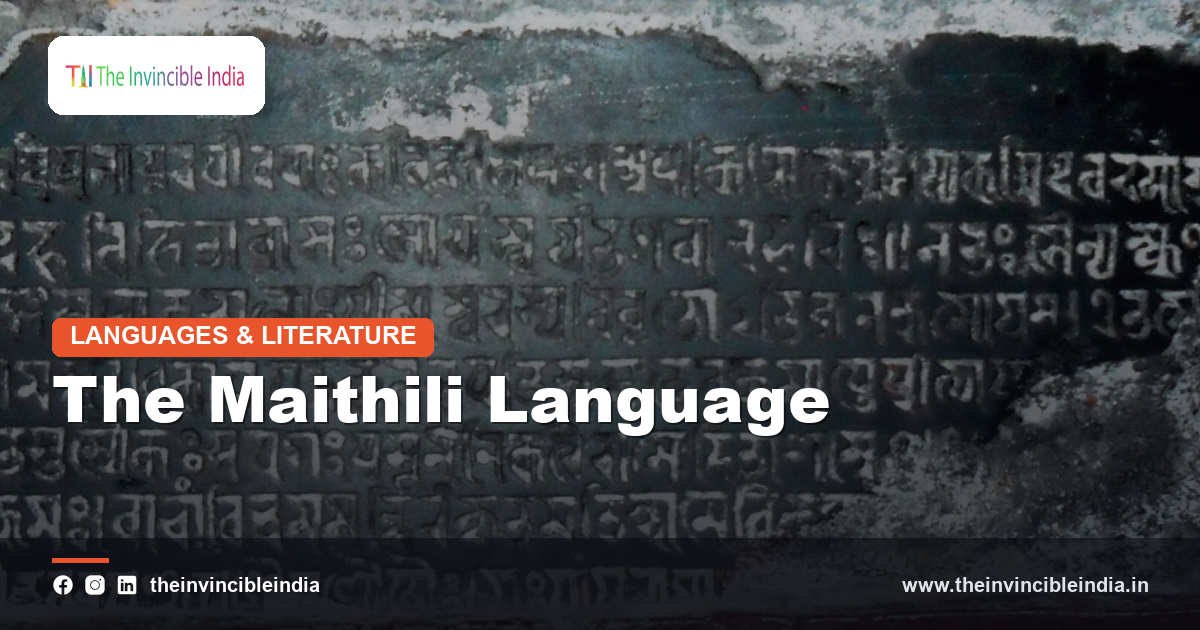
Maithili is an Indo-Aryan language spoken across the Mithila region, an area that straddles the modern border between the Indian state of Bihar and the plains of Nepal. It belongs to the same broad eastern group of languages of India that also includes Bengali and Odia, sharing with them a gradual descent from earlier Prakrit and Apabhramsha speech. Maithili is notable for its own historic script, its association with the celebrated poet Vidyapati, and a continuing tradition of folk song and oral literature that runs alongside its written heritage. Its recognition as a distinct literary and scheduled language affirms its long-standing cultural significance in eastern India.
Quick Facts
| Detail | Information |
|---|---|
| Language Family | Indo-Aryan (Indo-European) |
| Primary Regions | Mithila region: north Bihar and adjoining Nepal |
| Historic Script | Tirhuta (Mithilakshar) |
| Common Script Today | Devanagari |
| Notable Poet | Vidyapati |
| Status | Scheduled language of India |
Origins and Classification
Maithili belongs to the eastern group of Indo-Aryan languages, placing it among relatives such as Bengali, Odia, and Assamese, all of which descend from related Prakrit and Apabhramsha speech forms that developed across the eastern Gangetic plain. Its emergence as a distinct language is closely tied to the historical region of Mithila.
Over time, Maithili developed its own grammar, vocabulary, and literary conventions distinct from neighbouring Bhojpuri and Bengali, even as it shared certain features with both due to geographic proximity. This gradual differentiation gave Maithili a recognisable identity as the language of a specific cultural region rather than a mere dialect.
The Mithila Region
Mithila refers to a historic cultural region that spans the northern part of the Indian state of Bihar and extends into the adjoining plains of Nepal, an area long associated with learning, ritual scholarship, and artistic tradition. Maithili takes its name directly from this region.
The region’s identity is closely bound up with the language, and Mithila’s distinct customs, festivals, and artistic practices, including its well-known painting tradition, are often discussed together with Maithili language and literature as expressions of a shared regional culture.
Historically, Mithila was also known as a centre of scholarship, particularly in fields of logic, ritual, and classical learning, and this reputation helped shape a broader environment in which Maithili language and literature could develop alongside more formal Sanskrit scholarly pursuits carried on in the same region.
Historical Development from Prakrit
Like other eastern Indo-Aryan languages, Maithili evolved gradually from Magadhi Prakrit and later Apabhramsha speech forms over many centuries, as regional dialects across the eastern Gangetic plain slowly diverged into distinct languages. This long process of change unfolded alongside shifts in political and social life in the region.
By the time Maithili had matured into a distinct literary language, it had developed features that set it apart from its closest neighbours while still sharing a broad family resemblance with them, reflecting its place within the wider eastern Indo-Aryan linguistic landscape.
The Tirhuta Script
Maithili was historically written in its own script, known as Tirhuta or Mithilakshar, which developed within the Mithila region and is related to other eastern Indic scripts of the same broader family. This script was used for centuries in manuscripts, religious texts, and correspondence.
Tirhuta has a distinctive visual character shaped by regional scribal traditions, and its use marks Maithili as one of several Indian languages that possessed a script closely tied to a specific cultural region. Though Devanagari is more commonly used for Maithili today, Tirhuta remains an important symbol of the language’s historical depth.
Transition to Devanagari
Over the modern period, Devanagari gradually became the more widely used script for Maithili in print, education, and administration, largely because of its shared use across many other Indian languages and its broader familiarity. This shift eased the practical challenges of printing and teaching Maithili alongside Hindi.
Despite this transition, interest in the historic Tirhuta script has persisted among scholars and cultural institutions, who view it as an important part of Maithili’s heritage. Efforts to preserve knowledge of Tirhuta continue alongside the everyday use of Devanagari for the language.
Early Literary Tradition
Maithili’s literary tradition reaches back many centuries, with early works often composed in devotional and courtly contexts that reflected the intellectual and religious life of the Mithila region. These early compositions laid the groundwork for the language’s later poetic achievements.
The region’s long-standing reputation for scholarship, particularly in areas such as logic and ritual studies, provided a cultural environment in which Maithili literature could flourish, even as much of formal scholarly writing in the region continued to be conducted in Sanskrit.
Vidyapati and Maithili Poetry
The poet Vidyapati stands as the most celebrated figure in Maithili literary history, renowned for lyrical verse that combined devotional themes with vivid depictions of human emotion. His poetry helped establish Maithili as a serious literary language distinct from Sanskrit and other regional tongues.
Vidyapati’s work is often noted for its influence beyond Mithila, including on poetic traditions in neighbouring regions, and his verses continue to be read, sung, and studied as a foundational part of Maithili’s literary canon centuries after they were composed.
Generations of singers have set Vidyapati’s verses to music, and these musical renderings have carried his poetry well beyond the readership of printed books, embedding his language and imagery into the everyday devotional and cultural life of the wider Mithila region.
Themes in Classical Maithili Verse
Classical Maithili poetry often drew on devotional themes, particularly those centred on divine love and longing, expressed through richly emotional and lyrical language. These themes resonated with broader currents in devotional literature found across many regions of India.
Alongside devotional content, classical Maithili verse also engaged with courtly and social life, reflecting the concerns and aesthetics of the audiences for whom it was composed. This combination of the devotional and the courtly gives classical Maithili literature its distinctive emotional range.
Folk Songs and Oral Traditions
Maithili possesses a deep tradition of folk songs associated with weddings, seasonal festivals, and everyday rural life, many of which have been passed down orally through generations of singers, particularly women in domestic and community settings. These songs remain a vital living tradition.
This oral heritage complements the region’s written literary achievements and provides insight into everyday beliefs, humour, and social customs in Mithila. Folk songs in Maithili continue to be performed at festivals and family occasions, preserving linguistic and musical patterns of considerable antiquity.
Maithili and Madhubani Painting
The Mithila region is also known for its distinctive folk painting tradition, often called Madhubani or Mithila painting, which shares thematic and cultural ground with Maithili oral and literary traditions. Both art forms draw on shared regional stories, deities, and symbols.
This close connection between visual and verbal art in Mithila illustrates how Maithili culture expresses itself across multiple mediums, with painting and poetry often depicting the same festivals, deities, and domestic scenes that populate the region’s songs and stories.
Modern Maithili Literature
The modern period saw Maithili literature expand into prose forms such as the novel, short story, and essay, alongside a continuing tradition of poetry, as writers engaged with contemporary social and personal themes. This expansion helped Maithili adapt to changing literary tastes and forms.
Modern Maithili writers have addressed subjects ranging from rural life and social change to individual experience, contributing to a body of literature that builds on the language’s classical foundations while speaking to present-day concerns of its readers.
Recognition as a Scheduled Language
Maithili’s inclusion among India’s officially recognised scheduled languages marked an important milestone, affirming its status as a distinct language with its own literary tradition rather than a dialect of Hindi or Bengali. This recognition followed sustained advocacy by speakers and literary bodies.
The scheduled status has supported greater institutional attention to Maithili in areas such as education, publishing, and cultural promotion, reinforcing the language’s standing as an important part of India’s linguistic diversity.
Maithili in Education and Public Life
Maithili is taught and studied in schools and universities in parts of Bihar and is used in some local media and publishing, helping sustain its use among younger generations alongside Hindi. Literary societies and cultural organisations continue to promote Maithili language activities.
These institutional efforts exist alongside the language’s everyday use in homes and communities across Mithila, reflecting a layered relationship between formal educational support and the ongoing informal transmission of Maithili within families.
Digital platforms and community radio have more recently added new avenues for Maithili expression, giving younger speakers additional ways to encounter and use the language outside formal classroom settings, and complementing the long-standing role of print publishing and traditional performance.
The Nepal Connection
Because the historic Mithila region extends across the modern India-Nepal border, Maithili is also widely spoken in Nepal’s Terai plains, where it holds significant cultural and linguistic presence among local communities. This cross-border continuity is an important feature of the language.
Maithili speakers in Nepal maintain their own literary and cultural institutions, and the language’s shared heritage across both countries illustrates how linguistic regions in South Asia can extend beyond modern national boundaries while retaining a coherent cultural identity.
Maithili Drama and Performance Traditions
Alongside its poetry and prose, Maithili has a tradition of drama and performance, with plays and dramatic recitations drawing on both classical literary themes and everyday rural life in the Mithila region. These performances often bring Maithili literature to audiences beyond the printed page.
Community theatre groups and cultural associations in Bihar and Nepal continue to stage Maithili drama at festivals and public gatherings, helping keep the language vibrant in a performative, communal setting rather than confining it to formal study alone.
Such performances frequently intertwine song, dialogue, and movement in ways that echo the region’s broader folk traditions, illustrating how Maithili’s dramatic culture draws naturally on the same wellspring of oral storytelling that also sustains its folk songs and painting traditions.
Maithili Proverbs and Oral Wisdom
Maithili speech is rich with proverbs and idiomatic expressions that convey practical wisdom, humour, and social observation, many of which are rooted in the agricultural rhythms and family life of the Mithila countryside. These sayings remain in active everyday use.
Elders often pass such proverbs to younger generations through conversation and storytelling, reinforcing shared cultural values while also demonstrating the expressive flexibility of the Maithili language in capturing everyday human experience with brevity and wit.
The Maithili Language Today
Today, Maithili continues to be actively spoken, sung, and written across the Mithila region in both India and Nepal, sustained by a combination of formal recognition, educational support, and a deeply rooted oral culture. Its historic script and classical poetry remain sources of pride.
As Maithili writers continue to produce new literature and as folk traditions persist in villages and towns alike, the language stands as a living link between a distinguished literary past and the everyday cultural life of the Mithila region in the present day.
Sources & Further Reading
- Ministry of Culture, Government of India (indiaculture.gov.in).
- Sahitya Akademi (sahitya-akademi.gov.in).
Frequently Asked Questions
What is the Maithili language known for?
Maithili is known for its historic Tirhuta script, its association with the poet Vidyapati, and a rich oral tradition of folk songs tied to the Mithila region.
Where is Maithili spoken?
Maithili is spoken mainly in the Mithila region, which spans northern Bihar in India and the adjoining plains of Nepal.
What script was traditionally used for Maithili?
Maithili was traditionally written in the Tirhuta or Mithilakshar script, though Devanagari is more widely used for the language today.
Who was Vidyapati?
Vidyapati was a celebrated poet in the Maithili language whose devotional and lyrical verse became a foundational part of the region’s literary tradition.
Is Maithili a recognised language in India?
Yes, Maithili is included among India’s officially recognised scheduled languages, reflecting its distinct literary and cultural heritage.


