

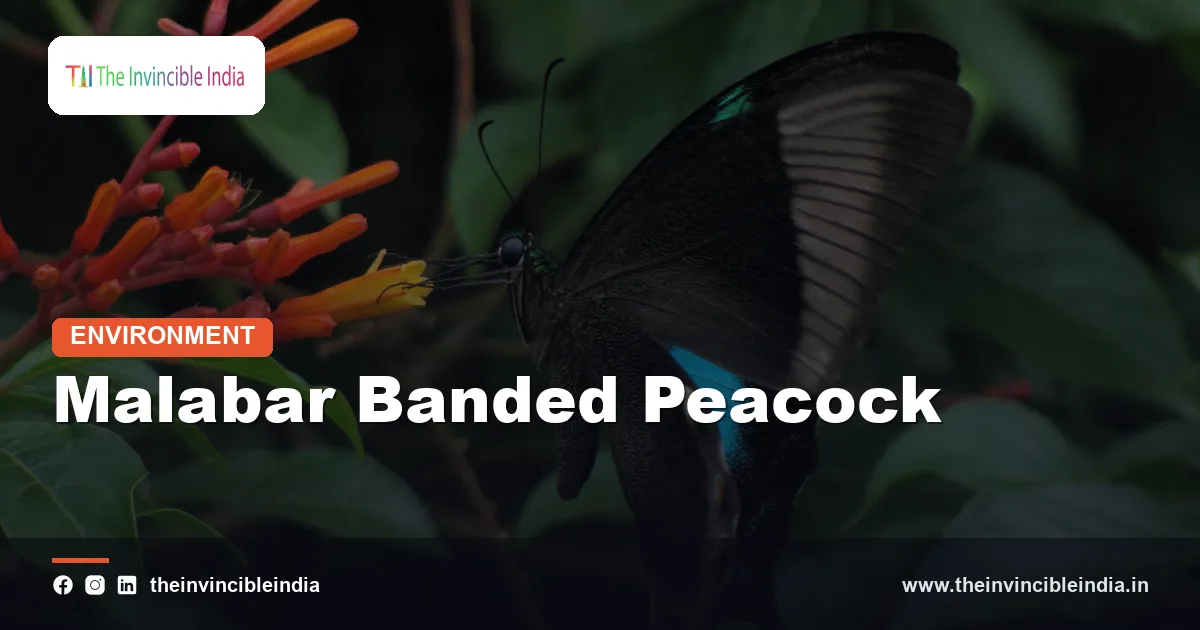
The Malabar banded peacock is a large black swallowtail butterfly, Papilio buddha, with a broad band of shimmering green scales on its wings, found only in the Western Ghats of southern India. It is one of the largest and most striking butterflies of the region, a strong and fast flier of forest canopies and clearings, and it was declared the state butterfly of Kerala in 2020.
The Malabar banded peacock is endemic to the Western Ghats, which means it occurs naturally nowhere else in the world. This explainer describes how to recognise the butterfly, where it lives, what its caterpillars eat, how its life cycle works and why its dependence on hill forests makes it a useful indicator of forest health.
Quick Facts: Malabar Banded Peacock
| Scientific name | Papilio buddha |
|---|---|
| Common names | Malabar banded peacock; Buddha mayoori in Malayalam |
| Family | Papilionidae (swallowtails) |
| Wingspan | Large, roughly 12 to 15 cm, among the biggest butterflies of peninsular India |
| Host plants | Members of the citrus family (Rutaceae), such as Melicope lunu-ankenda, formerly placed in the genus Evodia |
| Range and habitat | Endemic to the Western Ghats; moist deciduous and evergreen forests, forest edges and hill streams |
| Broods | Several broods through the year, with the best numbers in the monsoon and post-monsoon months |
| Flight | Fast and powerful, often high in the canopy; descends to mud and flowers |
| Status note | Kerala’s state butterfly since 2020; protected in India as a wildlife species |
Key Takeaways
- The Malabar banded peacock, Papilio buddha, is a swallowtail butterfly that is endemic to the Western Ghats of southern India.
- The Malabar banded peacock has a wingspan of roughly 12 to 15 cm and is one of the largest butterflies in peninsular India.
- Caterpillars of the Malabar banded peacock feed on plants of the citrus family, Rutaceae, found in forest understorey and canopy.
- Kerala declared the Malabar banded peacock its state butterfly in 2020, giving the species a prominent place in the state’s conservation message.
- The Malabar banded peacock depends on intact Western Ghats forest, so loss of habitat is its main threat.
- Males of the Malabar banded peacock often gather at wet mud and sandy stream banks to take up salts and minerals, a behaviour called mud-puddling.
What is the Malabar banded peacock?
The Malabar banded peacock is a large black swallowtail butterfly of the family Papilionidae, scientifically named Papilio buddha, that is found only in the Western Ghats. Its common name describes the bands of green and bluish scales across its dark wings, which catch the light like the feathers of a peacock.
The butterfly belongs to the genus Papilio, the largest group of swallowtails, which also includes familiar Indian species such as the common mormon, the blue mormon and the common banded peacock. The species name buddha was given by the British naturalist John Obadiah Westwood in 1872. In Malayalam the butterfly is known as Buddha mayoori, meaning the Buddha peacock.
The Malabar banded peacock is notable because only a small number of large swallowtails are restricted to a single mountain range. For this reason, naturalists regard it as a flagship species of the Western Ghats.
How can you identify the Malabar banded peacock?
You can identify the Malabar banded peacock by its large size, velvety black wings and the broad band of green or blue-green scales that runs across both the forewing and hindwing. The hindwing also carries a small cluster of red or crimson spots near the lower edge, and it ends in a short, slightly spoon-shaped tail.
The main features to look for are given here.
- Size: Very large for a butterfly in the region, with a wingspan of around 12 to 15 cm.
- Colour: Black base colour with a wide, glittering band of green and bluish scales.
- Hindwing: A band that seems to shimmer from green to blue depending on the angle of light, with red spots near the margin.
- Underside: Duller and browner than the upper side, with pale markings.
- Flight: Strong, gliding and rapid, usually at mid-height or in the canopy.
The colours of the Malabar banded peacock come mostly from microscopic structures on the scales, not from pigment alone. This is called structural colour, and it is the reason the green seems to change with the angle of the light and the viewer.
How is the Malabar banded peacock different from the common banded peacock?
The Malabar banded peacock differs from the common banded peacock mainly in its range, size and the finer details of its band, since the Malabar species lives only in the Western Ghats and is generally larger and broader in the band. The common banded peacock, Papilio crino, has a wider distribution across India and South Asia.
The two butterflies look similar at a glance, and even experienced observers may need a close photograph to separate them. The comparison below lists the main points.
| Feature | Malabar banded peacock | Common banded peacock |
|---|---|---|
| Scientific name | Papilio buddha | Papilio crino |
| Range | Endemic to the Western Ghats | Wide: Himalayan foothills, north-east, peninsula and neighbouring countries |
| Size | Generally larger | Medium to large, a little smaller |
| Band | Broad band of green and bluish scales | Band of blue-green to green scales, often more blue |
| Habitat | Hill forest with moist conditions | Forest, plantations and well-wooded gardens |
Location is the most reliable clue. A banded peacock seen in the forests of Kerala, Karnataka or Tamil Nadu hills may be either species, while one seen in the Himalayan foothills or in the north-east is the common banded peacock.
Where does the Malabar banded peacock live?
The Malabar banded peacock lives in the Western Ghats, the mountain chain running along India’s west coast, mainly in the moist deciduous and evergreen forests of Kerala, Karnataka, Goa and Tamil Nadu, and in parts of Maharashtra. It prefers forest openings, edges, shaded streams and hill roads where light reaches the ground.
The Western Ghats are recognised as a UNESCO World Heritage Site and as one of the world’s biodiversity hotspots, with a high proportion of endemic plants, amphibians, butterflies and other animals. The Malabar banded peacock is one of the endemic butterflies that make this range scientifically important.
Because the butterfly does not occur outside the Ghats, any large change in the forests of this range directly affects its numbers. It is most easily seen in places where the forest canopy is intact and streams or damp patches provide minerals.
What do Malabar banded peacock caterpillars eat?
Malabar banded peacock caterpillars eat the leaves of trees in the citrus family, Rutaceae, with the forest tree Melicope lunu-ankenda being a recorded host. Like most swallowtails of its group, the species lays its eggs on young, tender leaves of its host plants.
The early caterpillars look like bird droppings, being brown and white with a glossy surface, which helps them avoid predators. Later caterpillars turn green and stout, with a pair of eye-like markings near the head. When disturbed, a caterpillar can push out a forked, orange-red organ called the osmeterium, which gives off an unpleasant smell and deters ants and small predators.
Because the host plants are forest trees, the butterfly is far less common in open farmland, where the citrus family is represented by cultivated lemon and orange plants that other swallowtails prefer.
What is the life cycle of the Malabar banded peacock?
The life cycle of the Malabar banded peacock has four stages: egg, caterpillar, pupa and adult butterfly, in a process called complete metamorphosis. A single female lays eggs one at a time on tender host leaves, and the cycle may be completed several times in a year.
- Egg: A small, round, pale egg is laid singly on a fresh leaf.
- Caterpillar: The larva passes through five growth stages, called instars, shedding its skin between each one.
- Pupa: The fully grown caterpillar forms a pupa, or chrysalis, attached to a twig or leaf by a silk girdle and a silk pad. It is typically green or brown and well camouflaged.
- Adult: The adult butterfly emerges after about one to three weeks, depending on the weather, dries its wings and takes flight.
Adult swallowtails of this kind may live for a few weeks. Broods follow the rains, and the number of butterflies rises when new leaves appear on the host trees.
What does the Malabar banded peacock feed on?
The adult Malabar banded peacock feeds on nectar from forest flowers and takes minerals from damp soil. Males in particular settle on wet sand, mud or animal droppings along streams to gather salts, a habit known as mud-puddling.
The butterfly generally keeps its wings spread or half open while feeding, and it flutters its wings continuously at flowers instead of closing them, a behaviour common in large swallowtails. It visits flowers of plants such as lantana, ixora and other forest-edge flowering plants, and it can be approached while it drinks at mud patches.
This feeding habit is why wet forest roads, stream banks and quiet clearings are the best places in the Ghats to see the butterfly in the open.
How does the Malabar banded peacock defend itself?
The Malabar banded peacock defends itself mainly through speed, camouflage in its early stages and chemical or visual deterrents in its caterpillar stage. The adult relies on rapid, erratic flight high in the canopy, which makes it hard for birds, lizards and other predators to catch.
The eggs and young caterpillars are small and cryptic, while the grown caterpillar can display a false-eyed pattern and raise its forked osmeterium. The pupa is green or brown and blends into the twig or leaf on which it hangs. Mimicry of unpalatable butterflies is a well-studied topic among swallowtails, although the details differ by species and region.
For observers, the practical point is that the butterfly is wary. It usually settles only briefly at flowers and may return to the same mud patch several times in a morning, so patient watching from a distance gives the best view.
Why is the Malabar banded peacock important for conservation?
The Malabar banded peacock is important for conservation because it is endemic to the Western Ghats and depends on healthy forest, which makes it a visible indicator of the condition of this biodiversity hotspot. Declining numbers would signal degradation of the forest it relies on.
The main pressures on the butterfly come from loss and fragmentation of forest, conversion of land to plantations and settlements, quarrying and road building in hill areas, and the loss of host trees. Collecting for the trade in butterflies is another concern, so Indian wildlife law protects many butterfly species, and the Wildlife (Protection) Act, 1972 prohibits capture and trade of the protected ones.
By naming the butterfly as the state butterfly of Kerala in 2020, the state drew public attention to butterfly conservation. Butterfly counts, citizen-science projects and forest-department butterfly gardens help to monitor the species.
When and where can you see the Malabar banded peacock?
You can see the Malabar banded peacock mostly in the monsoon and post-monsoon months, from roughly June to November, in the forests of the Western Ghats. The butterfly is most active in warm, sunny spells between showers, and it flies from the morning to the early afternoon.
Some practical tips for butterfly watchers are given below.
- Visit wet forest roads, stream crossings and sunlit clearings in protected areas and forest reserves.
- Look for males at damp sand or mud in the morning, when they stop to drink.
- Walk quietly and do not touch the wings, since scales rub off easily.
- Carry binoculars, which allow observers to watch a feeding butterfly without disturbing it.
- Follow forest rules and do not collect specimens, which is illegal for protected species.
Bottom Line
The Malabar banded peacock is a large green-banded swallowtail that exists only in the Western Ghats. Its survival depends on keeping hill forests and their citrus-family trees intact, and its status as Kerala’s state butterfly reflects the value of that effort.
Frequently Asked Questions
What is the scientific name of the Malabar banded peacock?
The scientific name of the Malabar banded peacock is Papilio buddha. It is a swallowtail butterfly of the family Papilionidae and is endemic to the Western Ghats.
Is the Malabar banded peacock found only in India?
Yes, the Malabar banded peacock occurs only in the Western Ghats of southern India. This makes it an endemic species, found naturally nowhere else in the world.
Is the Malabar banded peacock the state butterfly of Kerala?
Yes, Kerala declared the Malabar banded peacock its state butterfly in 2020. In Malayalam the butterfly is called Buddha mayoori.
How big is the Malabar banded peacock butterfly?
The Malabar banded peacock has a wingspan of roughly 12 to 15 cm, which makes it one of the largest butterflies in peninsular India. Its size and fast, gliding flight make it easy to notice in forest clearings.
What do Malabar banded peacock caterpillars feed on?
Malabar banded peacock caterpillars feed on the leaves of forest trees in the citrus family, Rutaceae, such as Melicope lunu-ankenda. Young caterpillars resemble bird droppings, while older ones are green and have a defensive forked organ.
How can I tell the Malabar banded peacock from the common banded peacock?
The easiest way to tell the two apart is the location, since the Malabar banded peacock lives only in the Western Ghats while the common banded peacock occurs across a wider range. The Malabar species is also generally larger and has a broad green-blue band on its wings.
{“@context”:”https://schema.org”,”@graph”:[{“@type”:”FAQPage”,”mainEntity”:[{“@type”:”Question”,”name”:”What is the scientific name of the Malabar banded peacock?”,”acceptedAnswer”:{“@type”:”Answer”,”text”:”The scientific name of the Malabar banded peacock is Papilio buddha. It is a swallowtail butterfly of the family Papilionidae and is endemic to the Western Ghats.”}},{“@type”:”Question”,”name”:”Is the Malabar banded peacock found only in India?”,”acceptedAnswer”:{“@type”:”Answer”,”text”:”Yes, the Malabar banded peacock occurs only in the Western Ghats of southern India. This makes it an endemic species, found naturally nowhere else in the world.”}},{“@type”:”Question”,”name”:”Is the Malabar banded peacock the state butterfly of Kerala?”,”acceptedAnswer”:{“@type”:”Answer”,”text”:”Yes, Kerala declared the Malabar banded peacock its state butterfly in 2020. In Malayalam the butterfly is called Buddha mayoori.”}},{“@type”:”Question”,”name”:”How big is the Malabar banded peacock butterfly?”,”acceptedAnswer”:{“@type”:”Answer”,”text”:”The Malabar banded peacock has a wingspan of roughly 12 to 15 cm, which makes it one of the largest butterflies in peninsular India. Its size and fast, gliding flight make it easy to notice in forest clearings.”}},{“@type”:”Question”,”name”:”What do Malabar banded peacock caterpillars feed on?”,”acceptedAnswer”:{“@type”:”Answer”,”text”:”Malabar banded peacock caterpillars feed on the leaves of forest trees in the citrus family, Rutaceae, such as Melicope lunu-ankenda. Young caterpillars resemble bird droppings, while older ones are green and have a defensive forked organ.”}},{“@type”:”Question”,”name”:”How can I tell the Malabar banded peacock from the common banded peacock?”,”acceptedAnswer”:{“@type”:”Answer”,”text”:”The easiest way to tell the two apart is the location, since the Malabar banded peacock lives only in the Western Ghats while the common banded peacock occurs across a wider range. The Malabar species is also generally larger and has a broad green-blue band on its wings.”}}]}]}


