

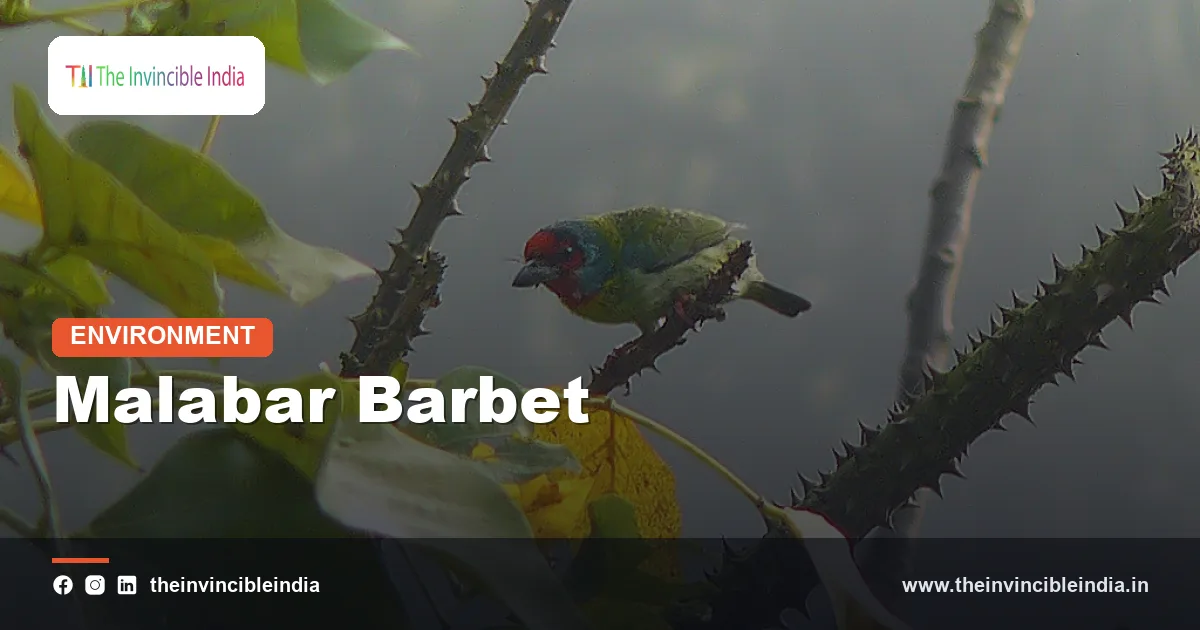
The Malabar barbet (Psilopogon malabaricus) is a small, stocky, green barbet with a crimson forehead and throat that is endemic to the Western Ghats of southwestern India, where its fast, ringing trill is one of the characteristic sounds of the forest. The species belongs to the Asian barbets, a group of big-headed, bristle-faced, fruit-eating birds that nest in holes they chisel into dead wood.
Because the Malabar barbet is green and spends much of its life in the leafy canopy, it is easier to hear than to see. Birdwatchers in Kerala, Karnataka, Goa and neighbouring hill regions usually locate it by its call and then search for the bird perched motionless in a fruiting tree. This explainer covers how to recognise the species, where it lives, what it eats, how it nests and why it matters to the forest.
| Scientific name | Psilopogon malabaricus (formerly placed in the genus Megalaima) |
|---|---|
| Family | Megalaimidae (Asian barbets), treated in some classifications within a broader barbet family |
| Size | About 16 to 18 cm long, a little smaller than a myna |
| Range in India | Endemic to the Western Ghats and adjoining hills of southwestern India |
| Habitat | Evergreen and moist deciduous forest, forest edges, shade plantations of coffee and cardamom, and wooded gardens |
| Diet | Mainly fruit, especially figs and small berries; also flower nectar and some insects |
| Breeding | Nest hole excavated in a dead branch or trunk; typically two to four white eggs; both parents share care |
| Conservation status | Least Concern on the IUCN Red List; protected under the Wildlife (Protection) Act, 1972 |
Key Takeaways
- The Malabar barbet is a small green barbet with crimson patches on the forehead and throat, and it lives only in the Western Ghats region of India.
- The call of the Malabar barbet is a fast, trilling series of notes that carries far through the forest and is the best way to find the bird.
- The Malabar barbet feeds mainly on fruit, particularly wild figs, and it helps disperse the seeds of many forest trees.
- The Malabar barbet nests in a hole that it chisels into a dead branch or trunk, which makes standing dead wood an essential habitat feature.
- The Malabar barbet tolerates shade plantations and wooded gardens, so it is one of the Western Ghats endemics that can be seen outside deep forest.
- The Malabar barbet is assessed as Least Concern, but its entire Indian range lies within the Western Ghats, which is a recognised global biodiversity hotspot.
What Does a Malabar Barbet Look Like?
A Malabar barbet looks like a plump, short-tailed, bright green bird with a large head, a thick pale bill, and crimson patches on the forehead and throat. The body is leaf-green above and paler green below, which makes the bird hard to see when it sits still among foliage.
Plumage and bare parts
The crimson on the head is the main field mark and is set against the green plumage, with bluish and dark tones on parts of the face and neck that give the bird a neat, patterned appearance. The bill is stout and heavy, and bristles at its base are the feature from which the name “barbet” is derived, since the Latin word barba means beard. The legs are short and strong, and the toes are arranged two forward and two backward, which is useful for gripping branches and clinging to trunks.
Size and shape
The Malabar barbet is roughly 16 to 18 cm long, which makes it about the size of a bulbul or a little larger. Males and females look alike to the human eye, and juveniles are duller, with less red on the head. In poor light the bird can look like a green blob with a heavy bill.
Similar species
Several other barbets overlap with the Malabar barbet in parts of its range, and they differ in head markings and voice.
- Coppersmith barbet: a smaller, more familiar bird with a red forehead, yellow patches around the eyes and a streaked underbody; its call is a metallic “tuk, tuk”.
- White-cheeked barbet: a larger bird with a streaked brown head and a white cheek patch.
- Brown-headed barbet: a larger green barbet with a brown, streaked head and a loud repeated “kutroo” call.
Where Does the Malabar Barbet Live?
The Malabar barbet lives in the forests and wooded landscapes of the Western Ghats and adjoining hills of southwestern India, and it is not found elsewhere in the country. It is described as an endemic species because its distribution is restricted to this one mountain region.
The Western Ghats form a long chain of hills running down the western edge of the Deccan plateau, from near the Tapi River in the north to the southern tip of the peninsula. They receive heavy monsoon rain and hold evergreen, semi-evergreen and moist deciduous forests, as well as grasslands and plantations. The region is listed as a UNESCO World Heritage property and is widely recognised as a global biodiversity hotspot.
Habitats used
- Tall evergreen and semi-evergreen forest, where fig trees and other fruiting species are plentiful.
- Moist deciduous forest and forest edges at low and middle elevations.
- Coffee, cardamom and tea plantations that retain large shade trees.
- Gardens and estates in hill towns that have old fruiting trees.
The Malabar barbet is generally a bird of low and mid-level hills rather than of the highest elevations, and it favours places where tall trees are close together. Its tolerance of shade-grown plantations means that well-managed agroforestry can keep populations in landscapes that are no longer pristine.
What Sound Does the Malabar Barbet Make?
The Malabar barbet makes a fast, rolling trill, a rapid series of notes delivered from a high perch, which carries a long way through the forest. The sound is repeated for long periods, especially in the morning and during the breeding season, and it often gives away the presence of the bird long before it is seen.
Barbet calls are central to their lives for the following reasons.
- Territory: a calling male announces that a fruiting tree and its surroundings are occupied.
- Pair bonding: mated birds may duet or call in turn from nearby perches.
- Dense habitat: in a green canopy where visibility is poor, voice is the main channel of communication.
To a listener, the call can resemble a rapid mechanical rattle and, at a distance, the trill blends with other forest sounds. Learning it is the quickest way to detect the species, and many records of the bird in surveys are based on hearing rather than sight.
What Does the Malabar Barbet Eat?
The Malabar barbet eats mainly fruit, especially the small figs of wild Ficus trees, together with other berries, occasional flower nectar and some insects. Fruit makes up the bulk of the diet, and the bird is a frequent visitor to fruiting trees in the forest.
Many different trees supply food during the year. Figs are particularly important because different species fruit at different times, so that some tree in the forest is usually bearing fruit even when most others are not. Fig trees are therefore often called keystone resources, since they sustain a large number of birds and mammals through the lean season.
Role as a seed disperser
The Malabar barbet swallows small fruits whole, digests the pulp and later passes or regurgitates the seeds, sometimes far from the parent tree. This movement of seeds helps forests regenerate and spreads plant species across the landscape. Barbets are among the many fruit-eating birds, along with bulbuls, hornbills, pigeons and mynas, that share this ecological job.
Insects and other food
Insects are taken as a supplement, particularly when the birds are feeding chicks. Caterpillars, beetles and other small invertebrates supply protein that growing nestlings need. Barbets also sometimes visit flowering trees for nectar, and in the process may carry pollen between blossoms.
How Does the Malabar Barbet Nest?
The Malabar barbet nests in a cavity that it excavates itself in a dead or decaying branch or trunk, typically laying two to four white eggs. Like woodpeckers, barbets chisel nest holes with their bills, although they are not true woodpeckers and are less powerful excavators.
The nest hole
The pair selects a soft, dead limb, often high above the ground, and cuts a small round entrance that leads to a chamber below. Wood chips fall to the ground, and the process may take days or longer. The cavity is not lined with elaborate material, and the eggs rest on the wood floor or a thin bed of chips.
Eggs and chicks
Both the male and the female incubate the eggs and feed the chicks, bringing fruit and insects to the nest. The chicks hatch blind and naked and grow slowly inside the protected chamber. When they fledge, they are fully feathered and capable of flight, although parents may continue to feed them for some time.
Why dead wood matters
Dead trees and snags are often removed from managed landscapes because they look untidy or are considered unsafe. For cavity-nesting birds, however, they are essential nesting infrastructure. Leaving standing dead wood, where it is safe to do so, supports barbets, woodpeckers, owls, hoopoes and many other species. Abandoned barbet holes are also used by other animals, including small owls, flying squirrels and bees.
Is the Malabar Barbet Endemic to India?
Yes, the Malabar barbet is endemic to India, because its entire range lies within the Western Ghats and neighbouring hill ranges of the southwest. Endemic species matter because their survival depends on one region, and any serious loss of habitat there threatens the whole species.
The Western Ghats have many endemic birds. The Malabar barbet is one of a group of such species that are restricted to this mountain belt and its associated forests. Others include the Malabar grey hornbill, the Malabar parakeet, the white-bellied blue flycatcher and the grey-headed bulbul, among many more. Birdwatchers often seek out these endemics on trips to Kerala, Karnataka, Goa and Tamil Nadu.
| Feature | Western Ghats landscape | Relevance to the Malabar barbet |
|---|---|---|
| Forest type | Evergreen, semi-evergreen and moist deciduous | Provides fig and other fruiting trees |
| Rainfall | Heavy monsoon rain on the western slopes | Supports tall canopy and year-round fruit |
| Plantations | Coffee, tea and cardamom estates with shade trees | Alternative habitat and nest sites |
| Protected areas | National parks, sanctuaries and tiger reserves along the range | Safe core habitat for resident birds |
How Does the Malabar Barbet Differ from the Coppersmith Barbet?
The Malabar barbet differs from the coppersmith barbet in its habitat, its voice and its markings: it is a forest bird of the Western Ghats with a fast trilling call, whereas the coppersmith barbet is a widespread bird of towns and open woodland with a steady, metallic “tuk-tuk” call. The two can be seen in the same general region, and learning to separate them is a useful exercise for beginners.
- Voice: the Malabar barbet gives a rapid trill, while the coppersmith repeats a single note at a regular rhythm, like a hammer on metal.
- Head pattern: the Malabar barbet has crimson on the forehead and throat; the coppersmith has a red forehead and a red chest patch with yellow around the eyes and throat.
- Underparts: the coppersmith has heavily streaked underparts, while the Malabar barbet is plain green below.
- Range: the coppersmith occurs across much of India, whereas the Malabar barbet is limited to the southwest hills.
What Is the Conservation Status of the Malabar Barbet?
The Malabar barbet is classified as Least Concern on the IUCN Red List, and it is legally protected in India as a wild bird under the Wildlife (Protection) Act, 1972. It is considered reasonably common within suitable habitat across its restricted range.
Even so, a Least Concern rating should not be read as a guarantee of safety for an endemic species. The Western Ghats have lost a great deal of natural forest over the past two centuries to plantations, agriculture, dams, roads and settlements. Further fragmentation could reduce the large fruiting trees and dead wood on which the barbet depends.
Threats
- Clearing of natural forest for agriculture, plantations and infrastructure.
- Removal of old fruiting trees and dead standing timber from estates and gardens.
- Pesticide use that reduces insect food for nestlings.
- Climate change, which may shift fruiting times and forest composition in the long term.
What helps
- Protecting forest corridors that connect hill reserves.
- Keeping shade trees in coffee and cardamom estates.
- Retaining safe standing dead wood for nesting.
- Planting native fruiting trees in gardens and restoration projects.
How Can You See a Malabar Barbet?
You can see a Malabar barbet by visiting forests, estates and wooded hill towns in the Western Ghats and by first locating the bird by its trilling call, then scanning the upper branches of a fruiting tree. The best time is early morning, when birds call most actively and visit fig trees to feed.
- Look for fruiting fig trees, which attract several bird species and make waiting worthwhile.
- Listen for the rapid trill and track it to a high exposed perch.
- Scan slowly, because the green plumage blends with foliage and the bird often sits still for long periods.
- Keep a respectful distance from nest holes, and avoid tapping or disturbing the tree.
- Carry binoculars, and use a field guide or a bird-sound app to compare similar barbet calls.
Bottom Line
The Malabar barbet is a small, green, fruit-eating bird whose trill is a signature sound of the Western Ghats. It links fig trees, dead wood and forest regeneration, and its fortunes depend on keeping large trees standing across one of the most important biodiversity regions in India.
Frequently Asked Questions
What is the Malabar barbet?
The Malabar barbet is a small green barbet with a crimson forehead and throat that is endemic to the Western Ghats of southwestern India. It feeds mainly on fruit, especially figs, and nests in holes it chisels into dead wood. It is best known for its fast, ringing trill.
Where is the Malabar barbet found?
The Malabar barbet is found in the Western Ghats and adjoining hills of southwestern India, in evergreen and moist deciduous forests and shade plantations. It does not occur elsewhere in the country. Birdwatchers commonly look for it in Kerala, Karnataka, Goa and Tamil Nadu.
What does the Malabar barbet eat?
The Malabar barbet eats mostly fruit, especially the small figs of wild Ficus trees, along with berries and occasional nectar. It also catches insects, which become important when it is feeding chicks. By swallowing fruit whole, it spreads seeds through the forest.
How can you identify a Malabar barbet by its call?
You can identify a Malabar barbet by its call because it gives a fast, rolling trill from a high perch, unlike the steady “tuk-tuk” of the coppersmith barbet. The trill is repeated for long stretches, especially in the morning. Listening for it is the easiest way to find the bird.
How does the Malabar barbet nest?
The Malabar barbet nests in a hole that it excavates in a dead branch or trunk, usually laying two to four white eggs. Both parents incubate and feed the chicks with fruit and insects. Standing dead wood is therefore an important habitat requirement.
Is the Malabar barbet endangered?
No, the Malabar barbet is not endangered and is classified as Least Concern on the IUCN Red List. Because it lives only in the Western Ghats, however, it depends on the protection of forests and large trees in that region. It is legally protected in India under the Wildlife (Protection) Act, 1972.
{“@context”:”https://schema.org”,”@graph”:[{“@type”:”FAQPage”,”mainEntity”:[{“@type”:”Question”,”name”:”What is the Malabar barbet?”,”acceptedAnswer”:{“@type”:”Answer”,”text”:”The Malabar barbet is a small green barbet with a crimson forehead and throat that is endemic to the Western Ghats of southwestern India. It feeds mainly on fruit, especially figs, and nests in holes it chisels into dead wood. It is best known for its fast, ringing trill.”}},{“@type”:”Question”,”name”:”Where is the Malabar barbet found?”,”acceptedAnswer”:{“@type”:”Answer”,”text”:”The Malabar barbet is found in the Western Ghats and adjoining hills of southwestern India, in evergreen and moist deciduous forests and shade plantations. It does not occur elsewhere in the country. Birdwatchers commonly look for it in Kerala, Karnataka, Goa and Tamil Nadu.”}},{“@type”:”Question”,”name”:”What does the Malabar barbet eat?”,”acceptedAnswer”:{“@type”:”Answer”,”text”:”The Malabar barbet eats mostly fruit, especially the small figs of wild Ficus trees, along with berries and occasional nectar. It also catches insects, which become important when it is feeding chicks. By swallowing fruit whole, it spreads seeds through the forest.”}},{“@type”:”Question”,”name”:”How can you identify a Malabar barbet by its call?”,”acceptedAnswer”:{“@type”:”Answer”,”text”:”You can identify a Malabar barbet by its call because it gives a fast, rolling trill from a high perch, unlike the steady “tuk-tuk” of the coppersmith barbet. The trill is repeated for long stretches, especially in the morning. Listening for it is the easiest way to find the bird.”}},{“@type”:”Question”,”name”:”How does the Malabar barbet nest?”,”acceptedAnswer”:{“@type”:”Answer”,”text”:”The Malabar barbet nests in a hole that it excavates in a dead branch or trunk, usually laying two to four white eggs. Both parents incubate and feed the chicks with fruit and insects. Standing dead wood is therefore an important habitat requirement.”}},{“@type”:”Question”,”name”:”Is the Malabar barbet endangered?”,”acceptedAnswer”:{“@type”:”Answer”,”text”:”No, the Malabar barbet is not endangered and is classified as Least Concern on the IUCN Red List. Because it lives only in the Western Ghats, however, it depends on the protection of forests and large trees in that region. It is legally protected in India under the Wildlife (Protection) Act, 1972.”}}]}]}


