

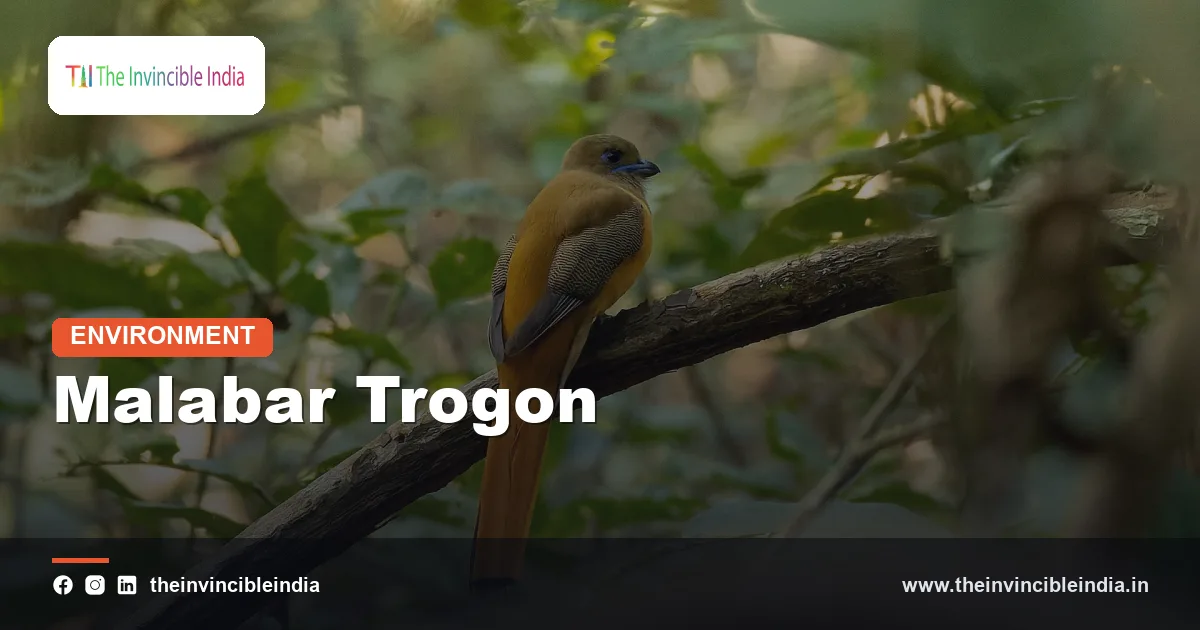
The Malabar trogon (Harpactes fasciatus) is a brilliantly coloured, long-tailed forest bird of the Western Ghats and other hill and moist forests of peninsular India and Sri Lanka, in which the male has a dark head and breast and a vivid crimson belly. Though its colours are among the boldest of any Indian bird, the Malabar trogon sits so still in the shaded mid-storey of the forest that it is often missed even when it is only a few metres away.
The species is a favourite target of birdwatchers visiting Kerala, Karnataka, Tamil Nadu and Goa, and it is a good indicator of healthy forest with old trees and plentiful insects. This explainer covers how to identify the Malabar trogon, where it lives, what it eats, how it nests and how it differs from other trogons of India.
| Attribute | Details |
|---|---|
| Common name | Malabar trogon |
| Scientific name | Harpactes fasciatus |
| Family and order | Trogonidae (trogons), order Trogoniformes |
| Size | Roughly 28 to 31 cm long, with a long, squared tail |
| Range and habitat in India | Evergreen, semi-evergreen and moist deciduous forest, mainly in the Western Ghats, with scattered populations in other hill forests of peninsular India |
| Diet | Insects such as moths, mantises, cicadas and caterpillars, plus spiders, small lizards and occasional fruit |
| Breeding | Nests in tree hollows or rotten stumps, generally in the dry season; clutch of about two to four eggs |
| Conservation status | Least Concern on the IUCN Red List; dependent on intact forest |
Key Takeaways
- The Malabar trogon is a medium-sized forest bird, about 28 to 31 cm long, with a long tail and soft, thin-skinned plumage.
- Male Malabar trogons have a dark head and breast, a thin white breast band, a bluish eye-ring and a bright crimson belly, while females have a buff to orange belly and a brown head.
- The Malabar trogon is found mainly in the Western Ghats and in hill forests of peninsular India and Sri Lanka.
- The Malabar trogon hunts insects by flying out from a perch, snatching prey from leaves or the air and returning to the same branch.
- Malabar trogons nest in holes in rotting wood and lay about two to four eggs, with both parents sharing nest duties.
- The Malabar trogon is classified as Least Concern, but it depends on mature, undisturbed forest and is sensitive to habitat loss.
What is the Malabar trogon?
The Malabar trogon is a member of the trogon family Trogonidae and the genus Harpactes, a group of Old World trogons found in South and South-East Asia. The family name comes from a Greek word meaning “gnawing” and refers to the way trogons use their serrated bills to grip food.
The common name refers to the Malabar coast of south-western India, where the species is most readily found. Trogons are an ancient group of birds with a limited number of species, and the Malabar trogon is one of only a few trogon species found in India.
As a resident bird, the Malabar trogon stays in its forest home through the year, though it may move short distances locally according to food and weather. Unlike many forest birds, it spends long periods perched upright and motionless rather than flitting restlessly through the canopy.
How can you identify a Malabar trogon?
A Malabar trogon can be identified by its upright posture, long tail and, in the male, a dark head and breast sharply separated from a crimson belly by a narrow white band. The female is less showy, with a brown head and breast and a buff to orange-tinged belly.
- Male head and breast: The head, neck and upper breast are dark, almost black, contrasting with the red underparts.
- Breast band: A thin white band separates the dark breast from the red belly.
- Eye-ring: A patch of bare blue skin around the eye gives the bird a distinctive look.
- Upperparts: The back is brown, and the wing coverts carry fine black and white vermiculations that give a grey, finely barred effect.
- Tail: The long tail is rufous-brown above and shows black and white barring below when seen from beneath.
- Female: The female lacks the crimson belly, and her underparts are a softer buff or orange-buff.
Trogons have unusually soft, thin skin and delicate feathers, which is why their plumage is easily damaged. The bill is short and broad with a hooked tip, and the feet are small and weak, so the bird seldom walks on the ground.
Where does the Malabar trogon live in India?
The Malabar trogon lives in evergreen, semi-evergreen and moist deciduous forests, especially in the Western Ghats from Goa and Karnataka southward through Kerala and Tamil Nadu. Smaller and more scattered populations are found in other hill forests of peninsular India, and the species also occurs in Sri Lanka.
The bird prefers a specific forest layer and habitat:
- Dense, shady forest with tall trees and a well-developed mid-storey
- Edges of streams, ravines and shaded valleys where insects are abundant
- Bamboo-mixed forest and coffee or cardamom plantations adjoining natural forest
- Low to middle elevations, rather than the highest hill tops
The Western Ghats are recognised internationally as a biodiversity hotspot, and the Malabar trogon is one of many forest birds that depend on this range. Protected areas such as national parks and wildlife sanctuaries across Kerala, Karnataka and Tamil Nadu offer reliable sightings, particularly along shaded forest trails and near streams.
What does the Malabar trogon eat?
The Malabar trogon eats mainly insects, which it catches by flying out from a perch to snatch them from foliage or the air, and it also takes spiders, small lizards and occasional fruit. Moths, caterpillars, mantises, cicadas and beetles form the bulk of its diet.
The feeding technique is called sallying. The trogon sits very still on a mid-level branch, watches for movement, then flutters out, grabs a prey item, often while hovering briefly, and returns to the same or a nearby perch. This low-energy strategy suits its quiet, watchful way of life.
- Insects: Moths, caterpillars, mantises, grasshoppers and large beetles are important food.
- Other invertebrates: Spiders and similar small animals are taken from leaves and bark.
- Small vertebrates: Tree lizards and small frogs are occasionally eaten.
- Fruit: Small fruits supplement the diet at times of the year when insects are fewer.
As a predator of forest insects, the Malabar trogon plays a modest role in controlling caterpillar and moth populations in the forest mid-storey.
Why does the Malabar trogon sit so still?
The Malabar trogon sits so still because it hunts by waiting and watching, and because immobility helps it avoid predators in the dim, dappled light of the forest. A perched bird may remain in the same spot for many minutes, turning its head slowly to scan for insects.
This behaviour is characteristic of trogons worldwide. The upright posture, with the tail hanging straight down, helps the bird blend in with vertical branches and hanging leaves. A male’s red belly may be hidden when the bird perches with its back toward the observer, so many sightings are of the brown back and tail rather than the red underparts.
Because of this stillness, finding a trogon requires patience. Birders often locate the bird by sound first, then scan the shaded mid-storey carefully, looking for an unusual upright shape and the long tail. Sudden movement is the quickest way to scare the bird away.
What does the Malabar trogon sound like?
The Malabar trogon gives a soft, rolling, mewing series of whistled notes, usually delivered from a perch in the mid-storey. The call is low in volume and carries only a modest distance, which makes it easy to overlook in a noisy forest.
Calling is most frequent in the early morning and in the breeding season, when males advertise their territories and pairs keep in contact. The sound of a trogon is often described as plaintive or cat-like. A bird may also make a short, dry rattling note when alarmed.
Because the bird calls without moving, recordings and careful listening are valuable tools. Some observers walk slowly along forest trails, stopping every few minutes to listen for the characteristic notes before searching with binoculars.
How does the Malabar trogon breed?
The Malabar trogon breeds by nesting in holes in rotting wood, such as decayed tree stumps and trunks, generally in the dry season, and lays about two to four eggs. The pair may excavate or enlarge a cavity in soft, decayed wood, and the nest has little or no lining.
The stages of breeding are typically as follows:
- Courtship: Males call and display to females, and the pair stays close during the nesting period.
- Nest site: A cavity is chosen in a rotting trunk or stump, often at a low to moderate height.
- Eggs: The eggs are white or off-white and rounded.
- Incubation and care: Both male and female share incubation and feeding of the chicks.
- Diet of chicks: Young birds are fed mainly on insects and caterpillars brought by the parents.
Suitable nest sites depend on old, decaying trees, which are often removed during logging or clearing. As a result, the Malabar trogon is vulnerable to the loss of old-growth habitat, even though it remains fairly widespread.
How is the Malabar trogon different from other Indian trogons?
The Malabar trogon differs from other Indian trogons mainly in its range and plumage, being the species of the Western Ghats and southern hill forests with a red belly and dark breast. The table below compares it with two other trogons found in India.
| Feature | Malabar trogon | Red-headed trogon | Orange-breasted trogon |
|---|---|---|---|
| Scientific name | Harpactes fasciatus | Harpactes erythrocephalus | Harpactes oreskios |
| Main Indian range | Western Ghats and southern and peninsular hill forests | Himalayan foothills and the north-east | North-eastern India |
| Male head colour | Dark brown to black | Red | Olive-grey |
| Male underparts | Crimson belly with a white breast band | Red belly with a white breast band | Orange-yellow underparts |
| Habitat | Evergreen and moist deciduous forest | Hill and montane forest | Lowland and foothill forest |
Range is the simplest way to separate the species: a trogon in the Western Ghats is almost certainly a Malabar trogon, while one in the north-east is more likely to be a red-headed or orange-breasted trogon.
Is the Malabar trogon threatened?
The Malabar trogon is not globally threatened and is classified as Least Concern on the IUCN Red List, but its population depends on the survival of mature, shaded forest. Forest fragmentation, felling of old trees and conversion of land to plantations or agriculture can reduce suitable habitat.
The main pressures on the species include:
- Habitat loss: Clearing of evergreen and moist deciduous forest removes feeding and nesting sites.
- Fragmentation: Roads, dams and settlements divide forest into smaller patches that support fewer birds.
- Loss of old trees: Dead and decaying trunks are essential for nesting.
- Pesticides: Chemical use near plantations can reduce insect prey.
- Disturbance: Heavy tourism or noise in sensitive forest areas may disturb breeding birds.
Much of its habitat in the Western Ghats lies within reserved forests, wildlife sanctuaries and national parks, which are protected under the Wildlife (Protection) Act, 1972. Wild birds in India are broadly covered by this law, and capturing them is prohibited.
How can you see a Malabar trogon?
You can see a Malabar trogon by walking slowly along shaded forest trails in the Western Ghats in the early morning, listening for its soft call and scanning the mid-storey for a still, upright bird with a long tail. Patience and quiet movement matter more than speed.
- Best time: The first two hours after sunrise, and again in the late afternoon, are usually best.
- Best habitat: Look near streams, forest edges and shaded paths with tall trees.
- Look carefully: A trogon may be perched silently only a few metres from the path.
- Use binoculars: The bird is easily frightened, so watching from a distance is better.
- Respect nests: Never approach a nest hole, and avoid sharing exact nest locations publicly.
Guided walks in forest reserves, with local naturalists who know the territories, often give the best chance of a clear sighting. Playback of recorded calls should be avoided, particularly in the breeding season.
Bottom Line
The Malabar trogon is a still, long-tailed forest bird whose crimson-bellied male is among the most striking sights in the Western Ghats. It is classified as Least Concern, yet it relies on shady, mature forest with old decaying trees, so forest protection is what keeps it in the landscape.
Frequently Asked Questions
What is the Malabar trogon?
The Malabar trogon is a colourful, long-tailed forest bird, Harpactes fasciatus, found mainly in the Western Ghats and other hill forests of peninsular India and Sri Lanka. The male has a dark head and breast with a crimson belly. It belongs to the trogon family Trogonidae.
Where can you see the Malabar trogon in India?
The Malabar trogon is best seen in evergreen and moist deciduous forests of the Western Ghats, including parts of Goa, Karnataka, Kerala and Tamil Nadu. Shaded trails near streams in national parks and sanctuaries are the most reliable places. Early morning is the best time to look.
How do you tell a male Malabar trogon from a female?
A male Malabar trogon has a dark head and breast, a thin white breast band and a crimson belly, while a female has a brown head and breast and a buff to orange belly. Both sexes have a long tail, and the male also shows a bluish patch of skin around the eye. The female is more subdued in colour overall.
What does the Malabar trogon eat?
The Malabar trogon eats mainly insects such as moths, caterpillars, mantises, cicadas and beetles. It also takes spiders, small lizards and occasionally fruit. It hunts by flying out from a perch to snatch prey and then returning to the same branch.
Why does the Malabar trogon sit so still?
The Malabar trogon sits still because it is a sit-and-wait hunter and because stillness helps it avoid predators in dim forest light. A perched bird may stay in one place for many minutes, scanning for insects. This makes it hard to find even though its colours are bold.
Is the Malabar trogon endangered?
No, the Malabar trogon is classified as Least Concern on the IUCN Red List. It does, however, depend on mature forest with old, decaying trees for nesting, so habitat loss and fragmentation are real concerns. Protected areas in the Western Ghats help safeguard its habitat.
{“@context”:”https://schema.org”,”@graph”:[{“@type”:”FAQPage”,”mainEntity”:[{“@type”:”Question”,”name”:”What is the Malabar trogon?”,”acceptedAnswer”:{“@type”:”Answer”,”text”:”The Malabar trogon is a colourful, long-tailed forest bird, Harpactes fasciatus, found mainly in the Western Ghats and other hill forests of peninsular India and Sri Lanka. The male has a dark head and breast with a crimson belly. It belongs to the trogon family Trogonidae.”}},{“@type”:”Question”,”name”:”Where can you see the Malabar trogon in India?”,”acceptedAnswer”:{“@type”:”Answer”,”text”:”The Malabar trogon is best seen in evergreen and moist deciduous forests of the Western Ghats, including parts of Goa, Karnataka, Kerala and Tamil Nadu. Shaded trails near streams in national parks and sanctuaries are the most reliable places. Early morning is the best time to look.”}},{“@type”:”Question”,”name”:”How do you tell a male Malabar trogon from a female?”,”acceptedAnswer”:{“@type”:”Answer”,”text”:”A male Malabar trogon has a dark head and breast, a thin white breast band and a crimson belly, while a female has a brown head and breast and a buff to orange belly. Both sexes have a long tail, and the male also shows a bluish patch of skin around the eye. The female is more subdued in colour overall.”}},{“@type”:”Question”,”name”:”What does the Malabar trogon eat?”,”acceptedAnswer”:{“@type”:”Answer”,”text”:”The Malabar trogon eats mainly insects such as moths, caterpillars, mantises, cicadas and beetles. It also takes spiders, small lizards and occasionally fruit. It hunts by flying out from a perch to snatch prey and then returning to the same branch.”}},{“@type”:”Question”,”name”:”Why does the Malabar trogon sit so still?”,”acceptedAnswer”:{“@type”:”Answer”,”text”:”The Malabar trogon sits still because it is a sit-and-wait hunter and because stillness helps it avoid predators in dim forest light. A perched bird may stay in one place for many minutes, scanning for insects. This makes it hard to find even though its colours are bold.”}},{“@type”:”Question”,”name”:”Is the Malabar trogon endangered?”,”acceptedAnswer”:{“@type”:”Answer”,”text”:”No, the Malabar trogon is classified as Least Concern on the IUCN Red List. It does, however, depend on mature forest with old, decaying trees for nesting, so habitat loss and fragmentation are real concerns. Protected areas in the Western Ghats help safeguard its habitat.”}}]}]}


