

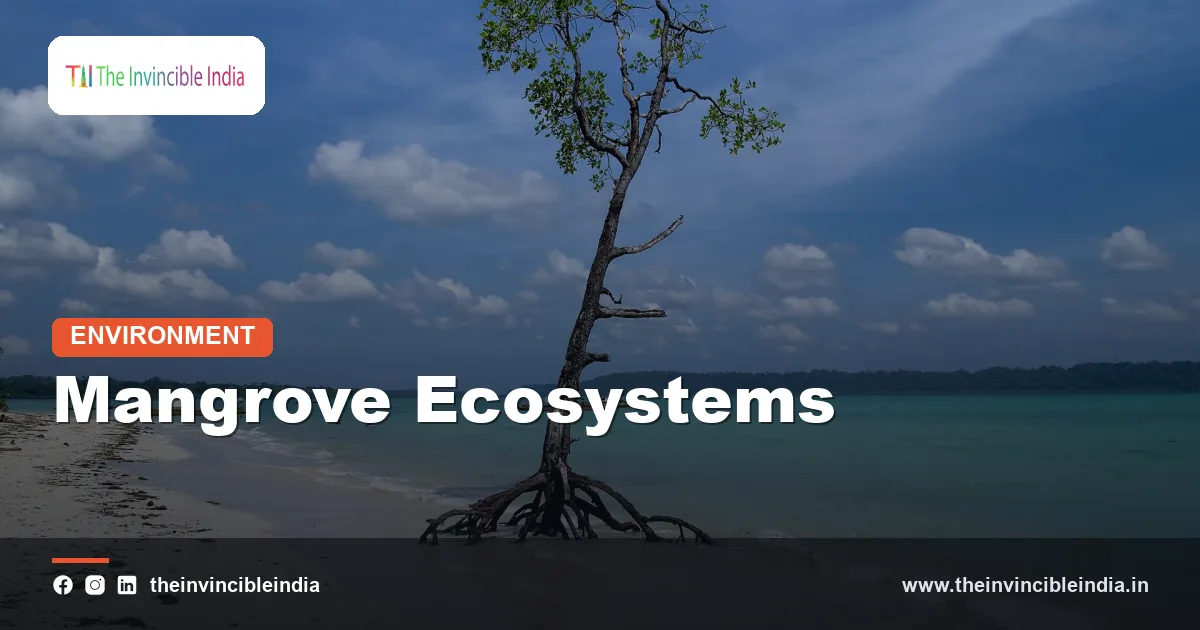
A mangrove ecosystem is a coastal forest of salt-tolerant trees and shrubs growing in the tidal zone where land meets the sea, along with the mud, creeks, fish, crabs and birds that live among their roots, and in India it stretches from the vast Sundarbans delta to Bhitarkanika, Pichavaram, the Godavari and Krishna deltas and the Gulf of Kutch. These forests stand in water that rises and falls twice a day, in soil that is salty and starved of oxygen, conditions that would kill most trees.
India has roughly 5,000 square kilometres of mangroves, a small fraction of its land area but a disproportionately important one. They shelter coastlines from cyclones, nurture fish and prawns, store large amounts of carbon and support the livelihoods of millions of coastal people. Their steady loss to ponds, ports and cities, and the recent push to restore them, make them one of the most closely watched ecosystems in the country.
| Attribute | Detail |
|---|---|
| What it is | Salt-tolerant tidal forest of trees, shrubs and associated wildlife |
| Habitat | Sheltered coasts, estuaries, deltas, creeks and lagoons in the intertidal zone |
| India’s mangrove cover | Roughly 5,000 square kilometres, under 0.2 per cent of the country’s area |
| Largest mangrove area | Sundarbans, the largest mangrove forest in the world, shared with Bangladesh |
| States with most mangroves | West Bengal, Gujarat, and the Andaman and Nicobar Islands |
| Other major sites | Bhitarkanika (Odisha), Pichavaram (Tamil Nadu), Godavari and Krishna deltas (Andhra Pradesh), Gulf of Kutch (Gujarat) |
| Key adaptations | Aerial breathing roots, stilt roots, salt excretion, live-born seedlings |
| Main benefits | Coastal protection, fish nurseries, carbon storage, livelihoods |
Key Takeaways
- A mangrove ecosystem is a salt-tolerant tidal forest, and India holds roughly 5,000 square kilometres of it, concentrated in West Bengal, Gujarat and the Andaman and Nicobar Islands.
- Mangrove trees survive salt and waterlogged mud through special roots that breathe air, mechanisms that remove or exclude salt, and seeds that germinate while still on the tree.
- The Sundarbans, shared by India and Bangladesh, is the largest mangrove forest in the world and home to the Bengal tiger, while Bhitarkanika and Pichavaram are other renowned sites.
- Mangroves reduce the force of waves and storm surge and help hold the shoreline together, although they cannot stop a major cyclone alone.
- Mangroves are nurseries for fish, prawns and crabs and are among the most carbon-dense ecosystems, which links them to the idea of blue carbon.
- Aquaculture, reclamation, pollution and reduced freshwater flow threaten them, while the MISHTI scheme and state programmes aim to restore and expand mangrove cover.
What is a mangrove ecosystem?
A mangrove ecosystem is a community of salt-tolerant trees growing in the intertidal zone together with the animals, microbes and soils that depend on them. The word mangrove refers both to the plants and to the habitat they form.
Mangroves are not one family of trees but many unrelated species that have independently evolved the same toolkit for life in salt water. Across the world there are roughly 70 true mangrove species, and India has several dozen of them, among which Avicennia, Rhizophora, Sonneratia, Bruguiera, Ceriops, Excoecaria and, in the Sundarbans, the sundari tree (Heritiera fomes) are prominent.
The ecosystem includes more than the trees. Tidal creeks wind between the roots, mudflats lie exposed at low tide, and the whole system exchanges water, nutrients and animals with the open sea. Fallen leaves feed crabs and microbes, which in turn feed fish, which then feed birds, crocodiles and, in the Sundarbans, tigers.
How do mangroves survive in salt water?
Mangroves survive in salt water through a set of adaptations that help them breathe in oxygen-poor mud, handle salt and reproduce in shifting tides. Different species use different combinations of these tricks.
- Breathing roots (pneumatophores): Species such as Avicennia and Sonneratia send up pencil-like or peg-like roots through the mud, with tiny pores that take in air at low tide.
- Stilt or prop roots: Rhizophora arches over the water on a web of supporting roots that anchor the tree in soft mud and also take in air.
- Salt management: Some species filter salt at the roots, others pump it into old leaves that are shed, and some, like Avicennia, excrete it through glands so that crystals can be seen on the leaf surface.
- Live-born seedlings: In a process called vivipary, seeds germinate on the parent tree and drop as long propagules that can float, stick in the mud and root quickly.
- Thick, waxy leaves: These reduce water loss, which matters because salt makes it hard for the roots to draw water in.
These traits explain the fringe-like look of a mangrove shore, with roots draped through the water and a floor studded with spikes. They also make the forest an efficient trap for silt, which slowly builds new land.
Where are mangroves found in India?
Mangroves in India are found along both coasts and on the Andaman and Nicobar Islands, with the largest area in the Sundarbans of West Bengal, followed by Gujarat and the islands. They cluster wherever rivers bring silt and freshwater to sheltered tidal shores.
- Sundarbans (West Bengal): the mangrove delta of the Ganga, Brahmaputra and Meghna, the largest mangrove forest in the world, and a UNESCO World Heritage Site and Ramsar site.
- Bhitarkanika (Odisha): a dense mangrove wetland in the Brahmani-Baitarani delta, known for saltwater crocodiles and nesting birds.
- Mahanadi delta (Odisha): further mangrove patches near the river mouth and Chilika region.
- Godavari and Krishna deltas (Andhra Pradesh): including the Coringa mangroves, one of the largest on the east coast outside Odisha and Bengal.
- Pichavaram (Tamil Nadu): a maze of channels and islets near Chidambaram, among the largest mangrove wetlands in the country, with nearby sites at Muthupet.
- Gujarat: the Gulf of Kutch and Gulf of Khambhat, where hardy Avicennia marina forms low, dense stands, and the state has seen considerable replanting.
- Maharashtra and Goa: creek mangroves around Mumbai, Raigad and Sindhudurg, often squeezed by the city.
- Andaman and Nicobar Islands: mangroves along many island creeks, relatively rich in species.
According to the periodic India State of Forest Report prepared by the Forest Survey of India, the country’s mangrove cover has hovered close to 5,000 square kilometres, with modest gains over recent assessments. West Bengal accounts for around two-fifths of the total, mostly the Sundarbans.
What makes the Sundarbans special?
The Sundarbans is special because it is the largest contiguous mangrove forest in the world and the only mangrove habitat for a significant tiger population. It spans the delta of the Ganga, Brahmaputra and Meghna rivers across India and Bangladesh.
The Indian part, in the South 24 Parganas and North 24 Parganas districts of West Bengal, is a labyrinth of islands cut by tidal channels. Its signature tree, sundari, gave the region its name, though local people debate whether the name comes from this tree or from the word for the sea, samudra. The Sundarbans National Park was listed as a UNESCO World Heritage Site in 1987 and the Indian Sundarbans were declared a Ramsar wetland of international importance in 2019.
The forest is home to the Royal Bengal tiger, estuarine crocodiles, Gangetic dolphins, fishing cats, monitor lizards and hundreds of bird species. Tigers here swim between islands and prey on fish and crabs as well as deer and boar. At the same time, around four and a half million people live in the Indian Sundarbans delta region, relying on fishing, honey collection and farming, and conflict with wildlife and cyclone damage are part of daily life.
How do mangroves protect the coast?
Mangroves protect the coast by slowing waves, absorbing wave energy and trapping sediment, which reduces erosion and softens the blow of storm surge. Their dense roots and trunks act as a living, self-repairing barrier.
Studies have shown that wave height can fall sharply over a few hundred metres of healthy mangrove, with the effect depending on the width of the belt, its density and the size of the waves. Roots bind soil and catch silt, which helps the shoreline hold its ground and, in some places, even build up as the sea rises. Mangrove belts also reduce wind and flood damage inland.
The evidence is real but not unlimited. After the 2004 Indian Ocean tsunami, reports from Tamil Nadu suggested that villages behind mangroves, such as those near Pichavaram, suffered less damage. Later analysis cautioned that the benefit depends on the width of the belt, the height of the wave and local geography, so mangroves work best as one layer within a wider coastal defence that includes embankments, early warning and shelters. They cannot stop an extreme cyclone on their own.
Why are mangroves important for fish and livelihoods?
Mangroves are important for fish and livelihoods because their roots and creeks shelter the young of many fish, prawns and crabs before they move out to the open sea. This nursery role supports coastal fisheries far beyond the forest itself.
The tangled roots offer protection from predators, and the leaf litter and algae supply abundant food. Species such as mullets, snappers, hilsa in the eastern estuaries, mud crabs and several kinds of shrimp spend part of their lives there. Fishing families also depend on mangroves for firewood, honey, thatch, fodder and sometimes tourism.
In the Sundarbans, honey collectors and fishers enter the forest at considerable risk from tigers and crocodiles, a livelihood cost that has led to widespread calls for alternative incomes. Elsewhere, communities have taken part in replanting and protection under joint management schemes, because healthy mangroves directly increase their catch.
How do mangroves store carbon?
Mangroves store carbon by capturing carbon dioxide through photosynthesis and burying much of it in waterlogged mud, where it decomposes very slowly. This makes them one of the most carbon-dense ecosystems per hectare.
The carbon sits in the trunks, branches and roots and, more significantly, in deep layers of peaty soil that can be a metre or several metres thick. Because the soil is wet and oxygen-poor, the dead plant material breaks down slowly and stays locked away for centuries. When mangroves are cleared or drained, however, this stored carbon can be released as carbon dioxide, turning a store into a source.
This is why mangroves feature in discussions of blue carbon, the carbon held by coastal and marine ecosystems. Estimates of exactly how much carbon India’s mangroves hold vary with the method used and the forest studied, and the figures are still being refined by researchers, including those at the National Centre for Sustainable Coastal Management in Chennai.
What are the threats to mangroves?
The main threats to mangroves are conversion for aquaculture, agriculture, ports and real estate, together with pollution, falling freshwater flow and rising seas. Historically, India lost large areas to prawn farms, salt pans and urban expansion.
- Land conversion: clearing for shrimp ponds, paddy, industry, ports and housing, especially near large cities such as Mumbai.
- Pollution: sewage, industrial effluent, oil and plastic waste clog roots and poison the mud.
- Altered water flow: dams and diversions reduce the river water and silt that mangroves depend on, raising salinity.
- Cutting and grazing: harvest for fuelwood and fodder, and browsing by cattle and camels in some areas such as Kutch.
- Sea-level rise and cyclones: mangroves can keep pace with moderate rise if sediment supply is good, but coastal squeeze occurs when roads and embankments block landward migration.
Indian law gives mangroves legal weight. They fall in the most protected category of the Coastal Regulation Zone, and court orders, notably from the Bombay High Court in 2018, have restricted destruction of mangroves around Mumbai. Enforcement, however, remains uneven.
What is India doing to restore mangroves?
India is restoring mangroves through state programmes and the national MISHTI scheme, which stands for Mangrove Initiative for Shoreline Habitats and Tangible Incomes. It was announced in the Union Budget of 2023 and launched in June 2023.
MISHTI aims to plant mangroves along the coast and on salt pans over about 540 square kilometres across several coastal states and union territories, over a period of roughly five years, funded in part through the Compensatory Afforestation Fund and rural employment schemes. Gujarat, Odisha, West Bengal, Andhra Pradesh and Tamil Nadu are among the states with significant replanting programmes, some with local community participation.
Experts stress that success depends on how restoration is done. Planting seedlings in unsuitable mudflats, or in the wrong species mix, often fails, while restoring natural tidal flow and letting mangroves regrow by themselves can be cheaper and more durable. Counting survival rather than the number of saplings planted is a recurring recommendation.
| Region | Notable mangrove site | Feature |
|---|---|---|
| West Bengal | Sundarbans | Largest mangrove forest in the world; tigers; World Heritage Site |
| Odisha | Bhitarkanika | Saltwater crocodiles; nesting birds; Ramsar site |
| Tamil Nadu | Pichavaram, Muthupet | Water-channel maze; tsunami buffer debate |
| Andhra Pradesh | Coringa, Godavari delta | Fishing cat habitat; prominent east-coast mangroves |
| Gujarat | Gulf of Kutch, Gulf of Khambhat | Hardy Avicennia stands; large replanting |
| Maharashtra | Mumbai and Raigad creeks | Urban mangroves under pressure |
| Andaman and Nicobar | Island creeks | High species richness |
Bottom Line
The mangrove ecosystem is among the most valuable and most vulnerable coastal assets India possesses. It buffers storms, feeds fisheries and holds carbon, yet it covers a sliver of the country and has long been treated as wasteland. Protecting existing forests and restoring tidal flow will do more than planting alone.
Frequently Asked Questions
What is a mangrove ecosystem?
A mangrove ecosystem is a coastal forest of salt-tolerant trees growing in the tidal zone, together with the mud, creeks and animals that live among their roots. It forms along sheltered coasts and river mouths. In India it ranges from the Sundarbans to Bhitarkanika, Pichavaram and the Gulf of Kutch.
Where is the largest mangrove forest in India?
The largest mangrove forest in India is the Sundarbans in West Bengal, part of the larger Sundarbans delta shared with Bangladesh that is the largest mangrove forest in the world. Other major sites include Bhitarkanika in Odisha, Pichavaram in Tamil Nadu and the Godavari delta in Andhra Pradesh.
How do mangroves breathe in salty mud?
Mangroves breathe through special roots that reach into the air, such as the pencil-like pneumatophores of Avicennia and the arching stilt roots of Rhizophora. These roots have pores that absorb oxygen at low tide, because the waterlogged mud has almost no oxygen of its own.
Do mangroves protect against cyclones and tsunamis?
Mangroves reduce wave energy, trap sediment and soften storm surge, so they can lessen damage on the coast behind them. Their protection depends on how wide and dense the belt is and how large the wave is, so they work best alongside embankments, warnings and shelters rather than as a complete defence.
Why are mangroves important for climate?
Mangroves are important for climate because they capture carbon dioxide and store it in their wood and especially in deep, waterlogged soil, where it can remain for centuries. They are among the most carbon-dense ecosystems per hectare. Clearing them can release this carbon back into the air.
What is the MISHTI scheme?
MISHTI, or the Mangrove Initiative for Shoreline Habitats and Tangible Incomes, is an Indian government scheme launched in 2023 to plant and restore mangroves along the coast and on salt pans. It targets about 540 square kilometres across coastal states and union territories over roughly five years, with community participation.
{“@context”:”https://schema.org”,”@graph”:[{“@type”:”FAQPage”,”mainEntity”:[{“@type”:”Question”,”name”:”What is a mangrove ecosystem?”,”acceptedAnswer”:{“@type”:”Answer”,”text”:”A mangrove ecosystem is a coastal forest of salt-tolerant trees growing in the tidal zone, together with the mud, creeks and animals that live among their roots. It forms along sheltered coasts and river mouths. In India it ranges from the Sundarbans to Bhitarkanika, Pichavaram and the Gulf of Kutch.”}},{“@type”:”Question”,”name”:”Where is the largest mangrove forest in India?”,”acceptedAnswer”:{“@type”:”Answer”,”text”:”The largest mangrove forest in India is the Sundarbans in West Bengal, part of the larger Sundarbans delta shared with Bangladesh that is the largest mangrove forest in the world. Other major sites include Bhitarkanika in Odisha, Pichavaram in Tamil Nadu and the Godavari delta in Andhra Pradesh.”}},{“@type”:”Question”,”name”:”How do mangroves breathe in salty mud?”,”acceptedAnswer”:{“@type”:”Answer”,”text”:”Mangroves breathe through special roots that reach into the air, such as the pencil-like pneumatophores of Avicennia and the arching stilt roots of Rhizophora. These roots have pores that absorb oxygen at low tide, because the waterlogged mud has almost no oxygen of its own.”}},{“@type”:”Question”,”name”:”Do mangroves protect against cyclones and tsunamis?”,”acceptedAnswer”:{“@type”:”Answer”,”text”:”Mangroves reduce wave energy, trap sediment and soften storm surge, so they can lessen damage on the coast behind them. Their protection depends on how wide and dense the belt is and how large the wave is, so they work best alongside embankments, warnings and shelters rather than as a complete defence.”}},{“@type”:”Question”,”name”:”Why are mangroves important for climate?”,”acceptedAnswer”:{“@type”:”Answer”,”text”:”Mangroves are important for climate because they capture carbon dioxide and store it in their wood and especially in deep, waterlogged soil, where it can remain for centuries. They are among the most carbon-dense ecosystems per hectare. Clearing them can release this carbon back into the air.”}},{“@type”:”Question”,”name”:”What is the MISHTI scheme?”,”acceptedAnswer”:{“@type”:”Answer”,”text”:”MISHTI, or the Mangrove Initiative for Shoreline Habitats and Tangible Incomes, is an Indian government scheme launched in 2023 to plant and restore mangroves along the coast and on salt pans. It targets about 540 square kilometres across coastal states and union territories over roughly five years, with community participation.”}}]}]}


