

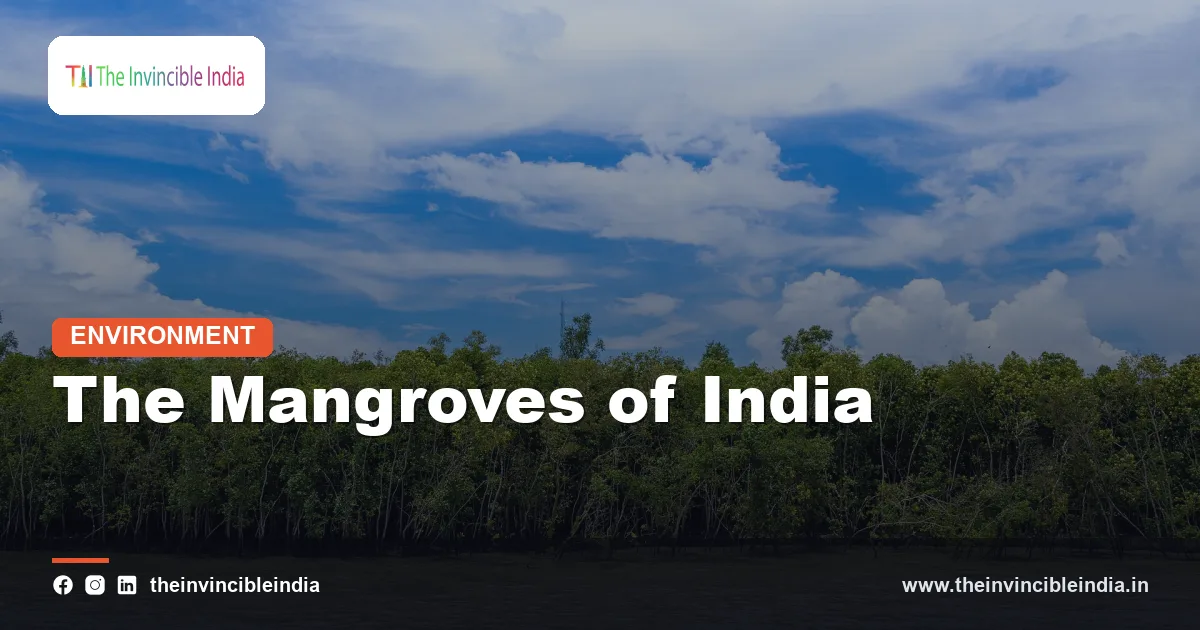
Walk along a muddy creek at low tide in Odisha, Gujarat or the Sundarbans and you will see a strange sight: a dense green forest standing in salty water, its trees propped up on tangled roots, with crabs scuttling over the mud and mudskippers flicking between the stilts. These are the mangroves of India, a belt of salt-tolerant forests that grows where rivers meet the sea. They are neither fully land nor fully ocean, and that in-between character is exactly what makes them so valuable.
For a long time mangroves were treated as wasteland, drained for farms, cleared for salt pans or used as dumping grounds. Today they are recognised as a natural defence against cyclones, a major store of carbon, a nursery for fish and home to tigers, crocodiles, dolphins and countless birds. This explainer covers how mangroves live, why they matter, where India’s mangroves are found, what threatens them and how they are being protected. Information was last reviewed on 1 October 2026.
| Topic | Key fact |
|---|---|
| What they are | Salt-tolerant trees and shrubs growing in the inter-tidal zone of tropical and sub-tropical coasts |
| Typical habitats | Estuaries, deltas, creeks, backwaters and lagoons |
| Key adaptations | Stilt (prop) roots, breathing roots (pneumatophores), salt-excreting leaves, viviparous seeds |
| Largest mangrove forest | The Sundarbans, shared by India and Bangladesh, the largest contiguous mangrove forest in the world |
| Leading states by cover | West Bengal, Gujarat and the Andaman and Nicobar Islands, followed by Odisha, Andhra Pradesh and Maharashtra |
| Official monitoring | Forest Survey of India, through its biennial India State of Forest Report |
| Legal shield | Coastal Regulation Zone rules under the Environment (Protection) Act, 1986 |
| Restoration drive | MISHTI (Mangrove Initiative for Shoreline Habitats and Tangible Incomes), announced in 2023 |
| Global observance | International Day for the Conservation of the Mangrove Ecosystem, 26 July |
What Are Mangroves?
Mangroves are not a single plant family. The word describes a group of trees and shrubs, drawn from many unrelated families, that have all independently evolved the ability to live in coastal water that is salty, waterlogged and low in oxygen. They grow in the inter-tidal zone, the strip of shore that is covered at high tide and exposed at low tide. Because of this, a mangrove forest is a daily-changing landscape of mud, roots, channels and shallow water.
Where mangroves grow
Mangroves thrive in sheltered places where the sea is calm enough for fine silt to settle. In India these include:
- Estuaries and deltas where large rivers such as the Ganga, Brahmaputra, Mahanadi, Godavari and Krishna drop their silt before entering the sea.
- Creeks and tidal inlets along the Gujarat and Maharashtra coasts.
- Lagoons and backwaters on the Kerala and Tamil Nadu coasts.
- Sheltered island coasts in the Andaman and Nicobar Islands.
Ecosystem in three layers
A mangrove is best understood as a whole ecosystem. The canopy shelters birds, monkeys and insects; the roots and water below support fish, prawns, crabs and molluscs; and the oxygen-poor mud stores huge amounts of organic matter. Common Indian species include the Avicennia (grey mangrove), Rhizophora, Bruguiera, Ceriops, Sonneratia and the Sundarbans’ own sundari tree, Heritiera fomes, which is believed to have given the region its name.
How Mangroves Survive: Remarkable Adaptations
Life in salty, muddy, oxygen-starved soil would kill most trees. Mangroves cope with it through a set of specialised features that biology students often study as classic examples of adaptation.
| Adaptation | What it looks like | What it does |
|---|---|---|
| Stilt or prop roots | Arching roots that spring from the trunk and lower branches, seen in Rhizophora | Anchor the tree in soft, shifting mud and withstand waves and tides |
| Pneumatophores (breathing roots) | Pencil-like roots that poke up through the mud, seen in Avicennia and Sonneratia | Take in air through tiny pores while the main roots are submerged |
| Salt excretion and exclusion | Salt crystals on leaf surfaces, or roots that filter salt at the source | Keep salt levels inside the plant manageable |
| Viviparous seeds | Seeds that germinate on the parent tree and drop as long, spear-like seedlings (propagules) | Let the young plant root quickly in the mud instead of being swept away |
| Thick, waxy leaves | Leathery, sometimes succulent leaves | Reduce water loss in a salty environment |
Why these features matter
Stilt roots and pneumatophores are more than curiosities. The thick network of roots slows tidal water, traps silt and builds up land over time. Viviparous propagules float for days or weeks before settling, which allows mangroves to colonise new mudflats. Together these traits make mangroves what ecologists call ecosystem engineers: they do not merely survive in the inter-tidal zone, they actively shape it.
Bioshields: Mangroves and Coastal Protection
India has a long cyclone-prone coastline, especially along the Bay of Bengal. Mangroves act as a living barrier, often called a bioshield, between the open sea and the settlements behind it. Their roots and trunks break the force of waves, slow down storm surges and hold the soil together against erosion.
Lessons from the 1999 Odisha super-cyclone
The super-cyclone that struck Odisha on 29 October 1999 was among the deadliest storms ever recorded in the region. In its aftermath, researchers and officials noticed that villages sheltered by healthy mangrove stretches often reported lower damage than comparable villages with no forest in front of them. The experience drew attention to coastal vegetation as part of disaster planning, alongside cyclone shelters and early warning.
Lessons from the 2004 tsunami
The Indian Ocean tsunami of 26 December 2004 reinforced the point. Reports from parts of Tamil Nadu, including areas near the Pichavaram mangroves, described reduced damage in hamlets with dense forest cover. Scientists are careful to add that mangroves are not a complete shield: a very large wave can overwhelm them, and their protection depends on width, density and species. They work best as one layer in a mix of defences, not as a replacement for early warnings and well-built shelters.
What mangroves do on a stormy day
- Reduce wave height and energy as water passes through the roots.
- Soften storm surges and limit how far seawater travels inland.
- Hold soil and reduce coastal erosion.
- Trap sediment, helping the shore keep pace with a slowly rising sea.
Blue Carbon, Fisheries and Biodiversity
Blue carbon
Mangroves are among the most carbon-rich forests on Earth. They draw carbon dioxide from the air and store it in leaves, wood and roots, but the largest store lies in the waterlogged soil, where decay is slow and carbon can remain locked up for centuries. Carbon held in coastal and marine ecosystems like mangroves, seagrass beds and salt marshes is called blue carbon. When mangroves are cleared or drained, this stored carbon can be released back into the atmosphere, so protecting them is also a climate action.
Nurseries for fish and livelihoods
The sheltered, nutrient-rich water among mangrove roots is a nursery for the young of many fish, prawn and crab species. Many of the fish that end up in the open-sea catch spend their early life in mangrove channels. Millions of coastal people depend on this chain for food and income, including:
- Fishers and crab collectors who work in creeks and tidal channels.
- Honey collectors in the Sundarbans, who gather wild honey from the forest.
- Families who use mangroves for fuelwood, fodder and thatching material in a regulated way.
- Boatmen and tourism operators who take visitors into the forest.
A hotspot of biodiversity
Mangroves host a surprising range of life: tigers and spotted deer in the Sundarbans, estuarine crocodiles in Odisha, fishing cats in Andhra Pradesh, migratory birds on the Gujarat coast, and olive ridley turtles on neighbouring beaches. They also filter runoff, trapping some pollutants and nutrients before they reach coastal waters.
India’s Mangroves: Cover and Distribution
India has a significant mangrove cover spread along both coasts and the island territories, though it is a very small share of the country’s land area. The Forest Survey of India (FSI) assesses it through satellite imagery and ground checks, and publishes the results every two years in the India State of Forest Report. Exact figures change from one edition to the next, so it is best to think of the picture in broad terms: mangrove cover is roughly in the range of a few thousand square kilometres, and in recent assessments it has been broadly stable to slightly increasing, helped by plantations and protection.
Leading states and regions
- West Bengal holds the largest share of India’s mangroves, mainly in the Sundarbans.
- Gujarat ranks high, with extensive mangroves in the Gulf of Kutch, Gulf of Khambhat and Kachchh, much of it expanded through plantation.
- Andaman and Nicobar Islands have rich, species-diverse island mangroves.
- Odisha has important stands in the Mahanadi delta and at Bhitarkanika.
- Andhra Pradesh has mangroves in the Godavari and Krishna deltas.
- Maharashtra has creek mangroves around Mumbai, Thane and the Konkan coast.
Two coasts, different forests
The east coast, fed by large rivers with plentiful silt and fresh water, has the lushest and most diverse mangroves. The west coast has narrower, patchier stands, mostly in creeks, estuaries and backwaters. Gujarat is a notable exception, where mangroves grow even in a dry climate, mainly the hardy Avicennia marina.
The Sundarbans: The World’s Largest Mangrove Forest
The Sundarbans is the crown jewel of the mangroves of India. It lies in the vast delta formed by the Ganga, Brahmaputra and Meghna rivers, spread across southern West Bengal in India and the south-west of Bangladesh. It is the largest contiguous mangrove forest in the world, a maze of islands, tidal rivers and creeks that is flooded and drained twice a day.
Recognition and protection
The Indian part of the Sundarbans is a UNESCO World Heritage Site, inscribed in 1987 as the Sundarbans National Park. The area also holds a Tiger Reserve, a Biosphere Reserve and a Ramsar wetland listing. The Sundarbans Tiger Reserve is part of India’s Project Tiger, which began in 1973.
The swimming tiger
The Sundarbans is the only mangrove forest in the world known to be a major home for tigers. The Royal Bengal Tiger here has adapted to the delta: it swims across wide tidal channels, hunts in the mud and can tolerate brackish water. Tigers in the Sundarbans are also known for conflict with people who enter the forest to fish, collect honey or gather wood, which is why local communities have long relied on the folk guardian Bonbibi.
Other residents
- Estuarine (saltwater) crocodiles and water monitor lizards.
- The Gangetic dolphin in the freshwater-influenced rivers, and other river dolphins in the region.
- Spotted deer, wild boar, fishing cats and many kinds of kingfishers, herons and eagles.
- Olive ridley and other marine turtles on the coastal beaches.
The Sundarbans has also taken the brunt of powerful cyclones, including Aila in 2009 and Amphan in 2020, and local people often say the forest softened their impact.
Other Notable Mangrove Sites in India
While the Sundarbans gets most of the attention, India has many other mangrove landscapes, each with its own character.
| Site | State or region | What makes it notable |
|---|---|---|
| Bhitarkanika | Odisha | A mangrove wetland in the Brahmani-Baitarani delta, famous for large estuarine crocodiles, a Ramsar site since 2002, close to the Gahirmatha turtle nesting beach |
| Gulf of Kutch | Gujarat | Home to the Marine National Park, set up in 1982 and regarded as India’s first marine national park, with mangroves, coral and mudflats |
| Pichavaram | Tamil Nadu | A labyrinth of small channels and islets among mangroves near Chidambaram, popular for boating and often cited in tsunami-protection discussions |
| Coringa | Andhra Pradesh | A wildlife sanctuary in the Godavari delta, known for fishing cats and birds |
| Godavari-Krishna deltas | Andhra Pradesh | Among the largest mangrove stretches of peninsular India, with the Krishna sanctuary also protecting mangroves |
| Andaman and Nicobar Islands | Island territory | Species-rich island mangroves with many mangrove tree species and a relatively undisturbed setting |
| Thane Creek and Mumbai | Maharashtra | Urban mangroves around a megacity, important for flamingos and flood moderation |
Smaller, quieter mangroves
Kerala’s Kannur district, the Mandovi and Zuari estuaries in Goa, the Muthupet lagoon in Tamil Nadu and the Mahanadi delta all hold valuable mangrove patches. Even small stands help local fisheries and protect shorelines, which is why community-led protection of these sites has gained attention.
Threats to the Mangroves of India
Despite their value, mangroves have been shrinking worldwide for decades, and India has faced similar pressures. The main threats include:
- Coastal development: ports, roads, real estate, industrial zones and reclamation, especially around large cities.
- Aquaculture: converting mangroves into shrimp ponds, a trend that surged in the 1990s on the east coast.
- Pollution: untreated sewage, industrial effluents, plastics and oil spills that choke breathing roots and poison water.
- Reduced freshwater flow: dams, barrages and diversions upstream cut the river water and silt that mangroves depend on, raising salinity.
- Sea-level rise: if the sea rises faster than sediment can build up, mangroves cannot migrate inland when roads, embankments or towns block their way.
- Cyclones and storms: natural events that damage forests, which can recover if conditions are healthy but recover slowly when stressed.
- Overuse: excessive fuelwood cutting and grazing, including camel browsing in parts of Kachchh.
A vanishing island as a warning
The Indian Sundarbans offers a sharp reminder of sea-level risk. Several islands, such as Lohachara, have been lost to erosion and rising water, and others face regular flooding and saline intrusion. Communities living there are often described as being on the front line of climate change.
How India Protects Its Mangroves
India has combined laws, schemes, protected areas and community efforts to look after its mangroves.
Law and regulation
- Coastal Regulation Zone (CRZ) rules: first issued in 1991 under the Environment (Protection) Act, 1986, and revised since, these rules classify mangroves as ecologically sensitive areas and restrict activity in and around them.
- Protected areas: mangroves inside national parks, wildlife sanctuaries and tiger reserves are covered by the Wildlife (Protection) Act, 1972.
- Court orders: the Supreme Court’s 1996 judgment in the Jagannath case restricted shrimp farming in coastal zones, and several High Court orders, especially in Maharashtra, have protected mangroves from destruction.
- Forest law: mangroves that fall under forest land are protected by forest conservation rules.
Schemes and restoration
A national programme for the conservation and management of mangroves and coral reefs has existed since the 1980s, with the Ministry of Environment, Forest and Climate Change guiding state forest departments. More recently, the Union Budget of 2023 announced MISHTI, which aims to restore mangroves along the coast and on salt-pan lands, while linking the work with tangible incomes for coastal people, including through convergence with other schemes.
Community and international efforts
- Village forest committees and self-help groups plant and guard mangroves in states such as Gujarat, Odisha, Tamil Nadu and West Bengal.
- Non-profit groups and research institutions support planting, monitoring and eco-tourism.
- Ramsar listings recognise wetlands such as the Sundarbans and Bhitarkanika.
- International platforms, including regional cooperation programmes and global mangrove alliances, support research and funding.
- UNESCO has marked 26 July as the International Day for the Conservation of the Mangrove Ecosystem, adopted in 2015.
Climate Resilience and the Road Ahead
As climate change brings stronger cyclones, higher seas and more erratic rain, mangroves are increasingly viewed as part of the answer rather than just a victim. They combine mitigation (storing carbon) with adaptation (protecting coasts and sustaining livelihoods), which is why they appear in discussions on nature-based solutions.
What good restoration looks like
- Restore the water first: successful projects often just reopen tidal channels and let natural regrowth begin, rather than planting seedlings on unsuitable mudflats.
- Use the right species: planting only one hardy species over a large area can create a poor, low-diversity forest.
- Involve local people: forests that provide income to villagers are far more likely to survive.
- Leave room to move: coastal planning should leave a landward buffer so mangroves can shift inland as the sea rises.
- Monitor results: follow survival rates over many years, not just the number of saplings planted.
Mangroves will not solve climate risk on their own, but protecting them is among the most cost-effective choices India’s coast has.
Conclusion
Mangroves are quiet workers. They hold the coast together, store carbon, feed fisheries and give shelter to species from tigers to turtles. From the tide-washed islands of the Sundarbans to the creeks of Gujarat and the deltas of Andhra Pradesh, the mangroves of India deserve to be seen not as muddy wasteland but as green infrastructure. Protecting them through strong laws, restoration schemes such as MISHTI and the involvement of coastal communities is an investment in both nature and safety for millions of people.
Frequently Asked Questions
What are mangroves and where do they grow?
Mangroves are salt-tolerant trees and shrubs that grow in the inter-tidal zone of tropical and sub-tropical coasts. In India they are found in estuaries, deltas, creeks and lagoons along both coasts and in the Andaman and Nicobar Islands, with the biggest forest in the Sundarbans.
How do mangroves survive in salty water?
They use several adaptations. Stilt roots anchor them in soft mud, pneumatophores or breathing roots take in air, special leaves or roots deal with salt, and viviparous seeds sprout on the parent tree before dropping into the mud as ready-made seedlings.
Why are mangroves called bioshields?
Their dense roots and trunks reduce wave energy, slow storm surges and hold the soil, which can lessen damage to nearby villages during cyclones and tsunamis. The benefits were noticed after the 1999 Odisha super-cyclone and the 2004 tsunami, although mangroves work best alongside early warning and shelters.
Which is the largest mangrove forest in the world?
The Sundarbans, shared by India and Bangladesh, is the largest contiguous mangrove forest in the world. The Indian part, in West Bengal, is a UNESCO World Heritage Site and is famous for the swimming Royal Bengal Tiger.
What is MISHTI?
MISHTI stands for Mangrove Initiative for Shoreline Habitats and Tangible Incomes. Announced in 2023, it aims to restore and expand mangroves along India’s coast and on suitable salt-pan lands, while helping coastal communities earn from the restored ecosystem.
What are the biggest threats to mangroves in India?
The main threats are coastal development, shrimp aquaculture, pollution, reduced freshwater and silt flow from upstream dams, overuse and sea-level rise. Stronger cyclones add to the stress, which is why protection under the Coastal Regulation Zone rules and community restoration are important.


