

The Maratha Empire was one of the most powerful and influential forces in Indian history, a rising power that came to dominate much of the subcontinent in the 17th and 18th centuries. Founded by the visionary warrior-king Chhatrapati Shivaji Maharaj, the Marathas challenged and ultimately helped bring down the mighty Mughal Empire, forging a vast dominion built on courage, ingenuity and a fierce spirit of self-rule. This guide explores the rise, expansion, key figures and lasting legacy of the Maratha Empire, one of the great chapters in the story of India.
Quick Facts: The Maratha Empire
| Detail | Information |
|---|---|
| Founder | Chhatrapati Shivaji Maharaj |
| Coronation of Shivaji | 1674, at Raigad Fort |
| Heartland | Maharashtra, in the Deccan |
| Later leaders | The Peshwas (prime ministers) |
| Peak | 18th century, spanning much of India |
| Known for | Guerrilla warfare, forts, naval power |
The Rise of Shivaji Maharaj
The founder of the Maratha Empire, Chhatrapati Shivaji Maharaj, was born in 1630 into a turbulent age dominated by the Mughals and the Deccan sultanates. From a young age, Shivaji displayed remarkable leadership and military genius, and he began carving out an independent kingdom by capturing forts in the rugged hills of the Sahyadri mountains. Inspired by ideals of self-rule (Swarajya) and the protection of his people and faith, he united the Maratha clans and built the foundations of a state that would grow into a mighty empire. His coronation as Chhatrapati in 1674 at Raigad Fort marked the birth of a sovereign Maratha kingdom.
Shivaji’s Military Genius
Shivaji Maharaj is celebrated as one of the greatest military commanders in Indian history, renowned above all for his mastery of guerrilla warfare, known as Ganimi Kava. Making brilliant use of the hilly terrain of his homeland, he employed swift mobile raids, surprise attacks and strategic retreats to outmanoeuvre far larger enemy armies. He built and captured a vast network of hill forts that served as the backbone of his defence, and he was also a pioneer of naval power, establishing a formidable navy to protect the Konkan coast. His innovative strategies allowed a relatively small force to challenge the greatest empires of the age.
Administration and Vision
Shivaji was not only a warrior but also a wise and progressive administrator whose systems of governance were remarkably advanced for their time. He organised his kingdom with an efficient council of ministers known as the Ashta Pradhan (Council of Eight), established fair systems of revenue and justice, and promoted the use of the Marathi and Sanskrit languages. He was known for his religious tolerance, his respect for women and non-combatants, and his care for the welfare of his subjects and soldiers. This combination of military brilliance and enlightened governance is a large part of why he remains so deeply revered.
The Struggle Against the Mughals
The rise of the Marathas brought them into direct and prolonged conflict with the Mughal Empire, then at the height of its power under Emperor Aurangzeb. For decades, the Marathas waged a determined struggle against Mughal domination, enduring immense hardship yet refusing to be subdued. Even after Shivaji’s death in 1680, his successors, including his son Sambhaji and later leaders, continued the fight. The relentless Maratha resistance drained the resources of the Mughal Empire and is widely regarded as a major factor in its eventual decline, shifting the balance of power in India.
The Era of the Peshwas
In the 18th century, real power within the Maratha state increasingly came to rest with the Peshwas, the hereditary prime ministers who governed in the name of the Chhatrapati. Under a succession of brilliant Peshwas, particularly Baji Rao I, one of the greatest military commanders of the era, the Marathas expanded dramatically, extending their influence across vast swathes of northern, central and southern India. This period saw the Maratha Confederacy reach the height of its power, with great Maratha families such as the Scindias, Holkars, Gaekwads and Bhonsles ruling over extensive territories.
The Maratha Confederacy at its Peak
At its zenith in the mid-18th century, Maratha power extended across much of the Indian subcontinent, from the Deccan in the south to the doorstep of Delhi in the north and beyond. The Marathas had effectively become the dominant power in India, filling the vacuum left by the declining Mughals. This vast dominion was organised as a confederacy, a coalition of powerful Maratha chiefs who acknowledged the authority of the Peshwa while ruling their own territories. At this peak, the Marathas seemed poised to become the paramount power across the whole of India.
The Battle of Panipat and Decline
The Maratha advance suffered a catastrophic setback at the Third Battle of Panipat in 1761, where a large Maratha army was defeated by the forces of Ahmad Shah Abdali in one of the bloodiest battles of the 18th century. Although the Marathas recovered much of their strength in the following years, the loss of so many experienced leaders and soldiers was a severe blow. In the decades that followed, internal rivalries and the rising power of the British East India Company gradually eroded Maratha dominance, culminating in a series of Anglo-Maratha Wars that ended their independence in the early 19th century.
The Legacy of the Marathas
The legacy of the Maratha Empire endures powerfully in India to this day. Chhatrapati Shivaji Maharaj is revered as a national hero and a symbol of courage, good governance and the spirit of self-rule, celebrated especially in Maharashtra but honoured across the country. The Marathas are remembered for their crucial role in weakening the Mughal Empire and shaping the political landscape of India. Their magnificent hill forts, their traditions of valour, and their contributions to administration, culture and identity remain a source of immense pride and inspiration, keeping the memory of this great empire vividly alive.
The Forts of the Marathas
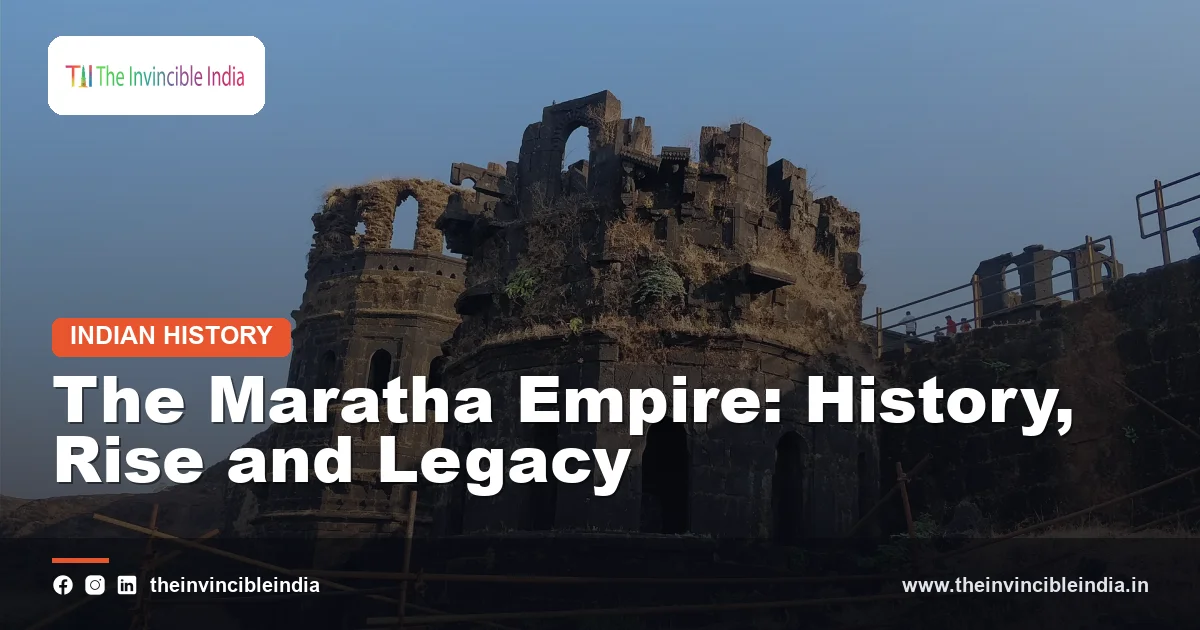
Forts were the backbone of Maratha power, and few aspects of the empire are as evocative as its network of hundreds of hill and sea forts scattered across the western Deccan and the Konkan coast. Shivaji Maharaj was a master of fort warfare, capturing, building and strengthening strongholds such as Raigad, his capital, along with Pratapgad, Sinhagad, Torna, Rajgad and the formidable sea fort of Sindhudurg. Perched atop steep hills or rising from the waves, these forts were nearly impregnable and allowed the Marathas to control territory, resist far larger armies and launch their campaigns. Today these majestic forts stand as proud monuments to Maratha valour and ingenuity, drawing trekkers, historians and admirers from across the country.
The Maratha Navy and Coastal Power
Unusually for an Indian power of the era, the Marathas understood the importance of sea power and built a formidable navy to protect their long coastline and trade. Shivaji Maharaj is often regarded as a pioneer of the modern Indian navy, establishing a fleet and a chain of coastal and island forts to guard against European powers and rival fleets. Under commanders such as the legendary admiral Kanhoji Angre, the Maratha navy became a dominant force along the western coast, challenging even the powerful European trading companies. This emphasis on maritime strength was a visionary aspect of Maratha strategy and an important part of their remarkable success.
Culture, Religion and Society
The Maratha Empire was not only a military power but also a patron of culture, religion and learning. The Marathas promoted the Marathi language and literature, supported temples and places of worship, and celebrated the region’s rich traditions of saint-poets and devotional Bhakti movements that had long inspired the common people. Figures such as the revered saints of Maharashtra shaped a distinctive cultural and spiritual identity that underpinned the Maratha sense of unity and purpose. This vibrant cultural life, combined with a spirit of religious tolerance and pride in self-rule, helped forge the strong regional identity that endures in Maharashtra to this day.
The Anglo-Maratha Wars
The final chapter of the Maratha Empire was written in its long confrontation with the British East India Company. Over a series of three Anglo-Maratha Wars fought between the late 18th and early 19th centuries, the two powers struggled for supremacy in India. The Marathas, though formidable, were increasingly hampered by internal divisions among the great Maratha houses, which the British skilfully exploited. Despite moments of fierce resistance and notable victories, the Marathas were ultimately overcome, and by 1818 their independence had come to an end, clearing the way for British dominance over India. Yet even in defeat, the courage and resilience of the Marathas left a lasting mark on the nation’s history.
The Maratha Legacy in Modern India
The influence of the Maratha Empire reaches far into modern India, where its memory remains a living source of pride and inspiration. Chhatrapati Shivaji Maharaj is honoured as one of the nation’s greatest heroes, his life and ideals celebrated in literature, cinema, public monuments and the names of institutions, airports and landmarks across the country. The Marathi-speaking state of Maharashtra takes particular pride in its Maratha heritage, and festivals, forts and traditions keep the spirit of the empire alive. Beyond regional pride, the Marathas are remembered nationally for their crucial role in resisting foreign domination and shaping the course of Indian history, ensuring their place among the most celebrated chapters of the nation’s past.
Why the Maratha Story Endures
The story of the Maratha Empire endures because it is, at its heart, a story of courage, vision and the unbreakable spirit of self-rule. From the daring exploits of Shivaji Maharaj to the vast reach of the Peshwas, the Marathas showed how determination and ingenuity could challenge the mightiest of empires. Their forts, their navy, their culture and their heroes remain a source of deep pride and inspiration, ensuring that the legacy of this remarkable empire continues to resonate across India to this day.
Exploring Maratha Heritage Today
Travellers keen to experience the Maratha legacy first-hand can explore the many magnificent forts scattered across Maharashtra, from the hilltop capital of Raigad, reached by a scenic ropeway, to the coastal ramparts of Sindhudurg and the historic heights of Sinhagad and Pratapgad. Museums, palaces and memorials across the state bring the story of the empire to life, while festivals and cultural events celebrate its heroes and traditions. For anyone interested in Indian history, a journey through these sites offers a vivid and inspiring connection to the age of the Marathas.
Frequently Asked Questions
Who founded the Maratha Empire?
The Maratha Empire was founded by Chhatrapati Shivaji Maharaj, who was crowned in 1674 at Raigad Fort and built an independent Maratha kingdom that grew into a mighty empire.
What was Shivaji Maharaj famous for?
Shivaji is famous for his military genius, especially his mastery of guerrilla warfare, his network of hill forts, his pioneering navy, and his wise and progressive administration.
Who were the Peshwas?
The Peshwas were the hereditary prime ministers of the Maratha state who wielded real power in the 18th century, leading the empire to its greatest territorial expansion.
What caused the decline of the Maratha Empire?
The Marathas suffered a major setback at the Third Battle of Panipat in 1761, and later internal rivalries and the rising power of the British led to their decline after the Anglo-Maratha Wars.


