

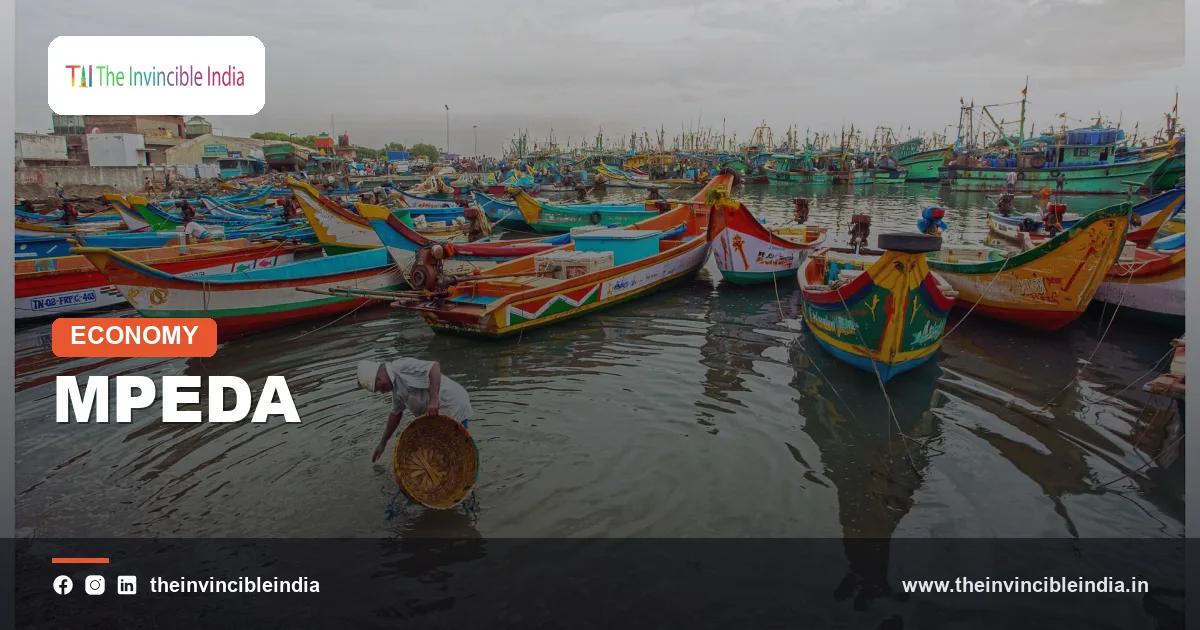
MPEDA, the Marine Products Export Development Authority, is the Government of India statutory body, established in 1972 under the Ministry of Commerce and Industry and headquartered in Kochi, Kerala, that develops and promotes the export of India’s marine products such as frozen shrimp and fish. MPEDA was created by the Marine Products Export Development Authority Act, 1972, and it regulates exporters, supports aquaculture and fisheries, and works on the quality and traceability of seafood shipments.
Seafood is one of the leading agricultural export items from India, and shrimp is the single most valuable product in the basket. MPEDA stands behind this trade as the registering authority, development agency and promoter. This explainer describes how MPEDA is organised, what it does for the shrimp and fish sectors, how quality certification and traceability work, and what challenges the industry faces. It was last reviewed on 21 October 2026.
| Attribute | Detail |
|---|---|
| Full name | Marine Products Export Development Authority (MPEDA) |
| Established | 1972, under the MPEDA Act, 1972 |
| Parent ministry | Ministry of Commerce and Industry (Department of Commerce) |
| Headquarters | Kochi (Cochin), Kerala |
| Type | Statutory export promotion authority |
| Main export item | Frozen shrimp, followed by frozen fish and other seafood |
| Related bodies | Rajiv Gandhi Centre for Aquaculture (RGCA), National Centre for Sustainable Aquaculture (NaCSA), Export Inspection Council (EIC) |
| Leading markets | United States, China, European Union, Japan, Southeast Asia |
Key Takeaways
- The Marine Products Export Development Authority (MPEDA) was established in 1972 under the MPEDA Act and is headquartered in Kochi, Kerala.
- MPEDA works under the Ministry of Commerce and Industry and is responsible for developing and promoting India’s seafood exports.
- Frozen shrimp is the largest seafood export item from India by value, and most of it comes from farmed Pacific white shrimp, scientifically named Penaeus vannamei.
- MPEDA registers exporters, processing plants, hatcheries and fishing vessels, and its registration is a requirement for exporting marine products.
- MPEDA’s affiliated bodies, such as the Rajiv Gandhi Centre for Aquaculture and the National Centre for Sustainable Aquaculture, support aquaculture research, farmer organisation and sustainable practices.
- Food-safety certification of exported seafood is carried out by the Export Inspection Council and its agencies, with MPEDA supporting residue monitoring, laboratories and traceability.
What is MPEDA?
MPEDA is a statutory body of the Government of India that promotes the development of the marine products industry with a focus on exports, covering both capture fisheries and aquaculture. It is one of the specialised export promotion authorities of the Department of Commerce, alongside the Tea Board, Coffee Board, Spices Board and APEDA.
The authority’s mandate goes beyond marketing. The MPEDA Act gives it powers to register those involved in the export trade, to fix standards and specifications for marine products, to regulate processing, packing and storage, and to carry out inspection. It also gives the authority a mandate to support fishing and culture activities, including the introduction of new technologies.
MPEDA is led by a Chairman, appointed by the central government, and has a board with representatives of the central and state governments, Members of Parliament, the industry and technical experts. Its offices are spread over the coastal states, and its headquarters in Kochi sit in a port city that has long been a seafood trading centre.
Why was MPEDA set up in 1972?
MPEDA was set up in 1972 to give India’s rapidly growing seafood export trade a dedicated statutory authority that could improve quality, expand the range of products and develop new markets. Before this, marine exports were small and mostly consisted of dried fish and a limited volume of frozen shrimp.
During the 1960s and early 1970s, global demand for shrimp, especially in Japan and the United States, rose strongly, and India began to supply it in larger quantities. The government saw that this was a high-value export that could earn foreign exchange for coastal communities. At the same time, the trade needed organised processing, cold chains, hygiene standards and an institution to represent it. The MPEDA Act of 1972 was passed to meet these needs.
The authority commenced work in the same period and soon set up a quality control system and promotional activities. Over the following decades, seafood exports moved from a small base to one of the major earners among India’s agricultural exports.
What does MPEDA do?
MPEDA registers and regulates marine exporters, supports fisheries and aquaculture development, promotes Indian seafood abroad, and works on quality control and traceability. Its functions are set out in the MPEDA Act and carried out through schemes, laboratories and field offices.
- Registration: MPEDA registers exporters, processing plants, storage facilities, fishing vessels and hatcheries, and issues registration certificates.
- Development of fisheries and aquaculture: It supports shrimp and fish farmers, hatcheries and feed suppliers, and promotes diversification into new species.
- Quality and standards: It prescribes specifications, monitors residues and runs laboratories to test products for compliance.
- Market promotion: It takes part in international seafood fairs, organises buyer-seller meets and runs brand promotion campaigns.
- Training and extension: It trains farmers and workers in hygiene, handling and good aquaculture practice.
- Data and research: It collects export statistics and supports research on resources, diseases and technology.
Why is India a leader in shrimp aquaculture?
India is among the world’s leading shrimp producers and exporters because of its long coastline, large areas suitable for coastal aquaculture, a base of small and medium farmers, and a well-developed processing and export industry. Shrimp farming is concentrated in states on the east coast, notably Andhra Pradesh, followed by Odisha, Tamil Nadu, West Bengal and Gujarat.
Two species have shaped Indian shrimp farming. The black tiger shrimp (Penaeus monodon) was the main farmed species in the 1990s, but disease outbreaks, especially white spot syndrome, reduced yields. From the mid-2000s, farmers shifted to Pacific white shrimp (Penaeus vannamei), a species that grows faster, tolerates higher stocking densities and can be bred under disease-controlled conditions. Today vannamei accounts for most of India’s farmed shrimp.
Shrimp farming is regulated by the Coastal Aquaculture Authority (CAA), which was established under the Coastal Aquaculture Authority Act, 2005 and registers farms and hatcheries to protect the coastal environment. MPEDA’s role is to promote development, support disease management and make sure that the farm output meets export standards. The country’s position as a major exporter is also due to the large processing sector that cleans, grades, freezes and packs shrimp for global buyers.
What does India export in marine products?
India exports a wide range of marine products, led by frozen shrimp, and exports have been worth more than US$7 billion a year in recent years, although the exact figure varies. Frozen shrimp makes up the largest share in value terms, while frozen fish makes up a large share in volume.
| Product group | Examples | Notes |
|---|---|---|
| Frozen shrimp | Vannamei, black tiger shrimp | Largest item by value; sold peeled, headless or in value-added forms |
| Frozen fish | Ribbonfish, pomfret, mackerel, tuna and others | Significant in volume; sent to Asian and other markets |
| Cephalopods | Squid, cuttlefish, octopus | Exported frozen, mainly to Asia and Europe |
| Dried and live items | Dried fish, live crabs, lobsters | Smaller volumes, niche markets |
| Value-added products | Breaded, cooked and ready-to-cook shrimp and fish | A growing segment aimed at retail and food-service buyers |
The main destination markets include the United States, China, the European Union, Japan, the United Kingdom and countries of Southeast Asia and the Middle East. The market mix changes with trade policy, tariff changes, antibiotic and residue rules, and shifts in consumer demand.
How does MPEDA ensure quality and traceability?
MPEDA ensures quality and traceability through a combination of laboratory testing, residue monitoring, registration of every link in the supply chain and coordination with the Export Inspection Council (EIC), which provides the official health certification for fish exports. The system aims to ensure that seafood leaving India meets the safety rules of importing countries.
Several features stand out:
- Registered supply chain: Farms, hatcheries, feed mills, processing plants and exporters are registered, so a lot can be traced to its source.
- Residue Monitoring Plan: A national plan tests farmed products for residues of veterinary drugs and contaminants, a requirement under the European Union rules for third countries.
- MPEDA laboratories: The authority operates quality control and testing laboratories, including a main one at Kochi, to support analysis of residues, microbiology and chemistry.
- Catch certification: For wild-caught fish going to the European Union, catch certificates help to demonstrate that products do not come from illegal, unreported and unregulated (IUU) fishing.
- Digital tools: Online systems for registration, batch details and certification support faster documentation and traceability.
Importing countries have been tightening requirements, including on antibiotic residues, labelling and origin. Compliance is therefore a major factor in whether Indian consignments are accepted, and MPEDA works with the industry to lower the rate of rejection.
What are the sustainability initiatives in the seafood sector?
Sustainability efforts in India’s seafood sector focus on responsible aquaculture practices, farmer clusters, environmental protection and sustainable capture fisheries. MPEDA and its affiliated agencies promote them to improve farm health, cut the use of chemicals and meet buyers’ expectations.
Rajiv Gandhi Centre for Aquaculture (RGCA)
The Rajiv Gandhi Centre for Aquaculture is the research and development arm of MPEDA, with its main facility in Tamil Nadu. It has worked on breeding of selected stock, disease diagnostics and hatchery technologies, and has supported the development of indigenous broodstock programmes for shrimp.
National Centre for Sustainable Aquaculture (NaCSA)
NaCSA is a society set up by MPEDA to organise small shrimp farmers into groups and clusters, in order to improve farm management, traceability and access to markets. Cluster-based methods help small farmers to share inputs and practice good health management together, which reduces disease and chemical use.
Responsible fisheries
For capture fisheries, MPEDA has supported measures such as fishing practices that protect turtles and other species, promotion of deep-sea and tuna fishing by Indian vessels, and cooperation with the Department of Fisheries on conservation measures. These efforts are aligned with national schemes such as the Pradhan Mantri Matsya Sampada Yojana (PMMSY), which seeks to develop the entire fisheries value chain.
Who regulates what in India’s seafood sector?
Several agencies regulate different parts of the seafood sector, with MPEDA responsible for export development and registration, the Department of Fisheries for fisheries policy, the Coastal Aquaculture Authority for coastal farms, and the Export Inspection Council for health certification. The overlap can confuse newcomers, so it is useful to separate their roles.
| Body | Main role |
|---|---|
| MPEDA | Registration of exporters and plants, export development, promotion, laboratories |
| Department of Fisheries (Ministry of Fisheries, Animal Husbandry and Dairying) | Fisheries and aquaculture policy, schemes such as PMMSY |
| Coastal Aquaculture Authority | Registration and regulation of coastal shrimp farms and hatcheries |
| Export Inspection Council (EIC) and its agencies | Official inspection and health certificates for export of fish products |
| Food Safety and Standards Authority of India (FSSAI) | Food safety rules for the domestic market |
Industry bodies such as the Seafood Exporters Association of India also represent the trade and engage with government on policy issues.
How does an exporter work with MPEDA?
An exporter works with MPEDA by first registering as an exporter of marine products, using processing plants that are approved for export, and then following product and shipping documentation procedures with the help of MPEDA and the Export Inspection Council. Registration with the authority is a legal requirement for those trading in marine products.
- Obtain an Importer-Exporter Code from the Directorate General of Foreign Trade.
- Register with MPEDA as an exporter, and make sure the processing plant and storage are registered and approved.
- Source raw material from registered farms, hatcheries or vessels where required, keeping the batch records needed for traceability.
- Arrange product testing and obtain a health certificate for the consignment from the Export Inspection Council or its designated agency.
- Complete customs, shipping and market-specific documentation for the destination country.
Procedures and fees are updated from time to time, so exporters should check current rules with MPEDA.
What challenges does the marine products sector face?
The marine products sector faces challenges that include disease in shrimp farming, antibiotic and residue compliance, trade barriers and tariffs in key markets, high concentration of exports in a few destinations, and environmental pressures. These issues affect both farmers and exporters.
- Disease and input quality: Outbreaks of viral and bacterial disease can wipe out crops, and the quality of seed, feed and water is vital.
- Residue and food safety: Importing countries test strictly for banned antibiotics and contaminants, and a few failed consignments can lead to heightened inspection of all Indian shipments.
- Trade measures: Tariffs, countervailing duties and import rules such as marine mammal protection requirements in major markets can change the economics of export.
- Market concentration: Dependence on a small number of destinations makes the sector exposed to shifts in any one of them, so market diversification is a continuing aim.
- Climate and coastal risks: Cyclones, rising temperatures, salinity changes and coastal land use affect production areas.
- Small producers: The majority of shrimp farmers operate on a small scale, which makes it hard to maintain consistent practices and traceability without organised clusters.
Bottom Line
MPEDA is the statutory authority that has helped turn India into a leading seafood exporter, especially of farmed shrimp, through registration, development schemes, laboratories and promotion. Its future role will centre on quality compliance, traceability, sustainable aquaculture and market diversification, as buyers around the world raise their expectations for safe and responsibly produced seafood.
Frequently Asked Questions
What is MPEDA?
MPEDA is the Marine Products Export Development Authority, a statutory body under the Ministry of Commerce and Industry. It was established in 1972 under the MPEDA Act and is headquartered in Kochi, Kerala. Its job is to develop and promote India’s seafood exports.
Is MPEDA registration compulsory for seafood exporters?
Yes, exporters of marine products from India need to register with MPEDA under the MPEDA Act. Processing plants, storage units, hatcheries and fishing vessels are also required to be registered. Exporters also need an Importer-Exporter Code and health certification for each consignment.
What is India’s main seafood export?
Frozen shrimp is India’s largest seafood export by value, and most of it comes from farmed Pacific white shrimp. Frozen fish, squid, cuttlefish and value-added products make up the rest of the basket. The main buyers include the United States, China, the European Union and Japan.
Who gives the health certificate for exported fish?
The Export Inspection Council (EIC) and its agencies give the official health certificates for fish and fishery products exported from India. MPEDA supports this system through registration, laboratories and residue monitoring. Importing countries rely on these certificates when accepting shipments.
What is the role of NaCSA and RGCA?
The National Centre for Sustainable Aquaculture (NaCSA) organises small shrimp farmers into clusters to improve practices and traceability, while the Rajiv Gandhi Centre for Aquaculture (RGCA) carries out research and breeding work. Both are linked to MPEDA. They support disease management, quality and sustainable farming.
Which shrimp species does India farm?
India farms mainly the Pacific white shrimp, Penaeus vannamei, and also the black tiger shrimp, Penaeus monodon, in smaller amounts. The shift to vannamei began in the mid-2000s because it grows faster and can be bred disease-free. Shrimp farms are regulated by the Coastal Aquaculture Authority.
{“@context”:”https://schema.org”,”@graph”:[{“@type”:”FAQPage”,”mainEntity”:[{“@type”:”Question”,”name”:”What is MPEDA?”,”acceptedAnswer”:{“@type”:”Answer”,”text”:”MPEDA is the Marine Products Export Development Authority, a statutory body under the Ministry of Commerce and Industry. It was established in 1972 under the MPEDA Act and is headquartered in Kochi, Kerala. Its job is to develop and promote India’s seafood exports.”}},{“@type”:”Question”,”name”:”Is MPEDA registration compulsory for seafood exporters?”,”acceptedAnswer”:{“@type”:”Answer”,”text”:”Yes, exporters of marine products from India need to register with MPEDA under the MPEDA Act. Processing plants, storage units, hatcheries and fishing vessels are also required to be registered. Exporters also need an Importer-Exporter Code and health certification for each consignment.”}},{“@type”:”Question”,”name”:”What is India’s main seafood export?”,”acceptedAnswer”:{“@type”:”Answer”,”text”:”Frozen shrimp is India’s largest seafood export by value, and most of it comes from farmed Pacific white shrimp. Frozen fish, squid, cuttlefish and value-added products make up the rest of the basket. The main buyers include the United States, China, the European Union and Japan.”}},{“@type”:”Question”,”name”:”Who gives the health certificate for exported fish?”,”acceptedAnswer”:{“@type”:”Answer”,”text”:”The Export Inspection Council (EIC) and its agencies give the official health certificates for fish and fishery products exported from India. MPEDA supports this system through registration, laboratories and residue monitoring. Importing countries rely on these certificates when accepting shipments.”}},{“@type”:”Question”,”name”:”What is the role of NaCSA and RGCA?”,”acceptedAnswer”:{“@type”:”Answer”,”text”:”The National Centre for Sustainable Aquaculture (NaCSA) organises small shrimp farmers into clusters to improve practices and traceability, while the Rajiv Gandhi Centre for Aquaculture (RGCA) carries out research and breeding work. Both are linked to MPEDA. They support disease management, quality and sustainable farming.”}},{“@type”:”Question”,”name”:”Which shrimp species does India farm?”,”acceptedAnswer”:{“@type”:”Answer”,”text”:”India farms mainly the Pacific white shrimp, Penaeus vannamei, and also the black tiger shrimp, Penaeus monodon, in smaller amounts. The shift to vannamei began in the mid-2000s because it grows faster and can be bred disease-free. Shrimp farms are regulated by the Coastal Aquaculture Authority.”}}]}]}


